Fabric cutting tools make more sense when you choose the cutting system before comparing blades, handles or sizes. Scissors lift and advance through fabric in a different way from a rotary cutter, while specialty scissors, powered cutters and rotating mats solve narrower jobs rather than replacing every general cutter. The practical choice depends on the shape of the cut, whether the fabric can stay flat, the number of repeated cuts, the material stack and the support surface the tool requires. Start with the cut that must happen, then narrow the decision to the tool family that actually owns it.
Define the cut before the tool
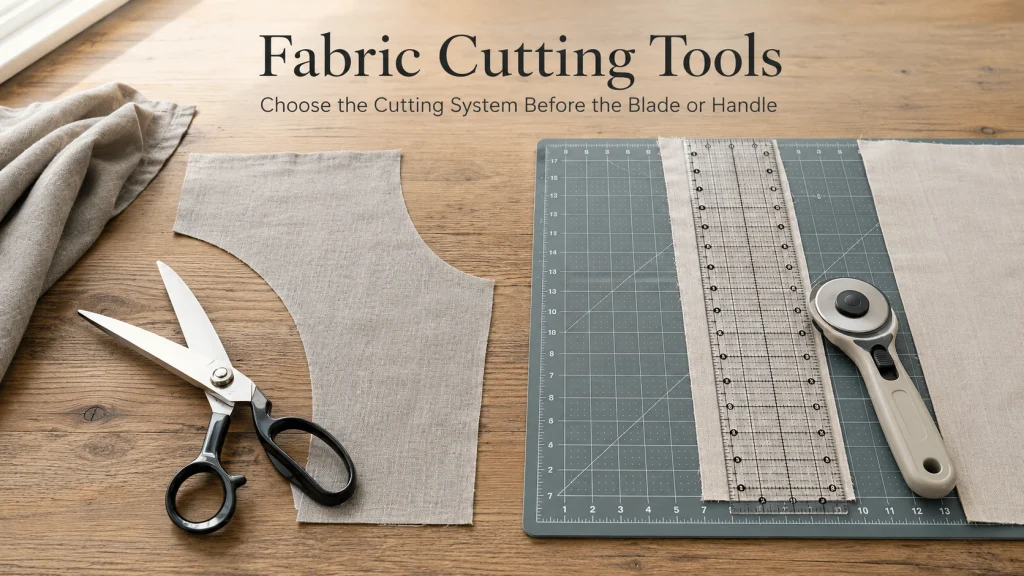
A marked fabric piece can sit beside dressmaker shears, a rotary cutter and mat, serrated scissors and household powered scissors, yet those tools are not four versions of the same answer. The useful first question is what the cut must do. A long straight cut across yardage, a tight curve around a pattern piece, repeated short snips into a rag-quilt seam allowance and a protected trim close to another fabric layer create different tool demands.
That is the job-first way to read fabric cutting tools. It also connects this section to reusable sewing tools by job without turning the decision into a shopping list. Once the cut is clear, blade style, handle geometry, mat size and maintenance become narrower questions.
Separate fabric cutting from thread snipping and seam removal
Not every sharp hand tool belongs in the same decision. Cutting garment pieces from yardage is different from trimming a thread tail, opening a stitched seam or cutting a buttonhole. Retail cutting pages often place these items together because they share a department, but the job at the table is what should control the classification.
If the task is shaping fabric before or during construction, stay with the cutting systems on this page. If the unresolved job is thread trimming, stitch removal or another small opening task, that decision belongs with the small hand tools rather than with another yardage cutter. That boundary prevents a broad list of tools for cutting fabric from becoming a drawer inventory with no decision logic.
Decide whether the fabric can stay flat during the cut
Scissors work by bringing two blades together while the hand advances through the material, so some fabric movement and lift around the blades is part of the system. Bent or tabletop-style handles can reduce that lift, but the cut still happens between opposing blades. That makes scissors useful when the fabric cannot be arranged on a dedicated rotary surface or when the cut needs frequent changes of direction.
A rotary cutter works from above against a cutting surface, which lets the fabric remain flatter while the blade follows a ruler edge or marked line. That advantage depends on enough stable table area for the fabric, mat and guide. If the workspace cannot support that setup, blade coatings and handle shapes are secondary.
Compare scissor and rotary cutting as different systems
The useful comparison is which system matches the cut, material layout and support surface. The same sewist may use shears for a curve and a rotary system for repeated straight strips because the jobs reward different mechanics.
| Decision | Scissor system | Rotary system |
|---|---|---|
| How the cut happens | Opposing blades open and close through the material | A circular blade rolls against a cutting mat |
| Surface dependency | Does not require a rotary mat | Requires a suitable cutting mat and usually benefits from a ruler |
| Fabric movement | Some lift occurs around the blades | Fabric can remain flat on the mat |
| Common strength | Curves, directional control and cutting away from a fixed mat | Straight cuts, repeated shapes and ruler-guided work |
| Next decision | Blade edge, handle, handedness and specialty form | Cutter size, compatible blade, mat, ruler and operating workflow |
If both systems still seem plausible, use the narrower scissors versus rotary cutter comparison. The point is to resolve the system first, because a precise blade specification cannot rescue a cutting method that does not fit the workspace or shape of the cut.

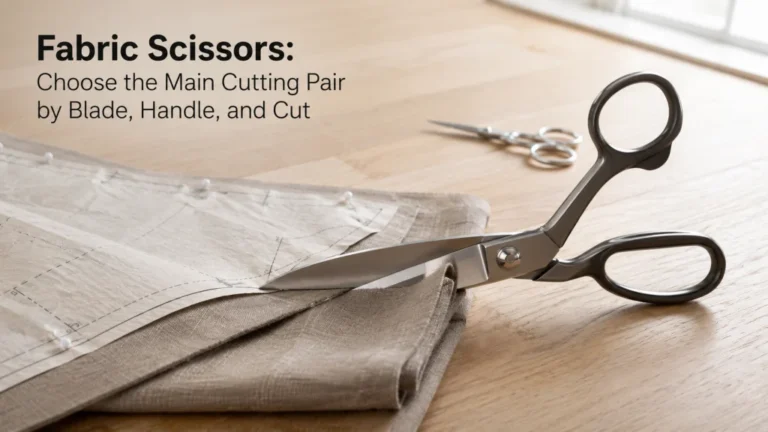
These 8-inch scissors use precision-ground steel blades for clean cuts through fabric and other craft materials. The bent handle helps keep material flat on the work surface while cutting. The classic orange handle provides an ergonomic grip for everyday sewing and craft work.
Check On AmazonIf you click this link and buy, we earn a commission at no additional cost to you.
Let one project use more than one cutting system
Choosing a cutting system does not mean every cut in a project must use the same tool. Long straight cuts, broad curves, tight corners and small trimming jobs can reward different mechanics. The useful unit of decision is the cut in front of you, not the project label.
Repeated straight strips may suit a flat rotary setup when the work surface supports it, while a curved piece in the same project may be easier to control with scissors. The reverse can also happen. Owning both systems is justified only when both kinds of cuts recur often enough to matter.
Key point: Choose by cut geometry and support needs first. Project labels such as garment, quilt, bag or home décor can suggest likely cutting patterns, but they do not decide the tool by themselves.
Evaluate general fabric scissors before specialty edges or handles
General fabric scissors or shears are the baseline scissor system. If ordinary fabric cutting is the actual job, compare fabric scissors for general cutting before assuming a specialty edge or handle is needed.
Specialty scissors make sense when the special feature maps to a recurring cut. The matrix below keeps each feature attached to its function rather than treating every variation as an upgrade.
Handedness
Handedness is a blade-and-handle decision, not just a label printed on the package. Current manufacturers sell true left-handed scissors with reversed blade orientation, while some symmetric or reversible tools use different approaches. A left-handed sewist should therefore verify how the exact tool is built instead of assuming that a larger finger loop makes a right-handed cutting geometry equivalent. The narrower decision belongs in left-handed fabric scissors selection.
Serrated grip
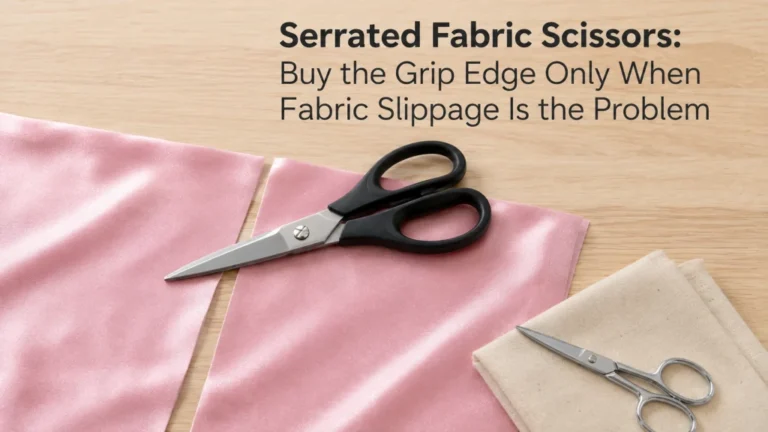
A serrated blade adds grip when material tends to move away from a smooth edge. It does not prove better cutting on every fabric, and the exact serration remains product-specific. Use serrated fabric scissors by task when blade grip is the unresolved issue.
Pinking edge
Pinking shears create a zigzag edge instead of a straight cut. Fiskars currently treats them as a separate scissor type and describes the edge as helping reduce fraying. If that cut shape is required, compare pinking shears and edge use; otherwise a straight edge remains the relevant system.
Duckbill protection
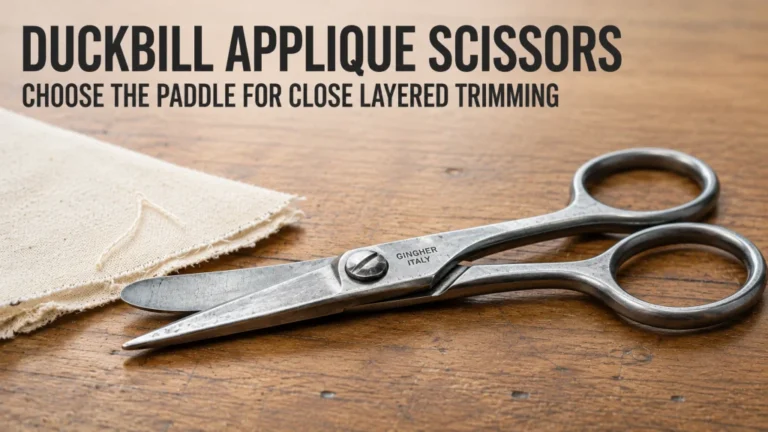
Duckbill or appliqué scissors use a broad lower blade or paddle to separate the material being trimmed from a layer that should remain untouched. Specialist suppliers describe that protected-layer function directly, which is why this form belongs to close trimming rather than general yardage cutting. The feature is useful only when the cut actually happens close to another layer. When protected close trimming is the real need, the next useful comparison is duckbill appliqué scissors by function.
Spring-assisted opening
Spring-assisted scissors reopen after the cutting stroke, changing repeated hand motion without changing the two-blade system. It is not a medical treatment or universal comfort guarantee. If automatic reopening is the specific need, compare spring-loaded fabric scissors by job.
Repeated rag snipping
Rag quilting creates repeated short snips along exposed seam allowances, a different task from cutting the original pieces. If that pattern recurs, compare scissors for repeated rag snipping while keeping material stack and workflow in view.
| Special feature | Job it should answer | What it does not prove |
|---|---|---|
| True left-handed geometry | Blade view and operation for a left-handed user | That every reversible handle is equivalent |
| Serrated edge | Added grip on material that shifts at a smooth edge | Better cutting on every fabric |
| Pinking edge | Zigzag edge creation | Suitability for all pattern cutting |
| Duckbill blade | Close trimming while separating another layer | General-purpose yardage performance |
| Spring opening | Repeated open-close cutting cycles | A universal ergonomic or medical benefit |
| Rag-snipping form | Repeated short snips in exposed seam allowances | Need for a second tool on unrelated projects |
The useful rule is simple: a specialty feature needs a specialty job. If the special edge or handle cannot be connected to a recurring cut, compare the general scissor system first rather than buying by feature count.

The KAI Serrated 3-Piece Set includes three scissors with micro-serrated stainless steel blades. The serrated edges are designed to add grip when cutting materials that can shift against a smooth blade. The different sizes support both smaller detail work and larger fabric-cutting tasks.
Check On AmazonIf you click this link and buy, we earn a commission at no additional cost to you.
Decide when household powered scissors create a different tool class
Household powered fabric scissors change the source of blade motion, so they belong to a separate cutting system. Check the exact instructions for allowed materials, power requirements, guard design and blade access for cleaning or replacement. Those details vary by tool and should come from the current manual.
Powered cutting can be worth investigating when repeated cutting is the unresolved job, but this page does not turn that into a universal speed or effort claim. It also does not route home sewists toward industrial straight-knife or round-knife systems. If powered household cutting is the real decision, the narrower household electric fabric scissors selection can handle that comparison while guard, storage and blade-change instructions stay model-specific.

The WORX WX082L.2 ZipSnip is a cordless electric cutting tool powered by an integrated 4V battery. Its rotating blade can cut fabric along with several other household materials. A blade guard and safety switch are part of the tool’s operating design, so use and blade handling should follow the manufacturer instructions.
Check On AmazonIf you click this link and buy, we earn a commission at no additional cost to you.
Build the rotary system as cutter, compatible blade, mat and ruler
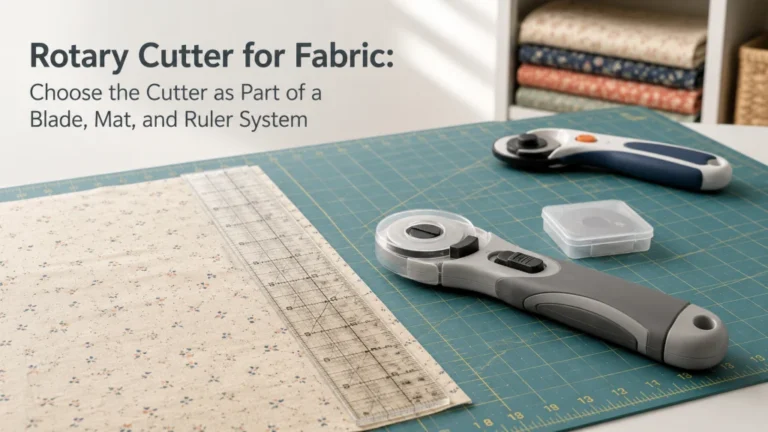
A rotary cutter is not a complete system by itself. Extension guidance pairs it with a cutting mat and grid ruler, while OLFA also directs users to a mat and ruler. The blade needs a suitable cutting surface, and straight work depends on a stable guide rather than the handle alone.
- Cutter: choose the size and handle system for the intended cut.
- Compatible blade: verify diameter, mounting interface and allowed blade type for the exact cutter.
- Cutting mat: provide a surface intended for rotary blades and large enough for the work.
- Ruler or guide: add it when the cut depends on a straight or measured edge.
This is why buying a replacement blade, a mat or a cutter should not be treated as three unrelated purchases. Start with choosing a rotary cutter system, then verify the pieces that must work together.

The Fiskars 3-Piece Rotary Cutting Set combines a 45 mm rotary cutter, a self-healing cutting mat, and a clear acrylic ruler. These components cover the main pieces of a ruler-guided rotary cutting setup instead of treating the cutter as a standalone tool. The mat provides the cutting surface while the ruler supports straight and measured cuts.
Check On AmazonIf you click this link and buy, we earn a commission at no additional cost to you.
Learn the operating workflow only after the cutter system is identified
Technique advice becomes useful after the cutter, blade and mat system are known. Handles expose, retract or lock blades differently, and blade-change hardware can vary within the same diameter. The exact manual therefore matters more than a generic control instruction.
The safe sequence is to identify the tool, read its guard and lock instructions, clear the cutting surface and then follow the documented cutting workflow. OLFA’s current guidance specifically says to cut away from the body, keep fingers away from the ruler edge and close the cutter after the cut. For the full operating sequence, use the rotary cutter workflow rather than expanding a family-selection page into technique training.
Choose rotary size before specialty blade details
Blade diameter changes rotary-cutting geometry. OLFA currently lists 18 mm, 28 mm, 45 mm and 60 mm craft sizes, positioning smaller diameters for tighter work and larger ones for broader or heavier cutting tasks. Diameter is therefore a task variable, not a good-better-best scale.
Do not turn those four sizes into universal capacity claims across brands. The exact cutter documentation still controls compatible blades, allowed materials and assembly. When diameter is the unresolved choice, compare rotary cutter sizes by task before considering decorative edges, coatings or replacement packs.
Treat blade replacement and blade-change procedure as separate decisions
“I need a new rotary blade” hides two questions: which blade fits, and how it is changed without defeating the guard or lock system. Diameter alone is not enough when the mounting interface or manufacturer compatibility list differs.
Use rotary cutter blade compatibility for the fit decision, changing a rotary cutter blade for the model-specific procedure, and rotary blade replacement timing when the question is wear rather than installation. There is no defensible universal blade-life number because fabric, pressure, mat condition, blade construction and cutting volume all change the result.
Choose a self-healing mat by work area and cutter system
A cutting mat is part of the rotary system, not merely a table protector. Current OLFA and Fiskars documentation describes self-healing mats as rotary-cutting surfaces with specific size and care guidance. The useful buying question is whether the mat supports the intended cut without forcing fabric or ruler off the work area.
If the mat itself is still the unresolved part of the system, compare how self-healing cutting mats differ before choosing dimensions. If the system is already settled and only dimensions remain unresolved, use choosing the right cutting mat size. Storage space matters too, because current manufacturer guidance commonly calls for these mats to be stored flat and away from damaging heat.

The OLFA RM-MG is a 24 x 36 inch self-healing mat designed for rotary cutting. Its larger work area can support fabric, rulers, and measured cuts without relying on a small cutting surface. The mat should be stored and cared for according to OLFA’s instructions to protect the cutting surface.
Check On AmazonIf you click this link and buy, we earn a commission at no additional cost to you.
Decide when a rotating mat solves a real handling problem
A rotating mat lets a small workpiece change orientation without repeatedly repositioning the stack. OLFA and Fiskars position these mats around small blocks, appliqué and shapes that require turning, a narrower job than simply providing a self-healing surface.
The decision therefore starts with the workpiece. When repeated reorientation is the actual handling problem, when a rotating cutting mat helps is the narrower decision. If the work is long yardage or broad pattern pieces, a rotating base may solve no meaningful problem and available cutting area may matter more.

The Fiskars 14 x 14 Rotating Cutting Mat provides a self-healing cutting surface that can rotate as the work changes direction. This format is useful for small fabric pieces and shapes that require repeated repositioning during cutting. The compact work area makes it better suited to smaller cutting tasks than to long yardage or large pattern pieces.
Check On AmazonIf you click this link and buy, we earn a commission at no additional cost to you.
Maintain mats and scissors from manufacturer guidance, not folk fixes
Maintenance advice is easy to overgeneralize because similar tools may use different materials, pivots, coatings or sharpening policies. Fiskars currently says to store its mats flat away from sunlight and extreme temperatures and clean them with warm water and mild soap, while OLFA publishes separate mat-care guidance. That evidence is stronger than transferring an unsourced fix between brands.
| Evidence level | Use it for | Decision |
|---|---|---|
| Exact manufacturer instructions | Cleaning, storage, blade change, lubrication or sharpening limits | Follow these first |
| Manufacturer family guidance | General care when the exact model is included in that family | Confirm the tool is covered |
| Specialist supplier description | Tool purpose, edge type and replacement availability | Useful for classification, not a substitute for the manual |
| Community tip or folk fix | Ideas to investigate | Do not treat as proof of safe care |
For the narrower tasks, use cleaning a self-healing cutting mat or fabric scissor sharpening decisions. If the manufacturer does not authorize a procedure, do not assume a trick for another tool can be transferred safely.
Storage and transport should preserve the same boundaries. Keep rotary blades covered or locked as the exact cutter instructs, protect scissor edges from loose contact with other tools, and follow the mat manufacturer’s requirement for flat storage when applicable. A portable sewing kit can contain several cutting systems, but each still needs the storage state specified for that tool rather than one improvised rule for the whole kit.
Separate cutting hardware from measuring and ruler decisions
A rotary ruler may be necessary to make a straight measured cut, but the ruler is not the cutting edge. That distinction matters because ruler length, grid readability, marking accuracy and measurement method are different buying questions from cutter diameter or blade compatibility. Combining them into one “best cutting tool” decision makes it difficult to see which component is actually limiting the work.
Choose the cutting system here, then treat rulers and measuring tools as their own reusable-tool decision. The interaction is still important: a rotary workflow often depends on both systems at once. Keeping ownership separate simply means a mat or cutter problem is not automatically solved by replacing the ruler, and a measurement problem is not automatically solved by changing the blade.
Keep fabric cutters separate from seam-opening and thread-snipping tools
The earlier boundary tells you which sharp tools belong in the fabric-cutting decision. This one matters later in the workflow, when a project moves from shaping fabric to trimming thread, opening stitches or making a small controlled opening. The cutting system does not need to follow the project into every later task simply because it is already on the table.
That handoff prevents duplication and misuse. Use scissors or a rotary system to form project pieces, then switch tool families when the job changes to seam opening, thread trimming or another small hand-tool task. A tool earns its place by the next job, not by sharing a drawer with the earlier cutter.
Explore fabric-cutting decisions
Once the cutting system is clear, continue only to the question that remains unresolved. The sections below separate general scissors, specialty forms, rotary components, mat choices, operating steps and maintenance so one narrow decision does not turn back into a product dump.
| Topic | What you’ll find |
|---|---|
| Choose fabric scissors | General scissor selection by cutting job, blade form and construction. |
| Fabric shears versus scissors | How the two labels overlap and where handle or blade geometry changes use. |
| Left-handed fabric scissors | What to verify about blade orientation, visibility and handle design. |
| Serrated fabric scissors | When a gripping edge answers a real material-control problem. |
| Choose pinking shears | When a zigzag edge is the required result rather than a decorative extra. |
| Duckbill appliqué scissors | Protected close trimming where another fabric layer must remain untouched. |
| Spring-loaded fabric scissors | How automatic reopening changes repeated cutting without changing the basic scissor system. |
| Choose rag-quilt scissors | Selection for repeated short snips along exposed seam allowances. |
| Household electric fabric scissors | Powered cutting as a separate home-use tool class with model-specific safety requirements. |
| Scissors versus rotary cutter | A direct system comparison when both approaches remain plausible. |
| Choose a rotary cutter | Cutter selection after flat rotary cutting has already been chosen. |
| Use a rotary cutter | The operating sequence after the cutter, blade and cutting surface are known. |
| Compare rotary cutter sizes | How blade diameter changes the kinds of cuts a cutter is suited to make. |
| Choose rotary cutter blades | Replacement and specialty blade fit for the exact cutter. |
| Change a rotary cutter blade | Model-specific blade removal, installation and guard handling. |
| Know when to replace blades | Wear signals and variables that make fixed blade-life rules unreliable. |
| Choose a self-healing mat | Mat construction, cutter-system fit and care boundaries. |
| Choose a cutting mat size | Work-area and storage questions after the mat type is known. |
| Choose a rotating cutting mat | Whether turning the support surface solves a recurring small-piece handling problem. |
| Clean a self-healing mat | Care steps bounded by the exact mat manufacturer’s guidance. |
| Sharpen fabric scissors safely | When sharpening is appropriate and when manufacturer or professional service guidance should control. |
Use the narrowest next page that matches the unresolved decision. If the system itself is still uncertain, return to the scissor-versus-rotary comparison instead of jumping ahead to blade size or maintenance.
Final Thoughts: choose the cutting system before the SKU
The useful sequence is cut first, system second, feature third. Compare size, handle, blade or replacement parts only after the cutting system is clear.
That order also makes buying nothing a valid outcome. A specialty cutter earns its place only when it solves a repeatable problem the current system does not handle well.
Frequently Asked Questions
✂️ Are fabric scissors or a rotary cutter better for beginners?
Neither system is automatically better for a beginner. Choose based on the cuts you expect to make, the available work surface and whether you can support a rotary cutter with the correct mat and ruler.
🧵 Can I use thread snips to cut fabric pieces?
Thread snips are primarily for short trimming tasks, not shaping yardage or full pattern pieces. Use a fabric-cutting system sized for the actual cut rather than forcing a small hand tool into a different job.
🌀 Does every rotary cutter need a cutting mat?
Follow the exact cutter manufacturer’s instructions, but current rotary-cutter guidance from major manufacturers is built around use with a suitable cutting mat. The mat protects the work surface and is part of the intended cutting system.
📏 What rotary cutter size should I buy first?
Choose diameter from the type of cut rather than from a universal starter rule. Current craft systems commonly include multiple sizes because tight detail work and broad or heavier cutting create different demands.
🖐️ Do left-handed sewists need special fabric scissors?
Check the blade orientation and handle design of the exact scissors. Some tools are truly left-handed, while others are reversible or ambidextrous, and those constructions are not automatically equivalent.
🔄 When is a rotating cutting mat useful?
It is most relevant when small pieces need repeated changes of orientation without moving the work off its alignment. For long yardage or large pattern pieces, total supported work area may matter more than rotation.
References and Sources
The sources below support the tool-family, rotary-system, maintenance and safety distinctions used in this article. Exact tool instructions remain model-specific.
- Utah State University Extension sewing supplies: Supports the role of rotary cutter, ruler and self-healing mat as distinct parts of a fabric-cutting setup.
- Fiskars scissors and shears: Supports current distinctions among general fabric scissors, pinking shears, spring-action designs and left-handed options.
- OLFA rotary cutter size guidance: Supports the current 18 mm, 28 mm, 45 mm and 60 mm craft-size framework and task-based size distinctions.
- OLFA rotary cutter safety guidance: Supports mat-and-ruler use, cutting direction, surface clearing and blade-closing practices.
These sources support the tool-family and safety distinctions used here. Exact compatibility, guard operation, blade replacement and maintenance instructions still belong to the documentation for the specific cutter, scissors, mat or powered tool in hand.