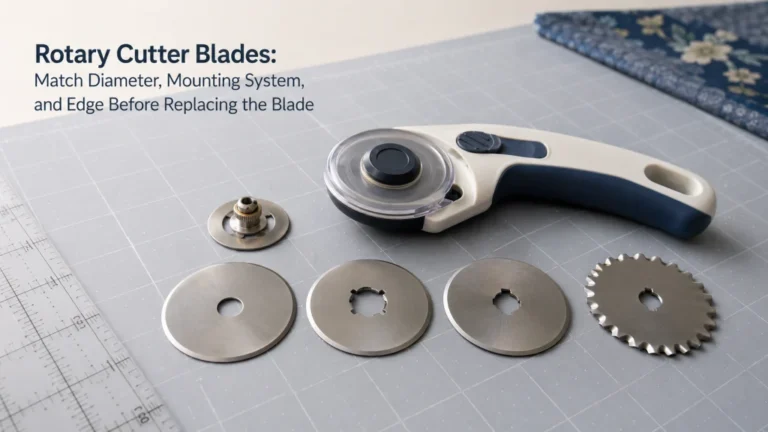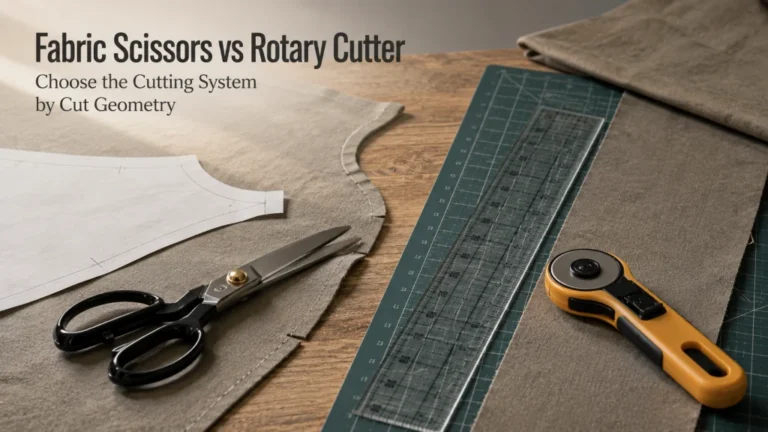
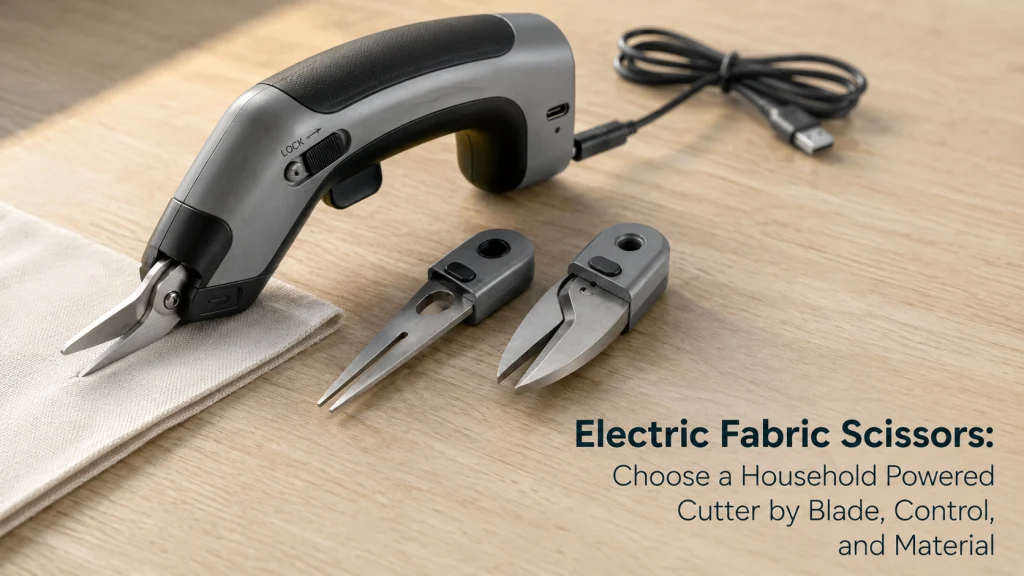
Electric fabric scissors are a household powered cutting tool, not a miniature industrial cutting machine. The useful comparison starts with the blade actually supplied for fabric, the materials the manufacturer supports, the trigger and guard design, and the charging or battery system. Powered cutting can reduce how much of the cutting motion comes from repeated hand opening and closing, but it does not prove better control, comfort, or suitability for every user. Choose the tool class first, then verify the exact blade, power system, and material claim before treating the word “electric” as a performance advantage.
Powered Scissors Are Not One Tool Class
Search for electric fabric scissors and the results can place compact cordless cutters beside powered rotary cutters, straight-knife cloth cutters, and other machines built for very different workloads. They all use a motor, but that is where the similarity can stop. Blade geometry, cutting capacity, guard design, material support, and the way the tool is guided through fabric can be completely different.
For home sewing and craft work, the relevant class is a compact consumer cutter designed to be held and guided by one person through flexible sheet materials. That class includes scissor-style powered cutters and some compact rotary-style powered cutters. The scissor-style form uses opposed cutting edges that shear through the material, while the rotary-style form uses a powered circular blade, so the blade evidence is not interchangeable even though both tools are handheld and motorized. The evidence card later in this article still applies to both: verify the exact blade type, supported materials, control system, and guard design for the specific sub-type you are considering. Industrial straight-knife systems belong elsewhere because they are built around a baseplate, reciprocating blade, much larger cutting capacity, and production-oriented fabric stacks.
If you are still deciding where a powered cutter fits among reusable sewing tools, start with the sewing tools guide. If your real need is broader than powered scissors, start with compare fabric cutting tools so the cutting method is chosen before the power source.
Separate Household Cordless Scissors from Industrial Fabric Cutters
The easiest scope check is to look at the physical architecture. A current BLACK+DECKER household power-scissor page describes a cordless handheld tool with interchangeable blades, a trigger, a safety lock, and USB charging. Madam Sew’s electric-scissor manual likewise describes a household tool with a trigger switch, replaceable cutting head, protective cap, and USB charging connection.
Compare that with Eastman’s straight-knife machines, which use a baseplate and high-speed reciprocating knife and are designed for cutting patterns through multiple material thicknesses. That is not a heavier version of the same handheld scissors. It is a different cutting system with different operating and safety assumptions.
Scope gate: If a search result is built around a straight knife, round knife, large baseplate, cutting table, or multi-ply production capacity, it has left the household electric-scissors decision covered here.
This distinction matters before any performance comparison. A household buyer should not use an industrial cutter’s thickness or speed specification as evidence for what compact electric scissors can handle.

The SnapFresh cordless electric scissors use a rechargeable 4V power system and two tungsten steel rotary blades. The listing identifies cardboard, leather, plastic, canvas, carpet, and wallpaper among its supported cutting materials. A safety switch works with the trigger to start the cutter, and the kit includes a charger, replacement blade, blade-removal pin, and user manual.
Check On AmazonIf you click this link and buy, we earn a commission at no additional cost to you.
Check the Exact Blade Intended for Fabric
A powered handle does not make every attached blade equally suitable for sewing fabric. BLACK+DECKER’s current cordless power-scissor documentation separates its supplied blades by intended material, identifying one blade for fabrics and paper and another for thicker materials such as leather and plastic. That is a useful evidence pattern because it shows why the tool name alone is incomplete.
When comparing electric scissors for fabric, write down the cutting head or blade that the manufacturer actually specifies for fabric. If several heads are included, do not assume the thick-material blade is automatically better for ordinary woven or knit yardage. The manufacturer may have designed different blade profiles for different material behavior.
The same rule applies when a cutting head is replaceable. Madam Sew documents a removable scissor head and provides a separate replacement procedure. A replacement head should therefore be treated as a tool-specific part, not as a generic powered-scissor blade that can be mixed across brands.

The WORX ZipSnip WX082L.2 is a cordless electric cutter built around a rotating stainless steel blade. Its Amazon listing identifies fabric, paper, plastic, leather, cardboard, and other materials among its cutting applications. The blade uses an automatic sharpening system, and this package includes an additional replacement blade and a portable storage case.
Check On AmazonIf you click this link and buy, we earn a commission at no additional cost to you.
Read Supported Material and Thickness Claims from the Manufacturer
Material lists are evidence only for the exact tool being described. BLACK+DECKER lists fabric among the materials for its household power scissors and provides blade guidance for fabric versus thicker sheet materials. Madam Sew’s manual describes its household electric scissors as intended for soft and flexible materials and names fabrics among the supported categories.
Those statements do not create a universal thickness rule for powered fabric scissors. “Fabric” can mean a single layer of light cotton, a dense denim stack, quilt batting, vinyl-backed material, or many other constructions. If the manufacturer does not publish a layer count or thickness limit for the exact tool and material, leave that capacity unknown instead of inventing a number from another cutter.
This is especially important when search results show industrial equipment with explicit multi-ply capacities. Those figures belong to the industrial machine that published them. They should never be copied into a household cutter comparison simply because both tools are powered.

The ZEITE cordless electric scissors use a built-in 4V battery and a self-sharpening rotary blade. The Amazon listing identifies denim, gift paper, plastic blister material, thin carpet, flower stems, and corrugated cardboard among its cutting applications, with the 1/4-inch capacity specifically stated for cardboard. The package includes two blades, a storage bag, USB charging cable, and user manual.
Check On AmazonIf you click this link and buy, we earn a commission at no additional cost to you.
Compare Trigger, Guard, and Lock Design
Powered cutting changes the control sequence because the blade can continue moving while the motor is engaged. Check how the tool starts, whether power stops when the trigger is released, what guards or caps cover the blade, and how the tool is secured for storage. Madam Sew’s manual states that releasing its trigger stops cutting and directs users to place the protective cap over the scissor blades when the tool is not in use.
BLACK+DECKER documents a safety lock on the trigger of its current household power scissors. That verifies the presence of the feature on that tool, not a universal powered-scissors design. Another household cutter may use a different lock, guard, or activation sequence, so the exact manual remains the safety reference.
Powered cutting safety: Keep fingers away from the cutting head, follow the exact guard and storage instructions, and disconnect or disable the tool as directed before any blade or cutting-head service. Do not bypass a lock or guard to make the cutter easier to activate.
The important comparison is therefore not whether one handle looks more comfortable in a product photo. It is whether the user can clearly identify the start control, stop behavior, blade protection, and storage state from the manufacturer’s documentation.
Check the Charging or Battery System
Cordless fabric scissors remove a trailing power cord from the cutting path, but they replace it with battery and charging questions. Verify whether the battery is built in or removable, what charging cable or adapter is required, whether the tool can operate while charging, and what indicator shows charge status if the manual provides one.
Do not compare runtime claims across products without keeping the test wording attached to the manufacturer. BLACK+DECKER publishes a runtime claim for its current craft scissors, while Madam Sew publishes a different continuous-cutting claim for its own electric scissors. Those numbers describe different tools and conditions, so neither should be turned into a general rule for powered fabric scissors.
For ownership planning, the practical question is simpler: can the tool be charged with the documented equipment, and will its power system fit the way you actually cut fabric? That answer can be verified without pretending a battery specification predicts cutting quality.

The Fanttik C10 Pro is a rechargeable rotary electric cutter with a 2000mAh battery and two cutting speeds. Its Amazon listing specifies up to 45 to 50 minutes of runtime per charge and a 10W Type-C charging port. A digital display shows battery status, while the package includes two blades for cutting materials including fabric, carpet, leather, and cardboard.
Check On AmazonIf you click this link and buy, we earn a commission at no additional cost to you.
Use a Blade, Power, and Control Evidence Card
A compact evidence card prevents powered-tool marketing from replacing the details that actually change the decision. Fill it out from the exact manufacturer page and manual before comparing two cordless fabric scissors.
| Evidence item | What to verify | What not to assume |
|---|---|---|
| Fabric blade | Exact blade or cutting head specified for fabric | Every included blade is equally suitable for sewing fabric |
| Supported materials | Manufacturer-listed materials for the exact tool | Unpublished layer or thickness capacity |
| Trigger | How cutting starts and stops | Every powered cutter uses momentary trigger control |
| Guard or lock | Blade protection and storage procedure | A generic safety feature substitutes for the manual |
| Power system | Battery type, charging method, and included charging hardware | Battery voltage predicts fabric-cutting quality |
| Replacement cutting part | Exact compatible blade or head and replacement procedure | Similar-looking replacement parts fit across tool families |
This card keeps the comparison anchored to evidence that can be checked before use. It also exposes missing information quickly, which is more useful than filling an unknown specification with a seller claim.
Compare Powered Scissors with Manual Rotary and Spring-Assisted Cutting
The presence of a motor answers only one question: what supplies the repeated cutting motion. A hand rotary cutter still uses a circular blade that the user pushes through the fabric, while spring-loaded scissors remain manual but reopen their blades with spring assistance. A powered scissor or cutter uses a motor to move its cutting element while the user guides the tool.
If motorized cutting is not actually required, compare spring-loaded fabric scissors before assuming battery power is the next step. If the real decision is blade path rather than motorization, compare fabric scissors and rotary cutters to decide between shear-style and rolling-blade cutting.
For a closer look at the manual circular-blade tool itself, choose a rotary cutter for fabric based on blade, mat, and task. Keeping those decisions separate makes the power source one feature instead of the definition of the whole cutting method.
Evaluate Effort and Control Without Turning Claims into Medical Suitability
A powered cutting head can reduce the amount of repeated manual blade opening or rolling motion required to make the cut. That mechanical fact does not prove that a particular tool is comfortable, easy to control, or appropriate for someone with pain, weakness, arthritis, limited dexterity, or another health condition. Those outcomes depend on the individual and should not be inferred from words such as “ergonomic,” “easy,” or “effortless.”
For a nonmedical evaluation, focus on observable control questions. Can you hold the tool in the intended orientation? Can you see the cutting line and blade entry point? Can you release the trigger immediately? Can you guide the tool around the curves or straight sections your work requires without forcing the material toward the blade?
Those questions help compare household cutters without promising treatment or accessibility. If a health condition materially affects safe tool use, product marketing is not enough evidence to determine suitability.
Final Thoughts: Verify the Household Cutter Before the Power Claim
The right powered fabric cutter is defined by more than a motor. First confirm that the result is a household handheld tool rather than industrial cutting equipment. Then verify the fabric blade, supported materials, trigger and guard behavior, charging system, and replacement cutting parts from the exact manufacturer documentation.
That evidence also tells you when buying nothing new is reasonable. If a manual rotary cutter, ordinary fabric scissors, or spring-assisted pair already gives you the control you need, power is optional. If powered cutting is genuinely required, choose from documented blade and control behavior rather than from the word “electric” alone.
FAQs
✂️ Are electric scissors for fabric the same as industrial fabric cutters?
No. Household electric scissors are compact handheld tools, while industrial cutters can use straight or round knives, baseplates, and specifications for stacked material. Compare within the correct tool class before using capacity claims.
🧵 Can cordless fabric scissors cut every type of fabric?
No universal material claim applies. Check the exact manufacturer’s supported-material list and the blade specified for fabric, then leave unpublished layer or thickness limits unknown.
🔋 What should I check in a rechargeable fabric cutter?
Verify the battery arrangement, charging cable or adapter requirement, charge indicator if provided, and whether the tool can operate while charging. Treat runtime as a product-specific claim rather than a universal expectation.
🛡️ What safety features should powered fabric scissors have?
Look for the exact documented trigger behavior, blade guard or cap, lock if provided, and storage procedure. Follow the tool manual rather than assuming all electric cutters use the same safety system.
🔄 Are powered fabric scissors better than a rotary cutter?
Not universally. A powered cutter motorizes the cutting motion, while a manual rotary cutter uses a hand-propelled circular blade. The better choice depends on the cut shape, fabric, control requirements, and whether powered cutting is actually needed.
⚡ Are electric sewing scissors easier on the hands?
They can reduce repeated manual opening and closing of scissor blades, but that does not prove comfort or medical suitability for a particular person. Evaluate control and handling without treating marketing claims as health evidence.
References and Sources
- BLACK+DECKER cordless power scissors documentation: Verifies the household tool class, fabric-specific blade guidance, trigger safety lock, supported materials, and USB charging system used as an evidence example.
- Madam Sew electric fabric scissors manual: Documents household intended use, trigger behavior, protective cap, charging, and cutting-head replacement for its exact tool.
- Eastman straight-knife cutting systems: Establishes the separate industrial straight-knife architecture used to define the household-versus-industrial boundary.