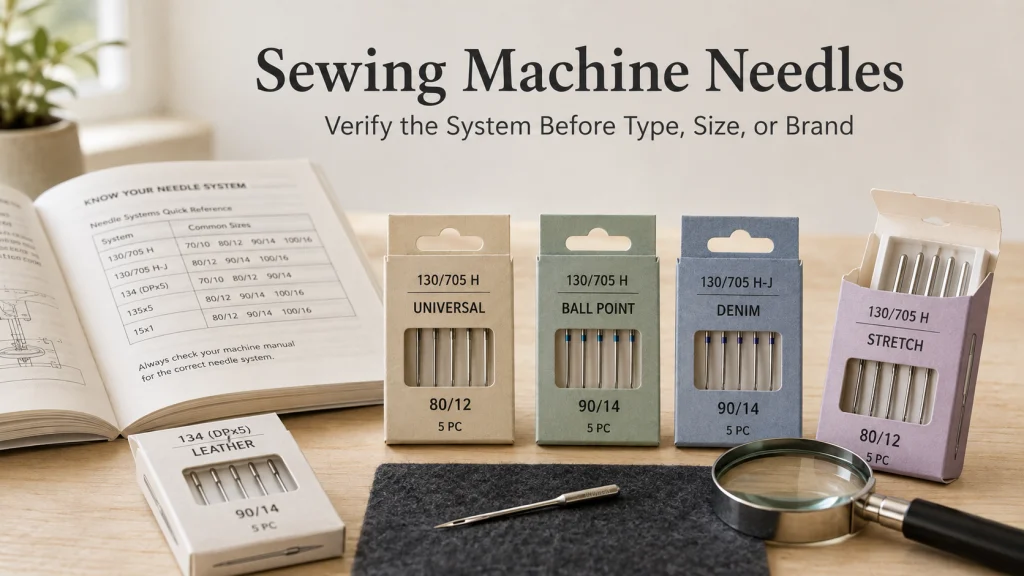
Sewing machine needles should be bought in a fixed order: verify the exact machine’s permitted needle system first, then check any special-format limits, needle type, allowed size, and brand. A fabric label such as Denim, Leather, Stretch, or Microtex describes application, but it does not prove that the needle physically belongs in a particular machine. Most current household machines use the familiar 130/705 H family, yet current manufacturer documentation also shows real exceptions and machines that permit more than one documented system. The practical result is a compatibility check that starts with the machine manual rather than a fabric chart.
System comes before type, size, or brand
Three needle packages can all look plausible: one may say 130/705 H Universal 80/12, another may use a household-system cross-reference, and a third may carry a specialty code. Add three machines and the buying problem becomes clearer. One may use the common household system, another may permit an additional documented system, and a specialty embroidery family may require a different format or named substitute.
The fabric cannot settle those differences. Before comparing sewing machine needle types, blade sizes, coatings, or brands, identify the exact machine and find the manufacturer’s needle requirement. Only after physical compatibility is established does the application label become useful.
Identify the exact machine and needle requirement
Start with the full model number, not only the brand name or machine family. Open the current manual or manufacturer support page and record the needle system wording exactly as published. If the documentation gives a size range, a special embroidery needle, an alternative system, or twin-needle limits, put those details in the same record rather than relying on a retailer package description.
SCHMETZ states that most home machines use 130/705 H and advises checking the machine owner’s manual because specialty models can use another system. That is the right hierarchy: the needle manufacturer’s compatibility information is useful, but the machine manufacturer controls the requirement for the exact model.
If the manual is missing, identify the machine before guessing at the needle. Check the model label on the machine, search the manufacturer’s current support area by that exact model number, and compare any downloadable manual or support record with the machine in front of you. If the model identity or needle requirement still cannot be confirmed, contact the manufacturer or an authorized service source with the model and serial information rather than inferring fit from an old needle that happened to be installed.
| Exact-machine check | What to record | Evidence status |
|---|---|---|
| Machine identity | Brand and full model number | Verified on the machine label and current documentation |
| Needle system | Exact system code or manufacturer wording | Verified from the manual or support page |
| Allowed size range | Only the range documented for the exact machine | Verified, without choosing a fabric-specific size here |
| Special formats | Twin needle, embroidery format, or alternative-system restrictions | Verified separately from ordinary single-needle fit |
| Unclear cross-reference | Package code that does not match the manual wording exactly | Unknown until a manufacturer cross-reference confirms it |
This ledger prevents the most common order-of-operations error: deciding that a needle “looks right for denim” or “says home sewing” before confirming that its system belongs in the machine.
Separate needle system from needle type and needle size
System, type, and size answer different questions. The needle system identifies the physical standard the machine is designed to accept. The type distinguishes a product family through features such as point shape, scarf, eye, groove, or blade design. Household needle types can share the same system while differing in those application features. The size describes blade diameter using the familiar metric and Singer or international size pair, such as 80/12 or 90/14.
| Field | Question it answers | Buying order |
|---|---|---|
| System | Does this needle physically belong in the exact machine? | Check first |
| Type | Which compatible product family matches the intended application? | Check after system fit |
| Size | Is this blade size permitted by the machine and appropriate for the later fabric-and-thread decision? | Verify the machine limit before choosing the application size |
A fourth label, brand, sits outside those three technical fields. Two brands may sell needles for the same documented system, type, and size, but brand substitution should still be checked against the exact machine requirement and the package specification rather than assumed from similar appearance.
Decode 130/705 H, HAx1, 15×1, and model-specific alternatives carefully
SCHMETZ identifies 130/705 H as the household needle system used by nearly all home sewing machines and states that 15×1 H is a cross-reference to that same system. That specific cross-reference is useful because it comes from the needle manufacturer. It should not be expanded into a rule that every code seen beside a household needle is automatically interchangeable.
HAx1 illustrates why the exact source matters. JUKI publishes the TL-2010Q needle specification as “HA x 1 (130/705H) / HL x 5 #9-#18,” explicitly tying those labels together for that model and also permitting HLx5. That model-specific line is stronger evidence than guessing from the package shape or from another machine’s manual.
The practical distinction is simple: a common code can be common without being universal. The exact machine record decides whether a cross-reference belongs in the verified column.
These cases are useful because they show two different kinds of exception: one machine can permit an additional documented system, while another family can call for a specialty format or named substitute. Neither case should be turned into a cross-model rule.
Read a needle package by system, type, size, coating, and special format
A needle package can carry several layers of information at once. Keep needle size, needle system, and needle type separate when reading a package, because individual product families can also add coatings or special-format codes. SCHMETZ’s package documentation follows that same separation. Read those fields individually instead of treating the largest word on the package as the whole specification.
| Package field | What it tells you | What it does not prove |
|---|---|---|
| System code | The needle standard or cross-reference claimed by the manufacturer | That the exact machine accepts every special format in that system family |
| Type name | The product family, such as Universal, Stretch, Microtex, Topstitch, or Leather | Physical machine fit by itself |
| Size | Blade diameter designation, often shown as a pair such as 80/12 | That the size is within the exact machine’s allowed range |
| Coating or finish | An additional product feature where the manufacturer specifies one | A different needle system unless the system code also changes |
| Special format | Twin or another non-standard configuration | Clearance, stitch, threader, or plate compatibility on the exact machine |
This card is especially useful when two packages share the same type name but differ in system or special format. The compatibility decision belongs to the full label, not the product name alone.

These SCHMETZ Universal sewing machine needles are size 80/12 and use the 130/705 H household needle system. The Universal type has a slightly rounded point and is intended for general sewing with woven and knit fabrics. Confirm that your exact machine manual permits the 130/705 H system and size 80/12 before use.
Check On AmazonIf you click this link and buy, we earn a commission at no additional cost to you.
Verify the machine’s allowed size range without turning this into a fabric chart
Needle size still has a compatibility boundary before it becomes a fabric-and-thread decision. If an exact manual limits the machine to a published range, stay inside that range. The fact that a larger or smaller size exists in the same needle system does not prove that the machine manufacturer permits it.
This article stops at that fit check. Choosing the actual size for a fabric, thread weight, seam stack, or sewing condition belongs to the separate relationship between fabric, thread, needle, and machine. Here, the buyer only needs to confirm that the intended size is allowed before comparing products.
Key point: “Correct system” and “allowed size” are two separate checks. A package can pass the first and fail the second.
Keeping those questions apart avoids building a giant size chart that quietly assumes every household machine has the same permitted range.
Use point, eye, scarf, groove, and blade features to distinguish product families
Once the system and size boundary are verified, needle geometry helps explain why product families are not interchangeable descriptions. SCHMETZ identifies the shank, blade, groove, scarf, eye, point, and tip as distinct parts of a home-machine needle. Product families alter some of those features for different sewing applications.
That does not mean the buyer should reverse the process and choose from geometry alone. A deeper scarf, different point, enlarged eye, reinforced blade, or another feature can explain the difference between two compatible product families, but it does not override the machine’s system requirement. Use geometry to compare what a needle is designed to do after fit has already been established.
Route universal-fit questions to the system comparison
The word “Universal” on a needle package is a type name, not permission to install that needle in every sewing machine. Likewise, the fact that 130/705 H is used across much of the household market does not erase specialty, semi-professional, vintage, embroidery, serger, coverstitch, or other documented exceptions.
If the unresolved question is whether household needle systems are interchangeable or what 130/705 H, HAx1, and related codes mean for fit, continue to household needle system compatibility. That decision should be settled before comparing fabric-oriented types.
Route Stretch versus Jersey to the type comparison
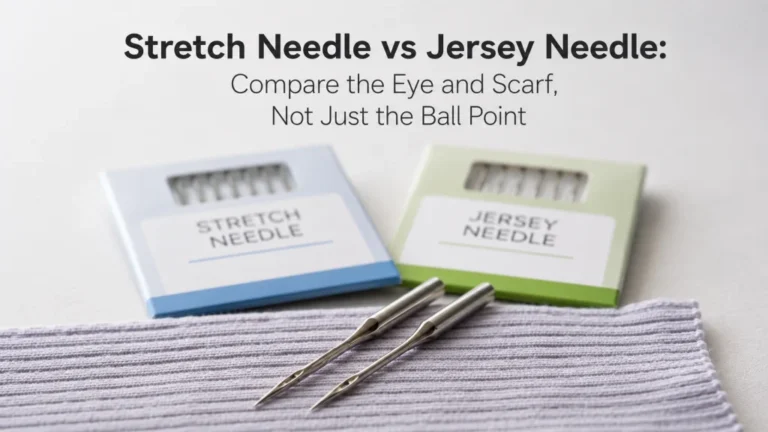
Stretch and Jersey labels can both appear in the household 130/705 H family while describing different needle geometries and intended applications. SCHMETZ, for example, documents its Stretch family as 130/705 H-S with a medium ball point, smaller eye, and deep scarf. The important buying question is therefore not whether both are household needles, but which compatible type matches the application.
When that distinction controls the purchase, use the Stretch versus Jersey needle comparison. This overview does not duplicate the detailed geometry or application decision.

These SCHMETZ Jersey needles are size 80/12 and use the 130/705 H SUK needle system. They have a medium ball point designed for knit and some stretch fabrics. Verify that your sewing machine accepts this needle system and size before choosing the Jersey type for the intended fabric.
Check On AmazonIf you click this link and buy, we earn a commission at no additional cost to you.
Route Quilting-needle purchasing to the dedicated product-family decision
“Quilting needle” is a product-family label, not a machine-system guarantee. A buyer should still verify that the package uses the system and size allowed by the exact machine before using the quilting application as the deciding factor.
If the intended purchase is specifically a household Quilting needle rather than a general system question, continue to Quilting needle product selection. Semi-professional machines that document HLx5 or another alternative need their own model evidence before the product family is chosen.
Route Topstitch purchasing to the eye and thread-path decision
Topstitch needles are differentiated partly by eye and thread-handling geometry, so the application question is more specific than “which size works for this fabric?” The product family can matter when the thread path and intended stitching call for those features, but system fit remains the first gate.
Use the Topstitch needle buying criteria when the larger-eye or thread-path purpose is what separates the candidate from an ordinary household needle.
Route Denim or Jeans selection to the product-family decision
A Denim or Jeans label tells the buyer which product family is being offered, but it still does not establish machine fit. Verify the system and permitted size first, then compare the family designed for the intended woven application.
When the purchase question is specifically about that product family, continue to Denim sewing machine needle selection. Detailed reasoning about which blade size matches fabric and thread remains outside this compatibility overview.

SCHMETZ Jeans and Denim needles use the 130/705 H-J needle system and feature a reinforced blade with a medium ball point. They are designed for denim, twill, canvas, quilts, and other thick woven fabrics. Check the exact sewing machine manual for the permitted needle system and size range before selecting a Denim needle from the assortment.
Check On AmazonIf you click this link and buy, we earn a commission at no additional cost to you.
Route Leather needle compatibility to the exact machine first
Leather creates an especially important naming trap because household and industrial needles can use very different systems even when both packages say “Leather.” SCHMETZ’s own compatibility Q&A notes that a household 130/705 H Leather needle and an industrial round-shank Leather needle are not the same fit question. The material label cannot resolve that difference.
For a general domestic machine, use the Leather needle compatibility check before assuming a Leather package belongs in the machine. Whether the project itself calls for a specialist leather-sewing system is a separate machine decision.
Route Microtex or sharp selection to the product-family comparison
Microtex is another type label that can sit inside the familiar household system while differing from a general-purpose needle in point geometry. That makes it a product-family decision after compatibility, not a shortcut around the system check.
If the buyer has already confirmed the machine requirement and now needs to distinguish a sharp household needle from other compatible families, continue to Microtex needle selection criteria.
Route twin-needle compatibility to a separate machine check
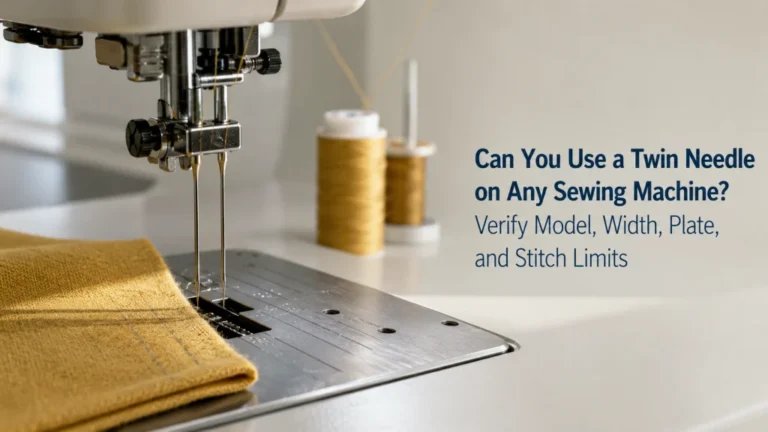
A twin needle is not merely two ordinary needles sold together. SCHMETZ packages twin products under special system codes such as 130/705 H ZWI, and machine manufacturers can impose their own width, stitch, presser-foot, threading, or needle-threader restrictions. A standard single-needle system match therefore does not prove twin-needle support.
Brother documentation for some machines, for example, specifies an exact twin needle, limits usable stitch width, and warns that unsuitable needle or stitch combinations can cause a strike. Those limits are model-specific, so the purchase belongs in twin needle machine compatibility rather than in a generic fabric chart.
Safety boundary: Never use a wider twin needle than the exact machine permits, bypass a guard or safety control, perform powered clearance testing, or continue sewing after a needle strike. Follow the exact manual for twin-needle support and permitted operation.
The same rule applies when the package physically enters the needle clamp. Physical insertion alone is not evidence that the needle clears the plate, foot, stitch path, or other machine limits.

The SCHMETZ Stretch Twin 2.5/75 combines two Stretch needles on one shank and uses the 130/705 H-S ZWI system. It is designed for elastic materials and highly elastic knit fabrics. Twin-needle support depends on the exact sewing machine, so confirm the permitted needle spacing, stitch settings, presser foot, and needle-plate clearance in the machine manual before use.
Check On AmazonIf you click this link and buy, we earn a commission at no additional cost to you.
Route SCHMETZ versus Organ substitution to matched specifications
Brand comparison comes after system, type, and size. A manual may name a factory-recommended brand, a specific part, or an allowed substitute. Current embroidery documentation from Brother provides a useful example because it names both a preferred needle specification and a permitted substitute for the covered machine family.
That is stronger evidence than assuming two brands are interchangeable because both sell household needles. When brand substitution is the unresolved question, use SCHMETZ versus Organ needle substitution and match system, type, size, and any model-specific wording before buying.
Keep Embroidery and Metallic families inside the broader needle decision
Embroidery and Metallic needles are legitimate product families, but they do not need separate standalone routes here merely because packages exist. The same compatibility order still works: exact machine, required system, allowed size, product-family features, and any special model instructions.
Embroidery also shows why the boundary can move. A domestic sewing-and-embroidery machine may use a documented household embroidery needle, while a multi-needle or specialist embroidery system can specify a different format and operating environment. When the machine system itself changes the answer, the decision no longer belongs to a general household-needle purchase.
Keep specialist-system needle requirements with the specialist machine
Sergers, coverstitch machines, semi-professional straight-stitch machines, multi-needle embroidery systems, and other specialist equipment can document needle requirements that differ from a typical household sewing machine. SCHMETZ, for example, sells BLx1 and DCx1 overlock systems for specific machines and states that those systems are not compatible with home sewing machines. Semi-professional straight-stitch machines can also publish model-specific alternatives that should stay attached to that machine’s own documentation.
Those examples are not reasons to buy a specialist machine. They show why the machine architecture must stay attached to the needle decision. If the specialist system changes the required needle, evaluate the needle as part of that system rather than forcing it into a general home-machine rule.
Keep installation and failed-result diagnosis out of the buying decision
This article ends when the correct product family has been identified and verified for the machine. Installing the needle, orienting the shank, setting up a twin needle, or preparing a material-specific sewing workflow belongs with normal machine use and the exact manual. Do not use a purchase article as a substitute for those operating instructions.
Likewise, a broken needle, repeated strike, skipped stitch, damaged thread, or unexplained failed result starts a symptom-led diagnosis. Do not keep buying different needle packages until the symptom disappears. Stop after a hard strike or unsafe condition and follow the exact machine documentation or qualified service boundary where required.
See More in This Section
Once the exact machine requirement is recorded, use the unresolved purchase question to choose the next comparison. The links below separate system fit, product-family differences, special formats, and brand substitution so those decisions do not collapse back into one oversized needle chart.
| Needle decision | Use it when the unresolved question is |
|---|---|
| Household needle system compatibility | Whether 130/705 H, HAx1, 15×1, or another code proves physical fit. |
| Stretch versus Jersey needles | Which compatible knit-oriented product family matches the application. |
| Quilting needle product selection | Whether a Quilting needle family is the appropriate compatible purchase. |
| Topstitch needle buying criteria | Whether eye and thread-path features justify a Topstitch family. |
| Denim sewing machine needles | Which compatible Denim or Jeans family to buy after system verification. |
| Leather needle compatibility check | Whether a Leather-labeled household needle actually fits the exact machine. |
| Microtex needle selection criteria | Whether a sharp product family is the relevant compatible choice. |
| Twin needle machine compatibility | Whether the exact machine permits the special format and its width or stitch limits. |
| SCHMETZ versus Organ substitution | Whether two brands match the required system, type, size, and model guidance. |
For the broader accessory decision beyond needles, return to sewing machine accessory compatibility. The same principle still applies: a generic product name is not proof that a component fits the exact machine.
Final Thoughts: A fabric recommendation is not a machine-fit test
The clearest buying order is to identify the exact machine, verify its needle system and permitted size range, check special formats separately, and only then compare type, application, and brand. Denim, Leather, Quilting, Stretch, or Universal can describe a useful product family without proving compatibility.
Keep manufacturer cross-references attached to the exact claim they support. Common household systems still have documented exceptions, alternative systems, and special-format requirements on particular machine families. That is enough reason to read the machine requirement before the fabric chart every time.
Frequently Asked Questions
🪡 Are all home sewing machine needles the same system?
No. 130/705 H is widely used in household sewing machines, but specialty, semi-professional, vintage, embroidery, serger, and coverstitch models can specify something else. Check the exact machine manual before treating any household label as proof of fit.
🔢 What does 80/12 mean on a sewing machine needle?
It is a dual size designation for the needle blade, with the metric size and Singer or international size shown together. Size does not replace the system check, and the intended size should also fall within the range permitted by the exact machine.
📦 Is 15×1 the same as 130/705 H?
SCHMETZ identifies 15×1 H as a cross-reference to 130/705 H in its package guidance. Use that documented cross-reference rather than assuming every similar code from every package or machine means the same thing.
🧵 Can I change needle brands if the system and size match?
Sometimes, but verify the exact type and any machine-specific recommendation as well. A manufacturer-documented substitute is stronger evidence than matching brand-independent numbers by appearance alone.
👖 Does a Denim needle fit every domestic sewing machine?
No. Denim or Jeans describes a needle product family, not universal machine fit. Verify the system and permitted size for the exact machine before choosing that family.
👯 Can any sewing machine use a twin needle?
No. Twin-needle support can depend on the exact special format, needle spacing, stitch, plate clearance, presser foot, threading method, and machine instructions. Use only a twin needle and operating conditions explicitly permitted for the exact machine.
References and Sources
- SCHMETZ needle package guide: Verifies package fields, dual sizing, the 130/705 H household system, and the documented 15×1 H cross-reference.
- SCHMETZ sewing machine needle guide: Supports the distinction between needle system, type, size, and anatomy features used to compare compatible product families.
- Brother embroidery needle requirements: Documents the HAX 130 EBBR factory recommendation and the permitted SCHMETZ 130/705 H-E substitute for the covered machine family.
- JUKI TL-2010Q specifications: Documents HAx1 (130/705H), HLx5, and the published #9 through #18 needle range for this current straight-stitch model.