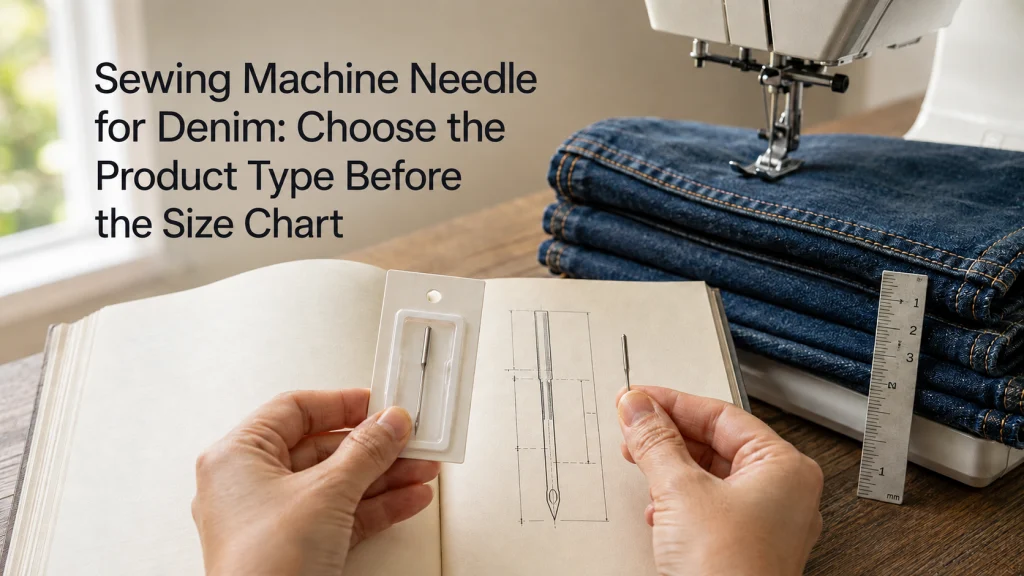
A sewing machine needle for denim should be chosen in two stages: first verify the needle system and product family, then size the needle from the actual fabric, thread, and layer stack. Denim and Jeans needles are documented as a distinct household needle type, but the word denim alone does not determine one universal blade size. A dedicated needle also does not increase the machine’s permitted needle range or prove that the machine can sew every heavy seam. The practical goal is to buy the right needle family without turning a product label into a machine-capacity claim.
Denim is a material family, not one needle size
A sewing machine needle for denim cannot be chosen from the fabric name alone. A lightweight stretch denim and a dense jeans hem can both be called denim while presenting very different conditions at the needle. One may be a relatively thin fabric with elastane and only two layers under the presser foot. The other may place several folded layers, seam allowances, topstitching thread, and a compact woven structure under the needle at once.
This page answers the product-family question first. It explains when a Denim or Jeans needle belongs on the buying list, how that family differs from a general-purpose needle at a high level, and what must still be checked on the exact machine. It does not publish a universal denim size chart, teach how to cross a bulky seam, or diagnose a needle that is already bending, striking, breaking, or skipping stitches.
Verify the machine’s needle system first
Needle type comes after fit. Before buying a denim sewing machine needle, check the machine manual for the needle system it accepts and any stated size limits. SCHMETZ notes that most home sewing machines use the 130/705 H system, but it also warns that some specialty and older machines can use something different. The machine manufacturer’s requirement controls the decision, not the fact that a package says “home sewing” or “denim.”
This distinction matters because two needles can both be marketed for household sewing and still not be interchangeable with every machine. The shank, scarf, overall system, and installation orientation must match what the machine is designed to use. If the manual identifies a different system, stop there and find a compatible needle family within that system rather than forcing a common household needle into the clamp.
- Record the exact machine model before shopping.
- Find the needle-system designation in the manual or official support material.
- Check whether the manual limits the permitted needle-size range.
- Verify installation direction and how far the needle must seat in the clamp.
- Reject a package that does not provide enough information to prove system fit.
If you need a broader explanation of the families and markings you may encounter, the site’s overview of common sewing machine needle types provides the surrounding context. For a purchase decision, however, the model manual still outranks a generic package description.
Define Denim or Jeans needle as a product family
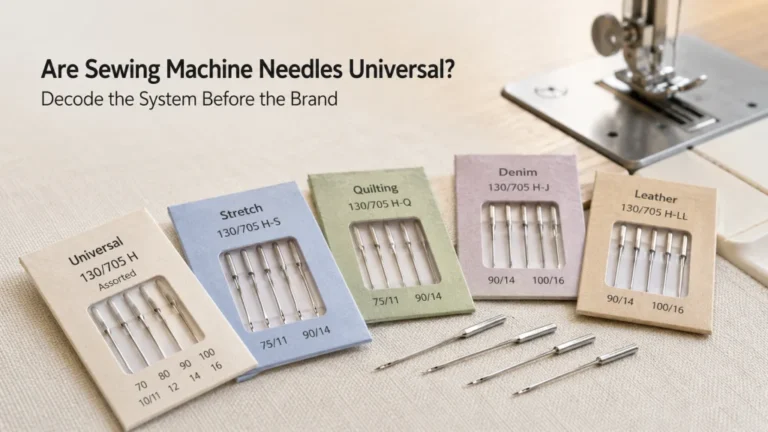
Denim and Jeans are not merely fabric words printed beside a size number. Current manufacturer guidance treats Jeans or Denim as a named needle type intended for materials such as denim, twill, canvas, and other dense woven applications. That gives the buyer a product-family decision that is separate from the later question of blade diameter.
SINGER currently lists Denim or Jeans as a distinct machine-needle category, while SCHMETZ identifies its Jeans needle as also being known as a Denim needle. The wording can vary by manufacturer, so search both names when necessary. What matters is that the package and technical description identify the intended needle type, not that the package happens to contain a large size.
Key point: “Denim” or “Jeans” identifies the needle family. The size number identifies blade diameter. Those are related decisions, but they are not the same decision.
A large Universal needle does not become a Denim needle because the number is similar to one found in a Denim package. Conversely, selecting a Jeans needle for a sewing machine does not settle which size belongs with the real fabric, thread, and number of layers in the project.

These SCHMETZ Jeans and Denim sewing machine needles come in a five-needle assorted pack. The assortment contains two 90/14 needles, two 100/16 needles, and one 110/18 needle. The product is made for denim and similar fabrics and uses a modified medium ball point with a reinforced blade.
Check On AmazonIf you click this link and buy, we earn a commission at no additional cost to you.
Compare documented geometry with a general-purpose needle at a high level
The useful comparison is not “strong needle versus weak needle.” It is how the manufacturer describes each product family’s geometry and intended application. SCHMETZ describes its Jeans or Denim household needle with a medium ball point and reinforced blade, while its Universal household needle uses a slightly rounded point and is positioned for numerous woven and knit fabrics.
That difference helps explain why a dedicated Denim or Jeans family exists, but it should not be turned into a universal performance promise. Point shape and blade construction are only part of the sewing system. The exact machine, permitted needle size, thread, fabric density, layer stack, presser-foot situation, feed behavior, and sewing technique can all change the result.
This is the boundary that keeps the buying decision useful. Product type answers what kind of needle you are evaluating. Size answers how large that needle’s blade should be for the conditions in front of the machine.
A Universal needle can still appear in manufacturer guidance for some woven materials, which is why the fabric name does not settle the choice by itself. The better comparison is not “Denim always wins” but whether the manufacturer documents a material-specific Denim or Jeans family for the fabric conditions you have, and whether the general-purpose option is also permitted for that use. When both appear plausible, keep the decision evidence-led rather than assuming the sharper-looking or larger needle must be better.
Read the package or listing before you add it to the cart
Once Denim or Jeans is the family you want to evaluate, the shopping task becomes simple: confirm that the listing actually identifies that family instead of showing only a size number or a broad household-needle label. Look for the product-family name, needle-system designation, size options, quantity, and manufacturer application wording. If those fields are missing or contradictory, the listing has not given you enough evidence to treat it as the right purchase.
Do not use package color, a photo of blue denim, words such as “strong,” or a large size number as substitutes for the product-family name. A useful listing should let you answer three questions before checkout: does the system fit the machine, is the needle explicitly identified as Denim or Jeans, and are the available sizes within the range you can actually evaluate for the project?
| Listing detail | What it should tell you |
|---|---|
| Product family | Denim or Jeans is named explicitly, not inferred from the photo |
| Needle system | The system can be checked against the machine manual |
| Available sizes | The package offers a size that can be evaluated within the machine’s permitted range |
| Application wording | The manufacturer identifies denim, jeans, canvas, or another intended material use |
| Package contents | The quantity and size mix are clear enough to know what is actually being purchased |
That check adds a buying step without turning the article into a product list. Once the listing passes those basic checks, the remaining question is whether the real denim, thread, and layer stack point to one of the available sizes.

These SINGER Denim sewing machine needles come in a five-needle pack in size 100/16. They are designed for denim, heavyweight canvas, duck, and other heavy tightly woven fabrics. The needles are made from cold-forged steel and are supplied in a compact transparent storage case with the needle size marked on the cover.
Check On AmazonIf you click this link and buy, we earn a commission at no additional cost to you.
Describe the actual denim by weight, density, stretch, and layer stack
Before choosing size, write down what the needle will actually pass through. “Blue jeans” is not enough information. A stretch denim with a soft hand behaves differently from a rigid, tightly woven denim, and a single test layer does not represent a hem intersection with multiple folds and seam allowances.
The goal is not to turn this page into a fabric laboratory. It is to capture the few properties that change the needle decision so you can move to size selection with better evidence.
| Denim property | What to record before sizing |
|---|---|
| Weight | Light, medium, or heavy relative to the actual project fabric, using a known fabric specification when available |
| Density | Loose, ordinary, or notably compact weave rather than assuming weight tells the whole story |
| Stretch | Rigid woven denim or denim containing meaningful stretch |
| Layer stack | The ordinary seam plus the thickest planned folded or intersecting area |
| Thread | The actual construction or topstitching thread that will pass through the needle eye |
This intake card also reveals when the word denim is hiding two different problems. If the question is really about a thick seam intersection, the next decision is not simply to keep increasing needle size. If the fabric itself is lightweight and stretchy, the material construction deserves attention before a dense woven recommendation is copied across unchanged.
Keep product type and blade size as separate decisions
A product page can correctly identify Denim or Jeans as the intended needle family and still leave the size decision open. That is not missing information. Size should respond to the real fabric, layer count, thread, and the permitted range of the machine rather than to a single material word.
Use this sequence as the boundary between the two questions:
| Decision stage | Question | Evidence to use |
|---|---|---|
| 1. Machine fit | Will this needle system fit the exact machine? | Exact model manual or manufacturer support |
| 2. Product family | Is Denim or Jeans the documented family for this material? | Needle manufacturer type and application guidance |
| 3. Blade size | What size suits this fabric, thread, and layer stack? | Property-first size guidance plus the machine’s allowed range |
| 4. Sewing execution | Can the machine feed and cross the thickest seam safely? | Exact machine guidance and denim-sewing technique |
This article stops before step three becomes a universal size chart. Once the family is identified, use the site’s fabric-based needle-size reasoning for the actual material instead of copying one number from a denim label.
Check the model’s permitted size range
A needle manufacturer may sell a Denim or Jeans family in several sizes, but that does not mean every size is permitted in every machine. The exact model manual may state a needle-size range, preferred system, thread relationship, or other limits. Stay inside those instructions even if a fabric chart elsewhere suggests a larger blade.
This is where compatibility and material selection meet. If the material appears to call for a needle outside the machine’s stated range, the correct conclusion is not to force the larger needle. Reassess the project, layer stack, thread, and machine suitability instead. A compatible accessory decision should always respect the machine interface and operating limits, which is the same principle used when you verify sewing machine accessory compatibility elsewhere on the site.
Warning: Stay inside the model’s documented needle range. If a larger size appears necessary to force the material through, reassess the fabric, thread, layer stack, and machine suitability instead of treating size escalation as the fix.
The important buying result is a smaller list, not a bigger needle. If a package matches the product family but falls outside the machine’s system or permitted size range, remove it from consideration.

These SCHMETZ Jean and Denim machine needles are supplied as a five-needle pack in size 100/16. The product is identified for domestic sewing machines and is made for denim and other densely woven materials. All five needles in this package use the same 100/16 size rather than an assorted size mix.
Check On AmazonIf you click this link and buy, we earn a commission at no additional cost to you.
Separate the needle purchase from heavy-seam sewing technique
Choosing a Denim or Jeans needle does not answer how to cross a bulky jeans hem, a flat-felled seam intersection, or several folded layers. At those points, presser-foot angle, feed, stitch settings, speed, material handling, seam construction, and the machine’s physical limits can matter as much as the needle family. That is a sewing-technique question, not a reason to keep changing needle products.
For example, a machine may sew two ordinary layers of the same denim without complaint and struggle only where several seam allowances stack together. That pattern should not be rewritten as “the denim needle is wrong” without checking the thick-seam conditions. Move that question to the site’s denim-sewing technique content rather than expanding this buying page into a procedure for forcing the machine over a hump.
A Denim needle does not prove machine capacity
A dedicated needle can be appropriate for denim while the machine still has limits on needle size, presser-foot clearance, feed, motor load, and the thickness or density of the material stack it can handle normally. A needle package cannot establish those limits, and neither can a “heavy duty” label on the machine.
This becomes most important at dense belt loops, folded hems, and intersecting seams. A reinforced blade is a feature of the needle, not permission to keep sewing through abnormal resistance. Judge the sewing system from the model documentation and from whether the fabric feeds and the needle clears the machine normally.
Machine-capacity boundary: A Denim or Jeans needle changes the needle choice. It does not upgrade the machine or prove that a thick stack is within the machine’s normal capability.
If the project exceeds those limits, the decision has moved beyond needle shopping. That keeps this page from turning a material-specific product choice into an unsupported capacity claim.
Keep thread selection as a separate material decision
Thread matters because it must pass through the needle eye and form a balanced stitch with the bobbin thread, but this page does not turn thread shopping into part of the Denim needle recommendation. Construction thread and heavier decorative or topstitching thread can create different needle-eye and setup demands, so record the actual thread before finalizing size.
If thread choice becomes the main question, move to the site’s thread and material content rather than assuming that “denim thread” and “denim needle” automatically form a matched pair. Product names can suggest intended use, but the machine, needle eye, thread diameter, stitch, and project conditions still have to work together.
Move breakage or skipped-stitch symptoms to troubleshooting
A buyer choosing a needle family is making a different decision from an owner diagnosing a failure. If the needle is already bending, breaking, striking the plate, shredding thread, or producing skipped stitches, do not keep this as a simple “which denim needle should I buy?” question. The symptom introduces setup, installation, size, thread, timing, feed, material, damage, and machine-condition possibilities that require a separate diagnostic path.
That boundary also prevents manufacturer performance language from being turned into a guarantee. A product description may explain the design goal of a reinforced blade or specialized point, but it cannot prove that one needle will eliminate breakage or skipped stitches in an unspecified machine and material stack. Diagnose the actual symptom instead of treating another package as the next troubleshooting step.
| If the question has become… | Move to… |
|---|---|
| Which needle family should I buy for denim? | Product-family and compatibility selection |
| Which blade size fits this exact denim and layer stack? | Fabric-based needle-size selection |
| How do I cross this bulky denim seam? | Denim-sewing technique |
| Why is the needle bending, breaking, or skipping stitches? | Symptom-led troubleshooting |
Use the route that matches the question in front of the machine. Keeping those decisions separate is more useful than trying to make one denim page answer purchasing, sizing, technique, and repair at the same time.
Do not carry the denim decision into leather
Material-specific needle families are not interchangeable just because both materials can feel difficult to sew. Denim is a woven textile, while genuine leather presents a different material structure and uses different needle geometry. If the project has shifted from denim to leather, start the product-family decision again rather than treating the Denim or Jeans label as a general “tough material” needle.
The next comparison should therefore be based on the new material and the exact machine. Use the separate page on how to choose a sewing machine needle for leather when that is the actual project. If the question remains denim, return to the system, family, material-property, and size sequence above.
Final Thoughts: Choose the product family, then size it from the real material
The cleanest way to buy a Denim or Jeans needle is to separate four decisions that search results often collapse together. Verify the machine’s needle system first, identify whether Denim or Jeans is the documented product family for the material, describe the actual fabric and layer stack, then choose size within the exact machine’s permitted range. That sequence works better than treating one number as the answer to every piece of denim.
It also keeps the needle in its proper role. A dedicated Denim or Jeans family can solve the product-type question without replacing thread selection, heavy-seam technique, or symptom-led troubleshooting. Once the product family is identified, return to the broader sewing machine needle selection process for the next compatibility decision.
Frequently Asked Questions
👖 Is a Jeans needle the same as a Denim needle?
Manufacturers commonly use Jeans and Denim for the same material-specific needle family. Check the package’s technical description and needle system rather than relying on the name alone.
🪡 What size sewing machine needle should I use for denim?
There is no single size for every denim project. Choose size from the actual fabric weight and density, thread, layer stack, and the exact machine’s permitted needle range.
⚙️ Will a Denim needle fit every home sewing machine?
No. Many modern home machines use a common household needle system, but exceptions exist. Verify the exact needle system in the machine manual before buying.
🧵 Can I use a Universal needle on denim?
A Universal needle is a different general-purpose family, and some manufacturer guidance lists both Universal and material-specific options for certain woven fabrics. For a denim-specific purchase, compare the exact material and machine requirements rather than assuming fabric name alone settles the choice.
📏 Does heavier denim always need the largest needle my machine accepts?
No. Needle size should respond to the real fabric, thread, and layer stack, not simply move to the machine’s maximum. A larger needle also does not increase machine capacity.
🛑 What should I do if the needle bends or strikes while sewing denim?
Stop sewing rather than forcing the material or immediately increasing needle size. Check the exact setup and machine guidance, then move to symptom-led troubleshooting if bending, strikes, or breakage continue.
References and Sources
Only current manufacturer material is used here for the technical claims that need external support. The sources below establish needle-family terminology, documented geometry, and the reason machine-system compatibility must be checked before purchase.
- SINGER machine needle guidance: verifies Denim or Jeans as a named needle type for denim, jeans, and canvas and separates needle type from size.
- SCHMETZ Jeans and Denim needles: verifies the Jeans or Denim product family, documented point and blade design, household needle system designation, and stated material applications.
- SCHMETZ needle system compatibility: supports checking the exact machine manual because most home machines use a common household system but exceptions exist.
These sources establish product-family terminology, documented geometry, and compatibility boundaries. They do not establish one universal denim needle size or prove that any specific home machine can sew every denim layer stack.