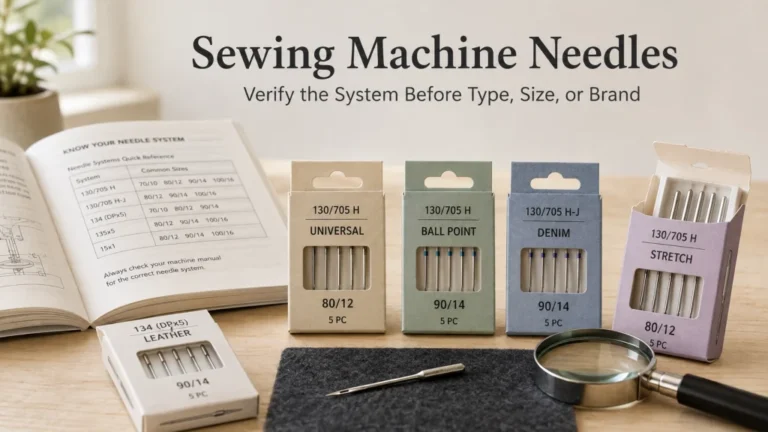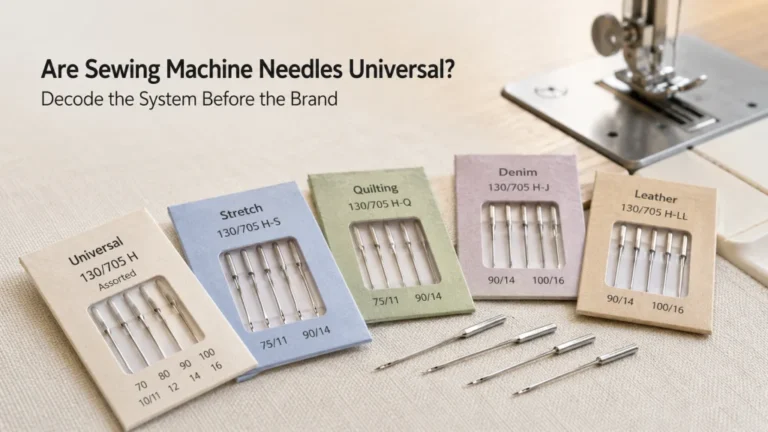
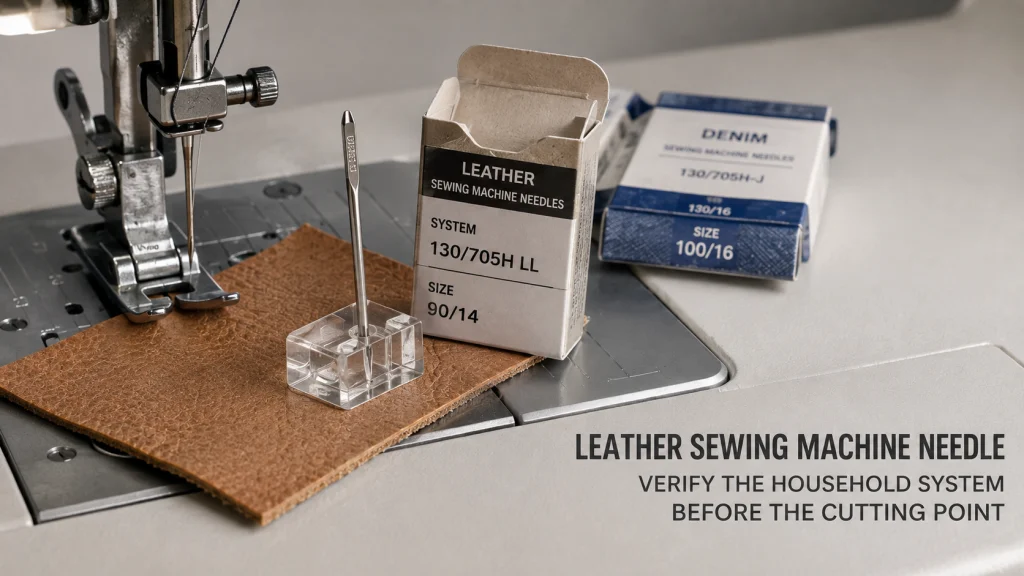
A leather sewing machine needle is not universal just because the package says Leather. For a general domestic machine, first match the needle system to the exact machine, then confirm that the chosen needle size is within the machine manufacturer’s permitted range. A household Leather needle such as SCHMETZ 130/705 H LL uses a cutting point, but that point geometry does not prove the machine can sew any particular leather thickness. The useful purchase decision is therefore system fit first, size eligibility second, and material capability only after the machine itself has been verified.
Leather describes the point job, not universal machine fit
Choosing a leather sewing machine needle by the word Leather alone skips the fit question. Two needles can both be sold for leather and still belong to different machine systems. A household flat-shank Leather needle and an industrial round-shank leather-point needle may share the same material label, but that label says what the point is intended to do, not how the needle fits the clamp, hook timing, or needle bar of your machine. That is why the first buying question is not simply, “Is this a leather needle?” It is, “Is this the needle system my exact machine requires?”
SCHMETZ currently identifies its household Leather needle as system 130/705 H LL and describes the LL point as a twist cutting point. The same manufacturer separately warns that some specialty machines use different systems and that the machine manufacturer’s specified system should control the decision. If you have not yet established the base system for your machine, first check whether sewing machine needles are universal for your exact model rather than treating the Leather label as fit evidence.
Identify the exact machine and required needle system
When shopping for a sewing machine needle for leather, start with the model number on the machine, not the needle package in your hand. The owner’s manual, manufacturer support page, or model-specific needle chart should identify the type of home sewing machine needle the machine accepts and may also limit usable sizes. If a manual specifies a different needle system, that instruction takes priority over a generic retailer statement that a package fits “home sewing machines.”
A first-time buyer can easily mistake brand compatibility for system compatibility. A package may say it works with common household brands, but brands contain multiple product families, older designs, and specialty machines. The safer sequence is to verify sewing machine needle compatibility from the machine side first, then shop only within the documented system.
If the original manual is missing, copy the exact model number from the machine and search the manufacturer’s current support site for the manual, needle chart, or model-specific support page. If the manufacturer does not publish enough information to identify the system, contact its support channel before buying rather than substituting a visually similar needle. The model number is the useful lookup key; the brand name alone is too broad.
- Record the exact machine brand and model number.
- Find the needle system named by the manual or current manufacturer support documentation.
- Record any permitted needle-size range or model-specific restrictions.
- Only then compare Leather needle packages within that system.
This short checklist prevents the most expensive form of guesswork: buying by application name and discovering that the shank or size is not accepted by the machine. It also keeps the decision at the component level, where fit can actually be verified.
Separate household Leather needles from industrial leather-point systems
Search results for leather sewing machine needles can mix household and industrial systems, which are not interchangeable categories. SCHMETZ’s current FAQ uses a useful example: a household Leather needle in the 130/705 H family is different from an industrial round-shank Leather needle identified there as 287 WH LR. Both may be marketed for leather, but their shank and system identities are different enough that the material name cannot be used as a compatibility shortcut.
That distinction matters most when shopping online, where search results can mix domestic and industrial listings on the same page. Do not rely on a close-up photo of the point, the word “Leather,” or the same numeric size alone. The system code is the part that ties the needle to a machine design.
| Package clue | What it tells you | What it does not prove |
|---|---|---|
| 130/705 H LL | Household base system with an LL Leather point designation | That every home machine accepts every available size |
| Industrial round-shank system code | The needle belongs to a different machine system unless the exact machine documents it | That a similar point or size makes it interchangeable |
| Leather | The needle point is intended for a leather-type application | Shank fit, machine clearance, or material capacity |
Use the card this way: system first, application second. If the package does not clearly identify the system, the product has not yet supplied enough evidence to buy it for an identified machine.
Read the household system code on the package
On the current SCHMETZ household Leather product, the useful code is 130/705 H LL. The 130/705 H portion identifies the household system family, while LL identifies the Leather point variant used on that product. A package may also show a needle size such as 90/14, 100/16, or another offered size, but that size is a separate variable from the system itself.
This separation prevents a common buying error. A buyer may find the right household system but select a size the exact machine does not permit, or find the desired numeric size in an industrial system that does not fit the machine at all. Read the whole code rather than stopping at the word Leather or the size number.
| Package element | Question to answer |
|---|---|
| Needle system | Does this match the exact system specified for my machine? |
| Point designation | Is this actually the documented Leather cutting-point type I intend to buy? |
| Needle size | Is this size within the range permitted for my exact machine? |
| Application wording | Does the manufacturer identify the point for leather or a related nonwoven material? |
The decoder is intentionally simple because the decision should be auditable from the package and the machine documentation. If one of those four answers is missing, pause the purchase rather than filling the gap with appearance or seller wording.
Identify the documented cutting-point geometry
A household Leather needle is not merely a large sharp needle. SCHMETZ describes its 130/705 H LL Leather needle as having an LL twist cutting point. That geometry is intended to cut into leather and related nonwoven materials, which is also why the manufacturer warns against using this Leather needle on knit or woven textiles.
Point identity should come from the needle manufacturer’s documentation, not from magnifying a product photo. Small differences in point shape are difficult to verify visually, and a sharpened-looking point does not establish the manufacturer’s intended application. For purchase compatibility, the meaningful evidence is the labeled system plus the documented point designation.
Key point: Point geometry verifies the needle type, not the machine’s leather capacity.
That boundary is especially important for someone new to leather sewing. The needle is only one interface component in the sewing system, and confirming its point type should not be allowed to stand in for confirming the machine.

SCHMETZ Leather Needles in size 110/18 use the 130/705 H LL household needle system and come five needles per card. The needles have an LL left-twist cutting point for leather, faux leather, paper, and heavy nonwoven synthetics. SCHMETZ notes that the cutting point leaves a permanent stitch hole and should not be used on knit or woven fabrics.
Check On AmazonIf you click this link and buy, we earn a commission at no additional cost to you.
Keep needle size as a separate axis
System and size answer different questions. The system determines whether the needle is built for the machine interface; the size describes needle dimensions within that system. A size that exists in a Leather product line is not automatically allowed by every machine that uses the same household system.
For example, Brother currently lists home sewing machine needles from size 65/9 through 100/16 for the CS7000X. That model-specific range means a household Leather needle sold in a larger size should not be assumed acceptable for that machine merely because the base system family looks familiar. General fabric-to-size reasoning belongs in the separate explanation of needle sizing, while this article stays focused on whether the Leather product physically belongs in the machine.
Note: Do not publish or rely on one universal Leather needle size. The correct size depends on the exact machine’s permitted range plus the material and thread decision made for the sewing task.
Keeping those axes separate also makes troubleshooting easier later. If the system is wrong, changing size does not repair the compatibility mismatch. If the system is right but the size exceeds the machine’s documented range, choosing another size within the permitted range is a different decision from changing point type.
Check the exact machine’s allowed size range
Once the household system is confirmed, return to the manual or current support page and look for needle sizes, thread limits, or any model-specific restrictions. Some documentation states a broad home-needle range, while other machines or specialty systems may be narrower. The package cannot override the machine manufacturer’s limit.
A practical example is a buyer holding a 130/705 H LL package in size 110/18 while the exact machine’s documentation stops at 100/16. The base household system may be the right family, but the selected size is still outside the documented range. The correct buying move is to find a permitted size in the verified system or stop and reassess the machine/material plan, not to force the larger needle into the clamp.
The size-range check is small, but it is where component compatibility becomes model-specific instead of generic. It should happen before any powered test or attempt to judge leather thickness.

This SINGER leather needle set contains three size 90/14 needles and two size 100/16 needles. The needles use a wedge-shaped point for leather, suede, vinyl, faux suede, and other thick nonwoven materials. They are made from cold-forged steel and use color coding to distinguish the two included sizes.
Check On AmazonIf you click this link and buy, we earn a commission at no additional cost to you.
Compare Leather and Denim or Jeans needles only at the point-geometry level
Leather and Denim or Jeans needles can both appear in searches for tough materials, but they are not the same product family. SCHMETZ identifies its household Leather needle as 130/705 H LL with a twist cutting point. Its current Jeans or Denim needle is identified as 130/705 H-J and uses a medium ball point with a reinforced blade for woven materials such as denim, twill, and canvas.
That difference is useful because it stops material difficulty from becoming the only buying criterion. Leather calls for a cutting-point discussion; denim remains a woven-fabric needle decision. If the adjacent question is about jeans rather than leather, use the separate process to choose a sewing machine needle for denim instead of treating the two labels as substitutes.
| Needle family | Documented point approach | Compatibility question that remains |
|---|---|---|
| Leather 130/705 H LL | LL twist cutting point | Does the exact machine accept the system and selected size? |
| Jeans or Denim 130/705 H-J | Medium ball point with reinforced blade | Does the exact machine accept the system and selected size? |
The table is not a material-selection chart. Its purpose is to show that the suffix and point geometry matter after the base machine system has been verified.

SINGER Denim Sewing Machine Needles are a five-count set in size 100/16. Amazon lists them for denim, heavyweight canvas, duck, and other heavy tightly woven fabrics. The needles are made from cold-forged steel with larger eyes and come in a compact transparent storage case marked with the needle size.
Check On AmazonIf you click this link and buy, we earn a commission at no additional cost to you.
A Leather needle does not prove leather thickness or machine capacity
Compatibility is a necessary check, not a capacity rating. A needle can fit the clamp and still be paired with a leather stack the machine cannot feed, clear, penetrate reliably, or form stitches through under the intended conditions. The Leather label therefore cannot be used as evidence that a domestic machine is “leather capable” in any universal sense.
This is one of the most important distinctions for a first-time owner. Installing the correct cutting-point needle changes one component, but it does not change the machine’s presser-foot lift, feeding architecture, thread limits, motor and drive design, clearance, or service boundaries. Those machine-level questions must be verified separately.
| Verified fact | What you may conclude | What remains unproven |
|---|---|---|
| Needle system matches the exact machine | The needle belongs to the documented interface family | Material thickness capacity |
| Selected size is within the model’s permitted range | The size passes the model-specific eligibility check | Reliable sewing on a particular leather stack |
| Needle has a documented Leather cutting point | The point geometry is intended for leather-type material | Feed performance, thread compatibility, or machine durability |
When the project itself is the uncertainty, stop at this boundary. Product fit has been answered; machine capability has not.
Keep walking-foot and leather-machine buying separate
A compatible Leather needle does not answer whether a different feed system or a dedicated leather-oriented machine is needed. Walking-foot systems, industrial needle systems, presser-foot interfaces, material transport, and machine purchasing involve different compatibility evidence than a household needle package. Combining those decisions encourages the buyer to treat one accessory as an upgrade to the whole machine.
If you are still sorting out attachment interfaces more broadly, use the site’s process to check sewing machine accessory compatibility before buying another component. For leather-machine selection, the machine itself must be evaluated as a separate equipment decision rather than inferred from the needle that happens to fit.
Warning: Do not force an oversized or wrong-system needle into the needle clamp, and do not perform powered clearance tests to see whether a questionable needle “works.” Follow the exact machine manual for needle installation and permitted sizes.
That keeps this purchase decision narrow and useful. By the end of this step, you should know whether the Leather needle belongs to the machine, not whether the entire machine is suitable for every leather project.
Keep leather handling and construction in the sewing workflow
After compatibility is confirmed, the next questions change. Stitch length, seam layout, handling, presser-foot behavior, thread choice, test scraps, and how permanent needle holes affect construction are all part of using the verified setup. They should not be smuggled into the purchase decision as proof that one needle size or point works everywhere.
This article therefore stops before giving a leather-sewing recipe. The useful handoff is simple: carry forward the exact machine model, the verified needle system, the selected permitted size, the Leather point identity, the leather description, and the intended thread. Those facts are enough to begin a material-specific workflow without losing the compatibility evidence already established.
Pro Tips: Keep the needle package until the project is complete. The system, point designation, and size printed on it are much more useful later than trying to identify a loose needle by appearance.
That small record also helps if the setup later develops a problem. You can separate “wrong component” from “correct component, unsuccessful result” instead of restarting from memory.
Route strikes, bending, breakage, or failed stitches to troubleshooting
Needle strikes, visible bending, breakage, repeated skipped stitches, jams, or abnormal machine behavior are not reasons to keep experimenting with larger Leather needles. Once a symptom appears, the problem has moved from pre-purchase compatibility into troubleshooting. Stop and preserve the exact setup details before changing multiple variables at once.
Record the machine model, needle system, type and size, thread, leather description, number of layers, stitch selected, and the symptom. If the needle strikes the plate or another machine part, if the machine develops a hard mechanical lock, or if there is uncontrolled motion, overheating, smoke, a burning odor, sparks, or exposed wiring, stop using the machine and follow the manual or qualified service route rather than continuing tests.
- Stop after a hard needle strike or visible bending.
- Replace a damaged needle only with a system and size already verified for the model.
- Do not assume a larger needle fixes skipped stitches or feeding problems.
- Do not continue powered testing when the machine is mechanically locked or electrically abnormal.
A successful compatibility check narrows the troubleshooting tree, but it does not eliminate other causes. That is exactly why the system and size should be documented before sewing begins.
Final Thoughts: verify the system before the cutting point
Buy a Leather needle from the machine outward. Confirm the exact model’s needle system, match that system on the package, identify the documented Leather point, and then verify that the selected size is within the machine’s allowed range. That sequence gives you a defensible component-fit decision without pretending the material label proves more than it does.
The final boundary matters just as much as the fit check: a compatible cutting-point needle does not establish leather thickness capacity, feed performance, thread suitability, or long-term machine durability. When those questions become the real issue, carry the verified component details into the appropriate machine, material, or troubleshooting decision instead of stretching the needle label into a capability claim.
Frequently Asked Questions
🪡 Which leather needle should I buy for my sewing machine?
Buy a household Leather needle only after its system matches your exact machine documentation and its size falls within the model’s permitted range. “Leather” describes the point application, not universal machine fit.
📦 What does 130/705 H LL mean on a Leather needle package?
On the current SCHMETZ household Leather product, 130/705 H identifies the household system family and LL identifies the Leather twist cutting point. You still need to check the exact machine and the selected needle size.
📏 Can I use a 110/18 Leather needle in any domestic machine?
No. A size that exists in the product line may still exceed the permitted range for a specific machine. Check the model manual or current manufacturer support page before installation.
🧵 Is a Leather needle the same as a Denim or Jeans needle?
No. SCHMETZ documents its Leather LL needle with a cutting point, while its Jeans or Denim H-J needle uses a medium ball point and reinforced blade for woven materials. Treat them as different point families even when both are household needles.
⚙️ Does fitting a Leather needle mean my machine can sew thick leather?
No. Needle fit proves only the component checks you actually verified, such as system and size eligibility. Leather thickness capacity also depends on the exact machine, material stack, thread, feed behavior, clearance, and other model-specific limits.
References and Sources
These references support the system, point-geometry, and model-specific size claims that control the compatibility decision. They are included because those details should be checked against current manufacturer documentation rather than inferred from a package photo or generic product name.
- SCHMETZ Leather Needles: verifies the current 130/705 H LL system, LL twist cutting point, and stated household Leather applications.
- SCHMETZ machine compatibility: supports checking the machine manufacturer’s specified needle system and notes that some specialty machines differ from the common household system.
- SCHMETZ needle FAQ: documents the household-versus-industrial Leather needle confusion and the need to keep needle size within what the machine can accept.
- Brother CS7000X needle guidance: provides a model-specific example of an allowed home sewing machine needle-size range.
- SCHMETZ Jeans and Denim Needles: verifies the H-J system designation, medium ball point, and reinforced-blade description used for the point-geometry comparison.
For a different machine, use its current manual or manufacturer support page as the final authority on the permitted needle system and size range. The cited CS7000X information is an example of model-specific verification, not a universal size rule for domestic machines.