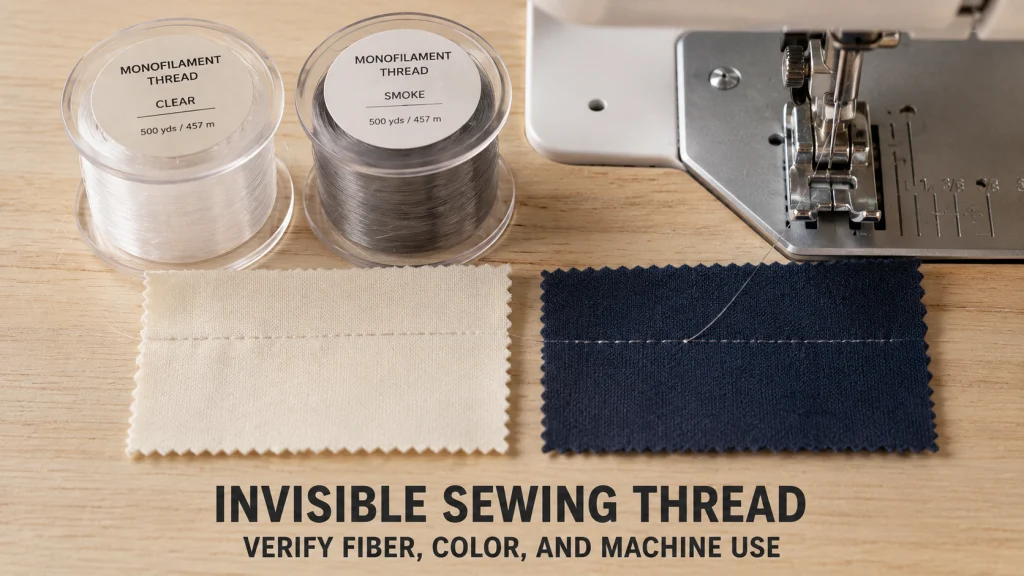
Invisible sewing thread is a visual category, not one standardized fiber. Current manufacturer labels show that monofilament sold for low-visibility machine stitching can be nylon or polyester, with clear and smoke versions used to blend against different backgrounds. Choose by reading the exact fiber, size, color, and intended machine application on the product label or current manufacturer page. This keeps a transparent-looking spool from being treated as interchangeable with every other monofilament thread.
Clear appearance does not identify the fiber
Two spools can both look like clear fishing line at a glance and still be different sewing products. If you are choosing invisible thread for a sewing machine, the first useful question is not simply whether the thread looks transparent, but what fiber and size the exact label identifies.
Current manufacturer documentation makes the distinction concrete. Aurifil identifies its monofilament as 100% nylon, while Superior Threads identifies MonoPoly as a 100% polyester monofilament. Both are marketed for low-visibility stitching, so appearance alone cannot tell you which material you are holding.
Key point: Treat “invisible,” “clear,” and “monofilament” as product-description clues. The exact fiber, size, color, and stated machine use on the current label control the buying decision.
This page stays with domestic machine-sewing selection. It does not cover fishing line, general craft monofilament, tension-setting tutorials, or universal claims about heat resistance, strength, or service life across all nylon and polyester products.

YLI Wonder Invisible is a clear nylon monofilament thread made for quilting and appliqué. The spool contains 2,000 yards, and the thread has a matte finish designed to blend with multicolored fabrics without adding noticeable shine. Amazon also describes the filament as soft and supple and recommends reduced top tension when sewing with it.
Check On AmazonIf you click this link and buy, we earn a commission at no additional cost to you.
Read the exact fiber and size before comparing invisible thread
The simplest check is also the one most likely to prevent a bad assumption: read the fiber line on the exact spool or manufacturer listing. “Monofilament” describes a single-filament construction, but it does not tell you whether that filament is nylon, polyester, or another material.
Current labels give more than one useful cross-check. Aurifil identifies its monofilament as 100% nylon, Superior Threads identifies MonoPoly as 100% polyester, and Sulky identifies its Invisible Monofilament as polyester. The point is not to rank those products. It is to show that the same low-visibility shopping language can sit on different fiber labels, so the exact product record has to settle the material question.
| Label field | What to record | Why it matters |
|---|---|---|
| Fiber | Nylon, polyester, or the exact material stated | Prevents “invisible” from being treated as one material |
| Construction | Monofilament or another construction | Separates transparent monofilament from fine conventional thread |
| Size | Weight, diameter, denier, ticket number, or other stated system | Lets you compare the actual thread rather than spool appearance |
| Color | Clear, smoke, gray, or exact manufacturer wording | Controls how the thread visually recedes against the fabric |
| Intended use | Machine quilting, appliqué, sewing, bobbin use, or other documented application | Shows whether the manufacturer supports the job you intend |
Size labels also need context because manufacturers may describe fine thread with different systems. Superior Threads, for example, gives MonoPoly as 100 wt and also publishes a .004 inch (.1 mm) diameter and 90 denier, while Sulky describes its invisible polyester monofilament as .004 without presenting that product primarily through the same weight label. A weight number, denier value, ticket number, and measured diameter are not four interchangeable scales, so do not convert one into another unless the manufacturer or a reliable technical reference provides that relationship.
A common shopping mistake follows from comparing the numbers as if they were one scale. A buyer may see “100 wt” on one product and “.004” on another and assume the larger-looking or smaller-looking number identifies the finer thread. It does not. Record each value with its unit, then compare diameter to diameter or use another genuinely matched specification when available.
- Photograph or write down the exact spool label before discarding packaging.
- Match the product name and fiber to the current manufacturer page when available.
- Record size using the system actually printed by the manufacturer.
- Keep color and intended application separate from fiber.
- Leave any missing field unresolved instead of guessing from appearance.
This label-first method also fits the broader way to compare sewing thread types: identify the thread that is actually in front of you before deciding where it belongs in the machine-sewing system.
Choose clear or smoke by the visual background
Clear thread is not automatically the least visible choice on every fabric. Against pale or light-colored material, a clear sewing thread can visually disappear well, while the same transparent line may catch light or read as a bright strand against a dark background.
Smoke exists to solve that visual problem. Superior Threads currently describes clear for light fabrics and smoke for dark fabrics, and Aurifil sells its nylon monofilament in both Clear and Smoke. The useful choice is the version that recedes into the specific fabric or multicolor area you are sewing.
| Fabric background | Color to test first | What to inspect on a scrap |
|---|---|---|
| Light or pale | Clear | Whether reflections make the thread more visible than expected |
| Dark | Smoke | Whether the darker filament blends instead of flashing bright |
| Mixed print | Test clear and smoke | Which option is less noticeable across both light and dark areas |
| High-sheen fabric | Test before choosing | How the thread catches light from the same viewing angle as the finished project |
Smoke is therefore a color route within the same low-visibility goal, not a separate thread category. Test it beside clear on the actual fabric because transparency, surface sheen, stitch density, and viewing angle all change what the eye notices.
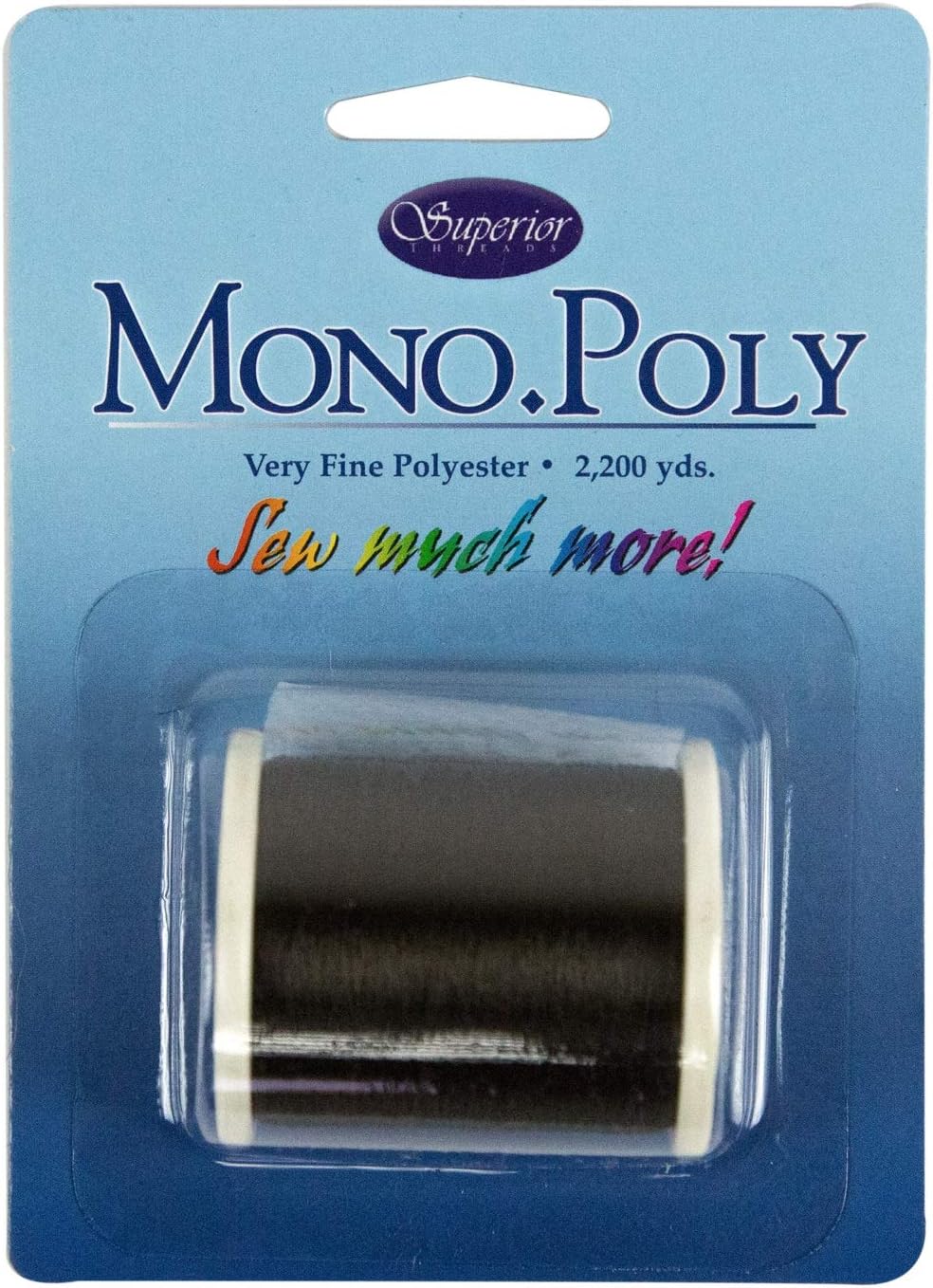
Superior Threads MonoPoly Smoke is an extra-fine 100% polyester monofilament thread supplied on a 2,200-yard spool. Amazon lists it at 0.004 inch in diameter and 90 denier with a reduced-sheen finish intended for low-visibility stitching. The thread is described for quilting, appliqué, apparel, and use in either the top thread position or bobbin.
Check On AmazonIf you click this link and buy, we earn a commission at no additional cost to you.
Verify that the exact thread is documented for machine sewing
A transparent spool sold in a craft aisle is not enough evidence that it belongs in a domestic sewing machine. Check the manufacturer’s current application language and then follow the exact sewing-machine manual for threading, needle compatibility, spool handling, and any model-specific restrictions.
Manufacturer documentation can be specific enough to make this check practical. Sulky describes its invisible polyester monofilament for machine appliqué and quilting and also documents bobbin and serger use. That kind of application statement is more useful than assuming that any transparent filament belongs in the same machine positions.
That does not make every monofilament product suitable for every machine position or project. It means those exact manufacturers document those uses for those exact products. If a different spool gives only a vague “craft” description, keep machine use unresolved until you find a current label, technical page, or manual that supports it.
Note: Universal heat, ironing, durability, and strength rules do not belong here. Nylon and polyester monofilaments can be formulated and sized differently, so any care or performance limit should come from the exact product documentation and the material being sewn.
One practical example is machine appliqué where the goal is to keep the securing stitch visually quiet across several fabric colors. Another is quilting where the top thread should recede rather than create a colored line. In both cases, the selection starts with a documented machine-sewing product, then moves to fiber, size, and clear-versus-smoke appearance.
For a wider supplies decision, the machine-sewing supplies overview explains how thread sits alongside needles, bobbins, and other consumables without treating any one supply label as universal.

Sulky Premium Invisible Thread is a clear 100% polyester monofilament thread sold in a 2,200-yard spool. Amazon describes the filament as very fine at 0.004 inch and characterizes it as soft, strong, smooth, and pliable. The product description identifies it for invisible quilting and appliqué.
Check On AmazonIf you click this link and buy, we earn a commission at no additional cost to you.
Separate monofilament from fine conventional bobbin thread
Fine bobbin thread and invisible monofilament can both reduce visual bulk, but they are not the same product category. A conventional bobbin thread may be a fine multi-filament or spun thread with an opaque appearance, while monofilament is defined by its single-filament construction.
This distinction matters when a package says “bobbin thread” but never says monofilament, or when a monofilament manufacturer also documents bobbin use. Product naming can add another trap: WonderFil describes InvisaFil as an “invisible” thread, yet its current specification identifies it as 100 wt, 2-ply cottonized polyester rather than monofilament. The location in the machine and the word “invisible” therefore do not define construction. Read the exact fiber and construction first.
If your real question is how to choose a fine lower thread, move to the bobbin thread selection criteria. If the project is specifically quilting and monofilament is only one possible route, the machine quilting thread comparison keeps that broader project decision separate from this product-label check.
A first-time buyer can easily miss the distinction because “fine,” “invisible,” and “bobbin” describe different things. Fine refers to size, invisible describes a visual goal or product positioning, and bobbin identifies a machine role. None of those words, by itself, proves monofilament construction.
Final Thoughts: Verify the product behind the invisible label
Invisible sewing thread is easiest to choose when you stop treating transparency as the specification. Read the exact fiber, construction, size, color, and documented machine use, then test clear or smoke against the fabric where the stitching actually needs to recede.
That process also keeps the decision bounded. You do not need a universal verdict on nylon versus polyester to make a sound purchase. You need evidence for the exact product in front of you and a clear reason for using monofilament on the project.
Frequently Asked Questions
🧵 Is invisible sewing thread always nylon?
No. Current products exist in both nylon and polyester monofilament. Read the exact fiber label instead of identifying the material by its clear appearance.
🪡 Can I use invisible thread in a sewing machine?
Use a product whose manufacturer documents machine sewing for the application you intend, then follow the exact machine manual. A transparent craft monofilament should not be assumed suitable just because it fits through a needle eye.
🌫️ Should I use clear or smoke monofilament thread?
Clear is commonly intended for lighter backgrounds and smoke for darker ones, but test the exact thread on a scrap. Prints, sheen, lighting, and stitch density can change which option is less visible.
🔍 Is monofilament sewing thread the same as bobbin thread?
No. Monofilament describes a single-filament construction, while bobbin thread describes a use or product role and may have a different construction. Check both the fiber and construction on the exact label.
🧺 Can I assume all invisible thread has the same ironing or heat limit?
No. Care and heat guidance depends on the exact product, fiber, and manufacturer documentation. Check the thread label and the fabric care requirements before applying heat.
References and Sources
- Aurifil monofilament specifications: Verifies 100% nylon fiber, Clear and Smoke colors, and documented machine-sewing applications.
- Superior Threads MonoPoly specifications: Verifies polyester monofilament, published weight, diameter and denier, Clear and Smoke options, and documented machine applications.
- Sulky invisible monofilament specifications: Verifies polyester fiber, .004 monofilament sizing, and documented machine-use language.
- WonderFil InvisaFil specifications: Verifies that an “invisible” thread can be a 100 wt, 2-ply polyester construction rather than monofilament.