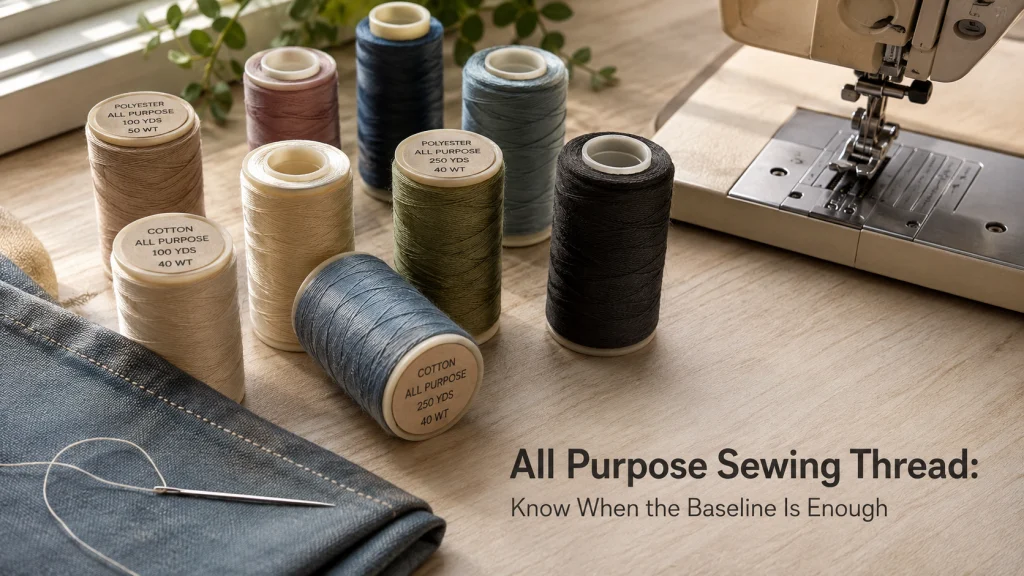
All-purpose thread is the sensible starting point for ordinary domestic machine sewing, but the label is not a promise that one spool fits every fabric, stitch, or machine. The useful check is simple: read the fiber and size on the spool, compare them with the seam you are making, then ask whether care, appearance, movement, or machine limits give you a reason to leave the baseline. Current all-purpose listings include polyester, cotton, and cotton/polyester constructions, so the words on the front of the spool are only the beginning of the decision. By the end, you should be able to keep a normal construction thread when it is enough and recognize the project conditions that justify a specialty choice.
All-purpose is a baseline, not every-purpose
All purpose sewing thread is useful because most ordinary home-sewing jobs do not need an exotic thread. A stable woven shirt seam, a simple cotton tote seam, or a routine repair on a medium-weight fabric can often begin with a normal machine-sewing thread whose fiber and size fit the fabric and the machine. That makes all-purpose thread a baseline: it gives you a reasonable place to start before the project presents a more specific requirement.
The mistake is reading “all-purpose” as “universally suitable.” Current retail categories place polyester, cotton, and cotton/polyester constructions under the same broad use label, and individual products can carry different size systems and intended applications. A spool can therefore be sold for general sewing while still differing materially from the spool beside it. The broad use label is only a starting point; the decision should move to the actual fiber, size, and intended use of the thread in your hand.
Key point: Keep the baseline when the seam is ordinary and the thread’s documented fiber, size, care, and machine suitability fit the job. Leave it only when a project requirement gives you a concrete reason.
That approach also keeps this decision separate from a full fiber comparison. If cotton versus polyester becomes the controlling question, compare polyester and cotton thread directly rather than forcing the all-purpose label to answer a different question.

Coats & Clark Dual Duty All-Purpose Thread is made with a polyester-covered polyester core for general sewing. This pack includes one black and one white 400-yard spool. It is designed for both hand and machine sewing across everyday fabric and construction projects.
Check On AmazonIf you click this link and buy, we earn a commission at no additional cost to you.
Read the exact fiber and size on the spool
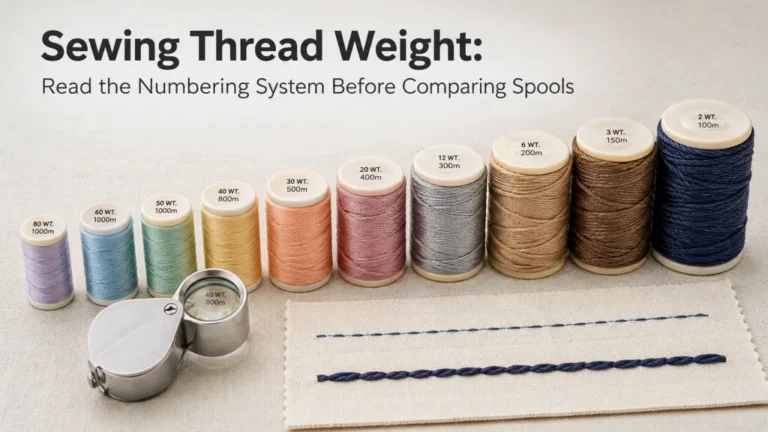
Start with the label, not the shelf category. Look for fiber content first: polyester, cotton, or a stated blend. Then find the size or thickness designation provided by the manufacturer. A general-purpose sewing thread still needs this check because thread sizing is not expressed in one universal retail format, so a familiar marketing name does not replace the actual number or specification printed for that product.
A current manufacturer label provides a useful example of how much more specific the back of the decision can be than the front. Gütermann’s Sew-all documentation identifies the thread as 100% polyester, gives a thickness of No. 100, and pairs it with a stated universal needle range of NM 70 to 90. That does not make the product a recommendation here. It shows the kind of evidence a sewist should look for before treating any general-purpose label as meaningful.
- Fiber: Is the thread polyester, cotton, or a defined blend?
- Size or thickness: What sizing system and value does the spool or manufacturer use?
- Machine use: Is the thread documented for domestic machine sewing, rather than only hand work or a specialist system?
- Needle relationship: Does the manufacturer or exact machine manual give a compatible needle range or other thread guidance?
- Finish: Is the thread ordinary, or is it unusually heavy, bonded, waxed, coated, metallic, or otherwise specialized?
- Care: Do the stated care properties make sense for the fabric and finished item?
The checklist matters because similar-looking spools can represent different decisions. A medium general-purpose polyester thread intended for normal machine sewing and a visibly heavier coated thread may both physically fit on a spool pin, but that tells you nothing about whether the machine’s tension path, needle, or bobbin system is intended to handle both. When the thread is unusually heavy or coated, the exact machine documentation should control the next step.
Warning: Do not assume that a thread is safe for a domestic machine because it is sold near ordinary sewing thread. SINGER’s current support for one Heavy Duty model specifically excludes some threads above its stated size limit as well as waxed or coated threads, which shows why machine-specific limits matter once you leave normal construction thread.

Gütermann Sew-All is a 100% polyester universal sewing thread for machine and hand sewing. The manufacturer specifies a No. 100 thickness and recommends universal needles in the NM 70 to 90 range. This listing provides a 1,094-yard spool for general seams, topstitching, and decorative stitching.
Check On AmazonIf you click this link and buy, we earn a commission at no additional cost to you.
Define the ordinary seam jobs the thread needs to cover
The baseline earns its place when the job itself is ordinary. Think about closing seams in stable garment fabrics, basic hems where the thread is not meant to dominate visually, routine repairs, or simple construction on common woven materials. In those cases, the thread needs to form reliable stitches with the chosen needle and fabric, survive the intended care routine, and avoid introducing a special visual or structural requirement.
For example, someone sewing a medium-weight cotton skirt with standard construction seams may have no project-led reason to reach for a specialty thread. If the selected all-purpose spool is documented for machine sewing, its size suits the needle and fabric, and its care properties fit the garment, staying with the baseline is a rational decision. Buying something more specialized would add complexity without solving a stated problem.
Performance at the machine can also tell you when to recheck the baseline, but it does not diagnose the thread by itself. Repeated upper-thread breakage, skipped stitches, shredded thread, or puckering are reasons to pause and verify the thread path, needle type and condition, thread size, tension, fabric, and the exact machine guidance before deciding that a different thread category is needed. SINGER troubleshooting documentation ties these symptoms to several possible causes, including incorrect threading, excessive tension, damaged or unsuitable needles, and fabric or feed conditions. Treat the symptom as a prompt to inspect the thread-needle-fabric combination, not as proof that an all-purpose spool has failed its intended role.
| Project condition | Baseline decision | What to check next |
|---|---|---|
| Ordinary construction seam on a stable woven fabric | Usually stay with an appropriate all-purpose thread | Fiber, size, needle match, care, and color |
| Seam must stretch substantially with the fabric | Stop and evaluate the stretch requirement | Thread behavior, stitch choice, fabric recovery, and exact machine setup |
| Thread is meant to be visually prominent | Stop and define the desired appearance | Thread thickness, needle requirement, stitch, and machine limits |
| Thread is unusually heavy or coated | Do not assume the baseline applies | Exact machine manual and manufacturer thread limits |
| Project has unusual care or exposure requirements | Recheck the thread rather than relying on its name | Fiber, finish, care instructions, and project requirement |
This router is deliberately stop/go rather than brand-led. The question is not whether another spool sounds more advanced. It is whether the project has introduced a requirement that the current thread cannot documentably meet. That keeps ordinary sewing simple while still giving specialty thread a clear reason to exist.
If you are still identifying the broader families of construction, decorative, heavy, or specialty thread, compare common sewing thread types before narrowing the purchase. The all-purpose decision works best after you know which kind of job the thread is being asked to do.
Check care, visible finish, and expected movement
Three project conditions commonly push the decision beyond a generic shelf label: what happens to the item in use, how visible the stitching is supposed to be, and how much the seam must move. These are different questions. A thread can be perfectly adequate for ordinary construction yet be the wrong choice when the stitching becomes a design feature or the seam must repeatedly extend with a highly elastic fabric.
Care is the first filter. Read the thread manufacturer’s care information and compare it with the fabric and finished item rather than assuming that every general-purpose spool behaves identically. If the item will be washed, pressed, or otherwise maintained in a way that makes the thread’s fiber or finish material to the result, the exact label matters more than the category name.
Appearance is the second filter. An inconspicuous construction seam and a deliberately bold line of topstitching are not asking the thread to do the same visual job. If the project calls for a thicker, more dimensional stitch, that is a reason to evaluate a thread designed for that role instead of doubling down on the baseline simply because the color matches. The machine, needle, and bobbin arrangement may also change when thread thickness changes.
Movement is the third filter. A stable knit with a seam that experiences little extension is not the same problem as a fitted stretch garment whose seam must repeatedly move with the fabric. Polyester is common among all-purpose products, but the word polyester alone does not prove that a particular thread, stitch, needle, and machine setup will meet every stretch requirement. When seam movement becomes the controlling factor, choose thread for stretch fabric as a separate decision.
Note: Current market labeling supports the need for this separation. WAWAK’s all-purpose category includes cotton, polyester, and cotton/polyester products rather than one standardized fiber construction, while SINGER describes regular all-purpose thread as the normal household-machine baseline within its own stated support scope.

Gütermann Top Stitch is a 100% polyester thread designed for prominent decorative and topstitch seams. It has a No. 30 thickness and the manufacturer specifies universal needles in the NM 100 to 120 range. The heavier three-ply construction produces a more dimensional stitch when the thread is intended to become a visible part of the project.
Check On AmazonIf you click this link and buy, we earn a commission at no additional cost to you.
Reject universal brand claims
A brand name does not answer the project question. One manufacturer may sell multiple thread constructions, sizes, finishes, and intended uses under the same brand, and retailers may group products differently. Treating “Brand X thread” as a single technical specification throws away the information that actually controls the decision.
The same rule works in reverse. A community recommendation that one familiar brand “always works” may describe a person’s machines and projects, but it does not prove that every spool from that brand suits every domestic machine. Community discussions are useful because they expose the confusion: sewists routinely ask whether ordinary, quilting, embroidery, or heavier thread can be interchanged. Those reports establish the decision problem, not a universal compatibility rule.
Use the exact spool and exact project instead. If one all-purpose option is 100% polyester at one documented size and another is cotton at a different size, compare those facts with the seam rather than ranking the logos. If two products meet the same ordinary requirement, there may be no technical reason to turn a baseline purchase into a brand contest.
An existing spool can remain a valid baseline when its fiber and size are known, it suits the machine, and it meets the seam’s care, appearance, and movement needs. When one of those conditions is not met, that gives you a specific reason to compare a different thread rather than shopping by brand reputation alone. For the wider set of needles, bobbins, thread, and other machine consumables that interact with this choice, choose machine sewing supplies by their actual function and compatibility.
Final Thoughts: use the baseline until the project gives a reason not to
All-purpose thread is most useful when you stop asking it to be universal. Read the fiber and size, confirm that the thread is intended for the machine, and compare it with the actual seam. For ordinary domestic construction, that may be all the decision needs.
Move away from the baseline only when you can name the reason: unusual seam movement, a deliberately prominent stitch, a heavier thread requirement, a special finish or care condition, or a machine limit that changes what can be used. If fiber itself becomes the question, compare cotton and polyester directly; if stretch becomes the controlling requirement, route the decision there. The useful outcome is knowing whether the spool already on the table meets the job, and if it does not, which documented requirement should control the next thread choice.
Frequently Asked Questions
🧵 What is all-purpose thread used for?
It is a general construction baseline for many ordinary hand and domestic machine-sewing jobs. Check the spool’s actual fiber and size, because products carrying the same broad label are not necessarily constructed the same way.
🪡 Can I use all-purpose thread in my sewing machine?
Regular all-purpose machine-sewing thread is a normal baseline for household machines, but the exact machine manual controls unusual thread sizes and finishes. If the thread is heavy, bonded, waxed, coated, or otherwise specialized, verify the machine’s stated limits before using it.
🧶 Is all-purpose thread always polyester?
No. Polyester all-purpose thread is common, but current all-purpose categories also include cotton and cotton/polyester constructions. Read the fiber content on the exact spool instead of inferring it from the front label.
👕 Is all-purpose thread enough for clothing?
It can be enough for many ordinary garment construction seams when the fiber, size, needle, care needs, and expected seam movement all fit. A highly stretch-dependent seam or intentionally bold topstitching may create a separate thread requirement.
⚙️ Does thread size matter on a domestic machine?
Yes. Thread thickness affects the needle relationship and can exceed a machine’s stated limits when you move into heavier or specialized threads. Use the exact product specification and machine documentation rather than assuming all spools sold for sewing are interchangeable.
🎨 Should thread color be the first thing I choose?
Color matters, especially on visible seams, but it should not replace the basic fiber, size, machine, and project checks. A perfect color match does not make an unsuitable thread construction suitable.
The repeated theme in these questions is scope. “All-purpose” narrows the search to a useful general category, but the spool label and the project still make the final decision.
When a question cannot be answered from those two pieces of evidence, the next useful source is the exact machine manual or the manufacturer’s documentation for that thread, not a broader marketing claim.
References and Sources
These sources were used to verify the current market labeling, a documented all-purpose product specification, household-machine guidance, and the community confusion that motivates the stop/go decision.
- WAWAK all-purpose thread category: Confirms that current all-purpose listings include polyester, cotton, and cotton/polyester constructions with different size labels.
- Gütermann Sew-all product information: Provides an exact current example with 100% polyester fiber, No. 100 thickness, and a stated needle range.
- SINGER household machine FAQs: Supports regular all-purpose thread as the general household-machine baseline within SINGER’s stated scope.
- SINGER Heavy Duty thread limits: Shows model-specific restrictions for unusually heavy, waxed, or coated threads and the need to match thread size with the needle.
- SINGER sewing troubleshooting tips: Supports treating thread breakage, skipped stitches, and puckering as symptoms with multiple possible setup, needle, tension, or fabric causes rather than proof that one thread category is wrong.
- QuiltingBoard thread-use discussion: Used only to document real user confusion about interchanging ordinary, quilting, and other thread types.
The technical claims above rely on the current retailer or manufacturer documentation listed here. Community discussion is treated only as evidence of the question people ask, not as proof of machine compatibility or thread performance.