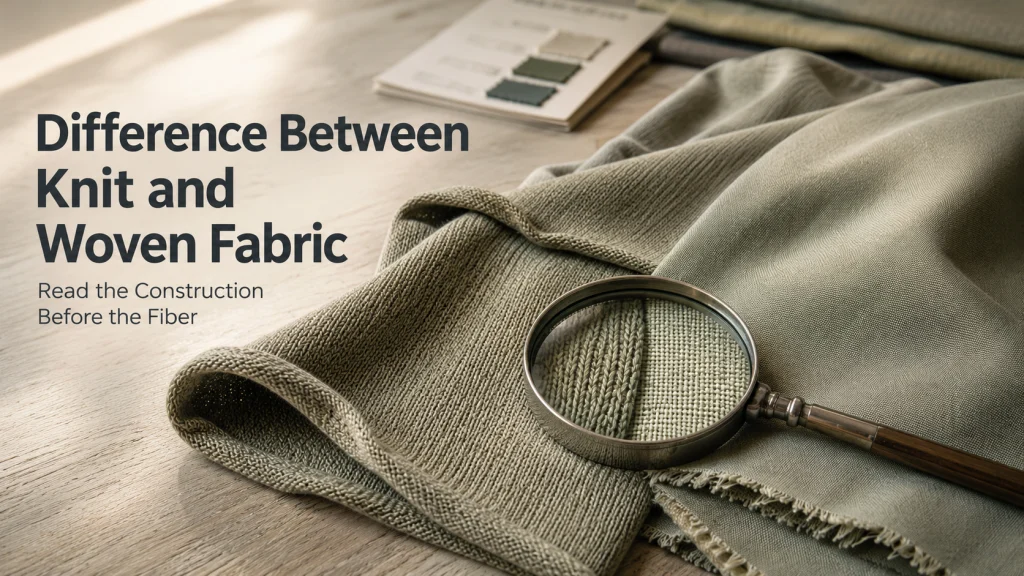
Knit and woven fabrics are defined by how yarns are formed into fabric, not by whether the fiber is cotton, polyester, rayon, or another material. Knits are built from intermeshing loops, while wovens are formed from two yarn systems crossing at right angles or other weave relationships. That construction influences stretch, recovery, drape, edge behavior, and the kinds of projects a fabric can support, but none of those behaviors should be treated as universal. The practical buying step is to identify both construction and fiber content before deciding whether a fabric belongs in the project.
Cotton can be knit or woven
When comparing knit vs woven fabric, start with construction rather than the fiber name printed on a label. A cotton jersey and a cotton plain weave can both be made primarily or entirely from cotton, yet their yarns are organized differently and the fabrics can behave very differently in the hand. The jersey is formed from loops, while the woven uses crossing yarn systems. That structural distinction is more useful for project selection than assuming that cotton means one predictable type of fabric.
This is a common buying trap because retail descriptions often put fiber content in the most visible position. A shopper sees 100% cotton and may picture stable quilting cotton, shirting, or another familiar woven, even though cotton can also appear in jersey, interlock, rib, fleece, and other knitted constructions. The same problem works in reverse with polyester, which can appear in both knit and woven fabrics. If the construction is still unclear, first compare fabric types for sewing by structure and intended use rather than treating the fiber name as the full answer.
Keep those two fields separate whenever you compare yardage online or in a store. Construction helps explain the basic mechanical behavior you can expect to investigate, while fiber content adds another layer involving feel, care, absorbency, strength, and other properties. Neither field replaces the other. Reading both is the first step toward choosing material that actually matches the project.
The difference between knit and woven fabric starts with yarn arrangement
CottonWorks describes knit fabric as yarn formed into intermeshing loops. In a basic knit, horizontal rows of loops are called courses and vertical columns are called wales, although the surface appearance changes with the specific knit structure. Woven fabric is formed differently, using one set of yarns running in the length direction and another set running across the width. Those lengthwise warp yarns and crosswise weft yarns interlace to form the woven structure.
You do not need a textile laboratory to use that distinction while shopping, but visual inspection alone is not always enough. A clear jersey may show recognizable V-shaped knit stitches on its face, while a plain woven may show a simple over-and-under crossing pattern, yet dense finishes, brushing, prints, or very fine yarns can hide the structure. Selvages and edge behavior can provide clues, but they are not universal proof either. When the surface is hard to read, a trustworthy product description that explicitly states jersey, interlock, rib knit, plain weave, twill, satin weave, or another construction is stronger evidence than a guess from appearance.
| Construction clue | Knit | Woven |
|---|---|---|
| Basic yarn relationship | Intermeshing loops | Interlaced warp and weft yarns |
| Useful terms in listings | Jersey, interlock, rib, double knit | Plain weave, twill, satin weave, poplin |
| What not to assume | That every knit has high stretch | That every woven has zero stretch |
Use the construction name as a starting classification, not as a complete performance specification. Two knits can differ sharply because loop structure, yarn, gauge, weight, and added elastic fiber can change the result. Two wovens can also behave very differently because weave design, yarn size, density, finish, and fiber content vary. The goal at this stage is simply to put the fabric in the correct structural family before making finer comparisons.
Compare directional stretch and recovery without using absolutes
Knit loops usually give a fabric more ability to change shape than a comparable woven construction, especially across the width, but the amount can range from modest to very high. CottonWorks notes that knit structures generally exhibit stretch because the loops can move and change shape, and its technical material also shows that different knit stitches alter extensibility. A stable double knit can therefore behave very differently from a lightweight jersey, even when both belong to the same broad family. Added elastane or another elastic fiber can further change both stretch and recovery.
Wovens are typically more dimensionally stable because their warp and weft yarns interlace rather than form loops, yet woven does not mean completely nonstretch. Some woven fabrics gain mechanical give from yarn arrangement, finishing, or weave geometry, and others include an elastic fiber specifically to add stretch. CottonWorks even documents woven cotton constructions engineered for mechanical stretch without elastomeric yarns, which is a useful reminder that construction labels do not predict a single percentage. Check the exact fabric specification or pattern requirement when stretch is a purchase-critical property.
Do not generalize: “knit stretches” and “woven does not stretch” are only starting shortcuts. They do not describe every fabric in either construction family. Direction, percentage, recovery, and added elastic fiber can change the buying decision. Check the exact fabric when stretch is important to the project.
Recovery deserves its own check because a fabric that stretches is not automatically good at returning to its original dimensions. A knit can extend easily yet remain relaxed after repeated pulling, while another knit with a different structure or fiber blend can recover more firmly. A stretch woven may provide limited give with a much more structured hand. If a project depends on measured stretch or recovery, use the exact material requirement rather than substituting a construction stereotype.
Compare body, drape, and edge behavior at the selection stage
Construction affects how fabric hangs, but drape is not determined by knit versus woven alone. Many knits conform readily because their loops can shift, while many woven fabrics hold a more stable shape, yet weight, yarn, density, and finish can reverse the impression you expected. A lightweight woven rayon can drape more fluidly than a heavy double knit. A dense sweatshirt knit can have far more body than a fine woven lawn.
That makes project language more useful than broad labels such as soft or structured. If a pattern or project calls for a fabric that falls close to the body, look for drape information alongside construction and weight. If it needs a crisp shape, investigate body and stability rather than assuming any woven will work. For a first project, the broader beginner fabric selection criteria can help separate easy-to-control material from fabric that is technically suitable but difficult to manage.
Cut-edge behavior also varies within each family. Some weft knits may curl, run, or unravel at particular edges because of their loop structure, while woven cut edges often release individual yarns as the interlacing is cut. Dense knits, bonded fabrics, tightly woven materials, and special finishes can behave differently, so the edge is a clue rather than a definition. Use it to support a construction identification, not to override reliable product information.
At the buying stage, you only need enough behavior information to decide whether the material belongs in the project shortlist. Detailed seam handling, needle choice, stitch choice, and feed troubleshooting come later after the material has been selected. Keeping that boundary matters because a fabric can be the correct construction but still need a different sewing setup. First decide whether the fabric itself has the required body, drape, stretch, and recovery.
Read exact fiber content and construction as separate product fields
In the United States, textile labeling rules focus on fiber identity and fiber percentages, along with other required information such as the responsible business and country of origin. That means a fiber label can correctly tell you 100% cotton or a cotton blend without telling you whether the fabric is jersey, interlock, poplin, twill, or another construction. For yardage shopping, the product description therefore matters alongside the fiber statement. A complete material record should identify both what the yarn is made from and how the fabric is constructed.
Online listings are easiest to compare when you extract the same fields every time. Start with construction, then fiber content, width, weight when stated, stretch information when stated, and the seller’s intended use or fabric description. Do not fill missing fields from photographs or from a familiar fabric name unless the source actually defines that name clearly. If construction is missing and it matters to the project, treat the listing as incomplete rather than guessing.
- Find an explicit construction term such as jersey, interlock, rib knit, plain weave, twill, or another named structure.
- Record the fiber percentages separately from the construction.
- Check width and fabric weight when the seller provides them.
- Look for directional stretch and recovery information when the project depends on stretch.
- Check whether the listing describes body, drape, opacity, or finish in a way that affects the project.
- Leave any missing field unknown instead of inferring it from a photo or fiber name.
For example, two listings can both say 100% cotton while one is a jersey knit and the other is a woven poplin. Fiber content alone would make them look equivalent even though their construction points toward different behavior and project uses. A listing that identifies both fields gives you a much stronger basis for selection. After that, weight and specific structure can narrow the choice further.
Avoid inferring construction from the fiber name
Cotton is the easiest example because both cotton knits and cotton wovens are common, but the same rule applies more broadly. Polyester can be knitted into jersey or fleece and woven into many apparel or utility fabrics. Rayon or viscose can also appear in different constructions, so a fiber term cannot stand in for the fabric system. If that naming is already causing confusion, understand rayon and viscose terminology separately from the knit-or-woven question.
The reverse mistake is treating a construction name as if it told you the fiber. Jersey describes a knit structure, not one fiber, while twill describes a woven structure that can be produced from different fiber contents. Poplin, satin weave, rib knit, and interlock work the same way as construction terms rather than guaranteed fiber identities. Keep fiber and construction in separate columns until both are verified.
Some fabrics also make visual classification less obvious than the basic examples suggest. A smooth or dense knit can look more structured than expected, while brushing, bonding, coatings, or surface finishes can hide the yarn pattern you would normally use as a clue. Names such as French terry or ponte still identify knit constructions rather than a halfway category between knit and woven, so appearance should not override the stated construction. If a fabric combines multiple layers or the listing uses vague marketing language, rely on the supplier’s exact construction description instead of inventing a hybrid label.
| Fiber field | Possible knit construction | Possible woven construction |
|---|---|---|
| Cotton | Jersey, interlock, rib | Plain weave, poplin, twill |
| Polyester | Jersey, double knit, fleece structures | Plain weave, twill, satin weave |
| Rayon or viscose | Jersey and other knit structures | Plain, twill, or other woven structures |
This matrix is intentionally broad because the exact fiber-construction combinations available from mills and retailers vary. It is not a promise that every listed combination will share the same weight, stretch, drape, or durability. Those properties depend on the specific fabric, not merely the box it occupies in the table. The practical lesson is to verify both columns before purchasing.
Narrow the fabric only after construction is known
Once construction is confirmed, compare the variables that actually separate candidates within that family. A buyer choosing a knit may need to distinguish a lighter single jersey from a more stable double-knit structure, while a woven buyer may need to compare weave, weight, and body. Construction gets you into the correct family, but it does not finish the purchase decision. That is why replacing one generic label with another is not enough.
If the shortlist contains knits, the next useful distinction may be to compare single jersey and interlock rather than continuing to compare all knits as one group. If the project still feels too broad, use project-specific sewing supply criteria to reconnect the material choice with the rest of the sewing system. Two fabrics can share the same broad construction and still differ enough in weight, surface, recovery, and body to suit completely different projects. The goal is to move from fiber, to construction, to the exact fabric properties the project requires. That sequence is more reliable than choosing from a familiar fiber name and hoping the structure behaves as expected.
Final Thoughts: construction is a separate buying variable
The woven vs knit fabric decision is not a contest between two materials with fixed personalities. It is a construction question that sits beside fiber content, weight, finish, stretch, recovery, and drape. A cotton knit and a cotton woven can share the same fiber while behaving differently because the yarns form different structures. Reading both fields keeps the purchase tied to the project rather than to assumptions about cotton, polyester, rayon, or another fiber.
Start with reliable construction information, then verify the behavior that matters for the project. Compare the exact fabric’s weight, drape, stretch information, recovery, and finish instead of letting the broad construction label make the whole decision. If the seller leaves a critical field unknown, keep it unknown until better documentation is available. That simple discipline makes the next fabric comparison much more precise without pushing into machine setup or sewing technique before the material is chosen.
FAQs
Most confusion around knit fabric vs woven fabric comes from mixing construction with fiber content or treating stretch as a definition. The questions below keep those variables separate so the answer stays useful while shopping. Exact behavior still depends on the specific fabric. Use a supplier’s construction and stretch information whenever the project requires a measurable property.
These answers stay at material-selection level rather than prescribing stitches, needles, or machine settings. Once you have identified the construction and chosen the fabric, sewing technique becomes a separate decision. That separation prevents a general construction comparison from turning into one universal setup rule. It also makes it easier to recognize when the listing itself is missing information.
🧶 Is cotton knit or woven?
Cotton can be either. Cotton identifies the fiber, while knit or woven identifies how yarns are formed into fabric. Check the construction name instead of assuming from the fiber content.
🧵 Are all knit fabrics stretchy?
Knits generally gain flexibility from their loop structure, but the amount and direction of stretch vary. Knit structure, yarn, weight, finish, and added elastic fiber can all change the result. Use exact stretch information when the project depends on it.
📐 Can woven fabric stretch?
Yes. Some wovens have mechanical give from construction or finishing, and others include an elastic fiber. Do not use “woven” as proof of zero stretch.
🔍 How can I tell whether fabric is knit or woven?
Look for an explicit construction term first. Visible loops can support a knit identification, while crossing warp and weft yarns support a woven identification, but finishes can hide those cues. Reliable supplier information is stronger than appearance alone.
🏷️ Does a 100% cotton label tell me the construction?
No. It tells you the fiber content, not whether the fabric is jersey, interlock, poplin, twill, or another construction. Read the product description for construction information.
👕 Is jersey always made from cotton?
No. Jersey is a knit structure and can be made from different fibers or blends. Verify fiber content separately from the word jersey.
References and Sources
This comparison uses technical textile references because the core distinction depends on how yarns form the fabric. CottonWorks provides separate knitting and weaving education that supports the structural definitions and the caution that stretch varies by construction. FTC textile guidance supports the distinction between fiber-content labeling and fabric construction. Those sources are enough for the claims made here, so broader retailer or community links are not needed as technical evidence.
The sources below do not establish one universally better construction for sewing. They support definitions, labeling boundaries, and examples of why stretch cannot be reduced to a simple knit-versus-woven rule. Project suitability still depends on the exact fabric and project requirements. Product-specific properties should be verified from the exact supplier documentation when they matter to a purchase.
- CottonWorks Knit Basics: Explains intermeshing knit loops, courses, wales, and how knit structures can vary in extensibility.
- CottonWorks Weaving Basics: Explains woven construction through interlaced warp and weft yarn systems and basic weave designs.
- FTC textile labeling guidance: Explains required fiber-content disclosures for textile products and why fiber labeling should not be treated as construction identification.
These references are intentionally limited because the article does not make product rankings, medical claims, or sewing-machine setup claims. Community discussions can show that sewists commonly confuse fiber, construction, and stretch, but they are not necessary to prove the textile structure itself. If an exact fabric listing is being considered, its own construction and specification fields should take over from these general references. That keeps general education separate from product-specific purchasing evidence.