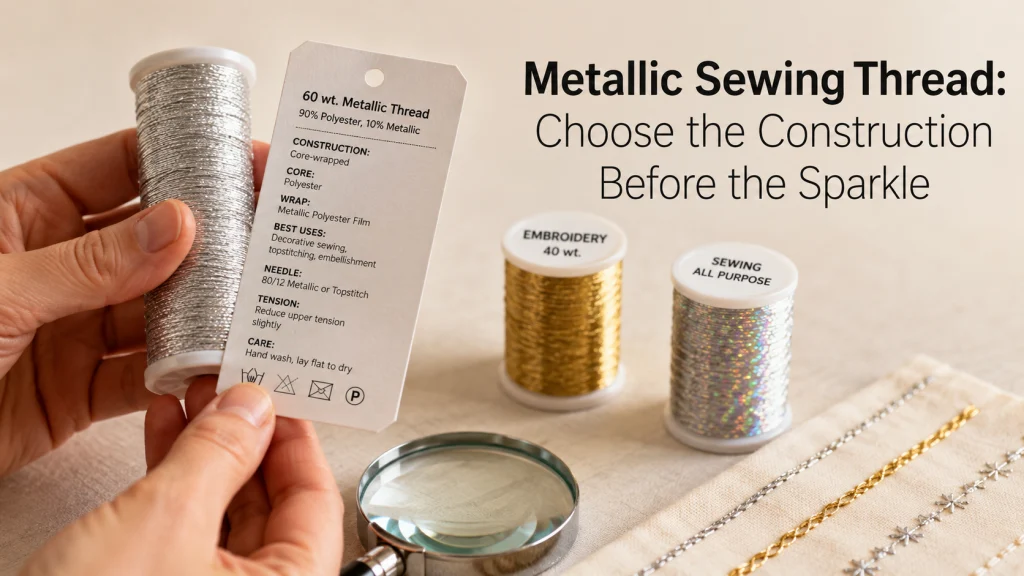
Metallic sewing thread can add reflective decorative stitching, but shine alone does not prove that a spool belongs in an ordinary domestic sewing machine. Start with the manufacturer’s intended use, then read the thread construction, size label, and application scope before comparing color or finish. A product made for machine embroidery may sit beside a decorative sewing thread or craft cord that looks similar while serving a different system. The goal is to identify machine-use evidence first, not to apply one universal metallic-thread setup to every machine.
Metallic appearance does not define machine suitability
A spool labeled metallic sewing thread can look like an easy purchase: choose silver, gold, or another reflective color and start stitching. The problem is that the visual effect does not tell you how the thread is built or where the manufacturer expects it to run. Current product documentation includes metallic constructions intended specifically for machine embroidery, constructions listed for ordinary sewing and decorative seams, and specialty materials sold for purposes that do not establish domestic machine compatibility at all.
That makes the first decision a scope check rather than a color choice. If your goal is decorative stitching on a regular home machine, stay with products whose documentation actually includes sewing or domestic machine use. If you are still sorting ordinary thread families before reaching specialty options, compare common sewing thread types first so the metallic effect does not obscure the more basic question of what the thread is designed to do.
Confirm the product is designed for machine stitching
When choosing metallic thread for a sewing machine, the most useful evidence is not the word “metallic” on the front of a spool. Look for an intended-use statement from the manufacturer that names machine sewing, decorative stitching, quilting, embroidery, overlocking, or another clearly defined machine application. Those labels are not interchangeable, but they tell you whether the maker has placed the thread inside a machine-stitching system at all.
This matters because listings can place three visually similar materials next to one another: a thread intended for a home sewing machine, a metallic product centered on machine embroidery, and a decorative cord intended for craft or hand use. A home sewist looking only at shine can easily cross those boundaries. Use the product-scope gate below before reading color charts or shopping by spool size.
| What the listing actually says | What that evidence supports | Next move |
|---|---|---|
| Sewing, sewing machine, or decorative machine stitching | The product is within scope for further domestic-machine evaluation | Read construction, size, and any machine-use limits |
| Machine embroidery only | The product has a defined embroidery application | Do not automatically treat that as ordinary domestic decorative-sewing approval |
| Craft cord, trim, handwork, or decorative cord with no machine-use statement | No machine suitability has been established | Keep it out of the domestic-machine shortlist unless the maker supplies machine-use documentation |
| Generic “metallic thread” with no construction or application details | Appearance only | Find better documentation before buying for machine stitching |
The gate is deliberately conservative. It does not say that every machine-labeled thread will behave the same way in every home machine, and it does not say that an undocumented cord could never pass through a needle. It says something narrower and more useful: do not make the machine the test bench for a product whose seller has not even established that machine stitching is an intended use.
When a listing gives only a color name, spool length, and a broad phrase such as “metallic thread,” treat the missing construction and size data as a reason to stop rather than fill in the blanks yourself. Check the manufacturer’s own product page or packaging for a machine-use statement and a defined size or thread designation. If those details still cannot be found, the product has not supplied enough evidence for a careful domestic-machine purchase, even if customer photos show decorative stitches.
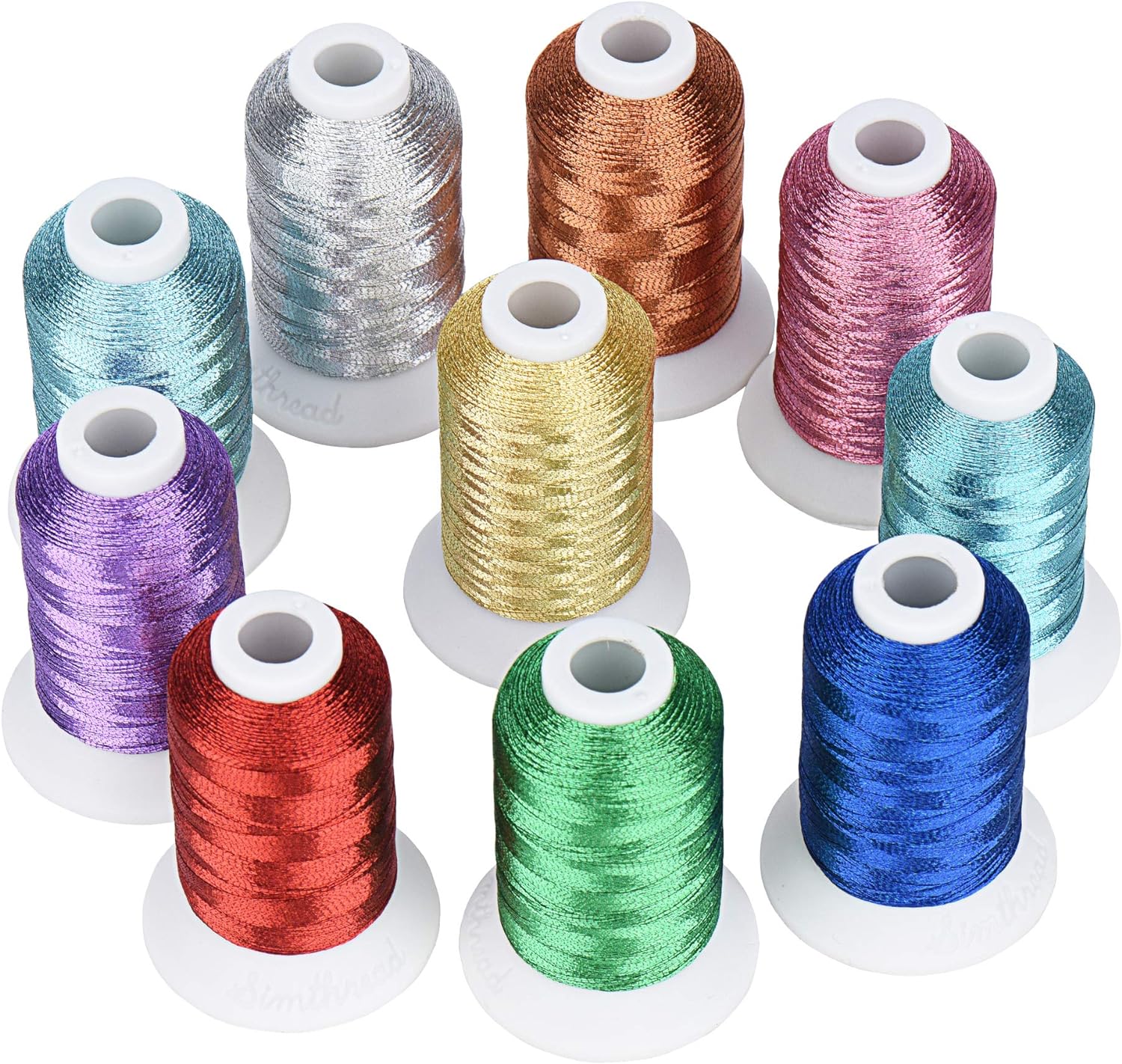
The Simthread metallic thread kit contains 10 essential colors for computerized embroidery and decorative sewing. Each spool contains 500 meters or 550 yards of 40 weight thread built around a soft viscose core with a metallic foil coating. The thread is listed as machine and hand washable, and the set is intended for decorative embroidery and sewing applications.
Check On AmazonIf you click this link and buy, we earn a commission at no additional cost to you.
Read metallic construction and base fiber
Metallic thread is not one single material recipe. Current technical pages show layered and wrapped constructions in which a core, reflective layer, coating, or other supporting material work together to create the visible finish. Other products use different fiber percentages and wrapped-yarn structures. The practical point is not to memorize one construction as “the” metallic thread, but to recognize that the shiny outer appearance can hide very different internal designs.
Construction matters because the thread has to travel from the spool, through the machine’s thread path, and through the needle while the decorative surface stays intact enough to form the intended stitch. A manufacturer that identifies the core, wrapping, coating, or fiber composition gives you more evidence than a listing that says only “sparkle thread.” That information also gives you a better way to compare two metallic options without pretending that equal color means equal machine behavior.
Note: Current manufacturer documentation demonstrates the construction difference directly. Coats describes one metallic line as a composite thread within a machine-embroidery scope, Superior Threads describes metallic thread as multiple material layers wrapped and twisted together, and Mettler publishes a wrapped construction with stated sewing applications. These examples establish variation in construction and intended use; they do not prove that one construction is universally best for every domestic machine.
The base fiber is only one part of that evidence. Polyester, polyamide or nylon-based cores, films, paper layers, coatings, and other components may appear in different products, so a single fiber word should not become a quality ranking by itself. Read the whole construction statement when the manufacturer provides one, then keep the intended application beside it. That pairing is far more informative than judging the spool from sheen alone.

The Madeira Metallic 40 Smooth Gift Box contains eight assorted spools of Metallic No. 40 thread, with 200 meters or 220 yards on each spool. The thread uses a twist construction in which a narrow metallized foil wraps the core, reducing the metallic proportion to approximately 25 percent. The set is designed as metallic machine thread for embroidery and decorative stitching applications.
Check On AmazonIf you click this link and buy, we earn a commission at no additional cost to you.
Read size and intended application together
After machine use and construction are established, move to the size label. Metallic products may use a weight, ticket, number, linear-density value, or another naming convention, and the label is meaningful only inside the system the manufacturer is using. A larger-looking number does not reliably mean the same physical thread size across every labeling method, so avoid translating an unfamiliar label by intuition.
This is especially important when a listing mixes embroidery language with sewing language. The product may be machine-capable while still being sized or documented for a different application than the decorative stitch you plan to make on a domestic machine. When the size notation itself is unclear, understand sewing thread weight labels before treating two products as equivalents.
- Find the manufacturer’s size or weight designation, not just the seller’s marketing title.
- Check whether the same documentation names sewing, decorative stitching, quilting, embroidery, or another machine application.
- Look for any stated machine, needle, or application limits without borrowing settings from a different product.
- Treat missing size information as missing evidence rather than assuming the thread is “standard.”
- Keep color, finish, and spool quantity as later comparison points, after the product has passed the scope check.
This sequence keeps the purchase grounded in evidence you can actually inspect. It also prevents a common shortcut: finding a metallic thread that looks visually appropriate, then searching afterward for a way to force it into the machine. The better order is machine-use scope, construction, size, application, and only then the aesthetic choice.

The New brothread kit contains 20 assorted metallic thread colors for computerized embroidery and decorative sewing. Each spool is listed at 40 weight with 500 meters or 550 yards of thread, and the listing describes an extra-strong polyester core coated with metallic foil. The product information also states that embroidery made with the thread can be washed by hand or machine.
Check On AmazonIf you click this link and buy, we earn a commission at no additional cost to you.
Separate domestic decorative stitching from embroidery-system use
A regular sewing machine and an embroidery system can both form stitches with specialty thread, but they do not create the same buying question. For ordinary domestic decorative stitching, the thread needs documented support for the kind of machine use you are considering. An embroidery-focused product page may provide excellent evidence for embroidery without answering the separate question of whether that same product is the best fit for general decorative sewing.
The distinction becomes more important when search results mix tutorials, embroidery-thread listings, quilting products, and craft materials under the same metallic wording. Do not import an embroidery-specific tension value, needle recommendation, speed, or thread-delivery method into ordinary machine sewing simply because both projects use reflective thread. Setup and troubleshooting belong to the exact machine, thread, stitch, fabric, and manufacturer instructions involved, not to the word “metallic” by itself.
If the project still needs a basic thread category decision rather than a specialty-thread decision, it can help to choose sewing supplies by machine use before narrowing to a metallic finish. The shine should be the final visual requirement layered onto a compatible sewing plan, not the evidence that creates compatibility.
Final Thoughts: verify machine-use construction before color and shine
By the time color and shine matter, the product should already have passed three checks: a documented machine application, a construction description you can identify, and a size label you can interpret in the maker’s own system. That order keeps the comparison focused on products that belong in the same buying decision instead of mixing embroidery-only thread, domestic decorative thread, and undocumented craft materials.
From there, the remaining choice is narrower and more honest. Fabric, stitch choice, machine design, thread path, and the manufacturer’s instructions can still change the result, so no product label can guarantee identical behavior across machines. The useful outcome is simply a defensible shortlist built from documented scope rather than appearance alone.
FAQs
✨ Can I use any metallic thread in a sewing machine?
No. Start with the manufacturer’s intended-use statement and confirm that machine sewing or the relevant machine application is actually listed. A shiny craft cord with no machine-use documentation should not be treated as sewing-machine thread just because it fits the visual goal.
🧵 Is metallic machine thread the same as embroidery thread?
Not automatically. Some metallic products are documented specifically for machine embroidery, while others are listed for sewing, quilting, decorative stitching, embroidery, or several applications. Use the stated application for the product in front of you rather than treating the terms as interchangeable.
🔎 What should I read on a metallic thread listing before buying?
Look for intended machine use, construction or fiber information, the manufacturer’s size designation, and any stated application limits. Color and shine matter only after those basic scope checks are satisfied.
📏 Does metallic thread weight work like ordinary thread weight?
The label still needs to be interpreted within the manufacturer’s sizing system. Do not assume that two numbers from different labeling conventions describe equivalent thread diameter or behavior. Check the stated system before comparing sizes.
🪡 Do I need special settings for metallic thread?
That depends on the thread, machine, stitch, fabric, and the instructions supplied for that combination. Do not copy an embroidery-specific setting into ordinary domestic sewing as a universal rule. Follow the thread maker’s application guidance and the sewing-machine manual when setup becomes model-specific.
References and Sources
- Coats Sylko Metallic technical page: Supports the example of a composite metallic thread documented specifically within a machine-embroidery application scope.
- Superior Threads thread characteristics: Supports the explanation that metallic threads can use layered, wrapped constructions rather than one universal material recipe.
- Mettler metallic thread specifications: Supports the example of a wrapped metallic construction with multiple documented machine-stitching applications.
These sources are used to establish product-scope and construction differences, not to rank or recommend a specific metallic thread for every home sewing machine.