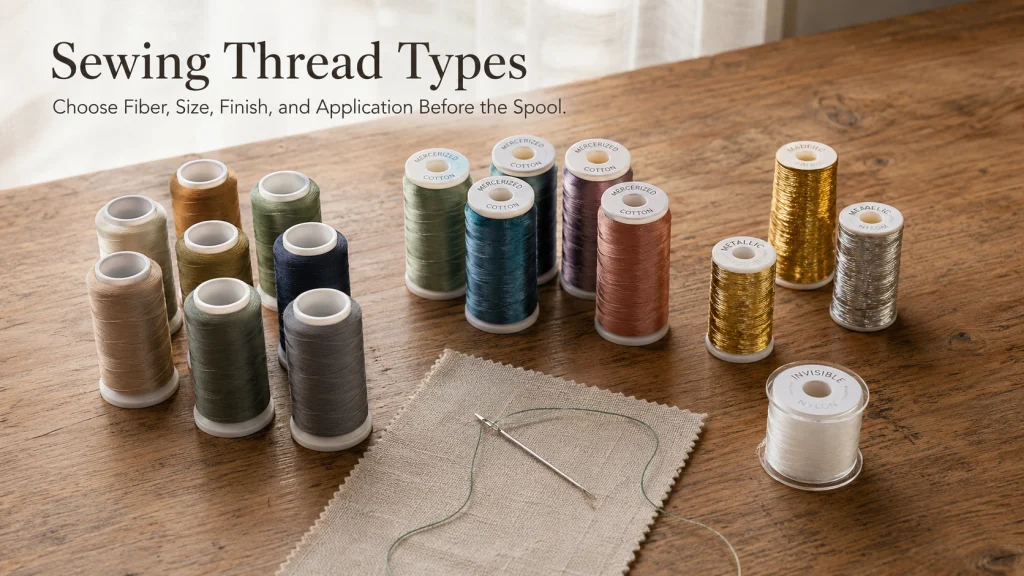
Sewing thread types make more sense when you separate four questions that spool labels often compress together: what the thread is made from, how it is constructed, how its size is expressed, and what job it is intended to do. A polyester core-spun thread, a mercerized cotton thread, a metallic composite thread, and a water-soluble temporary thread can all look like ordinary sewing supplies until the label is read closely. Start with the seam or visible-stitch job, then verify fiber, construction, size system, visual or functional effect, and whether the exact domestic machine is documented to handle the thread. That process is more reliable than choosing by brand reputation or by a single word such as cotton, polyester, heavy, or specialty.
Thread type is more than fiber
Put four similar-looking spools on a table and the useful differences may not be obvious at first glance. One can be spun polyester intended for ordinary closing seams, another can be mercerized cotton, a third can be a composite metallic thread built for visible decorative work, and a fourth can be a water-soluble thread intended only for temporary stitching. Calling all four simply “thread” hides the decisions that actually control the purchase.
Manufacturer documentation makes those layers visible. Coats separates sewing thread by raw material and construction, including staple-spun, core-spun, cotton, and continuous-filament forms. AMANN product data likewise records raw material, construction type, Tex or ticket size, application, and needle information as separate fields. The practical lesson is that sewing thread types are multi-axis choices, not a brand list.
Key point: Do not start with the spool. Start with the job, then read the label for fiber, construction, size system, intended application, and any machine-use limits that matter to that job.
Start with the seam or visible-stitch job
The first useful question is what the thread has to do after the stitch is formed. A construction seam that should visually disappear into the garment creates a different requirement from deliberate topstitching, temporary basting, decorative metallic stitching, shirring, bobbin-only use, or a quilted line that is meant to remain visible. Those jobs can point toward different fibers, constructions, sizes, finishes, and handling limits even before color enters the decision.
Write the job in plain language before comparing labels. “Join two layers of medium woven fabric with an unobtrusive seam” is more useful than “buy all-purpose thread.” “Create a visible topstitched line that should read clearly from normal viewing distance” is more useful than “buy heavy thread.” The more precisely the job is described, the easier it becomes to reject thread families whose intended use does not match.
| Job question | What to record | What it changes |
|---|---|---|
| Is the stitch structural or mainly visual? | Construction seam, edge finish, quilting line, topstitching, temporary seam, or decorative effect | Fiber, construction, size, and finish priorities |
| Should the thread blend or show? | Low-visibility seam, deliberate contrast, sheen, metallic effect, or transparent look | Color, luster, diameter, and specialty construction |
| Does the job need a special function? | Stretch behavior, temporary dissolution, elastic gathering, bobbin-only use, or other documented function | Whether a general-purpose thread family is still appropriate |
| What machine is forming the stitch? | Exact domestic model, documented thread path, needle system already verified, and stitch type | Whether the thread remains inside the machine’s user-level boundary |
Thread-selection decision tree:
- Name the job. If it is an ordinary construction seam, start with the general-purpose baseline. If the stitch must be deliberately visible, temporary, elastic, transparent, metallic, or otherwise functional, move to that specialty requirement first.
- Read fiber and construction separately. Record both fields instead of treating polyester, cotton, silk, or another fiber as a complete thread description.
- Identify the size system. Keep Tex, weight, ticket, denier, cotton count, or other notation attached to its system before comparing numbers.
- Check the intended application. Confirm that the manufacturer’s stated use matches the seam or visible-stitch job you wrote down.
- Check the machine boundary. If the required size, finish, coating, needle, or thread path exceeds the domestic machine’s documented range, stop and reassess the sewing system rather than forcing the thread through it.
That job-first sequence also prevents a common shopping mistake: choosing a specialty label because it sounds more capable. A thread designed for one specific function can be a worse fit for ordinary construction than a simpler thread whose size and construction match the seam.
Spool format is a separate purchase detail from thread type. A standard domestic spool, a larger cone, and a bulk package can contain thread with the same stated fiber and size while creating different storage, feed, and quantity decisions. Confirm that the package format can be supplied to the machine through the documented spool setup or an appropriate supported thread stand, and do not assume a larger cone changes the thread’s technical suitability for the seam. Treat package size as an ownership and purchasing factor after the thread family itself has been selected.

The Gütermann Sew-All set includes 20 spools of 100 percent polyester thread in assorted basic colors. Each spool contains 100 meters of thread made with Micro Core Technology. Sew-All is designed for machine and hand sewing across general seams, topstitching, and decorative stitching, making it a useful baseline before moving to a specialty thread.
Check On AmazonIf you click this link and buy, we earn a commission at no additional cost to you.
Separate fiber from thread construction
Fiber tells you what the thread is made from. Construction tells you how that material has been turned into the thread that passes through the machine. Coats’ technical documentation distinguishes staple-spun polyester, staple-spun cotton, core-spun constructions, and continuous-filament forms. A polyester thread can therefore be staple spun, core spun, or filament-based, and those are not interchangeable descriptions.
This is why simple rules such as “cotton fabric needs cotton thread” or “polyester is always the best thread for sewing machine use” are too broad. The project may care about appearance, laundering, stretch, abrasion, post-dyeing, seam visibility, thread size, or a specialist finish. Fiber remains important, but it is only one part of the selection record.
| Selection axis | Examples of label information | Question to answer before buying |
|---|---|---|
| Fiber or raw material | Polyester, cotton, silk, nylon, polyvinyl alcohol, or a composite material | What material properties and end use does the manufacturer document? |
| Construction | Staple spun, core spun, continuous filament, textured, monofilament, bonded, or composite | How is the thread built, and does that construction match the intended stitch job? |
| Size | Tex, weight, ticket number, denier, cotton count, or another stated system | Which sizing system is actually printed on this product? |
| Finish or surface treatment | Mercerized, bonded, glazed, lubricated, metallic, or another documented finish | Is the finish part of the intended application, and is it appropriate for the machine path? |
| Application | General sewing, topstitching, temporary seams, quilting, decorative stitching, or another named use | Does the manufacturer’s stated use match the job you wrote down? |
For example, Coats describes core-spun thread as a filament core wrapped with staple fibers, while AMANN lists staple-spun polyester as a separate construction in its general sewing range. Those descriptions tell you more than the word polyester alone because they identify how the thread is built as well as what it is made from.

Coats & Clark Dual Duty XP uses a polyester-wrapped core-spun construction rather than relying on polyester as the complete thread description. The collection contains 50 spools in assorted colors, with 125 yards on each spool. It is a general-purpose thread option that clearly illustrates why both fiber and construction matter when comparing sewing thread.
Check On AmazonIf you click this link and buy, we earn a commission at no additional cost to you.
Read size systems without assuming equal numbers mean equal diameter
Thread sizing is where otherwise careful comparisons often break down. Coats defines Tex as the mass in grams of 1,000 meters of thread, so a higher Tex number indicates a coarser thread within that direct system. The same Coats technical bulletin describes Metric Ticket as an inverse-style system in which a higher ticket number indicates a finer thread. AMANN separately explains that ticket numbers are historical classifications and are not identical to the thread’s actual linear density.
That is enough to reject a dangerous shortcut: 40 wt, No. 40, and Tex 40 do not automatically mean the same thread size. The number is meaningless until the system is identified. Even within familiar consumer labels, construction and fiber can complicate direct comparisons, so record the exact notation from the spool rather than translating it from memory.
Numbering caution: Never compare two thread numbers until you know which system each number belongs to. Higher means coarser in Tex, while higher can mean finer in inverse systems such as Metric Ticket. A ticket number is also not a substitute for actual linear density.
| Label system | Basic direction | Safe reading rule |
|---|---|---|
| Tex | Higher number means greater linear density | Compare Tex to Tex first, then consider fiber and construction |
| Weight | Common consumer convention is inverse: higher number generally indicates finer thread | Do not equate a weight number with Tex or ticket number |
| Metric Ticket | Higher number indicates finer thread | Use the manufacturer’s stated ticket relationship, not the printed number alone |
| Cotton count or cotton ticket | Uses a different historical basis from Tex | Keep the system name with the number when comparing labels |
| Denier or composition notation | Uses its own mass or ply expression | Do not convert informally without a source that defines the exact notation |
If thread size itself is the unresolved purchase question, move to the sewing thread size and weight labels comparison rather than forcing every numbering system into this broader article. The goal here is to identify the system correctly and stop before false equivalence begins.

Aurifil Mako Cotton is a 50-weight cotton thread supplied on a large 1,422-yard spool. The 50wt designation identifies the thread using a specific weight system, so the number should not be treated as equivalent to Tex or another sizing system. Its clearly stated fiber, weight label, and spool length make it useful when comparing thread specifications.
Check On AmazonIf you click this link and buy, we earn a commission at no additional cost to you.
Decide whether the thread should blend, show, stretch, disappear, or dissolve
Appearance and special function can override a generic fiber preference. A seam that should disappear visually may call for a finer, closely matched thread or a purpose-built transparent option. Topstitching usually reverses that priority: the thread is part of the visible design, so diameter, contrast, sheen, and stitch definition become intentional rather than something to hide.
Other specialty sewing thread families exist because the job changes, not because they are premium upgrades. Metallic constructions are built around a decorative visual effect. Elastic thread serves a stretch or gathering function under specific methods. Water-soluble thread is intended to disappear after temporary stitching. A bobbin thread may be designed around an under-thread role rather than ordinary two-sided construction sewing.
| Desired result | Selection direction | Next detailed decision |
|---|---|---|
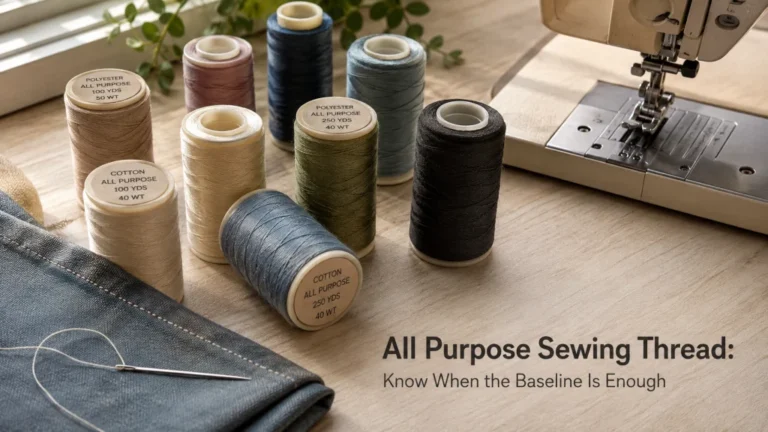
| Blend into an ordinary seam | Start with a general-purpose thread family whose fiber, construction, size, and color fit the project | General-purpose thread baseline |
| Choose between common fibers | Compare project requirements rather than matching fiber names by rule | Polyester and cotton thread comparison |
| Show as deliberate topstitching | Make visibility, size, finish, and machine suitability explicit | Choosing thread for topstitching |
| Create a metallic effect | Verify the composite construction, intended machine application, and handling requirements | Metallic thread for machine sewing |
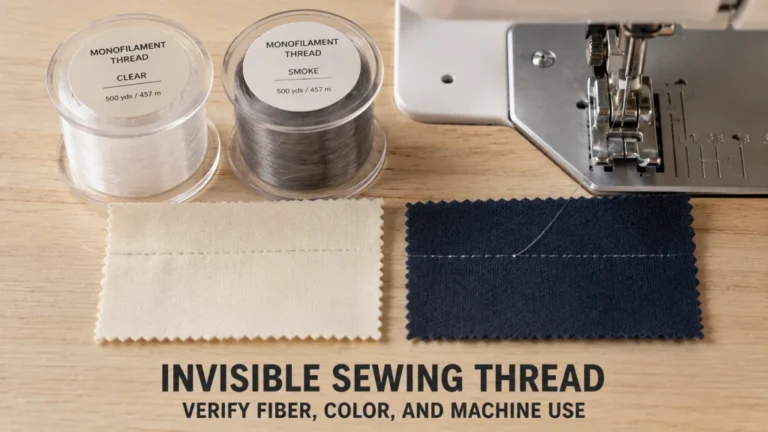
| Reduce visible thread presence | Check transparent or monofilament construction, size, color cast, and machine suitability | Invisible thread selection |
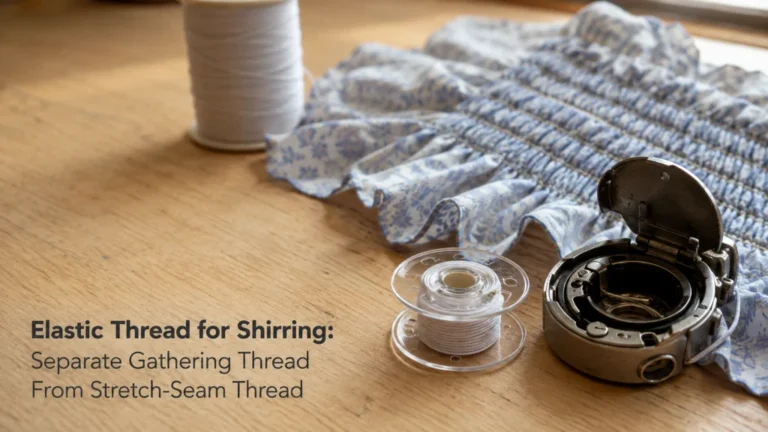
| Create elastic gathering | Use a thread family documented for elastic function rather than substituting a heavier ordinary thread | Elastic thread for shirring |
| Use a dedicated under-thread | Verify intended bobbin use, size, and exact machine setup separately | Understanding bobbin thread |
| Create temporary stitches that later vanish | Verify the exact dissolving material, intended temporary use, and removal condition | Water-soluble thread use cases |
AMANN, for example, documents a polyvinyl-alcohol sewing thread for temporary seams that dissolves in water. Coats documents metallic thread as a composite construction for decorative machine applications. Those are useful evidence anchors because they show why “specialty” is not one technical category: the function changes the material and construction requirements.

Gütermann Invisible Thread is a clear monofilament sewing thread supplied on a 274-yard spool. Its transparent appearance is intended for sewing where visible thread presence should be minimized, including applications such as quilting and hemming. It is a specialty choice for a visual requirement, rather than a general replacement for ordinary construction thread.
Check On AmazonIf you click this link and buy, we earn a commission at no additional cost to you.
Establish the domestic-machine boundary before heavy or coated thread
A domestic sewing machine has a finite thread path, tension system, needle system, stitch geometry, presser-foot clearance, and user-serviceable scope. A thread sold for upholstery, leather, industrial production, high-temperature textiles, bonded heavy sewing, or another specialist application should not be converted into a domestic recommendation simply because it fits through the needle eye. Manufacturer thread tables often pair heavier Tex sizes with much larger needle sizes, which is a warning to verify the machine boundary rather than improvise.
The exact machine manual controls what can reasonably be threaded and sewn at owner level. Check the documented needle system and size range, threading path, spool handling, stitch application, and any warnings before moving beyond ordinary consumer thread sizes or finishes. Do not force a thick, bonded, glazed, coated, or unfamiliar specialty thread through guides or tension assemblies that were not documented for it.
- The thread family is documented for ordinary sewing or a clearly defined consumer application.
- The exact thread size can be paired with a needle size the machine manual permits.
- The spool and thread can follow the documented path without bypassing guides or forcing the tension system.
- The stitch job remains within normal owner-level operation for the machine.
- The product is primarily documented for industrial, upholstery, leather, technical-textile, or other specialist equipment.
- The stated thread size implies a needle outside the domestic machine’s documented range.
- The finish or coating creates a handling requirement the manual does not address.
- The project requires a specialist serger, embroidery, longarm, or industrial thread path that materially changes the answer.
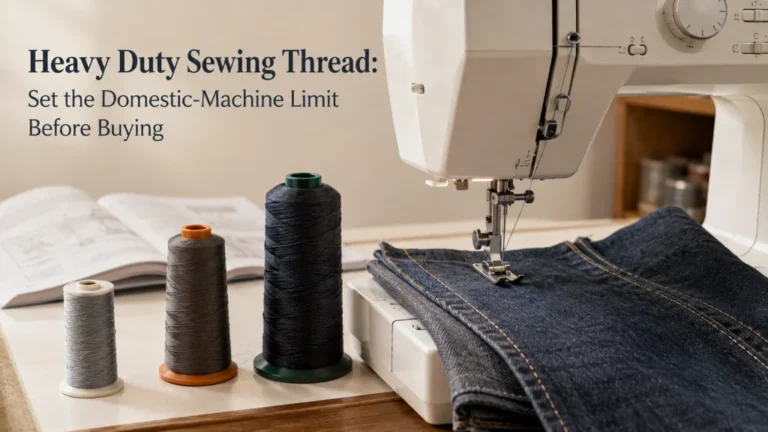
This boundary matters most with heavy-duty thread. Heavier is not a universal upgrade, and a high-strength product does not prove that a domestic machine can feed, tension, or form a reliable stitch with it. Use the heavy sewing thread suitability checks when size and machine limits become the central question.
See more thread-selection decisions
This page is the broad selection route. Once one variable becomes the deciding factor, use the narrower topic that owns that question rather than reopening a generic search for types of sewing thread.
| Topic | What you’ll find |
|---|---|
| All-purpose sewing thread | Build the general baseline for ordinary domestic construction sewing before considering a specialty family. |
| Polyester vs cotton thread | Compare the two common fiber choices without assuming the fabric fiber dictates the answer. |
| Understanding sewing thread weight | Read weight, Tex, ticket, denier, and other size labels without treating unlike systems as equivalent. |
| Choosing topstitching thread | Choose a deliberately visible thread by size, finish, contrast, and machine suitability. |
| Metallic sewing thread | Separate decorative metallic construction from ordinary thread and verify the machine-use boundary. |
| Choosing invisible sewing thread | Compare transparent thread construction, visual effect, size, and appropriate machine use. |
| Elastic thread for shirring | Identify when elastic function is actually required instead of substituting a general thread. |
| Bobbin thread for machines | Understand dedicated under-thread roles, size, and when ordinary top thread is not the same decision. |
| Hand-quilting thread machine suitability | Check whether a thread labeled for hand quilting belongs in a domestic machine path at all. |
| Heavy-duty sewing thread | Evaluate thread size, construction, intended application, and domestic-machine limits before use. |
| Matching thread color to fabric | Choose blend, contrast, or visible topstitch color after the correct thread family is established. |
| Estimating sewing thread quantity | Estimate spool quantity from project scope rather than buying by spool appearance alone. |
| Does sewing thread age? | Evaluate storage history and condition when an older spool is part of the project decision. |
| Water-soluble sewing thread | Use dissolving thread only where a temporary seam and removal method are actually intended. |
| Thread for machine quilting | Choose quilting thread by visible effect, size, construction, and domestic machine conditions. |
| Silk thread for machine sewing | Evaluate silk as a specific fiber choice rather than as a premium substitute for every seam. |
| Thread for stretch fabric | Focus on seam stretch requirements and the full machine, needle, thread, and fabric context. |
The broader machine-sewing supplies framework connects thread selection to the other consumables and project materials that must work with the machine. Keep the thread job fixed as you move into a narrower decision so one unresolved variable does not turn into a completely different shopping question.
Final Thoughts: choose the thread job before the spool
The useful order is simple: define the seam or visible-stitch job, identify fiber and construction, read the exact size system, decide what the thread should look or behave like, and confirm that the domestic machine is documented to handle the resulting choice. A label such as polyester, cotton, metallic, heavy, or all-purpose cannot answer all five questions by itself.
That is also why there is no universal best thread brand or one best thread for a sewing machine. The answer changes with the stitch job, thread construction, size system, fabric and layer conditions, needle already verified for the machine, desired appearance, and any specialty function. When one of those variables becomes the real question, follow that narrower decision instead of asking the spool label to do more work than it can.
Frequently Asked Questions
🧵 What are the main types of sewing thread?
There is no single complete list because thread can be classified by fiber, construction, size, finish, and application. Start by identifying the sewing job, then read all of those fields on the exact product label or manufacturer page.
🧶 Is polyester or cotton thread better for a sewing machine?
Neither fiber is universally better. The right choice depends on the seam, fabric, desired appearance, laundering or finishing conditions, thread construction and size, and the machine setup already verified for the project.
🔢 Is 40 wt thread the same as Tex 40?
No. Weight and Tex are different sizing systems, and their number direction is not the same. Keep the system name attached to the number and compare like systems before making any size judgment.
✨ When should I use specialty sewing thread?
Use a specialty family when the job requires its documented function, such as a metallic effect, temporary dissolution, elastic behavior, transparent appearance, or another specific application. Do not treat specialty as a synonym for better.
🪡 Can I use heavy thread in a domestic sewing machine?
Only when the exact thread size, required needle, thread path, and application remain within the machine manufacturer’s documented limits. If the thread is primarily intended for industrial, upholstery, leather, or technical applications, verify the system boundary before attempting to use it.
🎨 Should sewing thread match the fabric fiber?
Not as an absolute rule. Fiber matching can matter in some projects, but construction, size, seam function, appearance, processing, stretch, and machine conditions can matter just as much.
References and Sources
- Coats thread production guide: Supports the distinctions among raw materials, staple-spun, core-spun and continuous-filament constructions, plus Tex, Metric Ticket and cotton sizing systems.
- AMANN ticket-number guide: Supports the caution that ticket numbers are historical classifications and are not identical to actual thread linear density.
- AMANN general sewing thread data: Demonstrates how a manufacturer separately records raw material, construction, application, Ticket number, Tex number and needle information.
- AMANN water-soluble thread data: Supports the example of polyvinyl-alcohol thread designed for temporary seams that dissolve in water.
- Coats metallic thread data: Supports the example of metallic thread as a composite decorative machine-thread construction rather than an ordinary fiber label.