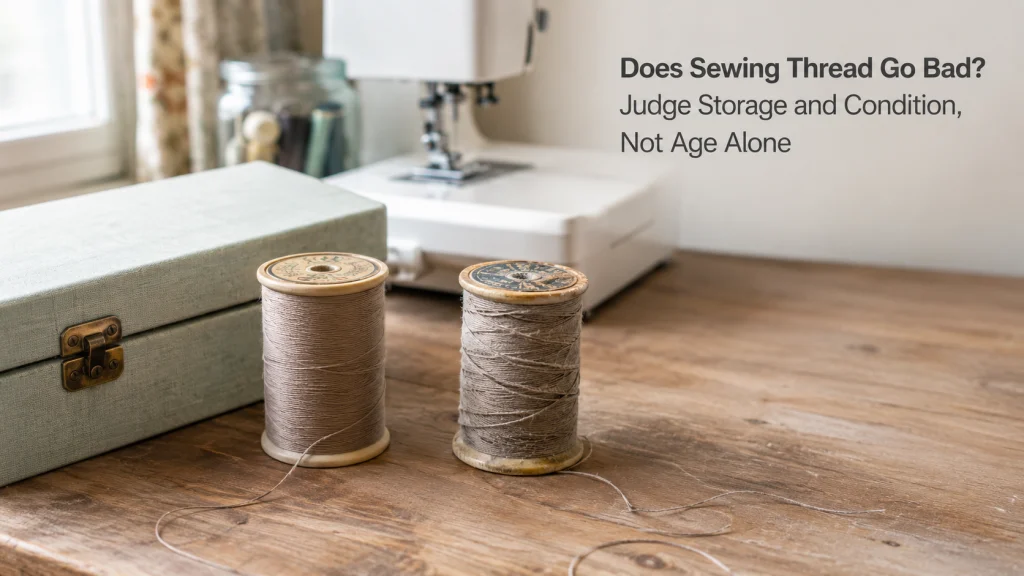
Old thread does not become unusable simply because the spool has been sitting for a long time. Storage history, fiber or product identity, exposure to light, heat, humidity, dirt, chemicals, and the thread’s present condition are more useful evidence than age alone. A spool with a known clean storage history deserves a different decision from an equally old spool found in a hot garage or damp basement. The practical goal is to identify what can be verified, inspect the thread and spool, and replace it when the condition or intended project makes uncertainty unacceptable.
Does Sewing Thread Go Bad? Age Is Not Storage History
Calendar age by itself is a weak verdict because two equally old spools may have lived in completely different conditions. One may have stayed clean, dry, dark, and protected in a closed drawer, while another may have spent years near sunlight, heat, moisture, dust, or fumes. Those storage differences can matter more than the number of years printed in someone else’s rule of thumb. Treat the age of a spool as a reason to investigate, not as proof that it has expired.
This distinction is especially important with inherited thread, estate-sale lots, and forgotten sewing-room storage. A label may be missing, the purchase history may be unknown, and there may be no reliable way to reconstruct how the spool was stored before it reached you. That uncertainty should stay visible in the decision instead of being replaced by an invented expiration rule. If the thread is going into an ordinary practice seam, the acceptable uncertainty can be much lower than it would be for a project where seam reliability has serious consequences.
Identify the Thread Fiber and Product Before Judging It
Start with the label, spool markings, packaging, and anything else that identifies what the thread actually is. Fiber content, thread construction, size, finish, and intended use can affect how useful a storage recommendation is, so a generic rule for every spool is too broad. AMANN explicitly notes that different raw materials and finishing processes prevent one universal statement about optimal storage for all sewing and embroidery threads. If the identification is uncertain, record that uncertainty rather than guessing from color, sheen, or the shape of the spool.
A clearly labeled household sewing thread can be evaluated more intelligently than an unmarked spool from a mixed box because you know what kind of supply you are dealing with. If the larger question is which thread families belong in machine sewing, compare common sewing thread types before deciding what an unidentified spool might replace. That comparison is about selecting the right thread category, while this article is about whether an existing spool still deserves use. Keeping those two decisions separate prevents an old spool from being judged only by whether its color happens to match the project.
Record Heat, Humidity, Sunlight, and Contamination Exposure
Storage history is the strongest clue you can gather before touching the thread. Manufacturer guidance consistently treats light, temperature, humidity, dirt, and contamination as conditions that can affect thread quality, so ask where the spool was kept and what it was exposed to. A closed sewing cabinet in a conditioned room is a different history from an attic, garage, damp basement, sunny windowsill, or open box near oils and household chemicals. When the history is unknown, mark it as unknown rather than assuming indoor storage was automatically gentle.
Coats advises protecting thread from soiling, light, heat, dampness, dryness, mildew, atmospheric pollution, and other contamination, while AMANN recommends cool, dry, dark storage protected from dirt, direct sunlight, high humidity, and chemicals. Those recommendations are written for thread care, not as a home method for calculating an expiration date. Their value is that they identify exposure categories worth checking when you inherit or rediscover old sewing thread. A spool with several adverse exposures deserves more skepticism than a spool with a clean, stable, well-documented history.
- Location: note whether the thread lived in a conditioned room, attic, basement, garage, storage unit, vehicle, or another environment with large changes in heat or moisture.
- Light: note direct sun, a bright windowsill, or long exposure under strong lighting.
- Moisture: look for evidence of damp storage, condensation, leaks, mildew, or damaged packaging.
- Contamination: note dust, smoke, oil, cleaning chemicals, fumes, food spills, pests, or other material that may have reached the spool.
- Protection: record whether the thread remained in closed packaging, a covered container, a drawer, or an exposed open rack.
A simple storage-history checklist is more useful than asking only how old the thread is. It also makes the decision repeatable when you are sorting a box of many spools instead of judging each one by intuition. Keep the checklist descriptive rather than assigning fake scores to exposures that manufacturers do not quantify for your exact product. The result should tell you what you know, what you do not know, and which spools deserve closer inspection.

This clear thread storage box holds up to 30 home sewing and embroidery thread spools on individual upright pins. The listing specifies space for spools up to 3 inches high and 1.9 inches wide. Its transparent acrylic construction makes colors visible from outside, while the lockable box keeps stored spools organized and protected from dust.
Check On AmazonIf you click this link and buy, we earn a commission at no additional cost to you.
Inspect Visible Condition and Spool Damage
Next, inspect the spool before putting the thread on a machine. Look for obvious contamination, mildew, water damage, discoloration that does not match the protected inner layers, damaged packaging, crushed or distorted winding, and thread that appears badly abraded or irregular. These observations do not tell you the exact remaining strength of the thread, but they can identify reasons not to trust it. A visibly compromised spool should not be rescued merely because the thread still feels strong when pulled by hand.
A hand-pull or “snap” test is often treated as a shortcut for old thread, but it is not a universal quality standard. Hand force is uncontrolled, different thread constructions behave differently, and passing one pull does not certify the whole spool or predict performance in every seam. At most, handling can reveal an obvious problem such as thread that separates, breaks with unusually little force, or shows inconsistent condition along the exposed length. Use that observation as one piece of evidence, not as permission to ignore poor storage history or visible damage.
| What you find | What it means for the decision |
|---|---|
| Clean spool, intact winding, known protected storage | Age alone is not a reason to discard it; proceed to a low-risk sample if the project allows. |
| Unknown history but no obvious damage | Keep the uncertainty visible and test only where failure would have low consequences. |
| Mildew, moisture damage, oil, chemical contamination, or severe soiling | Replace the thread rather than trying to prove it usable at home. |
| Repeated weak spots, separation, severe fuzzing, or damaged winding | Treat the poor condition as a replacement signal even if some sections appear usable. |
| Unmarked spool with uncertain fiber and purpose | Do not assume suitability for a demanding seam simply because the thread looks familiar. |
Pay attention to whether the problem is isolated to damaged outer wraps or appears repeatedly as you unwind a small amount. One nicked section caused by poor handling is different from widespread deterioration, although neither should be hidden from the decision. Do not unwind large amounts simply to chase a “good” section on a spool that is contaminated or broadly damaged. Replacement thread is usually cheaper than building an important project around material you already distrust.

The Carson MiniBrite PO-55 is a compact handheld magnifier with 5X magnification and a built-in LED light. Its 1.5-inch square acrylic lens is designed to provide a clear enlarged view with reduced distortion. The protective sliding case activates the LED when opened and covers the lens when the magnifier is stored.
Check On AmazonIf you click this link and buy, we earn a commission at no additional cost to you.
Use Manufacturer Storage Guidance Instead of a Fixed Age Cutoff
The useful answer to “does thread expire” is not a universal number of years. AMANN says normal storage conditions have no known adverse effect on the quality of its sewing and embroidery threads, while also warning against extreme temperature, humidity, sunlight, dirt, and chemical exposure. Coats likewise describes incorrect storage as a performance risk and gives controlled storage recommendations for temperature, humidity, cleanliness, and light. Neither source supports turning one calendar age into a pass-or-fail rule for every household spool.
This is why sewing thread shelf life should be treated as product- and condition-dependent rather than a countdown printed by a blog. A manufacturer’s storage guidance can tell you which environmental factors matter, but it still cannot reconstruct an unknown attic, garage, or estate-sale history. It also cannot certify a spool whose label is missing or whose condition has visibly changed. Use the documentation to improve the evidence hierarchy, not to manufacture certainty that the documentation does not provide.
Note: AMANN recommends cool, dry, dark storage and protection from dirt, direct sunlight, high humidity, and chemicals. Coats identifies light, temperature, humidity, contamination, mildew, and storage damage as relevant factors and provides controlled ambient ranges for warehouse storage. Both sources treat storage environment as part of thread care. These are useful storage benchmarks, but they are not universal household expiration dates.
The numeric ranges in industrial storage guidance should also be read in context. A home sewist usually does not have a monitored thread warehouse, and an old spool rarely comes with a complete environmental record. The practical lesson is to avoid prolonged extremes and protect thread from light, moisture, dirt, and chemical exposure rather than trying to recreate industrial inventory control at home. For broader decisions about needles, bobbins, stabilizers, and other consumables, review machine-sewing supplies and consumables separately so thread condition does not become a substitute for checking the rest of the setup.
After sorting old thread, keep the spools you trust separate from those that still have unresolved history or condition questions. Preserve labels where possible, and add a simple note to an unidentified spool instead of guessing its fiber or size. A questionable spool should not drift back into the everyday thread drawer where its uncertainty will be forgotten. This small organization step turns the inspection into a repeatable storage habit rather than a one-time decision.
Decide Whether to Test, Replace, or Discard the Thread
Once identity, storage history, and visible condition are recorded, make the decision around the project rather than the age of the spool. Clean thread with a known protected history may be reasonable to try on a scrap or another low-consequence sewing task if its fiber, size, and intended use fit the machine and material. Unknown thread can still be treated cautiously, but uncertainty should lower the stakes of the first use. Thread with visible mildew, chemical or oil contamination, serious moisture damage, repeated weak sections, or broad physical deterioration is a replacement case rather than a challenge to prove it can still sew.
The project matters because the cost of a thread failure is not the same everywhere. A short practice seam or temporary fitting sample gives you room to observe basic handling without pretending the test predicts long-term durability. A finished garment seam, quilt, bag, or other project with substantial labor invested deserves a higher confidence threshold. Protective, load-bearing, or safety-critical uses should not be approved from a household inspection or casual home test.
The spool is old, so discard it automatically, or the spool is not very old, so assume it is fine.
Identify the thread, record storage exposure, inspect the spool, consider the consequences of failure, and replace it when evidence is poor or the project demands higher confidence.
If you decide to replace an uncertain spool, do not use age as the only shopping criterion for the replacement either. Match the new thread to the fabric, seam purpose, machine, needle, and project requirements first. For ordinary household sewing where a general baseline is appropriate, choose an all-purpose sewing thread by fiber, size, construction, and intended use rather than by a vague promise that one spool suits every job. That keeps the replacement decision tied to the sewing system instead of turning “new” into the only specification that matters.

This Coats & Clark Dual Duty set includes one black and one white spool with 400 yards of thread on each spool. The thread is 100% polyester with a polyester-covered polyester core construction. Amazon lists it for both hand and machine sewing across fabric types.
Check On AmazonIf you click this link and buy, we earn a commission at no additional cost to you.
Final Thoughts: Age Is a Clue, Not a Verdict
Old thread deserves inspection, not an automatic sentence based on the calendar. Identify what the spool is, reconstruct its storage history as far as possible, and look for contamination, moisture damage, degraded winding, or other visible reasons to distrust it. Manufacturer storage guidance gives you the environmental factors that matter, while the condition of the actual spool tells you whether those risks may have become relevant. If important information is missing, keep the uncertainty instead of filling it with a made-up expiration age.
The final decision should also reflect what you are sewing. A clean, well-stored spool may justify a cautious low-risk sample, while a compromised or unknown spool may not be worth using in a project with substantial time, cost, or consequence attached to the seam. Home inspection cannot certify thread for protective or load-bearing use, and a casual pull test cannot establish universal remaining strength. When the evidence is poor, replacement is the simpler decision and the new thread should still be matched to the machine, needle, fabric, and seam purpose.
FAQs
Questions about old thread usually sound simple because the spool is already in your hand and the age is the most obvious unknown. The better answer usually depends on storage, identification, visible condition, and the consequences of a weak seam. That is why a fixed expiration rule is less useful than a short evidence check. The answers below keep those boundaries clear without turning a home inspection into a laboratory test.
These answers also stay focused on thread condition rather than machine troubleshooting. If a machine is already skipping stitches, shredding thread, or breaking thread repeatedly, that symptom may involve the needle, threading path, tension, burrs, fabric, or another setup issue. Replacing questionable thread can remove one variable, but it does not diagnose the machine. Use the FAQ to decide what the spool itself can reasonably tell you.
🧵 Does old sewing thread automatically need to be thrown away?
No. Age alone is not enough to judge the spool. Check identification, storage history, contamination, moisture exposure, visible damage, and the importance of the project. Replace it when the evidence is poor or the condition is clearly compromised.
📦 How should sewing thread be stored?
Keep it clean and dry. Protect it from direct sunlight, large heat or humidity extremes, and chemical contamination. Closed packaging, drawers, or covered containers can reduce dust and handling damage. Keep labels with the spool when possible so fiber, size, and intended use remain identifiable.
💧 Should I use thread that was stored in a damp basement?
Treat prolonged damp storage as a meaningful warning. Look for mildew, staining, damaged packaging, odor, or other evidence of moisture exposure. Unknown exposure adds uncertainty even when the outer wraps look acceptable. When both history and condition are doubtful, replacement is more defensible than trying to prove the spool usable.
🪡 Is a snap test enough to tell whether old thread is good?
No. A hand-pull test is uncontrolled and cannot certify the remaining strength or sewing performance of the entire spool. It may reveal an obvious weak section. It should not override poor storage history or visible deterioration.
☀️ Can sunlight damage stored sewing thread?
Yes. Manufacturer storage guidance specifically warns against direct sunlight and excessive light exposure. A spool kept near a sunny window deserves closer scrutiny than one protected in a dark container or drawer. Check the exposed thread and packaging for visible changes before deciding whether to use it.
🧶 Should I keep an inherited spool if the label is missing?
You can keep it, but the missing label limits what you can verify. Fiber, size, construction, intended use, and storage history may all be uncertain. Do not identify the thread from color or sheen alone. Avoid treating visual similarity as proof that it matches a demanding project or a specific thread requirement.
References and Sources
This article uses manufacturer storage documentation because the central question depends on whether storage conditions, rather than calendar age alone, affect thread quality. AMANN directly explains why one universal storage statement does not fit every sewing and embroidery thread and identifies the environmental conditions it recommends avoiding. Coats provides a separate technical storage reference covering light, heat, humidity, contamination, mildew, and physical storage problems. Those sources support the condition-led framework used above without creating a universal expiration claim they do not make.
Community discussions were useful for understanding why sewists ask about inherited and estate-sale thread, but they are not used here as technical proof. Informal snap tests, personal success with vintage thread, and individual breakage stories cannot establish a universal shelf life or pass standard. The published claims therefore stay tied to the manufacturer guidance below and to direct observations a reader can make about storage and visible condition. Neither source is used to certify an unknown spool for safety-critical, protective, or load-bearing sewing.
- AMANN thread storage guidance: Explains why storage recommendations vary with thread materials and processing, and recommends protection from heat, humidity, sunlight, dirt, and chemicals.
- Coats thread storage guidance: Documents storage risks involving light, temperature, humidity, contamination, mildew, damaged packaging, and prolonged adverse conditions.