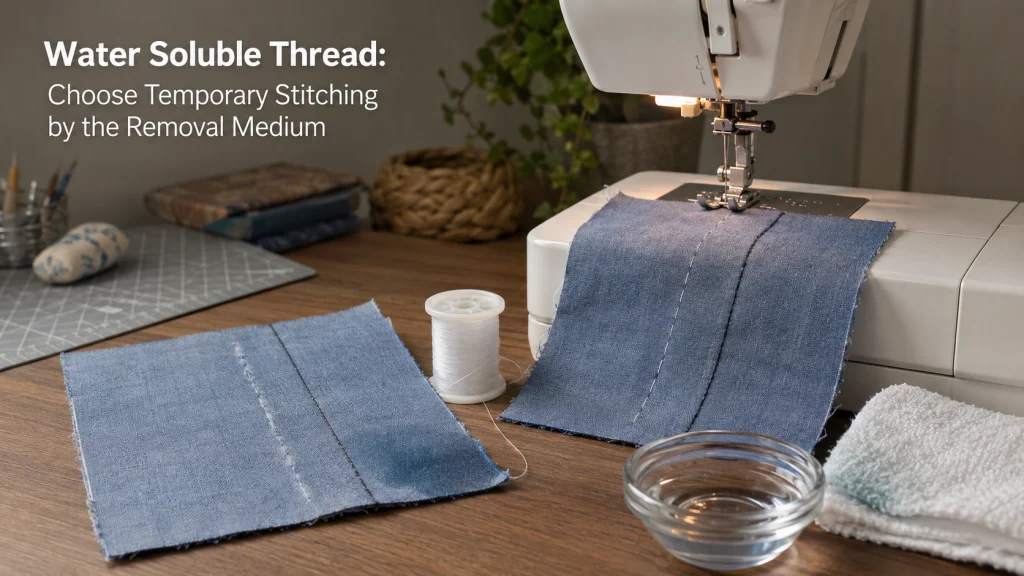
Water soluble thread is useful when a machine-sewn stitch is meant to hold something temporarily and the finished project can tolerate the method used to remove that thread. The key buying question is not simply whether the spool says water-soluble, because composition labels, removal instructions, handling cautions, and storage requirements can differ by product. Choose the temporary thread only after confirming the fabric, batting, interfacing, trim, and other project materials can safely tolerate the required water or steam exposure. If the stitch must remain structural after washing or finishing, use permanent construction thread instead.
Disappearing Thread Still Has Product-Specific Rules
A water soluble thread can make temporary machine stitching easier to remove, but the word soluble does not create one universal removal rule. Current manufacturer documentation shows why: one technical page identifies a polyvinyl alcohol thread for temporary seams, while another home-use thread page lists a different composition label and gives more detailed cautions about water, steam, testing, and storage. Those differences matter before the thread ever reaches the machine because the project must survive the removal method after the temporary stitch has done its job. Treat the exact spool instructions as part of the sewing setup, not as packaging text that can be generalized from another dissolvable sewing thread.
This article stays with machine-sewn temporary stitching and the consumable itself. It does not cover water-soluble stabilizer, independent hand-sewing technique, or the detailed construction method for basting, appliqué, trapunto, quilting, or another project. If you are still deciding which thread family fits a machine-sewing task, the sewing thread type comparison gives the broader route before a specialty thread is chosen. The important boundary here is simple: first decide whether the stitches are supposed to disappear, then verify how the exact thread is meant to disappear.
Confirm the Stitch Is Temporary
Water-soluble sewing thread belongs in a temporary role, not in a seam that must keep carrying load after the project is washed or otherwise exposed to the removal medium. Manufacturer examples include temporary positioning and tacking tasks, which is a very different job from permanent assembly. A temporary line can hold layers, a pocket position, a fold, or another construction detail long enough for the permanent sewing to be completed. Once that temporary function is over, the project should remain secure because the permanent stitching or finished construction is already doing the real work.
The first-time mistake to avoid is choosing a disappearing thread because removal sounds convenient without identifying which stitches can safely disappear. If a seam joins the project permanently, secures a load-bearing area, or is the only stitching holding a component in place, disappearance is a failure rather than a feature. Mark the temporary lines on the project plan before threading the machine so the soluble spool cannot be confused with the permanent construction spool. That distinction is especially useful when both threads look similar at the machine and only one is supposed to survive laundering or finishing.
| Stitch role | Thread direction | What must be true |
|---|---|---|
| Temporary positioning or tacking | Water-soluble thread may fit | The project can tolerate the documented removal method |
| Permanent construction | Use permanent sewing thread | The thread must remain intact through normal project use and care |
| Unclear stitch purpose | Do not choose yet | Identify what will hold the project after temporary stitches disappear |
Use the router before comparing any other thread detail. A specialty thread is only useful when its disappearing behavior solves a defined temporary-stitch problem. If permanent construction is actually the need, the all-purpose sewing thread selection is a better starting point for ordinary machine seams. That choice prevents a convenient removal feature from being used where durability is the real requirement.

This two-pack includes one black and one white spool of 100% polyester all-purpose thread. Each spool contains 400 yards, and the listing describes the thread for both hand and machine sewing across fabric types. Its construction uses a polyester-covered polyester core.
Check On AmazonIf you click this link and buy, we earn a commission at no additional cost to you.
Read the Exact Thread Composition and Intended Use
Do not assume every wash-away thread uses the same composition language or has identical handling behavior. Current manufacturer documentation identifies one water-soluble sewing thread as polyvinyl alcohol, while another home-use product is labeled 100% Vinylon and is presented for tacking applications. The useful lesson is not to turn those labels into a chemistry shortcut, but to read the documentation that belongs to the thread in your hand. If a spool does not clearly identify its material, intended use, or removal instructions, that missing information should remain a buying uncertainty.
Intended-use wording also helps separate temporary stitching from permanent thread selection. A manufacturer may describe positioning, tacking, basting, or temporary fixing, which tells you the thread is designed to disappear after it has served a short-term purpose. That does not prove compatibility with every fabric, machine setting, needle, bobbin arrangement, or finishing process. Read the machine manual for machine-specific setup, and read the thread documentation for what the consumable itself is designed to do.
Verify the Fabric and Project Can Tolerate Water or Steam Exposure
The removal medium belongs in the buying decision before the spool does. Manufacturer guidance for a home-use soluble thread specifically warns that the material should not be used on fabrics affected by water or steam and recommends testing on a fabric remnant before relying on the process. That is a practical boundary because the temporary stitch can dissolve exactly as intended while the project itself changes shape, finish, color behavior, texture, or structure. A successful thread-removal step is not a successful project outcome if another material in the assembly cannot tolerate the exposure.
Check the whole stack rather than the face fabric alone. Batting, interfacing, trim, labels, coatings, adhesives, decorative layers, and prefinished components may have care limits that differ from the main fabric. If any essential material cannot safely tolerate the documented removal method, choose a different temporary-stitch approach instead of trying to protect only part of the project. When care information is uncertain, a controlled scrap test using the same material stack is more useful than assuming that a small amount of water or steam will be harmless.
- Confirm the face fabric can tolerate the required exposure.
- Check batting, interfacing, coatings, trim, and adhesives separately.
- Use a representative scrap stack when the manufacturer recommends testing.
- Verify that color, texture, shape, and bonded layers remain acceptable after removal.
- Reject the soluble-thread route if the project cannot safely tolerate the required medium.
This check is where a specialty consumable becomes a project decision rather than a convenience purchase. The thread may be fully suitable for temporary stitching and still be the wrong choice for a water-sensitive assembly. If you need a broader way to evaluate consumables, compatibility, and other machine-sewing materials together, the sewing supplies selection framework keeps the project requirements in view. The safest choice is the one whose removal method fits every material that must remain in the finished work.
Read the Exact Dissolution Conditions
Do not borrow a dissolve temperature, exposure method, or residue claim from a different spool. One current home-use manufacturer page gives specific water-temperature guidance and states that dissolution time changes with conditions of use, while another manufacturer page simply describes its thread as water-soluble and residue-free without publishing the same temperature instructions on that product page. That difference is enough to show why one product’s removal conditions should not become a rule for the entire category. Use the instructions supplied for the exact thread you buy, especially when the project itself has a narrow care range.
Think of dissolution information as a small evidence ledger. Record what the manufacturer says about the removal medium, any temperature guidance, whether testing is recommended, and any statement about residue or incomplete removal. If a detail is absent, leave it unknown rather than filling the gap from a similar-looking spool. This is particularly important when the project cannot tolerate aggressive washing, prolonged soaking, or steam and the thread instructions do not clearly support a gentler alternative.
A scrap test is useful only if the test piece represents the real project closely enough to expose the same risks. After applying the documented removal method, check whether the fabric changed color, shrank, puckered, stiffened, lost surface finish, or developed a visible tide mark, and inspect bonded or layered areas for lifting or distortion. Also look at the former stitch line for any tacky feel, visible residue, or change in hand that would be unacceptable on the finished work. If the temporary thread disappears but the material stack does not return to an acceptable condition, the removal method has failed the project even though it dissolved the thread.
| Removal detail | What to record | What not to assume |
|---|---|---|
| Removal medium | Water, steam exposure, or another method stated by the exact manufacturer | That every soluble thread uses the same method |
| Temperature | Only the range or guidance stated for the exact product | A temperature copied from another spool |
| Dissolution time | Any stated dependency on use conditions | A universal time limit |
| Residue | Only a product-specific manufacturer statement | That all formulas leave the same result |
The ledger keeps the removal step reproducible without turning it into a false category-wide specification. It also helps when comparing two otherwise suitable temporary threads because the project may tolerate one documented removal process but not another. A dissolvable sewing thread with unclear instructions is not automatically a bargain if uncertainty moves into the finishing stage. Clear removal documentation and an acceptable scrap-test result are both part of the consumable’s usefulness.

SmartSolve Water-Soluble Thread comes on a 200-meter white spool for sewing, basting, hand quilting, appliqué, and other temporary stitching uses. Amazon states that the thread disperses completely in 30 seconds or less when exposed to water and agitation. The listing also describes it as readily biodegradable and designed to eliminate the need to manually remove temporary stitches.
Check On AmazonIf you click this link and buy, we earn a commission at no additional cost to you.
Read the Dry-Storage Requirements
A thread designed to react to water also deserves more storage attention than an ordinary spool left open near a work area. Current home-use manufacturer instructions tell the user to keep hands dry during use and to store remaining thread in a sealed bag with a desiccant. That is product-specific guidance, but it illustrates the larger rule: do not assume a soluble thread can be stored exactly like every permanent sewing thread. Moisture exposure before sewing can undermine the reason you bought a predictable temporary-stitch material in the first place.
Read the package and technical page before deciding where the spool will live between projects. Keep the thread away from the water, steam, high humidity, and other conditions the exact manufacturer warns against, and retain any protective packaging that is part of the storage instruction. Label the spool clearly if its appearance could be confused with permanent thread, because accidental use in a permanent seam creates a different kind of failure. Good storage is not about making the consumable precious; it is about preserving the documented behavior until you actually need it.

This Dry & Dry pack contains 200 individual 1-gram silica gel desiccant packets in paper packaging. The listing describes the packets for moisture protection and says the packet material is designed for moisture absorption. The packets are rechargeable, and the listing provides a microwave reactivation method for reuse.
Check On AmazonIf you click this link and buy, we earn a commission at no additional cost to you.
Separate Soluble Thread From Soluble Stabilizer
Water-soluble thread and water-soluble stabilizer can appear in the same project, but they solve different problems and should not be treated as interchangeable supplies. The thread passes through the sewing machine’s thread path and creates temporary stitches, while stabilizer is a separate support material used around or beneath fabric for particular machine-sewing processes. Buying one does not substitute for the function of the other, even when both are designed to disappear with water. Keep the decision tied to what needs to vanish: a temporary line of stitching or a temporary support layer.
This distinction also prevents the article from drifting into embroidery-support or stabilizer-selection advice that belongs elsewhere. If your problem is that the stitched line should disappear after permanent construction is complete, the consumable under discussion is the thread. If your problem is that fabric needs temporary structural support during stitching, you are making a stabilizer decision instead. Naming the disappearing component first is usually enough to route the purchase correctly.
Final Thoughts: Choose the Removal Method Before the Temporary Thread
Water-soluble thread is a narrow specialty consumable with a clear job: create machine-sewn stitches that are meant to disappear after they have served a temporary purpose. Before buying, confirm that the stitches are truly temporary, read the exact composition and intended-use information, and verify that the complete project can tolerate the documented removal method. Then compare dissolution instructions, storage requirements, and any scrap-test result that matters to the finished material. That sequence turns a vague search for disappearing thread into a controlled material decision.
If the project needs permanent construction thread, return to ordinary thread selection rather than trying to make a soluble product do both jobs. If temporary stitches are appropriate, compare only options whose documentation explains enough about removal and handling to match your project safely. Keep unknown conditions visible, especially when water or steam exposure could affect the fabric stack. The right choice is the temporary thread whose removal method fits the finished project, not simply the spool with the most convenient disappearing claim.
FAQs
💧 What is water-soluble sewing thread used for?
It is used for temporary machine stitching such as positioning or tacking when those stitches are meant to disappear later. The exact use still depends on the thread manufacturer’s instructions and the project’s ability to tolerate the removal method.
🧵 Can I use wash-away thread for a permanent seam?
No. If the seam must remain intact after normal washing or finishing, use a permanent construction thread that is appropriate for the machine, fabric, and project.
🌡️ Does every water-soluble thread dissolve at the same temperature?
No. Manufacturer documentation does not publish one universal dissolution condition across all products, so use the instructions for the exact thread in hand.
🧺 Can I use soluble thread on fabric that cannot be washed?
Only if the exact thread has a documented removal method that the complete project can safely tolerate. If water or steam can damage any essential material in the stack, choose another temporary-stitch approach.
📦 How should I store water-soluble thread?
Follow the exact product instructions and keep the thread protected from the moisture conditions the manufacturer warns against. Some manufacturer guidance specifically calls for dry handling and sealed storage with a desiccant.
References and Sources
- AMANN Waterfil technical page: Verifies polyvinyl alcohol composition, temporary-seam use, and the manufacturer’s water-soluble and residue statement.
- Fujix water-soluble thread instructions: Verifies composition labeling, temporary-use examples, water and steam cautions, scrap-testing advice, dissolution guidance, and dry-storage instructions.