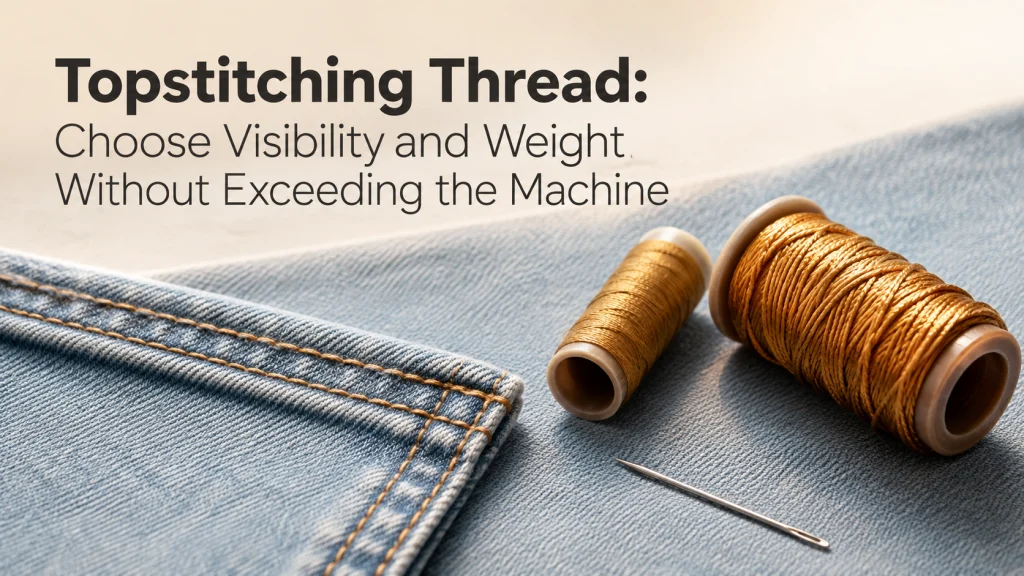
Topstitching thread is chosen first for how visible the finished stitch should look, then for fiber, size, finish, and whether the sewing machine supports that thread class. A thicker spool is not automatically a better topstitching choice, and a heavy-duty or bonded thread may cross into a different machine requirement entirely. Product labels and model support information matter more than broad words such as “jeans,” “strong,” or “heavy.” The goal is to choose enough visual presence for the project without exceeding the thread path the machine is designed to use.
Visible stitches do not require the heaviest thread
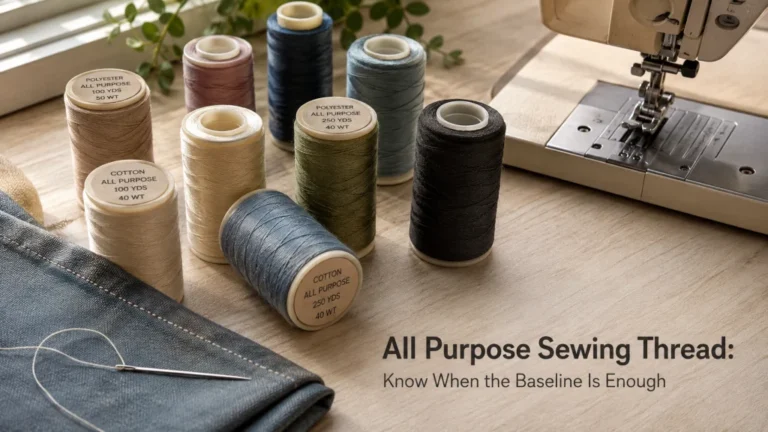
A standard all-purpose spool, a dedicated topstitching thread, and a much heavier bonded thread can all look like possible answers when you want a stitch line to stand out. The useful topstitching thread decision is not “Which one is strongest?” It is “How visible should this stitch be, and does the machine maker support this thread class for my model?” Those are different questions, and separating them prevents a visual choice from turning into an unnecessary machine-capability problem.
That distinction matters on ordinary domestic projects such as a contrasting line around a pocket, a waistband, a bag edge, or denim-style detailing. A moderately heavier thread can create a much more visible line than all-purpose thread without moving to the thickest thread on the shelf. If the project truly starts from load, abrasion, outdoor exposure, or a requirement for industrial-size thread, the decision has moved away from appearance-led topstitching and toward evaluating heavy-duty sewing thread.
Key point: Start with the appearance you want. Maximum thread size is not the goal unless the project has a separate structural requirement that calls for it.
That gives you a practical first filter before you compare labels. Once the visual target is clear, the next job is to decide how much thread presence is actually needed to create it.
Define the desired visual prominence
Topstitching can be quiet, obvious, or deliberately bold. Color contrast changes visibility, but so do thread diameter, surface finish, and how much the thread sits above the fabric. A dark thread on dark denim can still show because of its size and sheen, while a contrasting color may create a strong visual line even when the thread itself is not exceptionally thick.
Before shopping, describe the result in plain language. Do you want a subtle construction line that is visible only up close, a clearly defined garment-style topstitch, or a bold line that becomes a design feature? That description is more useful than starting with a product category and assuming it must be correct for every fabric and machine.
| Visual target | Selection direction | What to verify next |
|---|---|---|
| Subtle | All-purpose thread or a relatively fine decorative option may already give enough definition. | Color contrast and finish before increasing size. |
| Clearly visible | A dedicated domestic topstitching product may provide more presence without jumping to industrial-size thread. | Fiber, size system, intended use, and model support. |
| Bold | A heavier domestic-compatible thread may be appropriate if the machine documentation supports it. | The model’s thread limits before purchase or use. |
| Maximum thickness | Stop treating the decision as appearance alone. | Whether the project belongs in a heavy-duty or industrial thread path instead. |
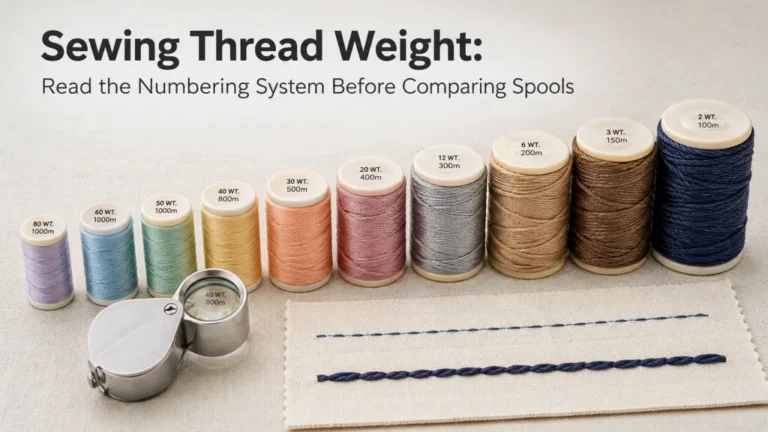
The ladder is intentionally not tied to one universal number. Thread-size systems use different scales and naming conventions. Coats Count currently converts among metric count, metric ticket, cotton count, cotton ticket, denier, decitex, and Tex, which is a practical reminder that a bare number is incomplete without the system behind it. If the label language itself is the confusing part, read sewing thread weight labels before deciding that one spool is meaningfully heavier than another.
This also explains why jeans-style topstitching does not automatically mean “buy the thickest jeans thread.” A jeans topstitching thread can be an appearance-led product, while a much heavier bonded thread may be intended for a very different machine, material, or end use. The visible stitch is the starting requirement, not permission to ignore the machine.

Coats & Clark Extra Strong Thread for Jeans is a cotton-covered polyester thread made for seams and hems on jeans and overalls. The Golden version contains 70 yards and is intended to create the familiar visible stitching associated with ready-to-wear denim. It is a relevant option when the project calls for an intentionally noticeable jeans-style stitch line.
Check On AmazonIf you click this link and buy, we earn a commission at no additional cost to you.
Read fiber, size, and finish on the exact product
Words such as “topstitch,” “jeans,” and “extra strong” are useful category clues, but they are not enough to establish what a spool actually is. Read the fiber content, the manufacturer’s size designation, the intended applications, and any description of finish or construction. Some listings shorten the category to topstitch thread, but that wording still does not tell you how thick the thread is or whether a particular domestic machine supports it.
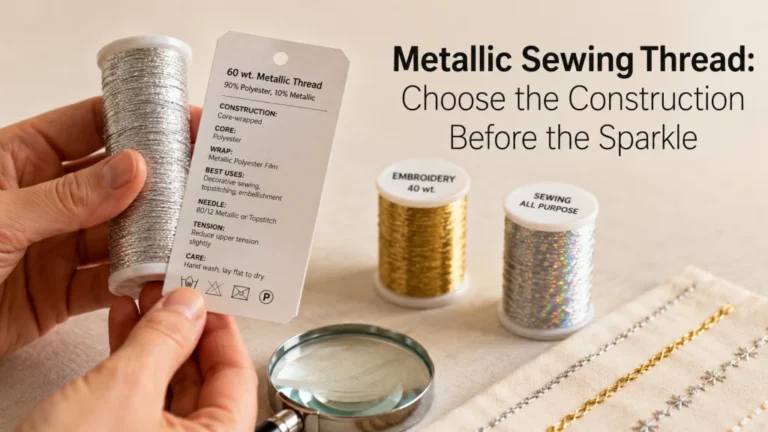
Fiber affects more than strength. Polyester can provide a different surface appearance from cotton or cotton-wrapped constructions, while specialty finishes can change sheen and visual definition. If your goal is primarily reflective or decorative shine rather than a heavier stitch line, it is worth separating that question from size and comparing metallic sewing thread characteristics instead of increasing thickness just to create more visual impact.
Note: Gütermann currently lists its Top Stitch product as 100% polyester, size No. 30, and intended for decorative stitches plus closing and topstitch seams. That is one documented product specification, not a universal size definition for every thread sold for topstitching.
A first-time buyer can easily miss this because product names sound more standardized than they are. Seeing “No. 30” on one spool and “Tex 30” on another does not make them equivalent. First identify the sizing system, then compare like with like instead of ranking raw numbers across systems.
For a quick product check, look for the following before placing the spool in your shortlist:
- fiber content, such as polyester or cotton-based construction;
- the size notation and the system used to express it;
- the manufacturer’s stated applications, especially whether topstitching is actually listed;
- surface description, including matte, glossy, or other decorative finish where documented;
- whether the product is presented for domestic sewing, industrial sewing, hand use, or another system;
- any machine or needle limitations stated by the thread manufacturer;
- the spool or cone format, plus any stand or holder requirement stated for the machine.
| Label system or notation | What the number tells you | Buying rule |
|---|---|---|
| Tex | A defined thread-sizing system. | Compare Tex with Tex, or use a technical conversion reference. |
| Denier or decitex | Separate sizing systems that use their own scales. | Do not compare the raw number directly with Tex. |
| Metric or cotton count and ticket systems | Several count and ticket conventions exist. | Identify the exact system before comparing two labels. |
| No., weight, or other product notation | The number is incomplete without the maker’s definition. | Use the manufacturer’s sizing information for that product line. |
| Ply or construction description | It describes construction rather than supplying a universal size equivalent. | Keep construction and size as separate label checks. |
That list and size-system check keep the buying decision grounded in what the spool actually is. The next boundary is even more important: a thread can be excellent for its intended job and still be the wrong class of thread for the machine on your table.

Gütermann Top Stitch is a 100 percent polyester three-ply thread with a No. 30 size designation. Gütermann lists it for decorative stitches and closing and topstitch seams, making it a dedicated option for visible stitching. The product also shows why fiber, size notation, construction, and intended use should be read together instead of choosing from the word heavy alone.
Check On AmazonIf you click this link and buy, we earn a commission at no additional cost to you.
Separate dedicated topstitch thread from heavy-duty thread
Dedicated topstitching thread starts with visible stitch appearance. Heavy-duty thread starts with a different question, usually related to material, seam demand, abrasion, outdoor use, or a specified thread class. The two can overlap in thickness or end use, but they are not interchangeable labels, and the heaviest option is not automatically the correct upgrade for a domestic machine.
This is where bonded thread causes particular confusion. Bonded nylon or bonded polyester can be sold in sizes that some domestic machines may accept and in larger sizes that belong on industrial equipment. The word “bonded” therefore does not prove compatibility, and the word “heavy duty” on a sewing machine does not create an unlimited thread path.
Start with how visible the stitch should be, then choose a documented domestic thread size and finish that produces that effect.
Start with the material and end-use demand, then verify whether the required thread class belongs on the exact machine system.
That separation prevents a common shopping mistake: choosing an oversized spool because the finished line looks impressive in a photo, then discovering that the domestic machine was never documented for that thread class. It also prevents the opposite mistake, assuming ordinary topstitching always requires specialty heavy-duty thread when contrast color or a moderate increase in thread size would have delivered the intended look.
Warning: Do not force oversized, waxed, coated, or otherwise unsupported thread through a domestic machine just because the spool physically fits on a stand or pin. Follow the manual or current model support information for acceptable thread types and limits.
If the project is still appearance-led after that check, stay in the topstitching path. If the required thread size is driven by load or an end-use specification, move to the heavier-thread decision before buying anything.
Check the machine’s documented thread limits
A spool can be marketed for home sewing and still need verification against the machine on your table. Thread must travel through the spool handling, guides, tension system, take-up path, needle area, and stitch-forming system. When a thread is too large or has an unsuitable coating, the problem is not solved by assuming a machine described as “heavy duty” will accept it.
SINGER’s current Heavy Duty 6800C troubleshooting documentation provides a useful bounded example. On that model’s support page, SINGER lists topstitching thread and jeans topstitching thread among acceptable thread types, and it gives a maximum of #69/Tex 70 for bonded nylon or bonded polyester. The same page says threads larger than #69/Tex 70 and waxed or coated threads are not recommended for that machine. Those numbers belong to that documented SINGER context; they are not a universal domestic-machine limit.
| What you know | What it proves | What it does not prove |
|---|---|---|
| The spool says “topstitching thread.” | The product is marketed for visible topstitch use. | That every domestic machine accepts its exact size. |
| The machine says “heavy duty.” | A manufacturer has chosen that product positioning. | An unlimited thread-size or coating range. |
| An exact manual or support page lists the thread type or size. | That documented model has manufacturer support for the stated range or application. | That another model from the same brand has the same limit. |
Spool format is a separate compatibility check, not proof that the thread itself is suitable. SINGER’s Heavy Duty 6800C support page, for example, recommends an external thread stand when larger cone-style threads are used. That instruction tells an owner how to support the package on that model; it does not turn every thread sold on a cone into a domestic-machine thread.
The model-specific check is the hard exit point in this article. If the thread maker’s label and the model support information line up, you have evidence that the combination belongs in the domestic sewing conversation. If the manual and current support material are silent, do not turn absence of a warning into proof of compatibility.
For the broader context around general-purpose, decorative, specialty, and task-specific spools, compare common sewing thread types. If you are stepping back to organize thread alongside needles, bobbins, stabilizers, and other consumables, understand sewing supplies by function before buying around one isolated label.
Final Thoughts: choose appearance before maximum size
A visible stitch should begin with a visual target, not a search for the thickest spool. Read the product label for fiber, size system, finish, and intended application, then confirm that the machine supports the thread class you are considering. That sequence keeps a simple design choice from becoming an avoidable feed, threading, or machine-limit problem.
If the thread you need exceeds the machine’s documentation, the answer is not to force it through. Either choose a less demanding thread that still gives the visual emphasis you want, or recognize that the project has moved into a different thread and machine requirement. The right topstitching thread is the one that creates the intended appearance while remaining inside the documented capability of the sewing system.
FAQs
🧵 Is topstitching thread always thicker than all-purpose thread?
It is commonly sold to create a more visible stitch, but “topstitching thread” is not one universal size. Read the maker’s size designation and compare products only within the same sizing system.
👖 Do I need special thread to get jeans-style topstitching?
Not necessarily. Contrast color, thread size, and finish all affect visibility, so first decide how prominent the stitch should look. If you choose a jeans topstitching thread, verify its size system and the model’s stated thread limits.
⚙️ Can a heavy-duty sewing machine use any thick thread?
No. “Heavy duty” does not establish an unlimited thread range. Check the manual or current manufacturer support information for the model and thread type.
🏷️ What should I compare on two topstitch thread labels?
Compare fiber, the stated size system, intended applications, and finish. Do not assume two printed numbers are directly comparable if the products use different thread-size systems.
🪡 Does this article tell me which needle to use with topstitching thread?
No. Needle compatibility and sizing are separate from selecting the thread itself. Use the thread maker’s guidance and the sewing-machine documentation when matching the thread to the setup.
References and Sources
- Gütermann Top Stitch product information: verifies the current product’s polyester fiber, No. 30 size designation, and listed topstitch and decorative applications.
- SINGER Heavy Duty 6800C support: verifies model-specific examples of acceptable thread types, stated limits for bonded and coated threads, and the external-stand recommendation for larger cone-style threads.
- Coats Count sizing tool: confirms that common sewing-thread labels use multiple count and size systems, including Tex, denier, decitex, and ticket-based systems.