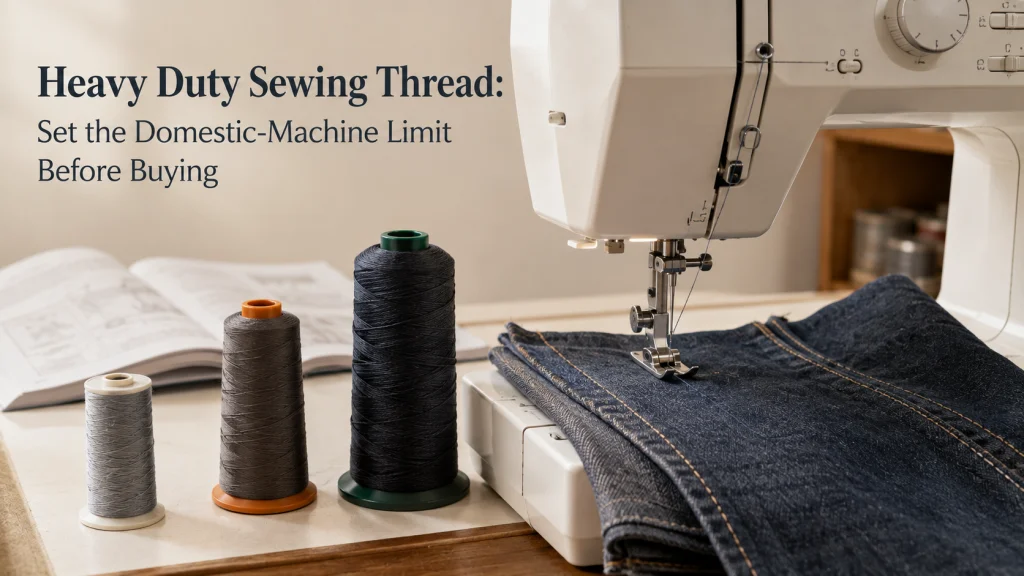
Heavy duty sewing thread should be chosen from the seam requirement backward, not from the thickest spool on the shelf. A domestic sewing machine may accept some heavier thread, but the usable range depends on the exact model, thread construction, needle relationship, and whether the thread is used on top or in the bobbin. Industrial bonded thread can cross that boundary even when its strength sounds attractive for bags, denim, outdoor items, or repairs. Define the job first, read the exact thread size and construction, then stop at the machine’s documented limit.
The strongest available thread is not the correct domestic choice
The phrase heavy duty sewing thread covers products built for very different machines and seams. A domestic-approved jeans or topstitching thread, a heavier general sewing thread, and an industrial bonded thread can all appear in the same search results even though they do not belong in the same thread path. Strength alone does not establish compatibility.
A home sewist making a bag, reinforcing denim, repairing an outdoor item, or sewing a high-stress seam may reasonably want more seam strength. The first question is not, “What is the strongest thread I can buy?” It is, “What does this seam need, and what thread construction and size can this exact machine handle safely?”
This page covers heavier thread only when a domestic machine’s documentation supports the choice. It does not select industrial thread systems, leather or upholstery machines, or industrial production equipment. For the wider consumables context, see the machine sewing supplies overview.
Define the seam and end-use demand
A strong sewing thread is useful only when its properties match the seam. Coats identifies seam strength, abrasion resistance, elasticity, chemical resistance, color fastness, and other performance factors as separate considerations. That means a thread chosen for a bag handle may have a different priority from one chosen for visible denim topstitching or an outdoor repair exposed to abrasion.
Start by naming the job the thread must perform. If the goal is primarily visual, a heavier-looking line may be a topstitching choice rather than a seam-strength requirement. If the seam carries load or receives repeated abrasion, strength and construction deserve more weight. If the project stretches, thread behavior under extension also matters, so thickness cannot stand in for the complete end-use requirement.
| End-use question | Evidence to record | What not to assume |
|---|---|---|
| Does the seam carry load? | Where the seam is used and what stress it receives | That the thickest thread automatically makes the seam adequate |
| Is abrasion a major concern? | Where the seam rubs during normal use | That every high-strength thread has the same abrasion behavior |
| Is the heavier line mainly decorative? | Desired visible stitch size and contrast | That appearance requires industrial thread |
| Does the material stretch or flex? | Movement expected in the finished item | That tensile strength alone defines a suitable thread |
| Will the item face weather or chemicals? | Actual exposure during use and care | That the word “heavy duty” proves environmental suitability |
Decision rule: Write the seam requirement before choosing the size. The thread should be heavy enough to meet the documented need while remaining within the machine’s supported range.
Coats’ technical guidance makes the same principle explicit: thread should be as fine as practical for the required seam strength. Thicker thread can provide more strength when fiber and construction are comparable, but it also changes needle requirements, bulk, and the way the thread passes through the sewing system. That is why “stronger” and “better for my domestic machine” are not interchangeable conclusions.

Gütermann Denim is a 100% polyester sewing thread developed for denim and other medium to heavy woven fabrics. This set contains six 100-meter spools in typical denim colors. The thread is designed for closing seams, topstitching, flat-felled seams, and decorative stitching, with a robust construction that is scrub resistant and colorfast.
Check On AmazonIf you click this link and buy, we earn a commission at no additional cost to you.
Read fiber, construction, and size on the exact product
The words heavy, extra strong, upholstery, outdoor, bonded, and topstitching do not form one standardized size system. Read the exact product data instead. Record the fiber, whether the thread is spun, corespun, filament, or bonded where stated, the finish or coating, and the manufacturer’s size designation.
Thread construction matters because two threads of similar thickness can behave differently. Coats distinguishes spun, corespun, monofilament, smooth multifilament, and textured filament constructions, each with different performance characteristics. The same source also notes that size can be expressed through systems such as Tex, ticket number, or count, so the printed number should not be interpreted without knowing the sizing system.
If the labels are confusing, use the sewing thread weight labels explained page before comparing products. A larger number can mean a coarser thread in one system and a finer thread in another, so raw numbers should never be compared across systems without conversion or manufacturer documentation.
| Thread field | What to copy from the product | Why it changes the decision |
|---|---|---|
| Fiber | Polyester, cotton, nylon, or another stated fiber | Fiber affects strength, abrasion behavior, elasticity, and end-use fit |
| Construction | Spun, corespun, filament, bonded, or other stated structure | Construction changes strength and sewability even at similar sizes |
| Finish | Coated, bonded, lubricated, or other stated finish | Some finishes may be outside a domestic machine’s permitted thread types |
| Size system | Tex, weight, ticket, count, or another exact label | The number is meaningless without the system it belongs to |
| Intended use | Domestic machine, topstitching, upholstery, industrial, or other stated use | Intended use helps separate a domestic candidate from a thread made for another machine class |
Visible topstitching needs a separate decision because a thicker-looking stitch can be an aesthetic goal even when the structural seam does not need heavier thread. If appearance is the main reason for changing thread, use the topstitching thread selection criteria rather than treating decorative thickness as proof of a heavy-duty requirement.

COATS & CLARK Dual Duty XP Heavy is a polyester sewing thread supplied on a 125-yard spool. This version is part of the Dual Duty XP Heavy line and is intended for heavier sewing applications rather than ordinary lightweight stitching. The Navy spool is identified as model S950-4900 and is machine washable.
Check On AmazonIf you click this link and buy, we earn a commission at no additional cost to you.
Verify the exact machine’s documented thread range
There is no universal Tex maximum for domestic sewing machines. The limit has to come from the exact machine or manufacturer support material. SINGER’s Heavy Duty 6800C guidance is a useful model-specific example because it names acceptable and unacceptable thread types instead of relying on the marketing phrase “heavy duty.”
For that model, SINGER lists bonded nylon and bonded polyester up to #69/Tex 70 among acceptable examples, while stating that thread larger than #69/Tex 70 and waxed or coated thread are not recommended. The same support page warns that thread that is too thick or coated can jam and may damage a home sewing machine. Those numbers belong to the documented SINGER Heavy Duty guidance and must not be copied as a maximum for an unrelated domestic machine.
Machine boundary: Never treat one model’s published thread limit as a universal domestic limit. If your exact machine does not document the heavier thread you want to use, do not assume that a larger needle or a stronger motor label makes the thread compatible.
The needle relationship matters as well. SINGER notes that the thread must pass freely through the needle eye and that the needle size must suit the thread. A heavy thread can also create a different bobbin question: the same support material notes that some heavier threads may need ordinary all-purpose or polyester thread in the bobbin because a thread that is too thick for the bobbin path may not feed properly.
| Domestic-machine gate | Pass condition | Stop condition |
|---|---|---|
| Thread type | The exact machine documentation permits the construction or finish | The documentation prohibits the type or identifies it as industrial-only |
| Thread size | The size is within a documented range for that machine | The desired size exceeds the stated limit or no supporting guidance can be found |
| Needle relationship | A supported needle provides adequate clearance for the thread | The thread cannot pass freely through an approved needle size |
| Bobbin use | The machine permits that thread below, or specifies a suitable lower thread | The heavy thread is too large for normal bobbin feeding |
If the machine is older or no longer has a detailed support page, start with the original user manual or a manufacturer-hosted manual archive for that exact model. If the thread limit is still unclear, contact the manufacturer’s support team or an authorized service provider with the model number and the exact thread construction and size you are considering. Do not treat a forum post, a similar-looking model, or the absence of an online warning as proof that a heavier thread is supported.
Passing this gate means the thread is a documented candidate, not that every fabric stack or seam will sew well automatically. Fabric, needle, stitch, presser foot, and machine setup still matter, but those technique questions come after the compatibility boundary rather than replacing it.
Separate domestic-heavy thread from industrial bonded thread
Search results often mix domestic heavy sewing thread with bonded nylon or polyester aimed at upholstery, leather, outdoor fabrication, and industrial machines. The word bonded describes a thread finish or construction treatment, not automatic domestic compatibility. Likewise, the word industrial does not mean universally stronger, better, or more appropriate for every demanding home project.
The stop gate is the machine documentation. If the seam requirement can be met by a heavier thread that the domestic machine explicitly supports, the project may remain inside the home-machine system. If the required thread size or construction exceeds the documented range, the correct next step is not to force that thread through the domestic path. The equipment requirement has changed.
| Thread candidate | Domestic evidence | Decision |
|---|---|---|
| Heavier thread with explicit domestic approval | Exact machine guidance supports its type and size | Keep it as a domestic candidate and verify the rest of the setup |
| Bonded thread within a named model’s documented limit | Exact model guidance permits that construction and size | Apply only to that documented machine scope |
| Industrial thread larger than the machine’s stated range | No domestic approval for the required size | Stop rather than forcing the thread through the machine |
| Waxed or coated thread prohibited by the machine maker | Explicit restriction | Reject it for that machine even if the seam needs high strength |
| Thread with unclear construction or size | Insufficient evidence | Do not buy on the heavy-duty label alone |
This gate is the central buying protection for the page. A demanding seam can justify stronger equipment, but it cannot increase the capacity of the machine already on the table. When the required thread falls outside that machine’s supported path, move the equipment decision up a level instead of treating thread thickness as an adjustable setting.
For the broader relationship among thread families and their normal machine-sewing roles, return to the sewing thread types overview. That keeps domestic thread selection separate from a specialist-system decision.
Final Thoughts: set the machine boundary before the strength target
A stronger seam does not begin with the thickest thread you can find. Define the end-use demand, read the exact fiber, construction, finish, and size, then compare that thread with the published limits for the exact domestic machine. Only candidates that pass that boundary belong in the next stage of the project decision.
If the required thread is larger, coated in a prohibited way, or intended for a machine system your domestic model does not support, stop there. Do not use a larger needle or a “heavy duty” machine label as permission to exceed documented limits. When the seam truly requires an industrial-size thread, the machine requirement has changed along with the thread requirement.
Frequently Asked Questions
These answers focus on selecting a heavier thread without crossing the documented boundary of a domestic sewing machine.
🧵 Can I use heavy duty sewing thread in a regular sewing machine?
Sometimes, but only when the exact machine documentation supports that thread type and size. “Heavy duty” on the spool does not prove domestic compatibility.
💪 Is thicker sewing thread always stronger?
Thicker thread can have greater strength when fiber and construction are comparable, but size is only one factor. Fiber, construction, finish, seam design, and machine compatibility also affect the decision.
🏷️ What does Tex mean on heavy sewing thread?
Tex is a thread-size system based on mass per length, and a higher Tex number indicates a coarser thread. Do not compare it directly with another numbering system without knowing how that system works.
🪡 Can I solve a heavy-thread problem by using a larger needle?
No. The needle must suit the permitted thread, but a larger needle does not expand the machine’s documented thread range or make a prohibited coating acceptable.
🧳 Do bags and denim always need industrial thread?
No. Start with the seam demand and the exact machine limit. Many demanding home projects may stay within domestic-approved thread, while another seam may genuinely require a thread or system outside that range.
⚙️ When should I stop trying to use heavier thread in a domestic machine?
Stop when the required construction or size exceeds the machine’s documented limit, the maker prohibits the coating, or the thread cannot pass normally through an approved needle and thread path. That is an equipment boundary, not a reason to force the setup.
If the product label still leaves the size unclear, resolve the sizing system before buying. A thread cannot be checked against a machine limit until you know what its size designation actually means.
References and Sources
These sources are included because the article depends on thread-selection principles and an exact domestic-machine limit. The numeric limit below applies only to the documented SINGER Heavy Duty guidance, not to domestic machines generally.
- SINGER Heavy Duty thread guidance: documents acceptable and prohibited thread examples for the Heavy Duty 6800C, including its model-specific bonded-thread size limit and warnings about oversized or coated thread.
- Coats sewing thread selection guidance: explains how seam strength, fiber, construction, finish, sewability, and thread size affect thread selection.
The SINGER example establishes one machine-specific boundary. The Coats material explains general thread properties but does not override the compatibility limits of a home sewing machine.