Sewing machine bobbins should be matched to the exact machine before you compare price, package quantity, material, or appearance. Class, profile, height, diameter, center bore, material, and the machine maker’s part number can all matter, and similar-looking bobbins are not automatically interchangeable. Use the exact model manual or manufacturer compatibility listing as the strongest evidence, then route any remaining question to the correct bobbin class, material, prewound, or bobbin-case decision. Do not wind, insert, or test an unidentified bobbin just because it seems to fit.
Similar size is not compatibility evidence
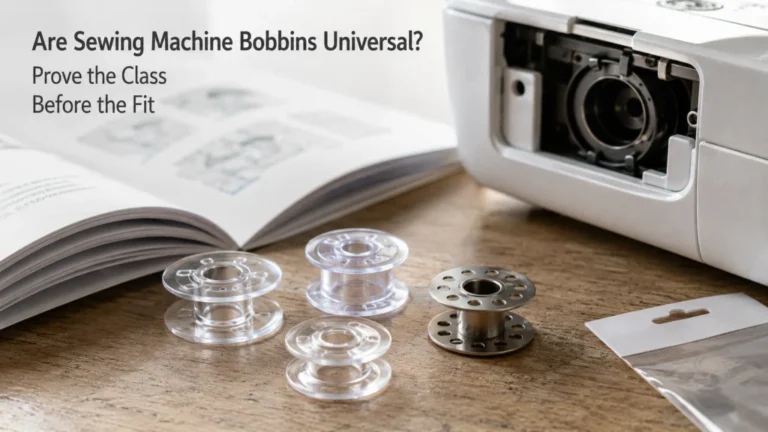
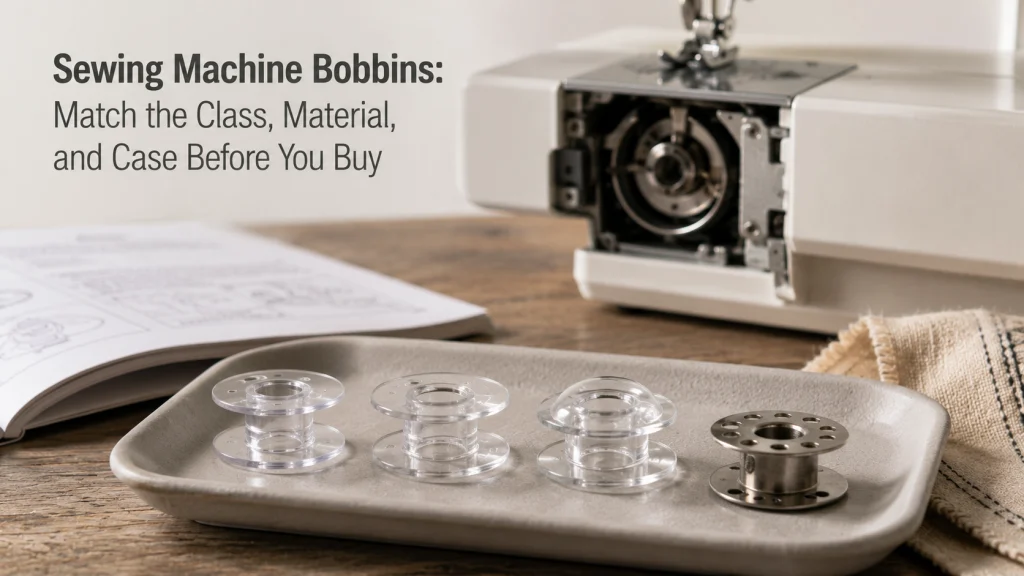
Imagine a small tray holding four loose bobbins: a flat Class 15, a subtly curved 15J, a domed Class 66, and a shorter L-style bobbin. At a glance, several can look close enough to invite guessing. That visual similarity is exactly where bobbin compatibility errors begin.
SINGER’s own support separates Class 15 transparent, Class 15J, Class 15 metal, Class 66 transparent, and Class 66 metal bobbins by profile, height, diameter, material, and model use. Brother likewise publishes exact bobbin part codes and classes for covered machines, while Janome publishes standard and metal bobbin families with model exclusions. The lesson is simple: the machine’s documented lower-system part requirement controls the purchase, not a loose bobbin that looks about right.
Identify the exact machine model before sorting bobbins
Start with the full machine model number from the machine label, manual, or official support page. Brand alone is too broad. Two machines from the same manufacturer can use different bobbin classes, different materials, or a different proprietary part family.
This matters especially with a second-hand machine, an empty accessory drawer, or a mixed box of inherited bobbins. Do not use the loose parts to reverse-engineer the requirement unless the machine documentation confirms the match. If you need the broader compatibility workflow before narrowing to bobbins, use the accessory compatibility guide. The correct sequence is machine first, documented bobbin requirement second, loose-bobbin identification third.
- Record the exact machine model.
- Locate the current manual or manufacturer support page.
- Write down the bobbin class, style, or part number exactly as published.
- Record any material restriction or model exception.
- Only then compare the bobbins you already own or plan to buy.
If the machine documentation is missing, use the manufacturer’s model support or accessory compatibility tools before relying on a retailer’s “universal” label.
Read the manufacturer bobbin part number or class first
A manufacturer part number can be stronger evidence than a broad class name because it ties the replacement to a specific compatibility listing. Brother, for example, identifies SA156 as a high plastic Class 15 bobbin for a large group of covered machines, SA155 as a high plastic Class 66 bobbin for another group, and SA159 as a Class 96 Type L metal bobbin for covered sewing and embroidery models. The model list determines where each statement applies.
Janome’s standard clear bobbin is part number 102261103, with an official compatibility list and explicit exceptions for several machines that use different bobbin formats. Janome also publishes separate metal bobbin part numbers for selected models. These examples show why the part number or exact compatibility page should be captured before the buyer starts comparing package shape.
| Evidence level | Example of evidence | How much weight to give it |
|---|---|---|
| Exact model listing | Manufacturer page says the bobbin or case works with the named machine | Strongest purchase evidence |
| Manufacturer part number | Exact bobbin or case code tied to a model list | Strong when the model match is current |
| Published class or style | Class 15, Class 66, 15J, Type L, or another named system | Useful but still check material and model restrictions |
| Visual similarity | Looks the same in a mixed tray | Not enough to prove fit |
| Retailer universal wording | Package claims broad compatibility without exact machine evidence | Reject if it conflicts with manufacturer documentation |
This hierarchy keeps a generic package claim from overruling a precise machine listing. When two sources disagree, stay with the exact machine maker until better model-specific evidence is available.

Brother SA156 is a 10-pack of clear plastic sewing and embroidery bobbins measuring 11.5 mm deep. Each bobbin includes a security notch for consistent winding. The transparent construction also allows compatible Brother machines to monitor the bobbin thread through their thread-sensing system.
Check On AmazonIf you click this link and buy, we earn a commission at no additional cost to you.
Separate diameter, height, flange profile, center bore, and material
Sewing machine bobbin sizes are more than one diameter measurement. SINGER publishes a Class 15 transparent bobbin at about 12 mm high and 21 mm in diameter with flat top and bottom surfaces, while its 15J bobbin is about 11 mm high and 20 mm in diameter with slightly curved surfaces. Class 66 transparent bobbins are shorter and curved on both sides. The differences are small enough that visual guessing is risky.
Material can be equally important. SINGER explicitly separates transparent and metal versions in several classes and says not to substitute them where the machine specifies otherwise. Brother’s SA156 Class 15 and SA155 Class 66 support pages specify high plastic bobbins for covered machines and warn against metal bobbins. Janome’s standard bobbin is clear resin, while selected models have their own metal bobbin parts.
| Bobbin family | Published profile cue | Published size cue | Material cue | What still controls the purchase |
|---|---|---|---|---|
| Class 15 | Flat top and bottom on SINGER’s transparent version | About 12 mm high and 21 mm diameter on SINGER’s published example | Transparent or metal versions exist in manufacturer listings | Exact machine model, material requirement, and part listing |
| 15J | Slightly curved top and bottom surfaces | About 11 mm high and 20 mm diameter on SINGER’s published example | Check the exact manufacturer listing | Do not substitute plain Class 15 unless the machine maker allows it |
| Class 66 | Curved or domed profile rather than flat Class 15 geometry | Shorter profile than the Class 15 examples above | Transparent and metal versions exist | Exact class, material, and model scope |
| L-style or Type L | Shorter industrial-style profile in documented applications | Use the manufacturer’s published dimensions or part code | Can be metal or another documented material depending on the application | Exact machine approval or replacement part number |
Similar diameter, similar color, and a bobbin that seems to sit in the case.
Exact machine model, published class or part number, profile, material, and manufacturer-approved model scope all agree.
Use this card only to narrow identification. It is not a universal dimensions chart, and the exact machine documentation still decides whether a candidate belongs in the lower system.
Do not force an unidentified bobbin into a case or onto a winder to “see if it works.” Fit testing by force can create binding or abnormal contact before you have proven compatibility.
Separate bobbin class from top-loading or front-loading layout
Top-loading and front-loading describe how the lower system is arranged and accessed. They do not, by themselves, prove the bobbin class. A buyer still needs the exact bobbin requirement from the machine documentation even after the loading layout is known.
Keep that distinction narrow here. This page is about buying the correct bobbin and known replacement case, not about how the lower mechanism works or how one loading architecture compares with another. Use the exact class, part number, and material requirement as the purchase evidence.
Use the interchangeability check when the bobbin class is still unknown
If the first question is simply whether one loose bobbin can be used across different machines, the broad compatibility decision comes before class-specific shopping. The sewing machine bobbin interchangeability check covers that first gate.
Do not skip that step because two packages share a diameter or because a retailer uses the word universal. Once the system is proven, return here and continue with part number, profile, material, and exact model evidence.
Use the Class 15J check when the profile is subtly curved
Class 15J deserves its own decision because it is easy to confuse with flat Class 15 bobbins. SINGER describes 15J as slightly curved and fractionally different in height and diameter from its transparent Class 15 bobbin, and explicitly says not to substitute one for the other in the machines that require a specific style.
If the package or machine documentation names 15J, use the Class 15J bobbin compatibility check. Do not collapse the label into a generic Class 15-family assumption.

The SINGER 06543 set contains 12 transparent plastic Class 15J bobbins in a reusable storage case. These bobbins have the Class 15J profile rather than the flat Class 15 shape. The listing identifies compatibility with selected SINGER Futura embroidery machine series and the Izek 1500.
Check On AmazonIf you click this link and buy, we earn a commission at no additional cost to you.
Use the Class 66 check when the machine specifies that family
Class 66 bobbins have a different profile from flat Class 15 designs, and material can still matter inside the family. SINGER separates transparent and metal Class 66 bobbins and warns against substituting across those material requirements. Brother likewise publishes model-specific Class 66 guidance for covered machines.
When the machine documentation names this family, use the Class 66 bobbin buying check. Confirm the exact model and material rather than stopping at the words Class 66.

The SINGER 2141 package contains four empty transparent plastic Class 66 bobbins. The listing identifies them for selected SINGER machines and other sewing machines that use the Class 66 format. Their transparent construction keeps the wound thread visible while the bobbin remains a model-specific replacement part rather than a universal bobbin.
Check On AmazonIf you click this link and buy, we earn a commission at no additional cost to you.
Use the L-style check only after the machine confirms the format
L-style bobbins are common in some sewing, embroidery, quilting, and semi-professional contexts, but the label should not be inferred from a short metal bobbin in a loose parts tray. Brother’s support for covered machines identifies a specific Type L metal bobbin by part code and model list, which shows why exact documentation matters more than visual identification.
If the machine or official part listing names L-style or Type L, use the L-style bobbin compatibility check. Keep industrial-system comparisons outside this domestic and small-maker purchase decision.

Magna-Glide Prewound L Bobbins come as a box of 100 white bobbins. Each bobbin is wound with 60-weight filament polyester thread on the product's magnetic-core bobbin design. The listing identifies them for sewing, quilting, and embroidery applications that use the L-style bobbin format.
Check On AmazonIf you click this link and buy, we earn a commission at no additional cost to you.
Compare metal and plastic only after the class is proven
Material substitution is not a shortcut around class identification. A metal and plastic bobbin can share a broad class label yet still be restricted by the machine maker. SINGER explicitly warns against several metal-versus-transparent substitutions, Brother prohibits metal bobbins on covered machines that specify high plastic bobbins, and Janome separates its standard resin bobbin from metal bobbins intended for selected models.
If class and model are already confirmed and only material remains uncertain, use the metal versus plastic bobbin check. Do not assume metal is an upgrade or plastic is a downgrade without exact manufacturer evidence.
Verify prewound-core compatibility before treating convenience as fit
Prewound bobbins add another variable because the core must still match the machine’s lower-system requirement. A package can be attractive for embroidery or repeated color work, but convenience does not prove that its core dimensions, style, or material are acceptable for the machine.
Use the prewound bobbin compatibility check when the core format is the remaining purchase question. Keep thread fiber and thread weight as a separate thread-selection decision rather than turning bobbin-core fit into a thread-performance claim.

This New brothread set contains 28 Size A SA156 prewound bobbins, including 17 white and 11 black bobbins. They use plastic sides and are wound with 60S/2 90-weight polyester bobbin thread. The product is sold for compatible embroidery and sewing machines that accept the Size A bobbin format.
Check On AmazonIf you click this link and buy, we earn a commission at no additional cost to you.
Match a known replacement bobbin case by exact part number and model list
A replacement bobbin case is not a visual substitute for another case that happens to fit into the opening. Janome, for example, publishes bobbin case units with exact part numbers and model compatibility lists. That is the level of evidence to look for when the original case is already known to be missing, damaged, or due for replacement.
If the purchase is specifically a case rather than a bobbin, use the bobbin case replacement compatibility check. This purchase route verifies the replacement part; it does not diagnose whether a case is truly defective.
| You need to buy | First evidence to capture | Next route |
|---|---|---|
| Extra empty bobbins | Exact machine bobbin class or part number | Class, material, or interchangeability check |
| Prewound bobbins | Approved core style, size, and material | Prewound-core compatibility |
| Replacement bobbin case | Exact case part number and model list | Known case replacement check |
| Unknown loose part | Machine requirement before visual identification | Do not purchase or test until matched |
This router keeps the bobbin and the bobbin case from being treated as one interchangeable purchase. They are different lower-system parts and need separate evidence.
Treat original part numbers and model lists as stronger than visual matching
The safest buying record is a small ledger that connects the exact machine to the exact lower-system part. This is especially useful when a machine is second-hand, the original bobbins are mixed with other classes, or an online listing uses broad compatibility wording.
| Machine evidence ledger | What to record |
|---|---|
| Machine | Exact manufacturer and model number |
| Official bobbin requirement | Class, style, or exact part number |
| Material | Plastic, resin, metal, or another documented requirement |
| Profile evidence | Flat, curved, domed, or another published shape descriptor |
| Case requirement | Exact case part number only when a case is being replaced |
| Source | Exact machine manual, support page, or manufacturer model list |
Once those fields agree, package quantity and current availability can be compared. If they do not agree, stop the purchase instead of using visual fit as the tiebreaker.
Keep bobbin mechanism and loading-layout comparison separate
This buying decision does not need a full explanation of how the bobbin, hook, and upper thread form a stitch. It also does not need a top-loading-versus-front-loading comparison. Those are mechanism and layout questions rather than replacement-part compatibility questions.
For purchasing, record only the loading layout when it helps locate the correct manufacturer documentation. The class, material, part number, and exact model list still control the fit decision.
Keep winding and insertion separate from the purchase decision
Once the correct bobbin has been identified and purchased, winding and insertion become setup tasks. Do not use a winding attempt as a compatibility test for an unidentified bobbin, and do not force a bobbin into the case because the package dimensions look close.
This separation keeps the decision clean: first prove the part, then use the machine’s normal setup procedure. If the correct part later needs normal winding or insertion instructions, follow the exact machine documentation rather than expanding the compatibility check into a setup tutorial.
Keep symptom-led diagnosis and repair decisions separate
A jam, thread nest, failure to pick up bobbin thread, scraping sound, or abnormal stitch does not prove that the bobbin class is wrong or that the bobbin case needs replacement. Those symptoms require their own diagnostic path because threading, needle state, insertion, debris, tension, and other conditions can create similar evidence.
If a known-correct bobbin produces scraping, binding, repeated needle strikes, abnormal contact, or another fault, stop powered testing and use the sewing machine stitch problem router. Do not buy a new case simply because a stitch symptom appeared.
Final Thoughts: Match the lower-system part before you wind it
The strongest bobbin purchase starts with the exact machine, not the loose bobbin in your hand. Record the manufacturer part number or class, confirm profile and material, check the exact model list, and reject any substitution that depends only on similar diameter or appearance. Class 15, 15J, Class 66, L-style, metal, plastic, and prewound formats each have their own compatibility boundaries.
Once the lower-system part is proven, the rest of the purchase becomes straightforward. Compare current package quantity and availability only among compatible options, then move to normal winding or insertion after the correct part is in hand. If the purchase is a bobbin case, use the case part number and model list rather than treating it as another bobbin choice.
Choose the next route by what remains unknown: if the bobbin class itself is still uncertain, continue with bobbin interchangeability and class verification. If the class is proven and only metal-versus-plastic substitution remains, continue with metal versus plastic bobbin compatibility. If the known purchase is a replacement case, continue with bobbin case replacement matching.
See More in This Section
- Bobbin interchangeability and universal-fit claims
- Class 15J identification and substitution
- Class 66 buying and fit
- L-style bobbin identification and fit
- Metal versus plastic bobbin substitution
- Prewound bobbin core compatibility
- Bobbin case replacement compatibility
Frequently Asked Questions
🧵 Are all sewing machine bobbins the same size?
No. Bobbins can differ in height, diameter, flange profile, center bore, material, and proprietary design. Similar overall size does not prove compatibility.
🔎 Can Class 15 and 15J bobbins be interchanged?
Do not assume so. SINGER documents different dimensions and profiles for its Class 15 transparent and 15J bobbins and explicitly says not to substitute them where the machine requires one specific style.
⚙️ Can I replace a plastic bobbin with a metal one?
Only when the exact machine manufacturer permits that material. Several SINGER and Brother support pages explicitly prohibit metal substitutions on machines designed around specific plastic bobbins.
📦 Are prewound bobbins universal?
No. The prewound core still has to match the machine’s required bobbin style, size, and material restrictions. Convenience does not override the lower-system specification.
🪛 How do I know which bobbin case to buy?
Use the exact machine model and manufacturer bobbin-case part number or model compatibility list. Do not select a replacement case by appearance alone.
⚠️ What should I do if a new bobbin scrapes or binds?
Stop powered testing and recheck the exact class, part number, profile, material, and model compatibility. Repeated scraping, binding, or needle contact belongs in symptom-led troubleshooting rather than continued fit testing.
References and Sources
- SINGER bobbin compatibility information: Documents Class 15, 15J, Class 66, material differences, dimensions, profile differences, and explicit non-substitution warnings.
- Brother SA156 bobbin information: Documents a high plastic Class 15 bobbin requirement and metal-bobbin restriction for the covered models.
- Brother SA155 bobbin information: Documents a high plastic Class 66 bobbin requirement and metal-bobbin restriction for the covered models.
- Brother SA159 bobbin information: Documents Class 96 Type L metal bobbins for the covered models.
- Janome standard bobbin information: Documents part number 102261103, clear-resin construction, model compatibility, and listed exceptions.
- Janome bobbin case compatibility: Documents a replacement bobbin-case part number and exact compatible model list.