A Class 66 bobbin is identified by more than a familiar diameter or a curved silhouette. The exact machine must first call for Class 66, and the replacement must then match the material the machine requires, because transparent and metal Class 66 versions are not automatically interchangeable. Manufacturer documentation is the strongest fit evidence when it names the bobbin class, material, dimensions, or compatible machine models. The practical goal is simple: prove the class first, prove the material second, and reject a near-match that only looks right.
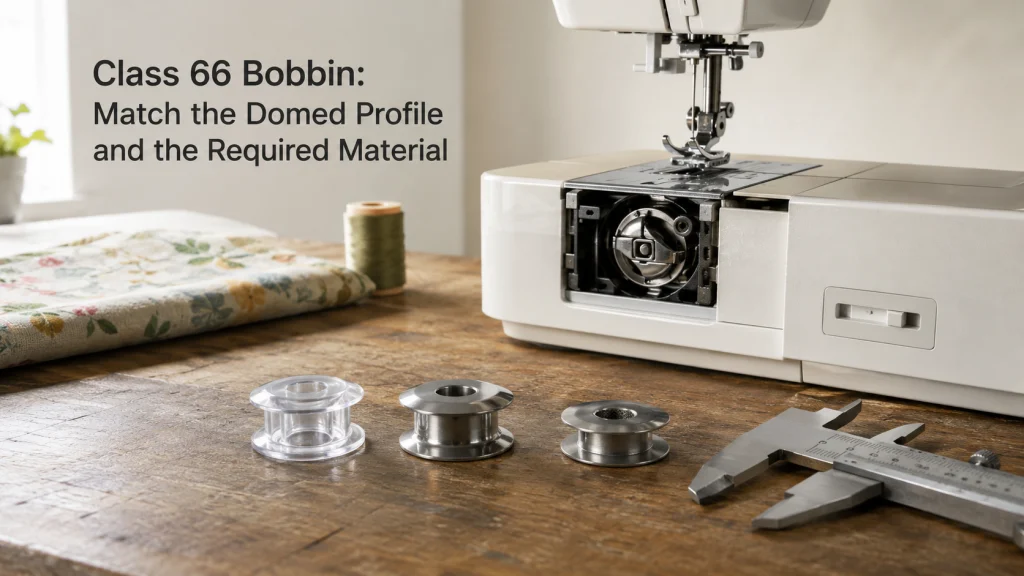
A Class 66 Bobbin’s Dome Is Only the First Proof
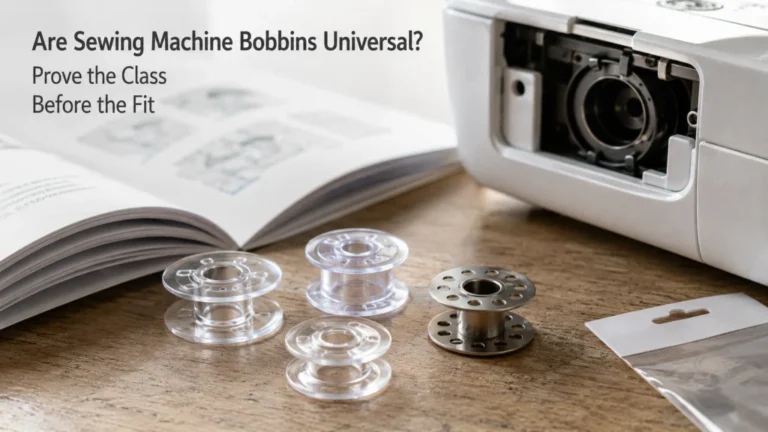
A Class 66 bobbin has a recognizable curved profile, but that shape is only the beginning of a compatibility check. Put a Class 66 bobbin beside a Class 15 or Class 15J bobbin and the differences can look small enough to invite a bad substitution. That is exactly why visual recognition should narrow the candidates, not settle the purchase. The machine’s manual, model-specific support information, or a manufacturer compatibility list has to confirm that Class 66 is the required family.
Material adds a second layer that is easy to miss after the class looks correct. Singer’s bobbin documentation separates transparent Class 66 bobbins from metal Class 66 bobbins and specifically warns against substituting one for the other when the machine requires the other style. A replacement can therefore be the correct class and still be the wrong bobbin for that machine. Treat class and material as two separate proofs before winding or installing anything.

These SINGER Class 66 bobbins are a set of four empty transparent plastic bobbins with the curved Class 66 profile. Amazon lists them for select older SINGER machines and some top drop-in bobbin systems. The listing specifically recommends checking the machine manual for compatibility and using the correct bobbin size rather than substituting another style.
Check On AmazonIf you click this link and buy, we earn a commission at no additional cost to you.
Confirm That the Exact Machine Specifies Class 66
Start with the machine, not the replacement package. The strongest starting point is an instruction manual, model support page, or accessory listing that names the bobbin class for that exact model. A loose bobbin found in a storage compartment is useful evidence only if you already know it belongs to that machine. Used machines often arrive with mixed accessories, so an old bobbin in the case should not overrule model-specific documentation.
If the class is still unknown, step back before comparing materials or shopping by shape. The broader process for checking whether sewing machine bobbins are interchangeable is the better starting point when you do not yet have a confirmed class. Once Class 66 is documented, this article’s narrower compatibility path becomes useful. That order prevents a familiar-looking bobbin from becoming the evidence for its own fit.
Identify the Curved Profile and Published Dimensions
Singer describes both the transparent and metal Class 66 styles with a curved top and curved bottom. Its current bobbin guide lists the transparent version at 10 mm high and 21 mm in diameter, while the metal version is listed at 11 mm high and 21 mm in diameter. Those figures are useful for identifying the documented family and for spotting an obvious mismatch. They are not permission to replace another bobbin merely because one or two measurements happen to be close.
The profile matters because neighboring bobbin families can share a broadly similar footprint while differing in height, flange shape, or intended machine interface. Use measurements as a cross-check after the class has been identified, especially when packaging is vague or a loose bobbin has no marking. If the measured shape conflicts with the manual or manufacturer listing, stop rather than forcing the candidate into the machine. A correct Class 66 replacement should make sense as a whole: class, profile, dimensions, material, and model evidence should point in the same direction.
| Bobbin family | Published profile | Published size | What the shape proves |
|---|---|---|---|
| Class 66 transparent | Curved top and bottom | 10 mm high, 21 mm diameter | Supports Class 66 identification, but not metal substitution |
| Class 66 metal | Curved top and bottom | 11 mm high, 21 mm diameter | Supports Class 66 identification for models that require this style |
| Class 15 transparent | Flat top and bottom | 12 mm high, 21 mm diameter | Rules against treating equal diameter as equal class |
| Class 15J | Very slightly curved top and bottom | 11 mm high, 20 mm diameter | Shows why a mild curve is not enough to call a bobbin Class 66 |
The table is best used as an elimination tool, not a universal fit chart. A 21 mm diameter appears in more than one documented family, and a curved side appears in more than one form. The exact machine specification still controls the final choice. That is the difference between identifying a candidate and proving compatibility.
Separate Class 66 From Class 15 and Class 15J
Class 66, Class 15, and Class 15J are close enough in appearance that casual comparison can be misleading. Singer describes Class 15 transparent bobbins as flat on both faces, Class 15J as only very slightly curved, and Class 66 as curved on both top and bottom. That progression is more useful than asking whether a bobbin is simply round, clear, or close in diameter to the original. The more precise question is whether its documented class and flange profile match what the machine requires.
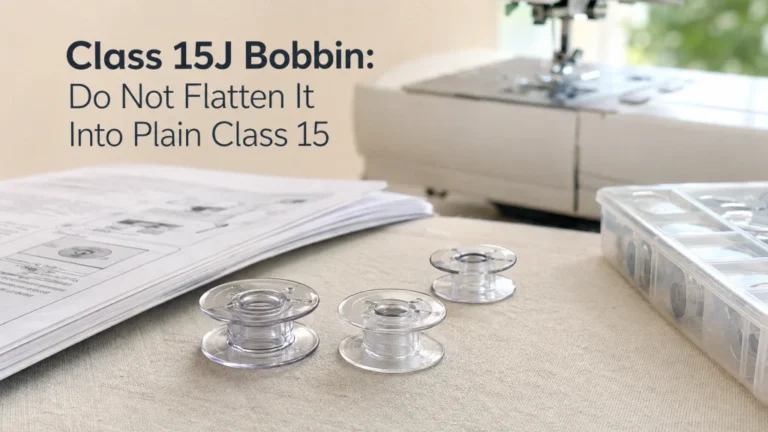
A candidate that may actually be 15J belongs on a different verification path, even if it drops into the same opening during a quick visual check. The detailed Class 15J bobbin compatibility checks focus on that family rather than treating it as a near-equivalent to Class 66. Do not use a trial fit, a shared diameter, or a seller’s generic compatibility wording as evidence that the classes can substitute for one another. Class 66 bobbin compatibility is strongest when the exact class appears in documentation for the exact machine.
This distinction matters before any symptom appears. Once a mismatched bobbin has been wound and used, a fit question can quickly turn into a thread, feeding, or stitch complaint that has several possible causes. Keeping the compatibility decision separate makes the next step clearer. It also avoids diagnosing the machine when the replacement part was never proven correct.

These Mandala Crafts bobbins are lightweight plastic 15J and SA156-style bobbins prewound with assorted-color thread. The set contains 36 bobbins with 2-ply spun polyester thread and includes multiple colors for sewing and embroidery work. Amazon also describes the bobbins as reusable after the supplied thread has been used.
Check On AmazonIf you click this link and buy, we earn a commission at no additional cost to you.
Check Whether the Model Requires Transparent or Metal Class 66
Confirming Class 66 does not finish the job because the family includes more than one material configuration. Singer’s documentation says transparent Class 66 bobbins should not be replaced with metal Class 66 bobbins, and its metal Class 66 guidance likewise limits that style to specific models. That makes material a compatibility field, not a personal preference after the class is known. If the manual or model-specific listing names transparent or metal, keep that requirement intact.
Do not assume that metal is automatically better because it feels more durable, or that transparent plastic is automatically newer and therefore more appropriate. The useful evidence is whether the machine was designed around that specific bobbin style. If the class is definitely Class 66 but the material requirement is still uncertain, use the focused metal versus plastic bobbin compatibility process rather than guessing from age or appearance. Material choice should come after class proof and before the replacement is treated as ready to use.
Key point: For Class 66, prove both the family and the material. A domed bobbin marked or sold as Class 66 is not automatically interchangeable with every other Class 66 bobbin. Match the exact machine documentation before using the replacement. Treat a material mismatch as a compatibility mismatch, not a cosmetic difference.
The material check is especially important with used machines because the bobbin already inside the machine may not be original. A previous owner could have mixed metal and transparent bobbins, stored several classes together, or kept accessories from another machine in the same case. Use that physical bobbin as a comparison object, not as unquestioned authority. Documentation that names both the class and the acceptable style is stronger evidence.

The SINGER 2139 set contains four metal Class 66 bobbins. Amazon lists compatibility with SINGER models 66-1 through 66-18, 99CL, 185, 192, 201, 609, 717, and additional top drop-in bobbin machines. The listing also instructs users to begin with an empty bobbin rather than adding thread to a partially wound one.
Check On AmazonIf you click this link and buy, we earn a commission at no additional cost to you.
Use Manufacturer Model Lists When They Are Available
A model list can turn a generic family label into machine-specific compatibility evidence. Singer’s Class 66 metal listing names models 66-1 through 66-18, 99CL, 185, 192, 201, 609, and 717 among the compatible machines. That list is more useful than a marketplace title that says a bobbin fits many vintage or top-loading machines without naming them. It also reinforces why the word Class 66 alone cannot prove that metal is correct for every machine in the broader family.
Use a model list alongside the manual rather than as a substitute for the exact machine record when both are available. Model suffixes, regional variants, revised parts, and machines with similar names can create false confidence if the identification is incomplete. If the exact model is named by the manufacturer and the required bobbin style agrees with the manual, the evidence is much stronger. If those sources disagree, stop and resolve the model identity or documentation before buying or installing a replacement.
- Confirm the complete machine model, including suffixes or variant markings when present.
- Find the bobbin class in the manual, support page, or manufacturer accessory information.
- Check whether the manufacturer names a required material or bobbin style.
- Use a current model list when one is provided for the replacement family.
- Reject a seller claim that conflicts with the machine maker’s model-specific documentation.
This checklist keeps compatibility evidence in the right order. The broad sewing machine bobbin reference can help place the class within the larger bobbin system, while this page stays focused on the Class 66 replacement decision. The more specific the documentation becomes, the less weight a generic fit claim should carry. A named machine and named bobbin style are better than resemblance.

This HONEYSEW set includes 20 metal Class 66 sewing machine bobbins identified as replacements for Singer part numbers 172222 and 32522. The Amazon listing provides a detailed compatibility list covering many Singer models, including 66, 99K, 185, 201, 401, 403A, and 404, along with White 8600 and 8800 machines. The product is sold as a replacement bobbin set for machines specifically named in that compatibility list.
Check On AmazonIf you click this link and buy, we earn a commission at no additional cost to you.
Reject Cross-Class Substitution Based on Diameter Alone
Diameter is one of the quickest measurements to compare, which also makes it an easy place to stop too early. The published Class 66 and Class 15 data show that two different bobbin families can share the same outside diameter while differing in height and flange shape. That means diameter can eliminate an obvious mismatch, but it cannot establish class by itself. The full profile and exact machine documentation still have to agree before the bobbin is treated as compatible.
This is a common first-owner misunderstanding because a bobbin can look like a simple spool that only needs to fit inside a circular space. In reality, the machine is designed around a bobbin system, not just a maximum diameter. Height, flange curvature, material, and the relationship with the holder or case all belong to the compatibility question. If a replacement is being justified mainly by diameter, the evidence is not complete enough to use it.

These SINGER Class 15 bobbins are a set of four empty transparent plastic bobbins with flat top and bottom surfaces. Amazon lists them for select SINGER and other compatible domestic sewing machines and instructs buyers to confirm compatibility in the machine manual. Their transparent construction also allows the remaining bobbin thread to be seen during use.
Check On AmazonIf you click this link and buy, we earn a commission at no additional cost to you.
Keep Bobbin Layout Separate From Class 66 Fit
Top-loading, drop-in, and front-loading descriptions can help you understand how a machine is arranged, but layout language is not a substitute for the bobbin class. Two machines can both be described in broad layout terms while requiring different bobbin families or different material versions within a family. Use layout to understand the machine’s architecture, then return to the manual for the actual compatibility field. That keeps a general mechanism description from becoming an accidental replacement rule.
For a wider explanation of how accessories and interfaces relate to the machine, the sewing machine accessory compatibility framework provides the broader context. This Class 66 page is narrower: it asks whether a specific replacement bobbin belongs in a machine already identified as requiring Class 66. It does not rank one bobbin layout as superior to another. The compatibility decision ends when class and material are proven, not when one layout sounds familiar.
Keep Winding and Insertion Out of the Replacement Decision
Winding direction, bobbin-winder setup, and insertion sequence matter when the correct bobbin is already known, but they answer a different question. A bobbin that winds poorly is not automatically the wrong class, and a bobbin that seems to sit in the holder is not automatically compatible. Mixing those steps can lead a buyer to test an unidentified near-match instead of verifying it first. The safe order is compatibility before operation.
Once the exact bobbin has been proven, follow the machine’s manual for winding and insertion because those instructions can vary by model. Do not use winding behavior as a substitute for manufacturer fit evidence, and do not alter a bobbin or winder to make an uncertain replacement work. If the problem begins only after a known-correct bobbin is installed, the question has moved beyond this replacement article. That separation keeps shopping, normal operation, and troubleshooting from collapsing into one confusing process.
Route the Remaining Question to the Right Compatibility Check
By the end of the Class 66 check, the unresolved issue should be specific. If you still do not know the bobbin class, return to the process for verifying an unknown bobbin class rather than forcing the Class 66 assumption. If the candidate may actually be a 15J, use the Class 15J identification details before making a substitution. If Class 66 is confirmed and only material remains uncertain, focus on the machine’s documented metal or transparent requirement.
This routing matters because each question requires different evidence. Unknown class calls for broad identification, a possible 15J calls for a cross-family distinction, and a proven Class 66 with uncertain material calls for a within-family material check. Keeping those branches separate prevents one article from pretending to solve every bobbin problem. It also gives a first-time owner a clear next action instead of another vague instruction to buy a bobbin that looks similar.
Final Thoughts: Match Both the Class 66 Family and the Required Material
A Class 66 replacement is a two-part compatibility decision. First, verify that the exact machine requires Class 66 through the manual, support documentation, or a manufacturer model list. Then verify whether that model requires the transparent or metal Class 66 style rather than treating material as interchangeable. The domed profile and published dimensions are useful checks, but they should support the documentation rather than replace it.
The best replacement is the one you can explain with evidence before it ever goes into the machine. You should be able to name the machine model, the required bobbin class, the required material, and the source that connects those facts. If one of those fields is missing, keep verifying instead of relying on diameter, color, age, or a loose bobbin that happened to come with the machine. That small amount of discipline prevents a near-match from becoming a much harder sewing problem later.
FAQs
🧵 How can I tell if a bobbin is Class 66?
Class 66 has a curved top and bottom, but shape alone is not final proof. Confirm the class in the exact machine’s manual or manufacturer support information, then check the documented material requirement.
📏 Is Class 66 the same diameter as Class 15?
Singer publishes a 21 mm diameter for both transparent Class 66 and transparent Class 15 bobbins. Their height and flange profiles differ, so equal diameter does not make the two classes interchangeable.
🔍 Is Class 15J the same as Class 66?
No. Singer documents Class 15J as a separate bobbin family with a very slightly curved profile, while Class 66 has more clearly curved top and bottom surfaces. Use the class specified for the exact machine.
⚙️ Can I replace a metal Class 66 bobbin with a transparent one?
Do not assume that the two materials are interchangeable. Singer specifically separates transparent and metal Class 66 bobbins and states that machines requiring one style should not automatically receive the other.
📖 Where should I check which bobbin my machine uses?
Start with the exact machine’s instruction manual, then use model-specific manufacturer support or accessory listings when available. A loose bobbin, seller description, or visual match is weaker evidence than documentation tied to the machine model.
🛠️ What if the correct Class 66 bobbin still does not work properly?
If the class and required material are documented and the problem appears during winding, insertion, or sewing, move to the machine’s operating or troubleshooting information. Do not change bobbin class or alter the machine just to chase a symptom.
References and Sources
- Singer bobbin selection guidance: Supports the published Class 66 profile, dimensions, and transparent-versus-metal substitution limits used in this article.
- Singer Class 66 metal compatibility listing: Supports the named machine models and the model-specific use of metal Class 66 bobbins.