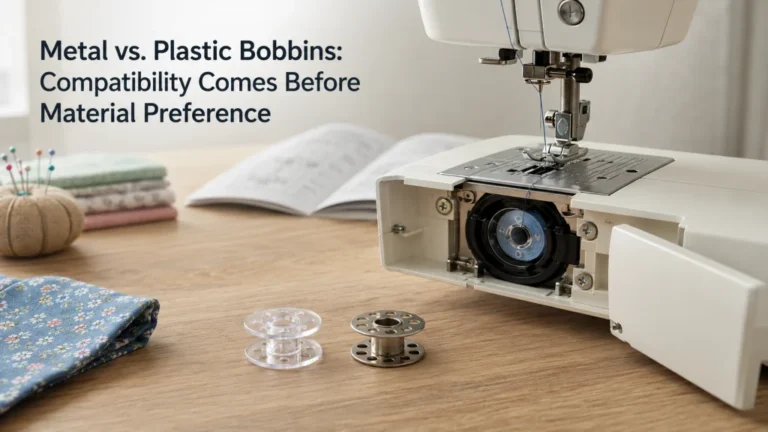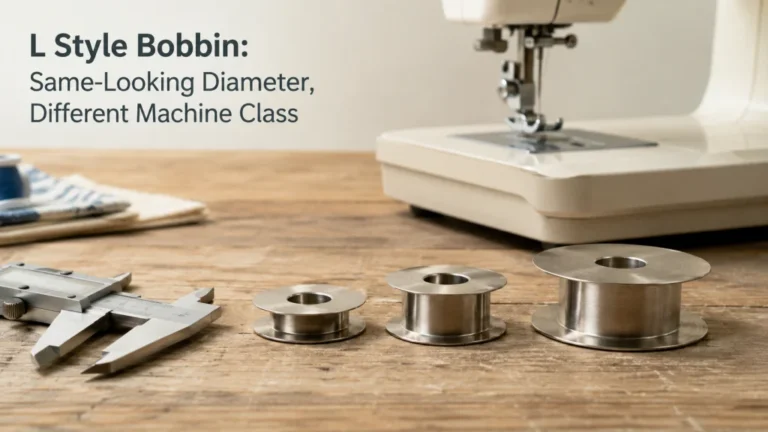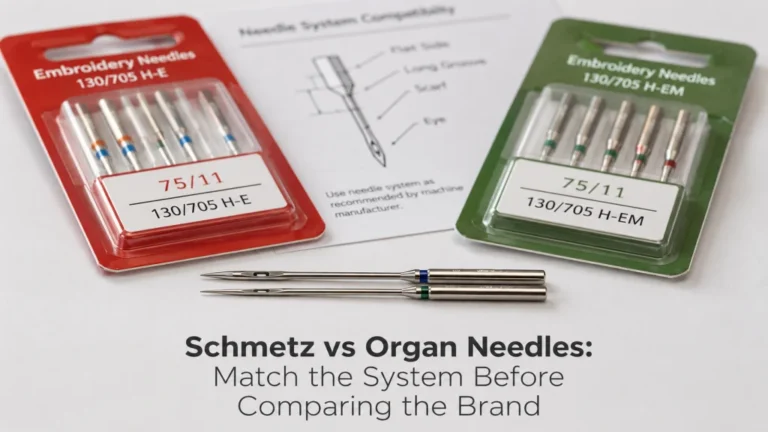
A Class 15J bobbin can look almost identical to a plain Class 15 bobbin, which is why visual guesses often create compatibility mistakes. The correct decision starts with the exact machine requirement, original bobbin label, or manufacturer documentation. A 15J label should be treated as a specific requirement, not flattened into a general Class 15 assumption.
Confirm that the exact machine or original part specifies 15J
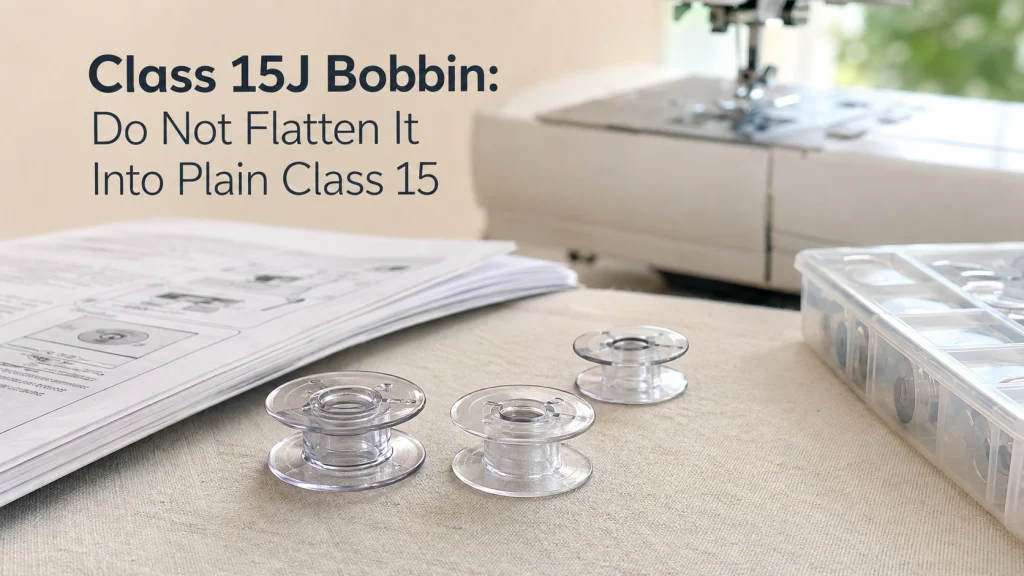
Put a plain Class 15 transparent bobbin beside a Class 15J bobbin and the difference can be subtle enough to invite a visual guess. That is exactly why the first question is not simply how a 15J looks. It is whether the exact sewing machine, original bobbin, manual, or manufacturer accessory record actually identifies Class 15J as the required system. A similar diameter, a bobbin that drops into the opening, or a seller description using broad Class 15 language does not establish compatibility.
Start with evidence tied to the machine in front of you. Check the original bobbin marking if it is known to be the correct part, then compare that information with the exact model manual, the manufacturer’s support material, or an accessory listing that names the model. If those sources identify 15J, keep that class requirement intact while you shop. If they do not identify the class clearly, the correct result is unresolved compatibility, not permission to substitute the closest-looking bobbin.
| Evidence source | What it proves |
|---|---|
| Exact machine manual | The bobbin requirement assigned to that model |
| Original bobbin label | The class or part identity of the existing component |
| Manufacturer accessory information | The documented compatibility boundary |
| Generic visual match | Only a clue, not compatibility proof |
The practical hierarchy is simple: machine-specific documentation outranks appearance. That same rule applies across sewing machine bobbin identification, because a part that looks familiar can still belong to a different class or profile. Do not force a near-fitting candidate into the machine or test an undocumented substitute under power just to see whether it works. Confirm the class first, then move to profile, material, and seller claims.
Read the current 15J profile and dimensions from the named manufacturer
The challenge with Class 15J is not that it looks radically different from every neighboring bobbin family. The problem is the opposite: the profile can be similar enough that a casual side view or diameter check feels conclusive when it is not. A source-defined profile matters because height, flange shape, and overall geometry work together in the bobbin system. One familiar measurement cannot stand in for the complete specification.
Singer’s current bobbin guidance distinguishes Class 15J from related bobbin styles and provides the manufacturer-defined profile and dimensions used for its own compatibility decisions. Use that current source as a matched set rather than mixing a height from one chart, a diameter from another seller, and a shape description from a forum post. When secondary pages disagree, the disagreement is a reason to narrow the claim, not to average the numbers into a new specification.
| Feature | Why it matters |
|---|---|
| Height | Can affect how the bobbin sits in the holder |
| Flange profile | Separates visually similar bobbin families |
| Diameter | Only one measurement, not a complete fit test |
| Manufacturer specification | Controls compatibility decisions |
Use the table as an identification sequence, not as a do-it-yourself fit experiment. First establish that the machine calls for 15J, then compare the candidate with the current manufacturer description of that class. If a third-party bobbin is labeled 15J but its dimensions or profile cannot be traced to a reliable specification, the label alone does not resolve the purchase. The useful outcome is a candidate that matches both the named class and the evidence attached to the exact machine.

The SINGER 06543 set contains 12 transparent plastic Class 15J bobbins in a reusable storage case. The product is identified specifically as Class 15J and is listed for selected SINGER Futura embroidery machine series and the Izek 1500. The bobbins are supplied empty so they can be wound with the thread required for the sewing setup.
Check On AmazonIf you click this link and buy, we earn a commission at no additional cost to you.
Compare 15J with plain Class 15 without assuming interchangeability
Class names create a predictable trap because “Class 15” and “15J” sound as though one must simply be a minor variation of the other. Their visual similarity reinforces that assumption. The safe comparison starts by treating the labels as separate requirements until the exact manufacturer documentation for the machine says a substitution is permitted. Similar naming is not a compatibility standard by itself.
A plain Class 15 bobbin may appear to enter the same bobbin area, and two transparent bobbins may look nearly identical when viewed from above. Neither observation proves that the profiles are equivalent in the machine’s bobbin system. The purchase question is not whether the part can be placed in the opening. It is whether the machine maker identifies that class, profile, and construction as suitable for the exact model.
This is also why conflicting web advice should not be converted into a universal rule. A statement that two bobbins worked in one machine does not establish that every model using one class accepts the other. The plan for this page is deliberately narrower: when Singer documentation names 15J and warns against substitution, that manufacturer-specific boundary controls the decision for the covered machine context.
Compatibility rule: Similar appearance is an identification clue. The machine’s named bobbin requirement is the deciding evidence.
Once the machine requirement and candidate label agree, you can continue checking profile and material. If they do not agree, stop there rather than using sewing performance as a compatibility test. This same evidence-first approach applies to other sewing machine accessory compatibility decisions, where visual similarity can be useful for identification but cannot replace an exact model match.
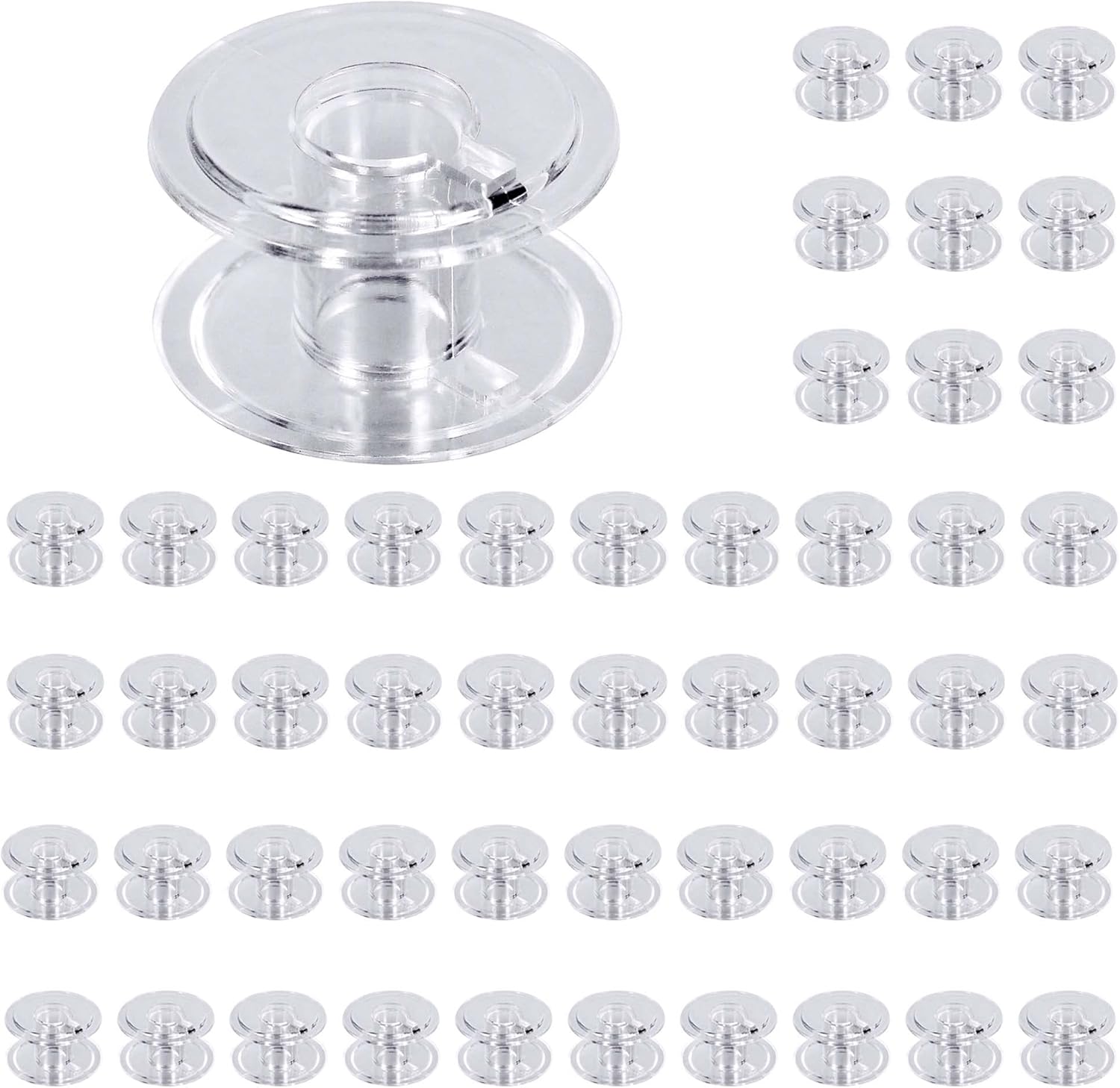
This SINGER package contains 50 empty transparent plastic Class 15 bobbins. The Amazon listing identifies them for selected SINGER and other domestic sewing machines that use the Class 15 format and instructs buyers to confirm the required bobbin size in the machine manual. Their transparent construction makes the remaining thread visible while the bobbin is in use.
Check On AmazonIf you click this link and buy, we earn a commission at no additional cost to you.
Separate class from plastic-versus-metal material
Class identification and material selection are related, but they answer different questions. The class tells you which bobbin family and geometry the machine expects. Material tells you how that correctly identified bobbin is constructed. Confirming one does not automatically confirm the other, so a shopper should not treat “Class 15J” as permission to choose any metal or plastic version carrying that label.
This distinction matters because online listings often compress several attributes into one compatibility claim. A candidate may have the right class name but a different construction from the original part or from what the manufacturer specifies for the model. The opposite can also happen: a transparent plastic bobbin can look like the original material while belonging to the wrong class. Keep class, profile, and material as separate checkpoints so one visual match does not silently answer all three.
| Question | What it decides |
|---|---|
| Is the class correct? | Whether the bobbin family matches the machine requirement |
| Is the material specified? | Whether plastic, metal, or another construction is allowed |
| Is the substitution documented? | Whether a different material version has manufacturer support |
Read those questions in order. If the class is wrong or unknown, material is not the next problem to solve. If the class is confirmed but the remaining uncertainty is plastic versus metal, move to the metal versus plastic bobbin choice rather than treating construction as cosmetic. That keeps this page focused on Class 15J identification while sending the separate material decision to the place where it can be evaluated properly.
Separate 15J from the more strongly domed Class 66 family
Class 66 belongs to a different identification path and should not be pulled into a 15J decision simply because both are common household sewing-machine bobbins. When several clear or translucent bobbins are sitting together, size alone can make them look more alike than they are. The side profile is more informative, especially when one candidate shows the more strongly domed form associated with the Class 66 family.
The practical mistake is trying to solve every bobbin question with one broad “Class 15 style” label. If the machine documentation calls for 15J, a candidate that instead matches a different named bobbin family should be investigated as that family rather than explained away as a harmless variation. Likewise, if the original bobbin has features that make 15J identification doubtful, do not force the evidence to fit the page you are currently reading.
Use the machine requirement first and the physical profile second. If the candidate appears to belong to the more domed family, continue with the Class 66 bobbin identification check instead. That separate route prevents two different questions from collapsing into one: whether the machine requires 15J, and whether the loose bobbin in your hand is actually a Class 66 part. A correct identification is more useful than a quick visual guess that happens to produce a part that fits into the opening.

The SINGER 2141 package contains four transparent plastic Class 66 bobbins. The product is intended for selected SINGER machines and other machines specifically documented for the Class 66 format. Class 66 bobbins use a curved profile, making them a separate bobbin family rather than a substitute for Class 15J based only on similar overall size.
Check On AmazonIf you click this link and buy, we earn a commission at no additional cost to you.
Treat third-party equivalence claims as claims to verify
Third-party listings can be useful for finding replacement candidates, but the compatibility statement on the listing is still a claim that needs support. A seller may group several machines, bobbin classes, or cross-reference terms into one title because shoppers search with different language. That merchandising choice does not establish that every listed term is technically equivalent for the exact machine you own.
When a listing says a bobbin is “15/15J,” “fits Class 15 machines,” or replaces several named parts, separate the pieces of the claim before buying. You need to know whether the exact model is included, whether the manufacturer requirement is actually 15J, and whether the candidate’s profile and material match the documented requirement. A review saying that the bobbin worked for another buyer can be useful context, but it cannot replace model-specific documentation.
- Confirm the exact machine model rather than relying on a family name alone.
- Check whether the listing identifies Class 15J specifically.
- Compare the candidate profile with current manufacturer information.
- Reject a cross-brand equivalence that has no exact documentation behind it.
Community threads and retailer comments are valuable here for one reason: they show how often owners encounter contradictory labels and substitution advice. They do not resolve the technical question. Use them to recognize the confusion, then return to the manufacturer source that controls the machine requirement. That prevents an anecdotal success or broad seller description from turning into a universal 15J interchangeability rule.
Route material substitution to the separate material check
Once the Class 15J requirement is confirmed, a remaining plastic-versus-metal question should be handled separately from class identification. The class answers which bobbin family the machine expects. The material check asks whether the same machine is documented for a particular construction or for an approved alternative. Keeping those questions separate prevents a correct class label from doing more evidentiary work than it can support.
For example, finding a metal bobbin sold under a familiar class name does not prove that it is an acceptable replacement for a plastic original. The reverse is also true. A material change may involve a different manufacturer recommendation even when the overall size appears similar. This page therefore stops once the Class 15J identity is established and the unresolved issue becomes construction rather than class.
That boundary also makes comparison shopping cleaner. First confirm that the exact machine requires 15J and that the candidate really is 15J. Then, if two candidates differ mainly by material, evaluate that difference with the dedicated material evidence rather than reopening the class question. Do not use a successful insertion test or a few stitches as proof that an undocumented material substitution is correct. The purchase should be supported before the bobbin is used, not justified afterward by the fact that the machine happened to run.
Keep winding and insertion questions in their separate checks
This page is about identifying and buying the correct Class 15J bobbin, not about diagnosing every lower-thread problem that can occur after purchase. Winding, insertion direction, thread path, bobbin-case setup, and stitch symptoms all depend on the exact machine and can produce problems even when the bobbin class itself is correct. Mixing those topics into the compatibility decision makes it harder to tell whether the part is wrong or the setup is wrong.
A useful boundary is the moment the correct bobbin has been identified. Before that point, the task is evidence: model requirement, class, profile, material, and replacement claim. After that point, the machine manual controls how the bobbin should be wound and installed. If a correctly identified bobbin is then associated with poor stitch formation, jamming, unusual noise, or another symptom, the next step is troubleshooting the setup rather than revisiting the class label without evidence.
This separation also avoids unsafe trial-and-error. Do not force a bobbin that does not sit normally, and do not use powered operation to test whether an uncertain candidate “probably fits.” Confirm compatibility first, then follow the exact manual for winding and insertion. That keeps the buying question narrow and prevents a normal setup mistake from being misreported as proof that Class 15J itself is incompatible.
Route broad fit uncertainty to the universal compatibility check
A Class 15J decision only works after the machine requirement is known. If the machine model is missing, the manual cannot be identified, the original bobbin may not be original, or the loose candidate has no reliable label, there is not enough evidence to begin from 15J. Starting with a specific class in that situation encourages confirmation bias: every similar transparent bobbin starts to look like the answer you were hoping to find.
Move back to the broader sewing machine bobbin compatibility check and establish the machine, bobbin system, and manufacturer requirement first. That broader process is designed for the stage where even the class is uncertain. Once it produces a documented 15J requirement, return here and compare profile, manufacturer information, and replacement claims without guessing.
If the uncertainty is wider than the bobbin alone, use the same evidence discipline across the machine’s accessory system. A model number and current documentation are stronger starting points than a visual match or a bag of unlabeled parts. The goal is not to make every candidate fit into a named class. It is to identify the class the exact machine actually calls for, reject unsupported substitutions, and only then buy a replacement with a traceable compatibility path.
Final Thoughts: use the class the exact machine names
Class 15J should not be treated as a cosmetic variation of plain Class 15. The safest route is to identify the exact machine requirement, confirm the manufacturer-defined profile, and reject substitutions that are only based on appearance.
When the documentation says 15J, keep the decision tied to 15J. When the requirement is unknown, return to the broader compatibility process instead of guessing.
FAQs
🧵 Is a Class 15J bobbin the same as a Class 15 bobbin?
No. They may look similar, but they should be treated as separate requirements unless the exact manufacturer documentation approves substitution.
📏 Can I identify a 15J bobbin by diameter alone?
No. Diameter is only one feature. Profile, height, and machine documentation also matter.
🔍 How do I know if my machine needs a Class 15J bobbin?
Check the exact model manual, original bobbin label, or manufacturer accessory information.
⚙️ Can a third-party Class 15J bobbin replace the original?
Only when the replacement claim can be verified against the machine requirement.
References and Sources
- Singer bobbin guidance: supports Class 15J profile, dimensions, and substitution boundaries.
- National Sewing Circle discussion: documents the recurring 15 versus 15J confusion, not technical compatibility rules.