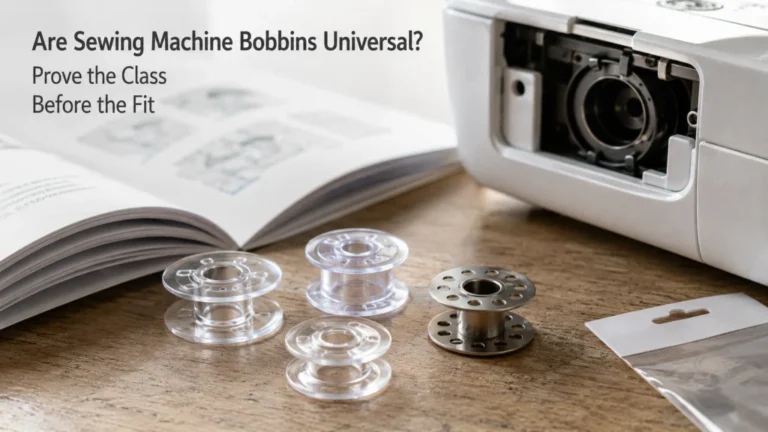
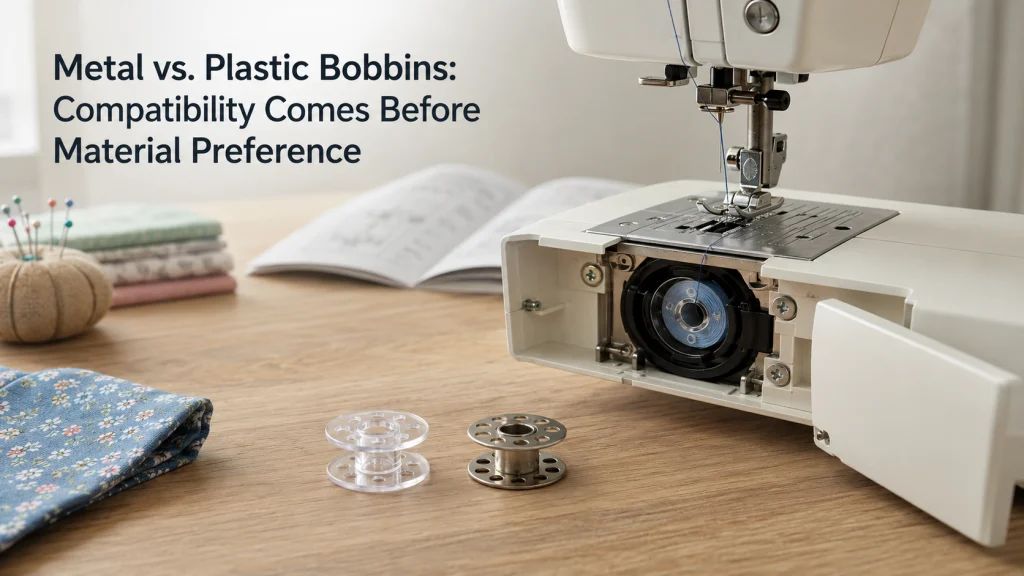
Metal and plastic bobbins should not be treated as interchangeable versions of the same part simply because the bobbin class appears to match. Some manufacturers specify plastic for particular machines, while others distinguish metal and transparent versions within the same nominal class. The safe buying order is to confirm the machine and bobbin class first, then check whether the required material is fixed or optional. Only after the manufacturer permits both materials does a performance comparison become a meaningful question.
Material Can Be a Fit Rule, Not a Preference
The metal vs. plastic bobbins question often sounds like a durability choice, but compatibility comes first. Brother support for machines using the SA156 identifies a plastic Class 15-type bobbin and specifically warns against using metal bobbins in those machines. Singer’s bobbin guidance also separates transparent and metal versions within Class 15 and Class 66 instead of treating material as a free substitution. Those manufacturer restrictions turn material into part of the fit specification.
That means a buyer should not begin with “Which material is better?” when the machine may support only one of them. Start with the model number and required bobbin class, then verify whether the manual or manufacturer support page also specifies plastic, metal, transparent plastic, or another construction. If the documentation fixes the material, the purchasing decision is already narrowed before noise, visibility, weight, or durability enters the discussion. For the broader component context, understand sewing machine bobbin requirements before comparing material alone.

This Brother package contains 10 clear SA156 sewing and embroidery bobbins measuring 11.5 mm high. The transparent plastic construction allows the remaining thread to be visible while the bobbin is installed. These bobbins are intended for compatible Brother sewing and embroidery machines that specify the SA156 bobbin type.
Check On AmazonIf you click this link and buy, we earn a commission at no additional cost to you.
Confirm the Exact Bobbin Class First
Material cannot rescue the wrong bobbin class. A plastic Class 15J bobbin is not made compatible with a Class 15 machine merely because both are plastic, and a metal Class 66 bobbin is not interchangeable with every other metal bobbin. The machine’s required class, dimensions, profile, and manufacturer part relationship remain the first compatibility layer. If the class is uncertain, return to verify the correct bobbin class before choosing between materials.
A useful purchase record starts with the complete machine model, then the class or manufacturer part number, followed by the material the source specifies. Keep those fields separate because one manufacturer may use visually similar bobbins with different profiles, while another may divide metal and plastic versions within the same broader class name. Do not let a package that says “Class 15” override a machine page that requires a particular Class 15 construction. Class establishes the family, but model-specific documentation still controls the final choice.
| Decision field | What to verify |
|---|---|
| Machine | Full model number and any meaningful suffix |
| Bobbin class | Class, style, or manufacturer part number specified for that machine |
| Material | Plastic, transparent plastic, metal, or another construction named by the manufacturer |
| Substitution rule | Whether another material is explicitly allowed, prohibited, or not addressed |
This order prevents a common shopping shortcut: finding two bobbins with similar dimensions and treating material as the only remaining difference. The apparent match may hide a profile, height, sensor, or model-specific restriction that matters more than the material preference. Record “not stated” when the manufacturer does not address a substitution. An unanswered field is safer than inventing permission from appearance.
After a replacement has been verified, label the storage container with the machine model, bobbin class or part number, and required material. Keep confirmed bobbins separate from loose parts whose origin is uncertain, especially if more than one machine shares the same workspace. The label is not compatibility evidence by itself; it is a way to preserve the evidence you already checked. That small step prevents a correct purchase from becoming an unidentified bobbin later.

The SINGER 06543 set contains 12 transparent plastic Class 15J bobbins in a reusable storage case. SINGER identifies Class 15J as a separate bobbin profile rather than an interchangeable Class 15 replacement. The package is intended for compatible SINGER machine families that specify the Class 15J bobbin system.
Check On AmazonIf you click this link and buy, we earn a commission at no additional cost to you.
Check Whether the Manufacturer Fixes the Material
Once the class is established, look for material language in the manual, support article, accessory page, or model-specific parts list. Brother’s SA156 guidance is unusually clear because it identifies the bobbin as a plastic Class 15-type and says metal bobbins should not be used in the covered machines. In that situation, there is no useful metal-versus-plastic preference debate for the owner. The plastic construction is part of the supported replacement specification.
Other machines may be documented differently, so do not generalize Brother’s restriction beyond the models covered by that support answer. The same principle applies when a manufacturer specifies metal instead of plastic or distinguishes two constructions within one class family. If both materials are genuinely permitted for the same machine, write that permission down before comparing secondary characteristics. Without that permission, a material swap is an unsupported compatibility experiment rather than a normal accessory choice.
The rule is deliberately conservative because bobbins operate inside a closely fitted hook and bobbin system. Material can affect mass, sensing, dimensions, or the manufacturer’s intended interaction with surrounding parts, even when the owner cannot see the reason from the outside. You do not need to reverse-engineer that reason to follow a clear compatibility restriction. You only need to preserve the specification the machine was designed around.
Separate Weight and Visibility From Compatibility
Metal and plastic obviously differ in physical properties, but those differences do not decide fit by themselves. A transparent plastic bobbin can make the remaining thread easier to see, while a metal bobbin may feel heavier in the hand. Those observations describe the parts, not whether a particular machine accepts them. Compatibility still comes from the machine’s specified class, construction, and replacement guidance.
This distinction matters because visible benefits are easy to turn into universal buying advice. Clear plastic may be convenient in a top-loading system where the bobbin is visible, but that does not mean every top-loading machine requires plastic for the same reason. Metal may feel more substantial, but that does not prove it is the preferred replacement in a machine supplied with plastic. Treat visibility and weight as secondary characteristics only after both candidate materials have been approved for the same machine.
Key point: A property can be real without being a compatibility rule. “Transparent is easier to inspect” and “metal is heavier” describe the bobbins, while “this machine accepts this bobbin” requires model-specific evidence.
That separation also keeps the article from drifting into unsupported performance claims. A lighter or heavier bobbin may behave differently in some systems, but the effect cannot be quantified from material name alone. Machine design, bobbin geometry, winding, thread, speed, and other conditions can all change the result. If the manufacturer supports only one material, those theoretical comparisons are irrelevant to the purchase.
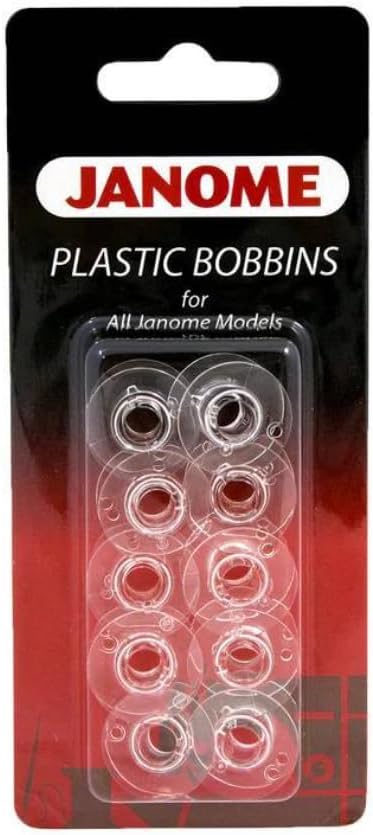
This Janome package contains 10 clear plastic replacement bobbins for compatible Janome sewing machines. The transparent construction makes the thread supply visible without removing the bobbin. Amazon identifies the set with Janome part number 200122614 and sells it as a replacement bobbin pack for Janome machine systems.
Check On AmazonIf you click this link and buy, we earn a commission at no additional cost to you.
Treat Durability, Noise, and Tension Claims as Unproven Without Controlled Tests
Community discussions often frame metal as tougher, plastic as quieter, or one material as better for tension. Those claims may reflect individual experiences, but they are not universal findings unless the machine, class, bobbin geometry, thread, winding method, sewing conditions, and comparison procedure are held constant. A metal bobbin that performs well in one hook system tells you little about a plastic-only machine. The same limit applies to a plastic bobbin that runs quietly in another model.
Durability also needs a defined failure condition before it can be compared responsibly. A bent metal bobbin, chipped plastic flange, warped bobbin, worn surface, or damaged winding hole are different failure modes, and frequency matters more than anecdotes about what seems stronger. Noise needs controlled machine speed and setup, while tension behavior requires the same thread path, winding quality, and sewing conditions. Without that evidence, the honest buying conclusion is compatibility first and performance unknown.
| Claim | What would be needed to test it fairly |
|---|---|
| Metal lasts longer | Same machine, approved class, repeated use, defined damage criteria, and enough cycles to compare wear |
| Plastic is quieter | Same machine, speed, thread, winding, stitch, material, and sound-measurement conditions |
| One material gives better tension | Same machine, approved bobbin geometry, thread, winding, upper setup, fabric, stitch, and repeated samples |
This claims ledger is useful even if you never run those tests. It shows why a confident material ranking cannot be built from mixed machines and mixed conditions. When the manufacturer permits only one material, testing the prohibited alternative under power is unnecessary and inappropriate. When both are supported, a controlled comparison can answer a narrower question for that specific machine.
Brother Shows How Plastic Can Be a Machine Requirement
Brother’s support entry for a large group of home sewing and embroidery models specifies the SA156-type plastic Class 15-type bobbin. The same entry tells owners to use the included bobbin or the same type and states that metal bobbins should not be used. That is stronger evidence than a generic article claiming plastic is preferable for modern machines. It establishes a restriction only for the machines covered by that Brother support information.
The example is useful because class and material appear together. A shopper could find a metal bobbin marketed with Class 15 wording and still have the wrong replacement for a Brother machine that requires the SA156-type plastic construction. The class name narrows the search, but it does not erase the material rule. Buying the familiar class in the wrong construction would therefore skip part of the manufacturer’s compatibility specification.
Warning: Do not test a material the manufacturer prohibits just to see whether it will sew. If a replacement bobbin binds, scrapes, sits incorrectly, or creates abnormal lower-area contact, stop and recheck the class, construction, and machine documentation before operating the machine.
Do not turn this Brother example into a loading-layout rule. Some top-loading machines from other families and eras use different bobbin constructions, including metal designs, so the position of the bobbin is not enough to establish material. The useful takeaway is narrower and more reliable: manufacturer support can make material mandatory for a defined model group. Check that evidence before buying substitutes.
Singer Shows Why the Same Class Name May Still Need a Material Check
Singer’s current bobbin guidance makes the material distinction unusually visible. It lists Class 15 transparent bobbins and warns against substituting Class 15 metal or Class 15J, while its Class 15 metal section says metal bobbins must be used in models that come with that style. The same guide separates transparent Class 66 from metal Class 66 and warns against substituting one for the other in machines intended for the other construction. A shared class number therefore does not automatically create two interchangeable material options.
This is exactly why “metal bobbin vs. plastic bobbin” should be treated as a compatibility question before it becomes a preference question. The label on the package needs to agree with both the class and the construction expected by the machine. If the manual calls for Class 15 transparent, a Class 15 metal bobbin is not validated merely because the diameter appears similar. Singer’s own instructions place the material distinction inside the replacement decision.
| Manufacturer evidence | Allowed construction | Prohibited shortcut |
|---|---|---|
| Brother machines covered by SA156 support | SA156-type plastic Class 15-type | Do not replace with metal simply because the class appears similar |
| Singer Class 15 transparent systems | Class 15 transparent as specified | Do not substitute Class 15 metal or Class 15J |
| Singer Class 15 metal systems | Class 15 metal where the machine comes with that style | Do not substitute Class 15 transparent or Class 15J |
| Singer Class 66 systems | Transparent or metal according to the specific machine | Do not swap material across the documented Class 66 construction |
The evidence card should be read as examples, not a universal cross-brand chart. Brother and Singer can define their supported replacements differently, and another manufacturer may use different terminology or part numbers. Always return from the generic class label to the machine-specific source before purchasing. The pattern to copy is the verification method, not another brand’s substitution rule.

This SINGER package contains four empty Class 15 bobbins made from transparent plastic. SINGER lists them as replacements for compatible domestic sewing machines from SINGER and several other manufacturers and directs users to confirm the correct bobbin size in the machine manual. The transparent construction makes the remaining thread visible while the bobbin is installed.
Check On AmazonIf you click this link and buy, we earn a commission at no additional cost to you.
Reject Material Substitution Based on Loading Layout Alone
Top-loading and front-loading layouts describe how the bobbin area is accessed, but they are not material specifications. One common shortcut says top-loading means plastic, while another says front-loading means metal. Current manufacturer documentation does not support either rule across all machines. Model family, hook design, bobbin class, sensing system, and the specified replacement matter more than loading direction alone.
Singer’s own guidance illustrates the problem because transparent and metal versions appear across different class families and model groups. That diversity breaks any simple rule based on insertion direction alone. A clear top cover may make a transparent bobbin convenient to monitor, while a removable bobbin case may make another construction look familiar. Neither layout detail authorizes a material unless the machine documentation supports it.
The correct sequence is simple enough to use while shopping. Read the machine model, confirm the class or part, check the specified construction, and only then compare candidate packages. If a retailer filter groups bobbins by top-load or front-load, use that filter as navigation rather than final evidence. The manufacturer record for the machine still gets the last word.
This approach also prevents old rules of thumb from being carried into newer machines. Loading layouts can persist while sensors, bobbin holders, dimensions, and compatible parts change across generations. A familiar-looking lower area therefore should not be treated as proof that a familiar material remains correct. Verify the part instead of reverse-engineering compatibility from the layout.
If the Bobbin Class Is Unknown, Stop the Material Comparison
The unknown-class problem is different from choosing between two already verified materials. It usually appears with a used machine, a mixed accessory box, or loose bobbins whose history is unknown. In that situation, do not let material become an identification shortcut simply because one loose bobbin resembles the part already installed. The task is to reconstruct the machine’s required bobbin system before deciding what the loose parts are worth.
The broader bobbin compatibility verification process is the better starting point when the original part is uncertain. Use the manual, manufacturer support page, accessory list, or exact part number to identify the required system. Dimensions and appearance can help sort candidates, but they should not replace model evidence. Once the class is secure, this material comparison becomes useful again.
A used machine deserves extra care because the bobbin already installed may not be original. Someone else’s successful use of a look-alike bobbin does not establish that it is the specified part, especially when the machine’s service or accessory history is unknown. Treat the installed bobbin as a sample until the machine documentation confirms it. That prevents an old substitution from becoming the standard for every future purchase.
Loose bobbins can still be sorted by what is plainly observable before any compatibility claim is made. Transparent or opaque molded parts can be separated from obviously metallic parts, and damaged, warped, or heavily burred pieces can be removed from the candidate pile. Those observations identify material or condition only; they do not identify class, machine fit, or permission to substitute. Keep an unlabeled bobbin in the “unknown” group until its dimensions, profile, and machine documentation point to the same answer.
When official documentation is difficult to find, record the full model number and contact manufacturer support rather than guessing from color or weight. A serial number may help identify a production variant, but it is not a bobbin specification by itself. Keep the material field unresolved until the class and supported construction can be tied to the machine. Unknown is a valid answer during research.
Keep Class 15J and Class 66 Material Questions Model-Specific
Class 15J and Class 66 deserve separate attention because their names are common enough to encourage visual substitution. If the machine requires 15J, use the Class 15J bobbin compatibility checks to establish the profile and machine fit before asking whether another material is permitted. If the machine requires Class 66, use the Class 66 bobbin identification process for the same reason. Material comes after the class-specific evidence, not before it.
Singer’s guidance is especially useful here because it separates Class 66 transparent from Class 66 metal and says each construction belongs to specific machines. That is a direct warning against turning the shared class number into permission to swap materials. A similar-looking bobbin with the same broad class label may still be the wrong construction for the model in front of you. Record the exact material instruction alongside the class rather than storing only the number.
This same habit works for other machine-interface accessories. A generic name is useful for finding candidates, but the exact machine controls fit, construction, and any permitted substitution. The broader sewing machine accessory compatibility framework applies the same evidence order to feet, plates, cases, and other fitted parts. Compatibility becomes easier when each field has a clear source.
For buying purposes, this keeps the decision clean. You are not choosing between metal and plastic in the abstract; you are choosing among the constructions the machine actually supports. If only one material is documented, the comparison ends there. If both are supported, then secondary preferences can be evaluated without risking a basic fit error.
Prewound bobbins add another layer because the core material, class, and winding format arrive as one packaged component. A prewound product labeled with the right class still needs to match the construction the machine permits, just as an empty replacement bobbin does. Do not assume that “prewound” creates an exception to a plastic-only or metal-only restriction. Establish the machine’s supported class and material first, then evaluate the prewound format separately.

The SINGER 2141 package contains four empty transparent plastic Class 66 bobbins. The bobbins have the curved Class 66 profile and are intended for compatible SINGER models and selected top drop-in bobbin machines. SINGER distinguishes this transparent construction from its metal Class 66 bobbins and directs users to match the replacement to the machine specification.
Check On AmazonIf you click this link and buy, we earn a commission at no additional cost to you.
Final Thoughts: The Right Material Is the One the Machine Supports
Metal and plastic bobbins are not universal upgrade paths for each other. Brother’s SA156 guidance shows a model group where plastic is required and metal is prohibited, while Singer’s guidance shows material-specific restrictions within Class 15 and Class 66 families. Those examples make the buying order clear: machine first, class second, material third. Only after all three agree should a bobbin be treated as a valid replacement candidate.
Leave durability, noise, weight, visibility, and tension preferences until the compatibility question is settled. If the class is unknown, return to class identification; if the machine uses 15J or Class 66, verify that class and its permitted construction before shopping. Do not test a prohibited material under power or rely on loading layout as a shortcut. The right bobbin material is the one supported for the exact machine, not the one that wins a generic pros-and-cons list.
FAQs
🧵 Can I use metal bobbins instead of plastic?
Only when the documentation for your machine permits that construction. Some manufacturers explicitly prohibit metal bobbins in models designed for a particular plastic bobbin.
⚙️ Are metal bobbins better than plastic bobbins?
There is no universal winner. Compatibility comes first, and claims about durability, noise, or tension need controlled testing on a machine that supports both materials.
👁️ Does a clear plastic bobbin mean it belongs in a top-loading machine?
Not by itself. Transparency can make thread supply easier to see, but loading layout and visibility are not enough to prove the correct class or construction.
🔩 Can metal and plastic bobbins share the same class number?
Yes, and that is why the material still needs verification. Singer, for example, distinguishes metal and transparent versions within Class 15 and Class 66 and restricts substitution by machine.
📖 What should I check before buying replacement bobbins?
Confirm the full machine model, required bobbin class or part number, and the material the manufacturer specifies. Then check whether any alternate construction is explicitly allowed.
🛑 Should I try a metal bobbin to see if it fits?
Not when the manufacturer prohibits it or compatibility is unknown. Do not operate the machine with an unverified bobbin, especially if it binds, scrapes, sits incorrectly, or creates abnormal contact.
References and Sources
- Brother bobbin type support: Confirms SA156-type plastic Class 15-type bobbins for the covered models and states that metal bobbins should not be used.
- Singer bobbin selection guidance: Defines material-specific Class 15 and Class 66 restrictions and warns against unsupported substitutions.