An L-style bobbin can look deceptively close to a Class 15 bobbin from above, yet the two are not interchangeable simply because their diameters are similar. The reliable way to buy a replacement is to start with the exact machine model, then confirm the bobbin class or manufacturer part number before using dimensions as supporting evidence. L-style bobbins are also distinct from the larger M-style format, and manufacturer exceptions matter more than generic substitution charts. By the end, you will know how to verify L-style bobbin compatibility without relying on appearance alone.
The Top View Hides the Compatibility Difference
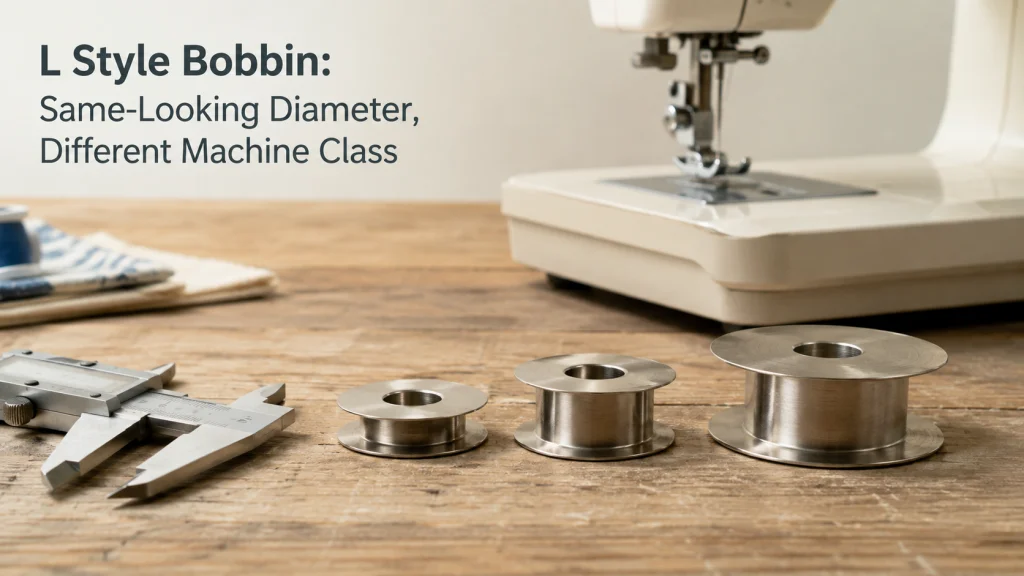
An L style bobbin and a Class 15 bobbin can look close enough from above to invite the wrong conclusion. Both are compact, round bobbins, and commonly published dimensions place them in nearly the same diameter range. Turn them sideways, though, and the more useful distinction becomes easier to see because L-style is noticeably shallower from flange to flange. That side profile is why diameter-only shopping can send an otherwise careful owner toward the wrong replacement.
The important point is not that one visual clue can identify every bobbin. A sewing machine that specifies an L-style bobbin needs the class, material, and part information required by that exact machine, not whichever bobbin drops into the opening most easily. Janome provides a useful example because its L-Class metal bobbin is restricted to select machines and is explicitly separated from the company’s standard plastic bobbin. If the machine class is still uncertain, start with how to verify bobbin compatibility before treating L-style as the answer.

This JUKI package contains five metal Size L bobbins made for TL Series sewing machines. The bobbins have a winding notch and are identified by JUKI part number A9851D250A0. Compatible models listed for this bobbin family include the TL-98 series, TL-2000Qi, TL-2010Q, TL-2200QVP Mini, and TL-18QVP.
Check On AmazonIf you click this link and buy, we earn a commission at no additional cost to you.
Confirm the Exact Machine Names L-Style or an Equivalent Part
L-style bobbin compatibility begins with the machine, not the loose bobbin in your hand. Check the exact model number on the machine and then look for the bobbin specification in the instruction manual, accessory list, parts documentation, or manufacturer compatibility page. The strongest evidence is a direct statement that the model uses L-style or L-Class, or a manufacturer bobbin part number that can be traced back to that model. A generic listing that says “fits many sewing machines” is weaker evidence because one brand can use several bobbin systems across different model families.
Janome’s documentation shows why this model-first check matters. Its L-Class page names select 1600P-series and multi-needle machines, while also stating that the L-Class metal bobbin is not a substitute for the standard plastic Janome bobbin. The 1600P-QC manual goes further by instructing owners to use the exclusive bobbin specified for that model. Those statements are stronger than a diameter match because they connect the replacement directly to the hook and bobbin-case system the manufacturer designed.
| Evidence to record | What it tells you | How much weight to give it |
|---|---|---|
| Exact machine model | Identifies the specific bobbin system being checked | Essential starting point |
| Manual names L-style or L-Class | Directly identifies the required class | Strong evidence |
| Manufacturer bobbin part number | Connects the replacement to a documented component | Strong evidence |
| Generic diameter or height | Supports identification after the model is known | Secondary evidence |
| Retailer fit claim without model proof | May suggest a lead but does not establish fit | Verify independently |
Record the evidence before buying multiples, especially when the original bobbin is missing or may already be an aftermarket replacement. A short model-and-part ledger is more useful than a drawer full of look-alike bobbins because it preserves the reason a replacement was judged compatible. It also makes later reordering easier without turning every purchase into another visual identification exercise. For a broader view of how bobbins fit into the machine’s accessory system, see sewing machine bobbin compatibility basics.
Read Diameter and Height as Supporting Evidence
Dimensions are useful once the machine documentation has narrowed the field. Generic bobbin charts commonly place L-style at about 20.3 mm in diameter and about 8.9 mm from flange to flange, while Class 15 is close in diameter but substantially taller, commonly around 11.5 to 11.7 mm. Published values can vary slightly by source, measuring method, and terminology, so a decimal measurement should not override an exact manufacturer fit statement. Think of dimensions as a confirmation tool rather than a universal compatibility rule.
The side view is especially helpful because the height difference is much more obvious than the top-view diameter difference. If two loose bobbins look almost identical from above, set them on a flat surface and compare the flange-to-flange height without forcing either one into a machine. A caliper can document the difference more clearly, but even a careful side-by-side view may reveal that one bobbin is several millimeters taller. That observation can rule out an obvious mismatch, but it still does not prove the shorter bobbin belongs in the machine.
| Side-profile check | L-style | Class 15 |
|---|---|---|
| Diameter | About 20.3 mm in common generic charts | Very close to L-style in common generic charts |
| Flange-to-flange height | About 8.9 mm | Usually about 11.5 to 11.7 mm |
| Most useful visual distinction | Noticeably shallower side profile | Taller side profile |
| Enough to prove compatibility? | No, verify exact machine documentation | No, verify exact machine documentation |
Note: Color and surface material are not reliable class identifiers. A shiny metal bobbin, a clear plastic bobbin, or an opaque plastic bobbin may provide a useful clue only when the exact machine documentation specifies that construction. Appearance alone cannot tell you that two bobbins share the same class or can substitute for each other. Treat material and finish as supporting observations after the model-specific fit evidence is known.
Do not turn this table into a tolerance chart. Small differences in molding, metal forming, labeling, or measurement do not create permission to substitute one class for another. The machine’s hook, case, and bobbin geometry work as a system, so the correct question is whether the replacement matches the documented class or part for that system. Dimensions help you catch mistakes after that evidence is established.
Class 15 vs. L-Style Bobbin: Same-Looking Diameter, Different Height
The phrase “Class 15 vs L style bobbin” usually appears when two bobbins seem to share the same footprint. That visual similarity is real enough to cause confusion, but the height difference changes how the bobbin occupies the case or hook area. A Class 15 bobbin is generally taller than an L-style bobbin, so treating them as one class based on diameter alone skips a major physical difference. The fact that one bobbin may appear to sit inside another system does not establish correct operating clearance, thread path, or tension behavior.
A useful hypothetical check is a machine whose manual clearly specifies L-style metal bobbins. If a taller Class 15 bobbin will not seat normally, that mismatch confirms only that it is wrong, not that every shorter bobbin is therefore correct. The reverse situation is equally important because a shallow bobbin may appear physically loose inside a space designed around a taller class. Compatibility should already be established before any normal owner-level insertion check, and the machine should never be used as a gauge for forcing an uncertain part to fit.
The practical shopping rule is therefore one-directional only in the evidence chain: machine documentation first, physical dimensions second. Do not reverse that logic and assume that a bobbin with the right diameter must belong to the machine. This distinction is especially important when replacement listings group several visually similar domestic bobbin types together. A precise class name is useful only when it is tied back to the exact machine.

These New brothread prewound bobbins are Size A Class 15 SA156 bobbins with clear plastic sides. The package contains 144 white bobbins wound with 60S/2 spun polyester thread in 90WT. Amazon lists compatibility with selected Brother, Babylock, Janome, Kenmore, JUKI, Elna, Singer, and other embroidery and sewing machines.
Check On AmazonIf you click this link and buy, we earn a commission at no additional cost to you.
Separate L-Style From the Larger M-Style Format
M-style bobbins are easier to separate from L-style because the diameter difference is more obvious. Generic bobbin references place M-style at roughly 24.9 mm in diameter, compared with roughly 20.3 mm for L-style, so the M format has a visibly larger footprint. That does not mean every large bobbin is M-style, because manufacturers can use proprietary or version-specific bobbins that happen to be large. It does mean an M-style candidate should not be collapsed into the L-style category just because both appear in quilting, embroidery, or specialist-machine discussions.
Janome’s own high-capacity bobbin examples illustrate the broader lesson. The company documents different jumbo bobbin versions for particular machines and states that those versions correspond to specific bobbin races and cases rather than functioning as universal large-bobbin replacements. That is exactly the kind of manufacturer-specific exception a generic size chart cannot resolve. When a machine uses a larger or specialist bobbin, identify the machine’s own class or part number instead of inferring the answer from the work the machine performs.
If you are comparing accessories across machines, keep the same evidence standard for each one. A larger bobbin may hold more thread, but capacity is not proof of fit and should not override the required geometry. Likewise, a smaller L-style bobbin should not be selected merely because the machine is described as high speed or professional. The replacement class has to come from the machine documentation or an equivalent manufacturer compatibility record.

The Blooy 18034 set contains 10 large M-type steel sewing machine bobbins. The listing identifies them as replacement bobbins for a range of industrial machines from brands including Brother, Consew, JUKI, and others. Model compatibility is provided by machine family, making the set intended for equipment that specifically uses the 18034 M-style bobbin format.
Check On AmazonIf you click this link and buy, we earn a commission at no additional cost to you.
Use Manufacturer Part Numbers When the Generic Class Is Missing
Not every manual gives the reader a clean generic label such as L-style, Class 15, or M-style. Some manufacturers document the replacement primarily through an accessory number, service part number, or model-specific bobbin listing. In that situation, the part number can be more useful than trying to translate the bobbin into a generic class that the manufacturer never uses. The goal is to preserve the documented fit relationship, not to force every bobbin into the same naming system.
Janome provides a concrete example because its L-Class documentation pairs a named bobbin type with part number 761094104 for a defined group of machines. The useful lesson is not to memorize that number for every Janome, but to connect a part number to the exact model list published with it. If a nearby machine carries a different bobbin specification, do not resolve the difference by guessing from appearance. Use the manufacturer’s support information for the exact machine and record which document established the replacement.
| Exact-model evidence ledger | Example entry |
|---|---|
| Machine | Janome 1600P-series model, exact suffix recorded |
| Generic bobbin wording | L-Class where the manufacturer uses that term |
| Part number | Record the number shown for the exact model and region |
| Material | Metal when specified by the manufacturer |
| Primary proof | Manual or manufacturer compatibility page |
| Secondary check | Dimensions and side profile |
This ledger is deliberately boring, and that is a strength. Bobbin compatibility is a poor place to rely on memory when several classes share a similar diameter or when one model family contains exceptions. Recording the model, part number, material, and source gives the next replacement purchase a reproducible path. The same method also applies to other machine-interface parts covered in sewing machine accessory compatibility.
An older machine with no manual needs the same evidence order, not a looser one. Record the complete model designation and serial number from the machine before searching the manufacturer’s support archive or contacting manufacturer support, because suffixes and production variants can matter even when two machines share a family name. A serial number can help support staff identify the exact machine, but it does not by itself prove which bobbin class fits unless the manufacturer connects that serial or model to a documented part. If official documentation cannot establish the bobbin, keep the part unidentified rather than promoting a look-alike replacement to confirmed compatibility.

The Brother SA159 package contains five metal bobbins designed for selected Brother PQ and PR series machines. Brother identifies SA159 as a Class 96 Type L metal bobbin and specifies it for models including the PQ1500 series and PQ1600S. The manufacturer recommends using the specified bobbin type rather than substituting bobbins intended for other machine systems.
Check On AmazonIf you click this link and buy, we earn a commission at no additional cost to you.
Reject One-Way Substitution Rules Unless the Exact Model Documents Them
Online bobbin advice sometimes turns physical possibility into a rule, such as claiming that one shallower class can always replace a taller class even when the reverse is impossible. That reasoning is not strong enough for a machine-interface component. A bobbin can physically enter a space and still be the wrong class, material, profile, or mass for the hook and case the manufacturer specified. Treat any one-way substitution claim as unverified until the exact machine documentation explicitly allows it.
Janome’s L-Class wording is a useful counterexample to broad substitution logic because the company specifically restricts the metal bobbin to select machines and says it cannot replace the standard plastic Janome bobbin. The restriction is model- and system-specific, which is exactly why a generic “same diameter” rule is unsafe as purchasing evidence. Other manufacturers may document different relationships, so the lesson is not that Janome’s rule applies everywhere. The lesson is that the manufacturer can define compatibility more narrowly than a generic class chart suggests.
- Verify the exact machine model before comparing bobbin classes.
- Use the manual or manufacturer compatibility page as the primary fit evidence.
- Match the specified material when the documentation distinguishes metal from plastic.
- Use diameter, height, and side profile to support identification, not to overrule the documentation.
- Reject retailer substitution claims that cannot be traced to the exact machine.
If an owner already has a bobbin that seems to work but cannot establish where it came from, treat it as an unidentified sample rather than proof of the correct class. Compare it with the documented replacement, not the other way around. That approach prevents an old aftermarket mismatch from becoming the reference standard for every future purchase. It also keeps the decision at owner level without drifting into hook adjustment or internal service work.
Treat Prewound L-Style Bobbins as a Separate Purchase Check
Prewound bobbins are one reason L-style terminology appears so often outside machine manuals. Thread suppliers commonly sell prewound formats in L-style, Class 15, and M-style, which makes the class name visible before the buyer has checked the machine. That order should be reversed: confirm that the owned machine accepts the relevant L-style format first, then evaluate the prewound product on its own terms. The fact that a prewound bobbin is labeled L-style does not prove that every machine using a similarly sized bobbin accepts that product.
Material, core construction, thread type, and manufacturer restrictions can still matter after the class is known. A machine that specifies a particular metal bobbin should not automatically be treated as compatible with any prewound L-style core simply because the outer dimensions appear close. Likewise, a prewound listing that names several machine families needs to be checked against the exact model rather than accepted as a universal fit chart. Once L-style compatibility itself is established, continue with choosing compatible prewound bobbins for the separate questions that come with a wound replacement.
The distinction keeps two decisions from being mixed together. First, determine whether the machine’s bobbin system is genuinely L-style or an exact manufacturer equivalent. Second, determine whether the specific prewound construction is allowed for that machine and use. Solving the first question does not automatically solve the second.
That sequence is especially useful for owners who inherit a machine with no spare bobbins. Instead of starting from a package label, start from the machine’s model documentation, establish the required bobbin, and only then compare available wound or empty replacements. It takes a few more minutes on the first purchase and makes later replacements much less ambiguous. It also keeps a convenient package format from being mistaken for compatibility evidence.

This New brothread package contains 144 white Type L SA155 prewound bobbins with clear plastic sides. The bobbins are wound with 60S/2 spun polyester thread in 90WT and are intended for selected commercial embroidery and home embroidery or sewing machines. Amazon specifically directs buyers to check the machine manual before purchasing because compatibility depends on the machine.
Check On AmazonIf you click this link and buy, we earn a commission at no additional cost to you.
Keep Machine-System Buying Separate From Bobbin Replacement
L-style bobbins appear in domestic-adjacent straight-stitch machines, multi-needle embroidery equipment, and other specialist systems, but the bobbin should not become the reason to choose one machine type over another. A bobbin class tells you something about a component interface, not whether the machine’s feed system, stitch capability, workspace, controls, service access, or project fit meets your needs. Once the machine is already identified, the bobbin question becomes narrow and practical. Before the machine is chosen, the larger equipment decision belongs to a different comparison.
This boundary also prevents misleading shortcuts such as assuming every straight-stitch machine uses L-style or every embroidery machine uses the same prewound core. Janome alone documents standard plastic bobbins, L-Class metal bobbins, and larger version-specific bobbins across different systems. That variety is enough to show why machine category cannot replace model evidence. The bobbin should follow the machine specification, not define the machine purchase.
For the owner standing beside a known machine, that separation simplifies the task. You do not need to re-evaluate the entire machine category just to replace a bobbin. You need the model number, the manual or manufacturer parts record, and a replacement that matches the documented interface. If that documentation does not identify L-style, do not promote it from candidate to compatible part based on shape alone.
Final Thoughts: Use the Class Named for the Machine, Not the Nearest Diameter
L-style bobbins are a good example of why sewing-machine compatibility cannot be reduced to a top-view measurement. The class can sit close to Class 15 in diameter while remaining clearly different in height, and M-style introduces a larger format that belongs to another set of systems. Those measurements are useful for identification, but they stay secondary to the exact machine manual, manufacturer compatibility listing, or documented part number. A replacement decision is strongest when all of those signals point to the same bobbin.
If the bobbin class is still unknown, do not guess from the loose part or from a retailer’s broad fit list. Return to the machine model and establish the required class first, then compare dimensions and material as a cross-check. If L-style is already confirmed and the next purchase is specifically prewound, move on to the separate prewound compatibility questions rather than reopening the class decision. That evidence order is slower than matching by eye, but it is far more dependable.
FAQs
🧵 Is an L-style bobbin the same as a Class 15 bobbin?
No. They are commonly described as having very similar diameters, but L-style is noticeably shallower from flange to flange. Use the exact machine documentation to determine which class belongs in the machine.
📏 Can I identify an L-style bobbin by dimensions alone?
Dimensions can support identification, but they should not be the only proof of compatibility. Confirm the machine model, documented class or part number, and required material before relying on a measurement.
⚙️ Can an L-style bobbin replace Class 15 if it physically fits?
Do not assume so. Physical entry into the bobbin area does not prove correct clearance, material, or compatibility with the hook and case. Only use a substitution when the documentation for the exact machine permits it.
🔩 Are all L-style bobbins metal?
No. L-style products can appear in different constructions, including prewound formats, while some machines specifically require a manufacturer-designated metal bobbin. Match the material and construction required for the exact model rather than buying by class name alone.
🪡 How is an M-style bobbin different from L-style?
M-style is substantially larger in diameter than L-style in common generic bobbin charts. That makes it easier to distinguish visually, but exact machine documentation still controls compatibility because large proprietary bobbins also exist.
📖 What if my manual gives a part number but never says L-style?
Use the manufacturer part number as the primary replacement evidence. You do not need to force a generic class label onto a bobbin when the manufacturer already documents the exact compatible part for your model.
References and Sources
- Janome L-Class bobbin compatibility: Confirms select-model use, L-Class part information, and the restriction against substituting the standard plastic Janome bobbin.
- Janome 1600P-QC instruction manual: Confirms that the model uses its specified exclusive bobbin and provides the owner-level bobbin removal and installation context.
- Superior Threads bobbin styles: Provides the generic L-style, Class 15, and M-style comparison used as secondary identification evidence.