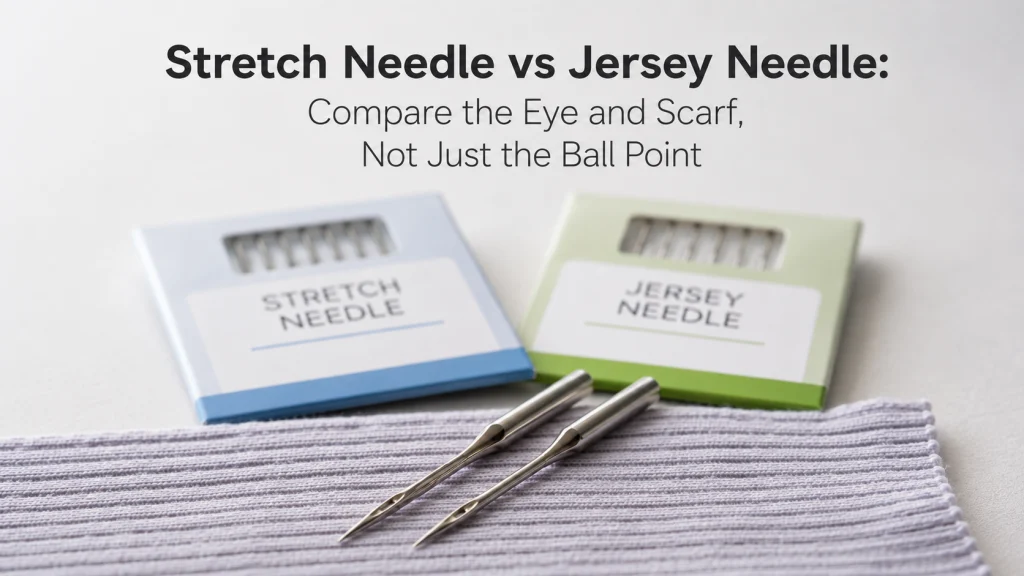
Jersey or Ball Point and Stretch needles can look almost interchangeable because their documented point shapes can be similar, but that similarity does not make the two product types identical. The useful purchase sequence is to confirm the needle system accepted by the exact machine, compare the documented eye and scarf geometry, then use the material’s elasticity as one input rather than relying on a fabric name alone. Manufacturer documentation is especially important because naming, sizes, and application language can vary by needle maker. Once the compatible needle family is chosen, stitch settings and handling belong to the sewing setup stage, while persistent skipped stitches belong to troubleshooting.
Similar point shapes can still belong to different products
Choosing between a Stretch needle and a Jersey needle becomes confusing as soon as both packages describe a medium ball point. Current SCHMETZ documentation separates the two by more than point shape: the Stretch design has a different eye and scarf and a more specific application around highly elastic materials. That means the package name and point description alone cannot settle the purchase.
That distinction matters because a buyer can make the wrong comparison in either direction. Choosing only by the word “knit” ignores how much the material stretches and what the needle maker says the geometry is designed to handle, while choosing Stretch automatically for every knit turns a conditional product choice into a universal rule. The safer route is to prove machine fit first, then compare the two documented product families on the features that actually differ.
Confirm the machine’s needle system first
Needle type is not the first gate. The machine manual controls which needle system, and sometimes which size range or special needle forms, the machine accepts. A package can describe exactly the fabric application you want and still be the wrong purchase if its system does not match the machine.
SCHMETZ currently identifies its Jersey/Ball Point home-sewing needle as system 130/705 H SUK and its Stretch home-sewing needle as 130/705 H-S. Those labels describe two needle variants within the home-sewing family, but the exact machine manual still has to permit the underlying system before either product type enters the comparison. If that basic fit has not been established, start with whether sewing machine needles are universal rather than guessing from shank appearance.
This gate keeps compatibility separate from fabric preference. It also prevents a visually similar needle from being treated as proof of fit, which is the same principle used across sewing machine accessory compatibility decisions.
Define Jersey or Ball Point and Stretch as product types
For the SCHMETZ home-sewing range, Jersey and Ball Point are two names attached to the same product family. Its current Jersey/Ball Point documentation pairs that family with a regular eye and use on knits and some stretch knit fabrics. Stretch is listed separately with its own system suffix, eye and scarf geometry, and application language.
That makes “ball point” a poor shortcut when the buyer is really deciding between two packages. A Jersey needle or Stretch needle decision should use the exact product name, system designation, geometry, application statement, and available size instead of treating every rounded knit-oriented point as one interchangeable class. Other manufacturers may use different naming, so their own documentation should control when the package is not SCHMETZ.
| Purchase check | Jersey or Ball Point | Stretch |
|---|---|---|
| Point in current SCHMETZ documentation | Medium ball point | Medium ball point |
| Eye | Regular eye on the current Jersey product description | Smaller eye; SCHMETZ’s comparison also describes it as shorter and narrower |
| Scarf | Not presented as the defining difference in the Jersey product description | Deep scarf |
| Stated application | Knits and some stretch fabrics | Elastic materials and highly elastic knitwear |
The table is a geometry and application card, not a performance ranking. It shows why a shared point description can still lead to different purchase choices without claiming that either needle will always sew a particular knit better.

These SCHMETZ Jersey needles use the 130/705 H SUK system and have a medium ball point with a regular eye. The size 80/12 package is intended for knit and some stretch-knit applications. They are a direct example of the Jersey or Ball Point product family discussed in this comparison.
Check On AmazonIf you click this link and buy, we earn a commission at no additional cost to you.
Use point geometry to rule out the wrong comparison
Point shape is useful here because it prevents a false either-or decision. In the current SCHMETZ families, the documented point does not separate Jersey from Stretch, so a buyer who treats “ball point” as the deciding feature is comparing the wrong characteristic. The point establishes that both products are intended to enter knit-oriented applications without proving that their remaining geometry or application range is the same.
That distinction changes what to inspect next on the package or manufacturer page. Once the point no longer differentiates the two candidates, the purchase decision should move to the system suffix, eye, scarf, stated application, and available size. In other words, point geometry is a screening step here, not the final selector.
Compare the eye and scarf geometry
SCHMETZ’s direct comparison states that the Stretch needle has a shorter, narrower eye and a deeper scarf than its Jersey needle. The current Stretch product page likewise describes a smaller eye and deep scarf. Those concrete differences are easy to miss when the buyer stops at the point description.
The scarf is the recessed area behind the needle blade near the eye, where the machine’s hook passes as a stitch forms. Geometry in this area is therefore part of how a needle is designed to interact with stitch formation, but that does not justify predicting universal results from the shape alone. Machine design, thread, material, needle condition, insertion, and setup still matter once sewing begins.
Note: The manufacturer attributes the Stretch eye and scarf geometry to reducing skipped stitches in highly elastic applications. That is a product-design claim for the documented needle family, not evidence that every skipped stitch means the wrong needle type was purchased.
The practical takeaway is narrower: once point shape stops differentiating the candidates, compare the eye and scarf instead of assuming the packages are duplicates. If a different task calls for a sharp, acute point, how a Microtex needle differs is a separate needle-family decision.
Compare the manufacturers’ stated application ranges
Current SCHMETZ guidance places Jersey/Ball Point on knits and some stretch fabrics, while Stretch is directed toward elastic materials and highly elastic knitwear, especially materials containing Lycra, Spandex, or elastic. That wording creates an overlap rather than a hard wall. Some stretchy fabrics sit inside the stated scope of both families.
The overlap is why neither “Jersey is enough for every knit” nor “Stretch is better for every knit” is supportable. SCHMETZ itself says the two types are sometimes interchangeable and recommends testing the needle, thread, and fabric combination for stitch quality. The purchase decision should therefore start with the documented intended application and remain conditional where the manufacturer leaves overlap.

These SCHMETZ Stretch needles use the 130/705 H-S system and come in size 90/14. Their design combines a medium ball point with a smaller eye and deep scarf for highly elastic knit applications. They are intended for materials such as knits containing Lycra, Spandex, or elastic when the machine accepts the required needle system and size.
Check On AmazonIf you click this link and buy, we earn a commission at no additional cost to you.
Use elasticity as a purchase input, not a fabric-name shortcut
A generic fabric name such as jersey does not fully describe how a particular material behaves. Two fabrics sold under similar names can differ in fiber content, recovery, stretch percentage, weight, and construction. This article does not turn those properties into a fabric-selection lesson, but the amount and source of elasticity are relevant because the needle manufacturer uses high elasticity and elastic fibers to distinguish the Stretch application.
Use the material information only far enough to route the needle choice. If the material is an ordinary knit and the needle maker lists Jersey for that application, Jersey remains a supported candidate. If the material is highly elastic or contains an elastic fiber specifically named in the Stretch documentation, the Stretch family becomes the more directly documented candidate, provided the machine system and size are also acceptable.
| Input | Next purchase check |
|---|---|
| Needle system not confirmed | Stop and verify the exact machine manual before comparing Jersey and Stretch. |
| Ordinary knit application within the Jersey documentation | Keep Jersey in consideration, then verify size and the exact needle maker’s instructions. |
| Highly elastic knitwear or elastic fiber named by the Stretch documentation | Give Stretch priority as the more directly stated application, then verify system and size. |
| Both product families appear to cover the material | Treat the overlap as conditional and use a controlled sample after purchase rather than claiming universal interchangeability. |
This flow deliberately stops before stitch length, stitch selection, presser-foot pressure, tension, or fabric handling. Those are sewing setup decisions, not evidence for which needle package belongs in the cart.
Check available sizes against the exact machine
Needle type and needle size answer different questions. Type routes the buyer toward a geometry and application family, while size has to work with the thread, material conditions, and limits of the exact machine. A correct Stretch or Jersey family in an unsuitable size is not a complete selection.
SCHMETZ’s current needle guide lists Jersey/Ball Point in sizes 70/10, 80/12, 90/14, and 100/16, while the same guide lists Stretch in 65/9, 75/11, and 90/14, plus a twin form. Those ranges can change and they should not be copied into a universal size chart for every brand. Use them only to see that the two families do not necessarily offer identical size choices, then confirm the exact machine manual and current package before purchase.
If the remaining question is how needle size relates to material and thread rather than which of these two product types to buy, return to the broader sewing machine needle types before making the final size choice.

This SCHMETZ Twin Stretch needle places two Stretch needles on one shared shank and uses the 130/705 H-S ZWI system. The 2.5/75 configuration creates two parallel rows of stitching and is designed for elastic and highly elastic knit applications. Confirm that the exact machine permits this twin-needle system, spacing, and size before use.
Check On AmazonIf you click this link and buy, we earn a commission at no additional cost to you.
Treat interchangeability as conditional, not universal
There is a useful middle ground between “these needles are the same” and “they can never substitute for each other.” Current SCHMETZ material explicitly says Jersey and Stretch are sometimes interchangeable. The same source also documents different eye and scarf geometry and different primary application language, so interchangeability cannot be assumed from point shape alone.
That makes evidence hierarchy important. First use the machine manual to establish system fit. Next use the exact needle manufacturer’s current documentation to compare the two families. Then use the actual material and a controlled sample to see whether the selected combination produces acceptable stitches. A forum comment or a package nickname can identify a question worth checking, but neither overrides the machine manual or the needle maker’s documented system and application.
Carry the chosen needle into the sewing setup stage
Once the product family and size have been selected, stop comparing packages and move to setup. Needle insertion, stitch choice, stitch length, tension, presser foot, fabric handling, and test-seam evaluation can all affect what happens at the machine, but changing those settings is outside this purchase comparison.
This boundary matters because otherwise every knit-sewing variable gets folded back into the needle purchase. A good buying decision gives the setup process a compatible, documented starting point. It does not pre-solve every stitch result before the needle is installed.
| Stage | Question owned here | What comes next |
|---|---|---|
| Needle choice | Does the exact machine accept the system, and does Jersey or Stretch better match the documented application? | Choose the supported family and size. |
| Sewing setup | How should the chosen needle, thread, stitch, and fabric be set up and handled? | Use the knit-sewing setup process for the exact machine and material. |
| Troubleshooting | Why do skipped stitches or other failures persist after a verified setup? | Diagnose the symptom rather than rotating through needle products endlessly. |
Keeping these stages separate makes the purchase decision cleaner. It also prevents a failed seam from being treated as proof that the other needle family must automatically be better.
Route persistent skipped stitches to troubleshooting
The Stretch needle’s documented eye and scarf are designed for highly elastic applications and are described by SCHMETZ as helping prevent skipped stitches, but skipped stitches have more than one possible cause. If the selected needle system, type, and size are appropriate and the symptom persists, repeatedly switching between Jersey and Stretch stops being a product-selection method.
At that point, check the exact machine’s setup and move into symptom-led diagnosis. Needle condition and insertion, threading, thread choice, material behavior, machine timing or service condition, and other factors may need to be separated rather than blamed on the product label. Stop sewing after repeated needle strikes or breakage, and do not diagnose an internal machine fault from this comparison alone.
Final Thoughts: Similar points do not make identical needles
The cleanest choice starts before the words Jersey or Stretch. Confirm the needle system the exact machine accepts, then compare the manufacturer-documented geometry and application range. In the current SCHMETZ families, the Stretch needle is distinguished most usefully by its eye, scarf, and focus on highly elastic materials.
That evidence supports a conditional choice rather than a universal winner. Use Jersey where the documented knit application fits, give Stretch priority where high elasticity or elastic fibers match the manufacturer’s stated scope, and verify size before purchase. If the machine’s needle system is still uncertain, return to the compatibility check first; if the family is chosen, move forward to setup rather than continuing to shop by package labels.
Frequently Asked Questions
🧵 Is a Jersey needle the same as a ball point needle?
In SCHMETZ’s current home-sewing range, Jersey is also labeled Ball Point, so those names refer to the same documented product family there. Do not assume every manufacturer uses the names identically; check the exact package and manufacturer documentation.
🪡 Should I use a Jersey needle or Stretch needle for knit fabric?
Start with the exact needle maker’s application statement rather than the fabric name alone. SCHMETZ places Jersey on knits and some stretch fabrics, while Stretch is aimed more directly at elastic materials and highly elastic knitwear.
🧶 Do Stretch and Jersey needles have different points?
Not necessarily. The current SCHMETZ comparison describes both as having a medium ball point; the documented differences are especially in the Stretch needle’s eye and scarf.
📏 Are Jersey and Stretch needles available in the same sizes?
Not across the current SCHMETZ guide. The listed ranges overlap at some sizes but are not identical, so verify both the current needle range and the size allowed by the exact machine before buying.
⚙️ Will changing from Jersey to Stretch fix skipped stitches?
It can be an appropriate product change when the material and documentation point to Stretch, but it is not a universal skipped-stitch fix. If the system, type, size, and setup are already verified and the symptom persists, move to troubleshooting rather than swapping needle families repeatedly.
References and Sources
- SCHMETZ Stretch and Jersey comparison: documents the shared medium ball point and the Stretch needle’s shorter, narrower eye and deeper scarf.
- SCHMETZ current needle guide: provides current Jersey and Stretch feature, application, and size listings used in this comparison.
- SCHMETZ Jersey needle documentation: identifies the Jersey/Ball Point naming, 130/705 H SUK system, medium ball point, regular eye, and stated knit applications.
- SCHMETZ Stretch needle documentation: identifies the 130/705 H-S system, medium ball point, smaller eye, deep scarf, and stated highly elastic applications.
- SCHMETZ sewing needle dictionary: defines the scarf and explains its position and relationship to hook clearance during stitch formation.