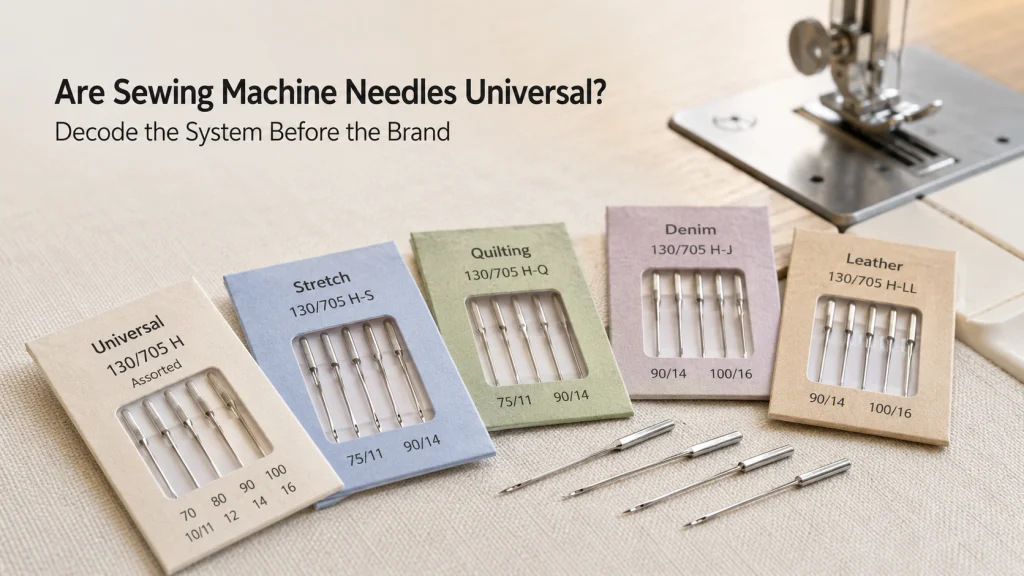
Most modern home sewing machines use a common household needle system, but that does not make every sewing-machine needle physically interchangeable. The reliable answer starts with the exact machine manual or support page, then matches the needle-system code on the package before type, size, or brand enters the decision. Codes such as 130/705 H, HAx1, and 15×1 can overlap when current documentation explicitly says they do, while specialty and semi-professional machines can require or permit different systems. By the end, you should be able to decide whether a needle package is eligible for your exact machine without relying on appearance or the word “universal.”
Define needle system as physical compatibility, not needle purpose
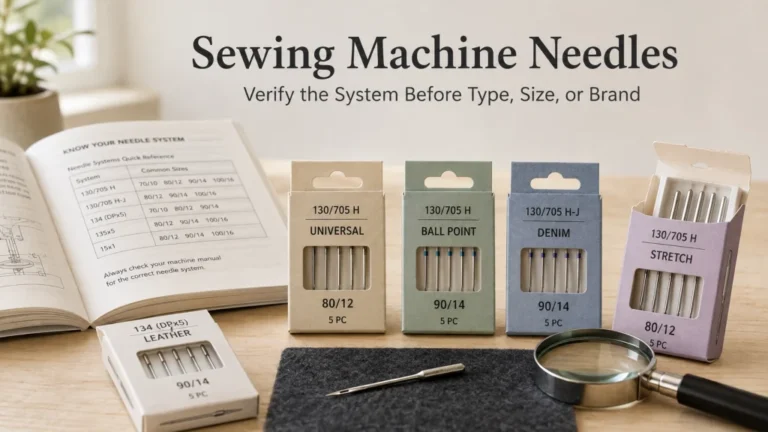
Are sewing machine needles universal? Only inside a defined needle system. A needle system describes the physical geometry the machine is designed around, including the features that position the needle correctly in the clamp and relative to the stitch-forming mechanism. That fit question comes before deciding whether the point style suits denim, knit fabric, embroidery, leather, or another material.
The confusion comes from the word “universal” doing two different jobs in sewing retail. It can appear in a needle type name, while buyers also use it casually to mean “fits every machine.” Those are not the same claim. The broader sewing machine needle selection process begins by establishing system fit before moving on to the other choices printed on a package.
That distinction is the central rule for this page. Physical insertion is an observation; compatibility needs model-specific evidence.
Start with the exact model manual or support page
Before reading the needle package, identify the exact machine model and find the needle requirement in its current manual, support page, or official specification. Record the wording exactly rather than translating it from memory. If the machine names one system and also lists an alternative, keep both entries because the alternative may be a manufacturer-approved option rather than a general equivalence.
This creates a simple evidence hierarchy. Exact machine documentation comes first, current manufacturer support for the same model comes next, and a needle maker’s compatibility page can clarify the needle maker’s own system labels. Retail listings and community discussions can help you locate terminology, but they should not override a conflicting machine requirement.
| Evidence level | What it can establish | What it cannot establish alone |
|---|---|---|
| Exact machine manual or support page | Required system, named alternatives, model-specific restrictions | Compatibility with an unlisted look-alike system |
| Needle manufacturer documentation | The maker’s own system code, cross-reference, and stated machine scope | A new equivalence the machine maker does not support |
| Current retailer listing | What the package is being sold as and which code is printed in the listing | Final proof for a model when official documentation differs |
| Forum or community post | Real confusion, terminology, and questions worth checking | Technical proof of fit |
Use this order even when the answer seems obvious. It prevents a broad household rule from being stretched across a machine that sits outside the usual household specification.
Decode 130/705 H, HAx1, and 15×1 only where documentation supports equivalence
SCHMETZ currently identifies 130/705 H as the system used by nearly all home sewing machines and states that 15×1 H is a cross-reference to 130/705 H. Its package guide describes the two as equivalent within that stated household context. JUKI’s current semi-professional comparison page also prints HAx1 together with 130/705H for several TL machines, providing a direct manufacturer example of that notation overlap.
The safe takeaway is narrower than “all three codes always mean the same thing everywhere.” When your exact machine names one of these household codes, look for an official cross-reference that supports the translation you are making. Keep suffixes and added letters intact, because a longer code may identify a more specific needle format rather than decorative packaging text.
| Code seen | What current documentation supports | Purchase decision |
|---|---|---|
| 130/705 H | Common household needle-system designation | Match it to the exact machine requirement before choosing type or size |
| 15×1 H | SCHMETZ cross-references it to 130/705 H | Use the cross-reference only within the documented scope |
| HAx1 | JUKI currently pairs HAx1 with 130/705H on named TL machines | Confirm the same relationship for your machine rather than assuming it globally |
This decoder is intentionally conservative. It translates only relationships supported by current documentation instead of building a homemade conversion chart from similar-looking codes.
A brand name can help you find the right manual, but it is not a needle-system rule by itself. Current manufacturer material shows why a quick brand check is useful only as orientation:
| Brand | What current official material shows | What you still need to check |
|---|---|---|
| Brother | A current standard-home support example specifies SCHMETZ 130/705H | Do not extend that household example to embroidery, overlock, or other Brother systems without the exact model page |
| Janome | A current household manual example lists HAx1 #14 with the machine accessories | Use the manual for your Janome model because other Janome systems and specialist machines can differ |
| BERNINA | BERNINA states that most BERNINA and bernette machines use 130/705 H | The word “most” leaves exceptions, so the exact manual still controls |
| SINGER | Current SINGER needle guidance describes broad compatibility across standard machines and directs owners to the machine manual | Do not turn the brand name into a universal system code when the exact model requirement is available |
The useful pattern is consistent across these brands: use the brand to locate current documentation, then let the model-specific needle requirement make the purchase decision.

This SCHMETZ assortment contains 20 Universal household sewing machine needles in sizes 70/10, 80/12, 90/14, and 100/16. The needles use the 130/705 H household needle system and have a slightly rounded point. The assortment provides several needle sizes while keeping the physical needle system consistent.
Check On AmazonIf you click this link and buy, we earn a commission at no additional cost to you.
Show why similar-looking systems are not automatically interchangeable
Two needles can look close enough to invite a guess while differing in the geometry that matters to the machine. Shank shape, shank diameter, overall proportions, and the relationship between the eye and the stitch-forming parts can change across systems. A needle that enters the clamp therefore proves only that it entered the clamp.
SCHMETZ provides a useful current boundary with its 134 U system. The company states that this needle has a round shank and is not compatible with standard household machines that require the flat-shank household system. That is exactly the kind of distinction a visual comparison can miss, and it is why machine accessory compatibility checks should be driven by interface evidence rather than appearance.
Key point: Never create an equivalence because two needles have similar length, the same size number, or a shank that appears to enter the clamp. The system code and exact machine documentation control the decision.
If a seller removes part of the code or uses a generic phrase such as “home needle,” find a source that exposes the actual system before buying. Missing system information is a reason to pause, not a reason to infer.
Use current HLx5 and HAX 130 EBBR examples as bounded exceptions
The broad household rule has real current exceptions and alternatives. JUKI’s semi-professional comparison page lists HAx1 (130/705H) and HLx5 for several TL models. That does not mean every machine accepting a household needle also accepts HLx5. It means the named machines have manufacturer documentation that permits both listed systems within the specified size range.
Brother provides a different kind of example for the PR1000E embroidery machine. Its support page specifies HAX 130 EBBR as the factory-recommended needle and states that SCHMETZ 130/705 H-E may be used as a substitute. The important evidence is not the brand combination; it is the explicit model-specific substitution published by the machine manufacturer.
Exception rule: A common household system is a starting expectation, not permission to erase a specialty code. Keep the full code shown by the machine maker and accept a second system only when the same model documentation allows it.
These examples are evidence cases, not product recommendations. They show why a broad household shortcut stops being useful as soon as the machine documentation names something more specific.
Separate needle system from type and size
Once the system is confirmed, two other package fields still matter: needle type and needle size. System answers whether the needle format belongs in the machine. Type describes the needle design for a sewing application, while size describes needle dimensions within that system. A package can therefore match the machine system and still be the wrong choice for the fabric and thread.
This article stops at physical system eligibility. Choosing a size for a fabric, deciding between Universal, Stretch, Jeans, Embroidery, or another point and eye design, and balancing needle size against thread belong to the material-selection decision. Keeping those questions separate prevents a correct fabric choice from being mistaken for proof of machine fit.
| Package field | Question it answers | Example of the wrong inference |
|---|---|---|
| System | Is this needle format physically specified for the machine? | “It is a denim needle, so it must fit my machine.” |
| Type | What sewing application is this needle designed to address? | “Universal type means universal machine fit.” |
| Size | Which needle size is being supplied within that system? | “Both packages say 90/14, so the systems must match.” |
Read the package in that order: system first, then type and size for the sewing job. That keeps a correct fabric choice from being confused with proof that the needle physically belongs in the machine.

These SCHMETZ Jeans needles use the 130/705 H-J needle system and come in size 100/16. Each card contains five needles with a medium ball point and reinforced blade designed for denim, twill, canvas, and other thick woven fabrics. The package clearly separates the needle system, Jeans application type, and needle size.
Check On AmazonIf you click this link and buy, we earn a commission at no additional cost to you.
Separate single-needle fit from twin-needle clearance
A compatible single-needle system does not automatically prove that a twin needle is safe to use. A twin format adds needle spacing and lateral clearance to the normal system question. The machine’s stitch width, needle plate opening, presser foot, selected stitch, and manufacturer instructions can all affect whether the paired needles have enough room.
That means “my machine uses 130/705 H” is only the first check when the package is a twin needle. Continue with the dedicated process for checking twin needle machine compatibility before using one. Do not use a successful single-needle installation as a clearance test for a two-needle format.
Warning: Do not rotate the machine under power to test uncertain twin-needle clearance. Follow the exact manual’s permitted checking procedure and stop if the required system, spacing, stitch, plate, or foot combination is not established.
The extra clearance question is why twin needles should not be folded into a generic yes-or-no answer about household needle systems.

This SCHMETZ assortment contains twin sewing machine needles from the 130/705 H ZWI family. A twin needle places two needles on one shared shank so two parallel rows of stitching can be formed at the same time. The twin format adds needle spacing to the normal household needle-system specification.
Check On AmazonIf you click this link and buy, we earn a commission at no additional cost to you.
Separate brand substitution from system compatibility
Brand is a later question. If two packages carry the required system and the machine maker does not impose a brand-specific restriction, you can then compare whether the candidate brands supply the needed type, size, finish, or other documented characteristics. But brand reputation cannot rescue a package whose system is wrong for the machine.
The reverse mistake also happens: a manual names one needle brand and a reader assumes every other brand is excluded. Sometimes the machine maker publishes an approved substitute, as Brother does in the embroidery example above. When the only remaining question is whether two brands are defensible substitutes after system, type, and size already match, use the separate SCHMETZ and Organ needle comparison.
Note: A manufacturer-named substitute is stronger evidence than a forum report that another brand “worked.” Successful sewing can be useful observational context, but it does not create a new compatibility rule for other models.
This keeps a familiar logo from carrying more evidentiary weight than the machine documentation.
Build a package-to-machine verification record
You do not need a technical database to make a defensible needle purchase. A short record is enough: exact machine model, the code named by the machine maker, any specifically allowed alternative, the full code on the candidate package, and the source used to connect them.
This record is especially useful when packaging uses multiple codes, a retailer shortens the description, or you own more than one machine. It prevents a needle bought for one machine from drifting into another machine’s storage simply because both packages look like ordinary household needles.
| Record field | What to enter |
|---|---|
| Exact machine | Full model designation from the machine or official documentation |
| Required needle system | Complete code exactly as published |
| Allowed alternative | Only a substitute or second system explicitly supported for that model |
| Package system code | Full code from the candidate needle package |
| Evidence source | Manual, model support page, or needle-maker cross-reference used for the match |
| Decision | Eligible, not eligible, or unresolved |
An “unresolved” result is useful. It tells you not to spend money or run a physical trial until the missing system relationship has been established.
Stop if the system is undocumented or the machine requires a specialty needle
If the manual is missing, the support page does not identify a system, or the candidate package omits the code, stop the compatibility decision there. Do not force the needle into the clamp, do not treat insertion as proof, and do not run the machine to “see if it works.” A strike can happen after the needle has already appeared to fit normally.
Vintage machines deserve the same restraint because historical model families can contain requirements that should not be reconstructed from a modern household rule. Specialty machines also need their own documentation. If the required system cannot be established from a credible source, the correct result is uncertainty rather than a guessed conversion.
- Do not force a needle that does not enter the clamp normally under the manual’s installation procedure.
- Do not convert an unfamiliar code into 130/705 H without a documented cross-reference.
- Do not use skipped stitches, thread breakage, or a jam as proof that the system is wrong or right.
- Do not continue after a needle strike or other hard contact.
- Do not extend one model’s approved substitute to a different machine without evidence.
This boundary keeps a purchasing question from turning into an unsafe compatibility experiment or a troubleshooting exercise.
Final Thoughts: universal is a system claim, not a guess
The practical end point is a written match you can defend: exact machine, exact needle-system requirement, candidate package code, and any allowed alternative named by the manufacturer. If one of those fields is missing, leave the purchase unresolved instead of filling the gap with a brand assumption or a visual comparison.
From there, return to choosing the right sewing machine needle for type and size. A twin package needs its separate clearance checks, while a brand-only difference belongs in the brand-substitution comparison after the technical fields already match.
Frequently Asked Questions
The word “universal” makes these questions sound simpler than they are. Start every answer with the exact machine’s required needle system, because the same package language can mean something different on a specialty or older machine.
The answers below stay focused on physical fit. Needle size for fabric, installation technique, and troubleshooting symptoms require separate checks.
🪡 Do all sewing machine needles fit all machines?
No. Most modern household machines use a common household system, but specialty, semi-professional, industrial, embroidery, serger, and older machines can have different requirements. Use the exact model manual or support page before buying.
🔢 Is 130/705 H the same as 15×1?
SCHMETZ currently cross-references 15×1 H to 130/705 H and describes them as equivalent in its household needle documentation. Preserve any suffixes on the actual package and confirm the requirement for your machine.
📖 What does HAx1 mean on a sewing machine manual?
It is a needle-system designation seen in household and some semi-professional documentation. JUKI currently prints HAx1 together with 130/705H on several TL machine specifications, but use your exact machine documentation rather than assuming every HAx1 reference has the same permitted alternatives.
👁️ Can I tell whether a needle fits by looking at it?
No. Similar appearance and successful insertion do not establish the system relationship. Match the printed code to the machine requirement or a documented cross-reference.
🧵 Does “Universal” on the needle package mean it fits every machine?
No. “Universal” can describe a needle type within a particular system. The system code, not the type name by itself, is the field that answers the physical machine-fit question.
⚙️ Can I use a different needle brand if the system code matches?
Matching the required system removes one compatibility question, but you still need the correct type and size and must respect any model-specific restriction. A manufacturer-published substitute is stronger evidence than a generic brand claim.
If the exact model requirement remains unclear after these checks, leave the package classified as unresolved. That is safer and more accurate than using a broad household rule to fill the gap.
References and Sources
These sources were used for the household system rule, documented cross-references, current manufacturer exceptions, and the warning against generalizing a similar-looking needle system. Community discussion was used only to confirm that “universal” and 130/705 H terminology creates real buyer confusion.
Needle recommendations and machine support information can change. Recheck the exact current manual or manufacturer support page for the machine in front of you before treating any package as compatible.
- SCHMETZ machine compatibility guidance: states that most home machines use 130/705 H while directing owners to the machine manufacturer’s required system.
- SCHMETZ needle package decoder: identifies 130/705 H as a household system and cross-references 15×1 H to it.
- Brother household needle support: provides a current standard-home example specifying SCHMETZ 130/705H and keeps the claim tied to the covered machine.
- Janome household machine manual: lists HAx1 #14 in the standard accessories for the covered household model, illustrating why Janome requirements should be read model by model.
- BERNINA needle guidance: states that most BERNINA and bernette machines use 130/705 H while leaving room for model exceptions.
- SINGER needle compatibility guidance: describes broad standard-machine compatibility but directs owners to check the machine manual rather than assuming every machine uses one format.
- JUKI semi-professional machine specifications: lists HAx1 (130/705H) and HLx5 for named TL models, providing a current bounded alternative-system example.
- Brother needle compatibility support: specifies HAX 130 EBBR for the covered embroidery machine and names 130/705 H-E as an allowed substitute.
- SCHMETZ 134 U system specification: shows that a similar-purpose needle with a different shank system is not compatible with standard flat-shank household machines unless the machine specifies the relevant system.
- Sewing community compatibility question: illustrates how a buyer can see 130/705 H and “Universal” yet still be unsure whether the physical-fit assumption is valid.
The technical conclusions above rely on manufacturer and needle-maker documentation. The community example establishes the question people actually encounter, not a machine-compatibility rule.