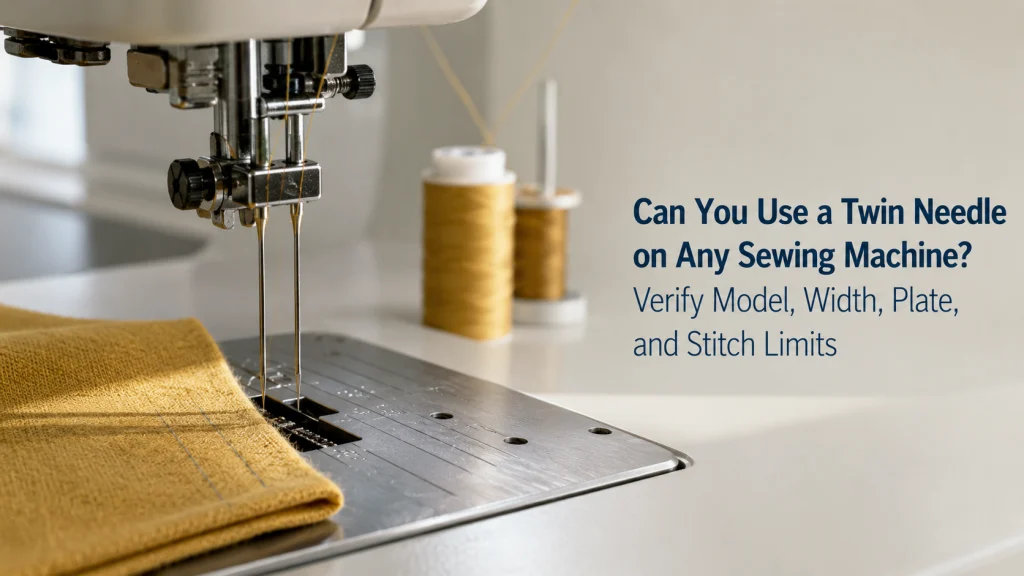
You cannot assume a twin needle will work on every household sewing machine just because the shank fits or the machine can sew a zigzag. Twin needle compatibility depends on explicit model support, the approved needle or spacing where specified, needle-plate and presser-foot clearance, permitted stitches, and any twin-needle setting or threading provision required by the manufacturer. Same-brand machines can differ, so model documentation matters more than age, brand reputation, or stitch-width capability. Verify support first, then choose the twin needle only within the limits documented for that exact machine.
Same brand, different twin-needle support
Can you use a twin needle on any sewing machine? No. JUKI provides a useful same-brand example: its HZL-F600 specification page lists twin needle sewing as supported, while the HZL-K65 page lists twin needle sewing as unsupported. Both are household sewing machines from the same manufacturer, which immediately rules out shortcuts such as “the brand supports twin needles” or “a modern zigzag machine should be fine.”
The buying decision therefore starts with the model number, not with the needle package. If you have not yet confirmed the ordinary household needle system used by the machine, first check whether sewing machine needles are universal. Twin format adds another compatibility layer because two blades occupy lateral space that a single needle does not.
Define twin needle compatibility as more than shank fit
A household twin needle places two needle blades on one shared shank. That shared shank can make the accessory look deceptively simple because it may insert into the needle clamp much like a single household needle. Shank fit is only the first gate, though. The two blades also need enough lateral clearance through the selected presser foot and needle plate for the stitch the machine is allowed to sew.
Compatibility also includes the machine’s documented control state. Some machines provide a specific twin-needle mode or setting, some specify particular stitches, and some identify an approved twin needle or part number. A twin needle should therefore be treated as a machine-interface component, not as a generic consumable that becomes safe once it fits into the clamp.
| Compatibility gate | What must be verified | What does not prove it |
|---|---|---|
| Machine support | The exact model documentation permits twin-needle sewing | Brand, age, price, or zigzag capability |
| Needle format | Approved part, household system, spacing, and size where specified | A shared shank that happens to enter the clamp |
| Physical clearance | Needle plate and presser foot clear both blades for the permitted stitch | A wide-looking needle opening |
| Stitch eligibility | The selected stitch and width are allowed with the twin needle | The machine can sew that stitch with a single needle |
| Thread provision | The machine has the documented second-spool and threading arrangement | Finding somewhere to place a second spool |
If any gate remains undocumented, stop there instead of using the next gate to compensate. A wide plate opening, for example, does not override a model page that says twin-needle sewing is unsupported.
Check whether the exact model documents twin-needle sewing
Start with the exact model page, manual, support page, or manufacturer accessory list. Look for direct language such as twin needle sewing, double needle, twin-needle mode, an approved twin needle, or a model-specific procedure. The absence of a statement on a retailer listing is not enough to prove incompatibility, but explicit manufacturer support or non-support is strong evidence.
The JUKI HZL-F600 and HZL-K65 example shows why this gate comes first. The F600 page lists twin needle sewing as supported and also includes a twin needle and auxiliary spool pin among its accessories. The K65 specification table marks twin needle sewing as unsupported, so its general sewing features do not create permission to use one.
Key point: Exact-model documentation outranks a broad compatibility rule. Do not infer twin-needle support from another machine in the same brand family.
Once the model passes this first gate, move to the approved needle details. If the machine fails the gate, there is no useful reason to shop wider spacing, a different twin type, or a more open presser foot in hopes of creating compatibility that the manufacturer does not document.
Find the approved part number, spacing, and blade size where provided
Manufacturer accessory lists can narrow compatibility much further than a package labeled for household machines. JUKI lists twin needle part number 40083061 for a defined group of models that includes the HZL-F600, and the accessory description specifies 2 mm spacing. JUKI lists another twin needle, part number 40145877, for a different model group. Those lists show why part number and model applicability matter even within one brand.
Brother documentation makes the same point from another direction. One model-specific support page instructs owners to use only the twin needle made for the covered machine and gives part code 131096-121, along with presser-foot and stitch-width restrictions. Another Brother support page for a different model group specifies a different twin-needle part code. The useful lesson is not to memorize either code; it is to locate the code that belongs to your exact model.
| Evidence found | What it proves | What still needs checking |
|---|---|---|
| Exact model lists twin-needle sewing | The format is supported in principle | Approved needle, stitch, foot, plate, and setup limits |
| Manufacturer accessory part lists the model | That accessory is intended for the listed model | Stitch and operating restrictions in the manual |
| Support page gives a twin-needle part code | The covered models use that documented part | Whether another part or spacing is also permitted |
| Retail package says “household” | The product belongs to a household needle format | Exact-machine support and clearance |
This ledger prevents a common compatibility mistake: taking one true statement, such as “this is a household twin needle,” and treating it as proof of the whole fit chain. Each claim answers only one part of the purchase decision.
Decode twin-needle spacing and size notation
Twin-needle markings commonly combine the distance between the two needles with the blade size. SCHMETZ explains that in a marking such as 2.5/75, the first number is the distance between the needle blades and the second number is the needle size. That distinction matters because increasing spacing moves the two blades farther apart even when the blade size itself remains unchanged.
SCHMETZ lists Universal Twin needles in multiple combinations, including narrow and much wider spacings. That product range is useful for understanding the notation, but it is not a compatibility chart for your machine. A machine that accepts the household 130/705 H needle system does not automatically have clearance for every twin spacing sold in that system.
| Example marking | First number | Second number | Compatibility question |
|---|---|---|---|
| 2.0/80 | 2.0 mm needle spacing | Needle size 80 | Does the exact machine permit that spacing and needle size? |
| 2.5/75 | 2.5 mm needle spacing | Needle size 75 | Is that combination documented for the machine and material? |
| 4.0/90 | 4.0 mm needle spacing | Needle size 90 | Does plate, foot, and stitch clearance remain within documented limits? |
Do not read the table as a list of widths that any particular machine can use. It is only a notation decoder. The approved spacing still comes from the exact machine documentation or a manufacturer accessory list that names the machine.

This SCHMETZ twin needle assortment contains three twin needles in 1.6/70, 2.0/80, and 3.0/90 configurations. Each twin needle mounts two needles on one shank to create two parallel rows of stitching. The assortment provides three spacing and blade-size combinations in one package, making the printed twin-needle notation easy to compare directly.
Check On AmazonIf you click this link and buy, we earn a commission at no additional cost to you.
Verify needle-plate and presser-foot clearance
Twin needles occupy more lateral space than a single needle, so the selected plate and presser foot must clear both blades. This is where the assumption “it fits the clamp” becomes dangerous. SCHMETZ specifically warns that the throat plate must accommodate the twin needles and that a stitch swinging too far sideways can cause the needles to hit the plate and break.
Brother support likewise connects twin-needle use to the correct presser foot and to a clearance check on covered models. Its needle-strike support instructions tell the user to turn the handwheel slowly toward them after adjusting stitch width and verify that the needle does not touch the presser foot or plate. Use such a handwheel check only when the exact manual or model-specific support material calls for it; do not invent a powered clearance test.
- Confirm the exact presser foot required for twin-needle use.
- Confirm that the installed needle plate is the one permitted for the selected stitch.
- Check whether the manual specifies a handwheel clearance check before sewing.
- Do not use machine power to “see if it clears.”
- Stop immediately if either blade contacts the foot, plate, or another machine part.
Clearance is a condition, not a one-time property of the machine. Changing the stitch, stitch width, needle position, presser foot, plate, or twin spacing can change whether the two blades still have room to travel.
Verify allowed stitches and width limits
A machine can support twin-needle sewing without allowing every stitch. JUKI’s twin-needle accessory information states that not all stitches are approved for twin-needle use. Brother also directs owners to select an appropriate stitch and, for covered models, provides a defined stitch-width limit. Those are model-specific operating limits, not a universal maximum for all sewing machines.
This is why zigzag capability alone proves very little. A machine may have a wide maximum zigzag range for single-needle sewing while restricting twin-needle sewing to a narrower set of stitches or widths. The correct setting is the one the exact model documentation permits with the specific twin-needle arrangement.
Warning: Do not copy a stitch-width limit from another model. A width that is documented for one machine can still exceed the safe clearance of another machine, foot, plate, or twin spacing.
Before purchase, look for a stitch chart or support page that identifies which stitches accept the twin needle. If the documentation names only selected stitches, treat all unlisted stitches as unverified until the manufacturer says otherwise.
Verify the second-spool and threading provisions only as compatibility evidence
A twin needle uses two upper threads, so the machine needs a documented way to supply and route both threads. JUKI lists an auxiliary spool pin with the HZL-F600 and describes the additional spool pin as useful for twin-needle sewing. Brother’s support instructions for covered machines likewise call for an extra spool pin and separate threading steps for the two needle eyes.
For this buying decision, those details matter only because they prove the machine was designed with a twin-needle setup in mind. They are not a reason to turn compatibility checking into a full threading lesson. Once fit is confirmed, follow the exact machine instructions for thread path, spool direction, needle-threader restrictions, and any twin-needle setting.
Reject the shortcut that zigzag capability alone proves fit
The popular shortcut sounds reasonable: if a machine can move one needle side to side for zigzag, its plate must be wide enough for two needles. The problem is that plate opening is only one part of the system. Twin spacing, needle position, selected stitch, presser-foot opening, model software or mode restrictions, and manufacturer approval can all narrow what is allowed.
The JUKI comparison is enough to break the rule. The HZL-K65 has adjustable stitch width, yet its specification table marks twin needle sewing as unsupported. That means a zigzag-capable household machine can still fail the very first compatibility gate.
“The machine has zigzag, so a household twin needle should work.”
“The exact model documents twin-needle support, and the approved needle, stitch, foot, plate, and width conditions have been verified.”
This distinction is the reason a generic compatibility answer is not good enough. Twin-needle fit has to be proven as a chain, and the chain begins with the exact machine.
Keep hemming technique separate from compatibility
Once a machine and twin needle are verified as compatible, questions about actually sewing a knit hem, controlling tunneling, stabilizing fabric, balancing tension, or choosing a seam allowance become technique questions. Those choices depend on fabric, thread, needle type, hem construction, and the machine’s stitch behavior, not just whether the hardware clears.
That separation matters when buying. Do not interpret a disappointing test hem as proof that the twin needle is mechanically incompatible, and do not interpret physical fit as proof that a particular hem will look good. Compatibility answers whether the setup is permitted; technique determines the result after that point.

The SINGER Universal Twin Stretch needle places two needles on one shaft and creates two rows of stitches simultaneously. The product uses a 4.0 mm twin configuration and is designed for stretch materials such as spandex, Lycra, and suede. The package contains one twin needle and is intended for applications such as hemming stretch fabrics.
Check On AmazonIf you click this link and buy, we earn a commission at no additional cost to you.
Keep coverstitch system choice separate from twin-needle fit
A twin needle on a conventional household machine and a coverstitch machine are different sewing systems. The fact that both can produce parallel rows on the top of some hems does not make them interchangeable at the compatibility level. If the real question is whether a separate coverstitch system better suits repeated knit hemming, that is a machine-system decision rather than a needle-fit decision.
For the purchase in front of you, stay narrower. First determine whether the owned sewing machine supports a twin needle and which format it permits. Only after that should workflow, seam formation, volume of hemming, and specialist-machine cost enter the decision.
Stop after any strike, bend, or undocumented fit question
A needle strike is not a cue to try a little more speed or force. If a twin needle touches the presser foot, plate, or another machine part, stop sewing and remove power before handling the needle area. A bent needle should not be reused, and repeated contact means the setup needs to be rechecked against the exact model documentation.
Do not diagnose timing, internal alignment, needle-bar damage, or other mechanical faults from a compatibility check. If the machine has repeated hard needle strikes, a hard mechanical lock, uncontrolled motion, abnormal contact that remains after the documented setup is restored, or any condition the manual reserves for service, use qualified service rather than improvising an internal adjustment.
Use a five-step compatibility gate before buying
The fastest safe way to narrow a twin-needle purchase is to verify the evidence in a fixed order. That prevents a package claim or attractive spacing from pulling the decision ahead of the machine’s actual limits. It also makes it easier to stop early when the setup is unsupported.
- Confirm exact-model support. Find twin-needle permission in the manufacturer manual, support page, specification page, or accessory list.
- Confirm the approved needle details. Record the part number, household needle system, spacing, and size only where the manufacturer provides them.
- Confirm physical clearance requirements. Check the documented presser foot, needle plate, needle position, and any manual handwheel check.
- Confirm stitch eligibility. Use only stitches and width settings permitted for twin-needle operation on that model.
- Confirm the second-thread provision. Verify the extra spool arrangement, threading path, and any machine setting required for twin-needle sewing.
If the ordinary needle system is still unclear, return to sewing machine needle selection and compatibility before buying a special format. For broader machine-interface parts such as feet, plates, bobbins, and other add-ons, use the sewing machine accessory compatibility framework rather than relying on visual similarity.

The SCHMETZ Twin Stretch needle is a 2.5/75 twin needle sold as one needle per package. It uses two needles mounted on one shank for sewing two parallel rows of stitches. SCHMETZ lists elastic materials, highly elastic knitwear, and fabrics containing Lycra or Spandex among the intended applications for its Stretch Twin needle family.
Check On AmazonIf you click this link and buy, we earn a commission at no additional cost to you.
Final Thoughts: Model support comes before the twin needle
Twin needle compatibility is not a yes-or-no property of household sewing machines as a whole. One current model can document support while another machine from the same brand does not, and even a supported model can restrict the approved needle, spacing, presser foot, stitch, or width. That makes exact-model documentation the first buying filter.
Start with the machine number, then verify the approved twin format and operating limits before choosing a needle. If support, clearance, or stitch eligibility is undocumented, do not fill the gap with a general rule. A twin needle is inexpensive compared with a machine, so the evidence should earn the purchase before the accessory reaches the needle clamp.
Frequently Asked Questions
🪡 Can I use a twin needle in any sewing machine that does zigzag?
No. Zigzag capability does not prove twin-needle support. Verify the exact model, approved needle or spacing, presser foot, plate clearance, and allowed stitches from the manufacturer documentation.
📏 What do the numbers on a twin needle mean?
For common twin-needle markings such as 2.5/75, the first number indicates the distance between the two needle blades and the second indicates needle size. The machine still has to permit that spacing and size.
⚙️ Does a wider needle plate mean I can use a wider twin needle?
Not by itself. Presser-foot opening, stitch swing, needle position, machine mode, and model-specific limits also affect clearance, so plate width alone is not compatibility evidence.
🧵 Do I need two spools of thread for a twin needle?
A twin needle uses two upper threads, but the exact spool placement and thread paths are machine-specific. Follow the documented second-spool and threading arrangement for the exact model.
🦶 Can I use any presser foot with a twin needle?
No. Use the presser foot specified for twin-needle operation on the exact machine and verify clearance for the permitted stitch. A foot that works with a single needle may not clear both twin blades.
🛑 What should I do if the twin needle hits the plate or foot?
Stop sewing immediately and do not continue under power. Recheck the needle, foot, plate, stitch, width, and model instructions, and use qualified service if hard strikes or abnormal contact continue.
References and Sources
- JUKI HZL-F600 specifications: Verifies explicit twin-needle support and the included twin needle and auxiliary spool pin for this model.
- JUKI HZL-K65 specifications: Verifies that twin needle sewing is listed as unsupported on this same-brand household model.
- JUKI twin-needle accessory list: Verifies model-specific twin-needle part numbers, applicable models, and 2 mm spacing for the listed accessories.
- Brother twin-needle support: Verifies a model-specific part code plus stitch-width, presser-foot, and threading restrictions for the covered machines.
- SCHMETZ twin-needle notation: Explains household needle-system context and how twin spacing and needle size are represented in markings such as 2.5/75.