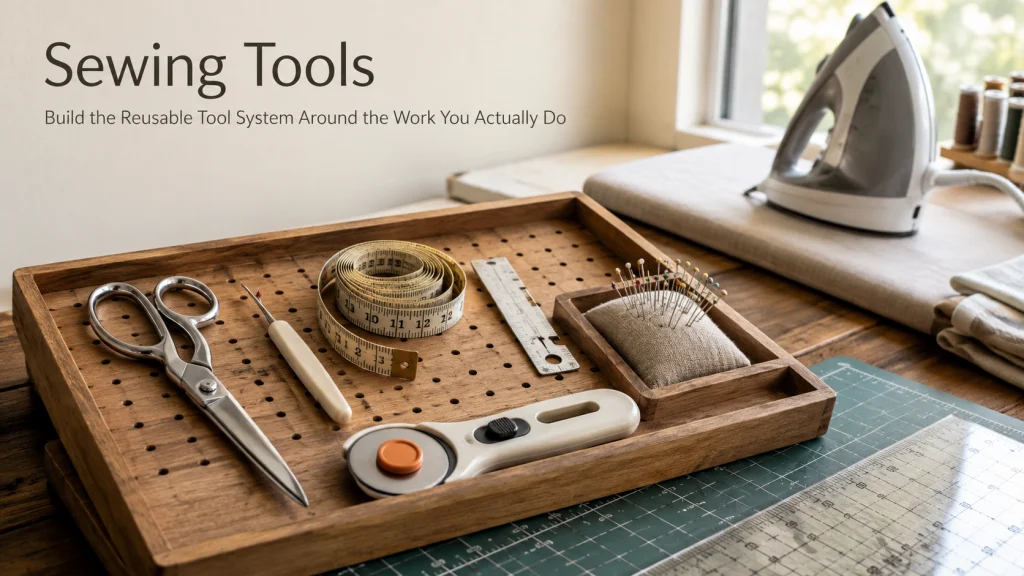
Sewing tools are easier to choose when each item is tied to a job instead of copied from a generic starter list. For machine sewing, the useful distinction is between reusable non-machine tools, consumables that get used up, parts that must fit the machine, and techniques that require practice rather than another purchase. A beginner can start with a small working set for the projects actually on the table, then add cutting, measuring, pressing, preparation, workspace, or storage equipment only when a repeated task justifies it. This approach keeps a sewing tool kit focused without pretending every sewist needs the same collection.
One sewing list can contain four different ownership categories
Put fabric shears, thread, a presser foot, a seam gauge, an iron, a cutting mat, and a storage case on one table and they can all look like sewing tools and equipment. They are not the same kind of purchase. Some are reusable tools, some are materials that are gradually consumed, one may be a machine-interface component, and some exist mainly to support the room or workflow around the machine.
That distinction matters before buying anything. A dull cutting edge creates a cutting-tool decision, a missing spool of thread creates a supply decision, and a presser foot creates a compatibility question tied to the exact machine. Treating all three as entries on one beginner checklist makes it harder to know what is actually missing and easier to buy duplicates.
Define a reusable sewing tool by the job it keeps doing
For this article, a reusable sewing tool is a non-machine item that repeatedly helps perform a physical job around machine sewing. It may cut, measure, mark, hold, turn, remove stitches, press, shape, support a pattern-preparation task, improve task lighting, support the machine, or organize equipment. The important feature is not that it appears in a sewing aisle, but that it remains in the work system after one project is finished.
That definition also prevents the word “tool” from becoming a catch-all. A ruler can be a reusable measuring tool, while the fabric underneath it is project material and the machine needle beside it is a replaceable machine-interface component. Naming the job first gives the reader a cleaner ownership decision than naming the object first.
Separate reusable tools from consumables and project materials
Thread, fabric, interfacing, elastic, and many other sewing supplies are bought for the material they contribute to a project or because they are gradually used up. They can sit in the same drawer as reusable equipment, but they answer a different question. When the task is choosing material, quantity, or a consumable for a particular project, the decision belongs with sewing supplies rather than with reusable tools.
Lists of sewing tools for beginners often mix long-lived equipment with items that need replenishment. A pair of fabric shears may serve across many projects, while thread colors and project materials change with the work. Budgeting those two groups separately makes it easier to see whether money is going into durable capability or into the next project.
The distinction does not make one group more important than another. It simply keeps unlike decisions from being bundled together, which is the first step toward a tool collection that reflects actual work.
Keep non-machine tools separate from machine-interface parts
A presser foot, bobbin case, needle plate, machine needle, extension table, pedal, power cord, or other component that connects to or operates with a particular machine is not just a generic hand-tool purchase. Fit can depend on the exact model, interface, part number, or manufacturer documentation. Visual similarity and a familiar product name are not enough to prove compatibility.
By contrast, a tape measure or seam ripper performs its job without attaching to the sewing machine. That is the practical boundary here: this article deals with reusable non-machine tools and workspace equipment, while machine-interface components require an exact compatibility check. Keeping that line visible prevents an apparently simple “tool list” from quietly turning into machine-parts advice.
Boundary: If the item must physically fit, connect to, power, or be specified for the sewing machine, verify it for the exact machine rather than treating it as a generic reusable tool.
That rule is more useful than memorizing where a retailer places the item in a menu. Retail categories can mix hand tools, supplies, and machine accessories, while the ownership question remains different for each one.
Start with the job the tool must perform
The simplest way to avoid an oversized beginner kit is to write down the repeated task before naming a product. “I need cleaner fabric cuts” is more informative than “I need more sewing gadgets,” and “I keep losing the same small tools” points to organization rather than another cutting or measuring purchase. The job becomes the filter for the tool family.
The worksheet below keeps that reasoning visible. It does not prescribe a particular item, because the useful choice can change with project scale, material, workspace, storage limits, and the tools already owned.
Cut
Cutting may involve large fabric pieces, short thread ends, repeated straight cuts, curves, or pattern preparation. Those jobs can call for different cutting systems, and one system does not automatically replace another. Start by identifying what is being cut, how often, and on what surface before deciding whether an additional cutting tool earns a place.
Measure and mark
Measuring and marking tools turn dimensions, seam allowances, placement points, and construction references into visible work. The useful distinction is whether the task needs a flexible measure, a rigid reference, a small repeatable gauge, or a reusable marking instrument. Material response still matters, so any marking method should be checked against the project fabric rather than assumed harmless.
Hold, turn, open, or remove
Small hand tools often solve narrow but frequent jobs: keeping layers together temporarily, opening a sewn seam, turning a corner, guiding a casing, or removing stitches. These are easy to overbuy because many variations look inexpensive in isolation. A better test is whether the job recurs often enough that the existing method is genuinely awkward or unreliable.
Press and shape
Pressing is more than owning a source of heat. Flat surfaces, narrow areas, curves, seams, and shaped garment sections can require different support under the fabric or between the fabric and the iron. Choose the pressing family from the geometry and material involved, then follow the fabric and equipment instructions for heat, steam, and protection.
Fit and prepare
Reusable preparation equipment can hold, position, trace, project, or support work before it reaches the sewing machine. Dress forms and pattern-preparation hardware belong here only as equipment decisions. Pattern drafting, grading, and fitting theory are separate subjects and are not taught in this article.
Support the machine and body at the workspace
Furniture and lighting should be treated as task support rather than decoration. The relevant questions are whether the machine has stable support, whether the work surface accommodates the task, and whether the user can see the needle area, markings, and material clearly. This article does not make medical or ergonomic-treatment claims, and a furniture change should not be presented as a cure for pain or disability.
Store, organize, and transport
Storage becomes a tool-system decision when equipment is hard to find, sharp edges are left exposed, or the same items need to move between spaces. A case, organizer, or transport solution should follow the inventory and movement pattern rather than precede them. Someone who sews at one fixed table has a different storage problem from someone who carries equipment to a class or shared workspace.
| Job to solve | Question to record | Tool family to inspect |
|---|---|---|
| Cut | What material, shape, scale, and cutting surface are involved? | Fabric-cutting tools |
| Measure or mark | Is the reference flexible, rigid, repeatable, or temporary? | Measuring, gauges, rulers, marking instruments |
| Hold, turn, open, remove | Which small action keeps interrupting the work? | Pins, clips, seam-opening and turning tools |
| Press or shape | Is the work flat, narrow, curved, or heat-sensitive? | Irons, pressing surfaces, shaping forms, protective aids |
| Fit or prepare | What must be held, positioned, traced, or prepared? | Reusable preparation equipment |
| Support the workspace | What needs stable support, visibility, or task space? | Furniture, lighting, task layout |
| Store or transport | What must stay protected, findable, or portable? | Cases, organizers, transport equipment |
Once the task is written this way, the shopping decision gets narrower. Instead of asking for the “best sewing tool,” the reader can compare only the family that performs the missing job.
Build a minimum tool set from current work, not a fixed starter-kit list
Utah State University Extension separates basic supplies from optional and more advanced items, which is a useful reminder that not every legitimate tool is needed at the same time. A rotary cutter, self-healing mat, grid ruler, pressing form, and other specialized equipment can be useful without belonging in every first purchase. The project sequence should decide when a tool moves from “later” to “now.”
A small working set therefore starts with jobs that already exist. If the current project requires cutting fabric, measuring, temporary holding, opening a mistaken seam, and pressing, cover those jobs with equipment already available before adding specialty versions. The next purchase should solve a repeated limitation that the current set cannot handle well.
- Minimum now: keep the reusable tools that directly support the current project sequence.
- Use what already works: do not replace a serviceable general tool merely because a specialty version exists.
- Add after repetition: upgrade when the same task repeatedly exposes a clear limitation.
- Delay speculative purchases: a future project type is not the same as a current tool requirement.
- Recheck storage: every added tool also needs a safe, findable place when not in use.
This is a more durable definition of basic sewing tools than a fixed count. The minimum changes when the work changes, but the decision rule stays the same.
Evaluate replaceable consumables inside a reusable tool separately
Some reusable tools contain a part that wears out or is intentionally replaced. A rotary cutter is reusable, for example, while its blade is a replaceable cutting component. The ownership decision therefore has two layers: whether the reusable tool solves a recurring job, and what ongoing replacement, maintenance, or safe-disposal requirements come with it.
This matters because a low purchase price does not describe the whole ownership pattern. Before choosing any tool with replaceable edges, inserts, batteries, surfaces, or other wear parts, check the manufacturer documentation for replacement method and safety requirements. Fiskars, for example, publishes a specific blade-replacement sequence for its rotary cutters, which illustrates why blade handling should follow the exact tool instructions rather than a generic shortcut.
Sharp-tool safety: Follow the exact manufacturer instructions for blade guards, blade changes, storage, and disposal. Do not handle an exposed rotary blade or bypass a safety feature contrary to the tool instructions.
The same logic applies without ranking brands or models. A reusable tool can be inexpensive to acquire but inconvenient to maintain, store, or keep supplied, so the replaceable part deserves its own line in the decision. When two tools perform the same job, compare the ongoing cost and availability of replacement blades, pads, inserts, batteries, or other wear parts alongside the purchase price. A lower upfront cost is less useful if keeping the tool in service creates a recurring expense that does not fit the way it will actually be used.

The OLFA RTY-2/DX uses a 45 mm rotary blade for fabric cutting and other craft work. Its squeeze-handle design exposes the blade during use, and the blade cover adds protection when the cutter is stored. The replaceable blade also makes ongoing blade cost and replacement part availability relevant to ownership.
Check On AmazonIf you click this link and buy, we earn a commission at no additional cost to you.
Cut fabric with a reusable cutting system
Fabric cutting is a system because the edge, material, cutting motion, and work surface interact. Shears can cut without a dedicated mat, while a rotary cutter depends on an appropriate cutting surface and introduces a replaceable blade. Thread snips, seam rippers, scissors, shears, rotary cutters, blades, and mats may all appear under retailer cutting menus even though they solve different parts of the job.
The right next step is therefore to define the cut rather than to collect every cutting format. Someone making occasional garment pieces on a table may have a different requirement from someone making repeated straight cuts against a ruler. Detailed selection belongs in the fabric cutting tools for sewing section, where cutting method, surface, edge type, and safety can be compared without crowding this overview.
Measure and mark with reusable guides, gauges, and instruments
A flexible tape, rigid ruler, small seam gauge, grid ruler, and marking instrument can all support measurement, but they do not do the same job. The choice turns on what must be referenced and repeated: a body or curved surface, a long straight edge, a short fixed distance, a grid, or a temporary visible mark. Buying several overlapping rulers before that need exists adds inventory without adding much capability.
Marking also brings a material check that pure measuring does not. Utah State University Extension advises testing a marking device on project fabric to confirm that it can be removed, which is a practical boundary between choosing the reusable instrument and assuming one mark behaves the same on every textile. The measuring and marking tool options section takes those job differences further.

The Clover 9506 is a reusable sliding gauge for repeated sewing measurements and marking. It can help mark seam allowances, hems, tucks, pleats, and buttonhole spacing. Its adjustable cursor lets you set a measurement and reuse that reference instead of measuring the same distance from scratch each time.
Check On AmazonIf you click this link and buy, we earn a commission at no additional cost to you.
Hold, open, turn, and remove with small reusable hand tools
Pins, clips, seam rippers, awls, stilettos, bodkins, turners, and small hand-sewing tools solve short physical tasks around the machine rather than changing the machine itself. Their value is often obvious only when the task appears repeatedly. A point turner that never leaves the drawer is not more “complete” than a simpler set that matches the work being done.
Temporary holding is a good example of why a generic list is weak. The useful question is not whether a beginner owns both pins and clips, but which holding method fits the material, construction stage, heat exposure, and handling needs of the project. For those decisions, continue to small reusable sewing hand tools instead of treating every small object as mandatory.

The Clover White Ergonomic Seam Ripper is designed for removing sewn seams and unwanted stitches. Its narrow tip can slip under thread so individual stitches can be cut during correction work. The covered hand-tool format also makes it easy to keep with other frequently used sewing notions.
Check On AmazonIf you click this link and buy, we earn a commission at no additional cost to you.
Press and shape with heat tools and pressing forms
Pressing equipment ranges from the heat source and flat surface to forms that support curves, narrow areas, seams, collars, sleeves, or other shaped sections. Utah State University Extension lists tools such as a dressmaking ham, press cloth, sleeve roll or board, tailor board, and needle board among more advanced supplies, showing how quickly a simple “you need an iron” statement can become project-specific. That is a reason to add shaping equipment when the work creates the need rather than in anticipation of every possible project.
Heat, steam, surface protection, and fabric response also make pressing a safety and material-handling decision. Follow the equipment and fabric instructions rather than assuming one temperature or steam setting is universal. The pressing tools and shaping equipment section separates the different pressing jobs in more detail.

The Dritz 562 Tailor's Ham provides a shaped surface for pressing curved areas instead of forcing them flat. It is intended for work such as darts, sleeve caps, and curved seams. Its two covered sides are intended for different fabric and temperature ranges, so pressing settings should still follow the fabric requirements.
Check On AmazonIf you click this link and buy, we earn a commission at no additional cost to you.
Fit and prepare work with reusable forms and preparation tools
Some equipment earns its place before stitching begins: dress forms, pattern weights, projection or tracing support, and reusable hardware for holding or preparing work. These items can be substantial purchases, so the task should be specific before the tool is selected. Owning a form or preparation system does not automatically make it necessary for every garment, pattern, or home sewing workflow.
The boundary here is deliberate. This site can help decide what reusable equipment supports preparation, but it is not teaching standalone pattern drafting, grading, or fitting theory in this article. Readers comparing equipment for those preparation jobs can move to reusable sewing pattern preparation tools.
Support sewing work with furniture, lighting, and task layout
A sewing machine needs stable support, and the surrounding work may need room for cutting, handling fabric, pressing, or viewing markings. Lighting also serves a task: illuminating the needle area, a dark fabric surface, a ruler edge, or another detail that must be seen clearly. Those requirements can be evaluated without turning the discussion into generic interior design.
Furniture and lighting should likewise be bought for a defined constraint, not because a sewing room photo includes them. Existing household furniture may be sufficient when it is stable and appropriately sized for the work, while another setup may need a different surface or dedicated light. The sewing furniture and task lighting section handles those workspace decisions without making medical or ergonomic-treatment promises.

The OttLite 2-in-1 LED Magnifier Light can be configured as either a floor lamp or a table lamp for detailed workspace tasks. Its flexible neck allows the light and magnifier to be positioned over the area being worked on. The built-in optical magnifier can also help when viewing small sewing details, markings, and other close work.
Check On AmazonIf you click this link and buy, we earn a commission at no additional cost to you.
Store, organize, and transport reusable sewing equipment
Storage should follow the equipment inventory and the way the sewing space is used. The person who needs scissors and a seam gauge within reach at one fixed workstation has a different problem from the person carrying tools between home and a class. Sharp tools also need protection that keeps edges and points from becoming a handling hazard when put away.
Current sewing-community discussions show how strongly limited space and portability can shape organization choices, but those experiences establish the question rather than proving one storage design is best. The useful decision remains concrete: what must be protected, what must be found quickly, and what must travel. Those questions are developed in sewing storage and transport systems.

The Everything Mary XXL Rolling Sewing Machine Tote is built for storing and transporting sewing equipment between locations. It uses a zippered soft-sided case with multiple compartments, carrying handles, a telescoping handle, and four wheels. Check the dimensions of the equipment you plan to carry before choosing any machine storage case.
Check On AmazonIf you click this link and buy, we earn a commission at no additional cost to you.
Final Thoughts: Buy the reusable tool for the job, not the checklist
A useful sewing tool system grows from repeated work rather than from the length of a beginner list. Classify the need first, separate reusable equipment from supplies and machine-interface parts, then identify the job that is genuinely missing a capable tool. That sequence gives both new and experienced sewists a reason to buy, delay, reuse, or skip an item.
The practical test is simple: name the task, name what the current setup cannot do well enough, and choose only the tool family that addresses that gap. If no clear gap exists, buying nothing is a valid equipment decision. When the job changes, return to the same classification instead of rebuilding the sewing room from somebody else’s checklist.
Frequently Asked Questions
✂️ What sewing tools do I actually need as a beginner?
Start with reusable tools that support the jobs in your first real projects, such as cutting, measuring, temporary holding, seam opening, and pressing where those tasks are required. Add specialty tools only after a repeated job exposes a limitation in what you already own.
🧰 Is a preassembled sewing tool kit worth buying?
Only if the included reusable tools match work you expect to do and do not duplicate equipment you already have. Judge the contents item by item rather than assuming a larger kit is automatically better value.
📏 Are sewing supplies the same as sewing tools?
Not in this framework. Reusable tools perform repeated jobs, while consumables and project materials are used up, incorporated into projects, or replenished as the work changes.
🌀 Do I need a rotary cutter to start sewing?
No single cutting format is mandatory for every beginner. Consider a rotary system when the cutting job makes its ruler-and-mat workflow useful, and follow the exact manufacturer’s blade, guard, replacement, and storage instructions.
🪡 Is a presser foot part of a basic sewing tool set?
A presser foot is a machine-interface component, so fit must be verified for the exact machine rather than assumed from a generic tool list. Treat that as a compatibility decision, not as a generic reusable hand-tool purchase.
🔥 When should I add specialized pressing equipment?
Add it when a recurring pressing job involves shapes, narrow areas, surfaces, or material conditions that the current setup does not handle adequately. Match heat and steam use to the fabric and equipment instructions rather than relying on one universal setting.
References and Sources
- Utah State basic sewing supplies: Separates needed, optional, and more advanced sewing equipment and documents practical uses for cutting, measuring, marking, seam-opening, and pressing tools.
- WAWAK cutting and measuring categories: Shows current specialist retail groupings for cutting, measuring, marking, pattern, and related reusable tool families.
- Fiskars rotary cutter safety guidance: Provides manufacturer instructions for replacing and safely handling rotary-cutter blades.