The best serger is not the machine with the longest feature list. It is the overlock system whose thread configurations, threading workflow, differential feed, edge-finishing options, documentation, and service route match the work you will actually repeat. Current home sergers range from relatively simple manual-threading machines to premium air-threading designs, and both can be sensible choices for different buyers. Write the serger brief first, then compare only the features that change that brief.
Two good sergers can be wrong for opposite buyers
A search for the best serger quickly puts very different machines in the same ranking. Brother currently lists the 1034DX as a lower-priced 3/4-thread serger with color-coded manual threading and differential feed, while JUKI lists the MO-1000 as a 2/3/4-thread overlock with powered air threading for the loopers, an automatic needle threader, differential feed, and a much higher suggested retail price. Both are current home-serger examples, but their ownership workflows are not interchangeable.
That contrast is more useful than a winner label. A buyer who expects occasional edge finishing and is comfortable following a manual threading path may value simplicity and lower entry cost. A buyer who changes thread frequently and places a high value on reducing looper-threading friction may justify paying more for a different architecture. Neither conclusion can be reached from stitch speed, brand name, or price alone.
Key point: Rank the requirement before the machine. Decide which overlock jobs, thread configurations, threading steps, materials, and support conditions are non-negotiable before comparing models.
Confirm the work really calls for a serger
A serger trims and overcasts an edge in one operation and can form stretch-friendly overlock seams and edge finishes that a conventional domestic sewing machine approaches differently. That does not make it a universal second machine. If the actual work is mostly straight stitching, buttonholes, zippers, topstitching, or ordinary woven construction, the purchase may not solve the problem that started the search.
Before comparing a serger machine, write down the recurring job that justifies it. Typical reasons include repeated seam finishing, overlock construction on suitable garments, rolled edges, or a workflow where trimming and overcasting together materially reduce repeated steps. If the unresolved question is whether you need an overlocker at all, use the serger versus sewing machine decision before evaluating models.
Define the home-serger boundary before looking at models
This comparison is limited to current home overlock machines for US sewists and small makers. Retail listings may call the same category a serger sewing machine, but that wording does not change the machine family. Industrial overlock, coverstitch-only, and combination systems solve different jobs and do not belong in the same shortlist.
The broader specialist sewing-machine types framework is useful when the machine family itself is still uncertain. Stay with a home serger when the recurring job is overlock sewing and edge finishing. Move to a different machine family only when the required stitch operation cannot be delivered by the ordinary overlock setup you are evaluating.
Write the required stitch and seam-finishing jobs
Start with jobs, not features. A useful serger brief might say: finish raw woven edges, construct selected knit seams, make rolled hems several times a month, and change between two or three common thread setups without turning each change into a major reset. That brief immediately gives you something concrete to verify in manuals and product specifications.
A vague brief such as “I want professional seams” does not identify a stitch configuration or workflow. Translate the desired result into documented operations you will repeat often enough to affect the purchase.
| Requirement field | Write your actual need | Evidence to verify |
|---|---|---|
| Recurring edge finish | Overlock, narrow edge, rolled hem, or another documented operation | Exact model stitch chart and manual |
| Construction use | Whether the serger will join seams or mainly finish seam allowances | Documented stitch configuration and project conditions |
| Material pattern | Mostly stable wovens, mixed wardrobe sewing, or frequent stretch fabrics | Differential-feed range, pressure adjustment where applicable, and disclosed test evidence |
| Thread changes | Rare, occasional, or frequent color and configuration changes | Complete threading path, looper aids, and needle-threading method |
| Ownership constraints | Workspace, storage, dealer access, manual availability, and service route | Official dimensions, documentation, support, and warranty information |
Once this worksheet is filled in, features become easier to reject. If an advertised capability never appears in your recurring jobs, it should not carry much weight in the ranking.
Decide which thread configurations must be available
Thread count is a capability question, not a score, and manufacturer pages do not always describe configurations in identical shorthand. Brother lists the AIR1800 and JUKI MO-1000 with 2/3/4-thread capability, while the Brother 1034DX page emphasizes 3/4-thread use even though its specification table currently shows a broader thread-change field. When page fields conflict, check the exact manual before buying.
Only require a configuration when you can name the operation it enables in your own work. More available threads do not automatically mean better seams, better durability, or a better purchase. If the buying decision turns specifically on two-thread, three-thread, or four-thread use, continue to the thread-configuration comparison instead of letting the broad ranking absorb that narrower question.
| Configuration question | What to record | What not to assume |
|---|---|---|
| 2-thread capability | Whether the exact model and manual document a two-thread setup and required converter or changeover | Every 3/4-thread machine can be converted |
| 3-thread use | Which needle position and operation the manual assigns to the setup | All three-thread stitches serve the same job |
| 4-thread use | The documented stitch path and intended overlock operation | Four threads prove universal seam strength |
This worksheet turns thread count into a yes-or-no requirement. If you cannot connect an extra configuration to a recurring operation, it is probably not a reason to pay more.
Treat differential feed as a requirement only when the work needs it
Differential feed is common on current home sergers, but the useful question is whether your materials and jobs make adjustable feed behavior important. Stretch fabrics, fine fabrics, gathering effects, or recurring edge distortion are conditions where the documented range becomes relevant.
Do not infer performance from the presence of the feature alone. Janome lists a 0.5 to 2.0 differential-feed ratio on the AirThread 2000D, while JUKI lists 0.7 to 2.0 on the MO-1000. Those numbers describe adjustment ranges, not proof that one machine will handle your exact knit, seam stack, thread, or pressure setting better than another. Buyers whose projects are dominated by stretch materials should use the knit-focused serger criteria rather than turning the broad page into an unsupported fabric ranking.
The Brother AIRFLOW 3000 is an overlock serger with air assisted looper threading, designed to trim fabric edges and finish seams in one pass. It supports common overlocking techniques and includes differential feed for managing knit and stretch materials. This listing is a bundle with additional feet and thread accessories, making it a close functional alternative to the Elna air threading serger, though control placement and stitch configurations differ. Check workspace clearance, local service support, thread compatibility, and the exact contents of the seller bundle before purchase.
Check On AmazonIf you click this link and buy, we earn a commission at no additional cost to you.
Audit the complete threading workflow
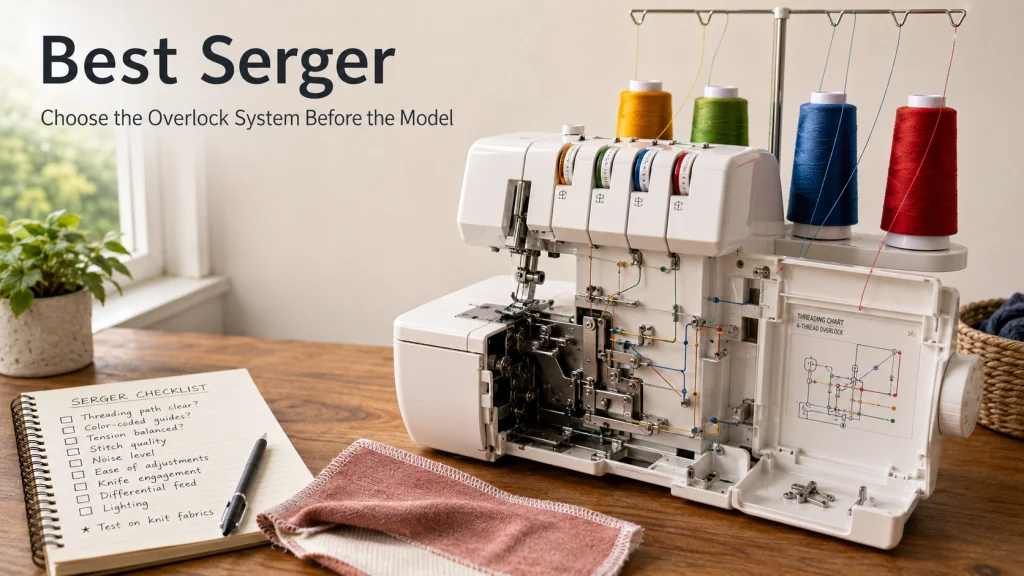
Threading is not a single feature. A machine may combine color-coded guides, a lower-looper aid, air-supported looper threading, and a needle threader in different ways. What to look for in a serger depends on how often you rethread and which step actually slows you down.
Use the manual, not marketing shorthand, to trace the whole path from spool to stitch. A premium looper-threading system may reduce one demanding part of the setup while leaving needle threading, thread order, tension release, presser-foot position, or other steps separate. The workflow matters more than the feature label.
Manual color-coded paths
Color coding gives the operator a visible route through the guides and tension path. Brother documents printed color-coded guides on the 1034DX. The thread still has to follow the manual path correctly, and a buyer comfortable with that sequence may not gain enough from automation to justify a higher-priced system.
Lower-looper aids
Some machines simplify the lower looper without powered air threading. Check whether the aid changes access, thread placement, or uses a mechanical threader, then verify the exact manual steps. Do not treat every looper aid as equivalent to air threading.
Air-supported looper threading
Air systems route thread through looper tubes rather than requiring manual placement through the full looper path. Brother documents this on the AIR1800, JUKI on the MO-1000, and Janome on the AirThread 2000D. It can change repeated thread changes materially, but its value still depends on how often looper threading affects your routine.
Needle threading remains a separate question
Looper automation does not tell you how the needles are threaded. JUKI lists an automatic needle threader on the MO-1000 and Janome a built-in needle threader on the AirThread 2000D. Verify both systems independently, then use the air-threading serger comparison if threading architecture is the deciding issue.
Threading workflow audit: Record the thread order, access to each looper, any lower-looper aid, whether loopers use air, how needles are threaded, how a thread configuration is changed, and which steps require the manual to be open. Then decide which steps you are actually paying to simplify.

The Brother 1034D is a dedicated serger for finishing fabric edges, trimming seam allowances, and forming overlock seams with three or four threads. It uses a sturdy metal frame, color-coded thread guidance, and a removable trim trap to support regular garment sewing and knit projects. The machine can sew up to 1,300 stitches per minute and includes accessory feet for additional operations. This is not a general-purpose straight-stitch sewing machine. Confirm the model, included feet, and current seller listing before purchasing because the original ASIN may refer to a different bundle or 1034DX variant.
Check On AmazonIf you click this link and buy, we earn a commission at no additional cost to you.
Check rolled hem, knife controls, free arm, and workspace only when they change the work
Rolled-hem changeover, knife control, a free arm, work-area dimensions, lighting, and accessory storage can all be useful, but they should remain secondary until the core overlock brief is satisfied. A quick rolled-hem change matters when rolled edges are frequent. A removable free arm matters when the projects and construction sequence genuinely benefit from it. A larger body or workspace may help one setup while making storage harder in another.
Verify the exact feature rather than accepting a vague label. Brother currently documents rolled-hem changeover and knife control on the AIR1800, while JUKI documents automatic rolled hemming and an option to deactivate the upper knife on the MO-1000. These are examples of features that can change a workflow, not proof that either machine should rank above another for a buyer who rarely uses them.

The Brother AIR1800 is a 2, 3, and 4-thread serger with air threading for the loopers. It includes quick-change levers for rolled hemming and a switch for activating or deactivating the cutting knife. Differential feed and color-coded thread guides support adjustment across different overlock workflows.
Check On AmazonIf you click this link and buy, we earn a commission at no additional cost to you.
Verify needles, feet, manuals, and service without turning this into compatibility shopping
Before buying, confirm the needle system, included feet, manual availability, and manufacturer support or service route. Brother’s 1034DX page lists standard sewing-machine needles and three included feet, while JUKI’s MO-1000 page lists its needle size, standard accessories, manual, and support route.
This check stops at ownership readiness. It should not turn into a presser-foot or needle compatibility catalog before you even own the machine. Record only what materially changes initial use, first-year cost, or service access, then move on. Exact accessory fit belongs in a separate compatibility decision after the machine is identified.
Set the evidence threshold for every recommendation
Keep specifications separate from promotional claims. A documented thread configuration, differential-feed range, included foot, dimension, or linked manual is a specification. A claim of better results on difficult fabric remains a performance claim unless an independent test discloses the exact machine, material, thread, needle, stitch setup, and comparison conditions.
A review that repeats features or star ratings does not establish stitch quality, threading time, durability, or material capacity. Mark those points unknown unless a named test discloses its conditions. Unknown is better than pretending a specification proves performance.
How to read a manufacturer specification page: Start with checkable fields such as thread configurations, differential-feed range, stitch dimensions where listed, speed, machine dimensions, included items, needle specification, manual, warranty, and support route. Treat phrases such as “professional results,” “effortless,” or “perfect for difficult fabrics” as marketing claims unless the page gives a test method or measurable condition. If the product page and manual differ, use the exact manual and current support documentation before buying.
| Evidence example | Verified official facts | Status limit |
|---|---|---|
| Brother AIR1800 | 2/3/4-thread change, differential feed, air looper threading, rolled-hem change, 1,300 maximum stitches per minute, current Brother support and warranty route | Does not prove it is easier for every buyer or better on every stretch fabric |
| JUKI MO-1000 | 2/3/4-thread capability, looper air threading, automatic needle threader, differential feed, rolled hem, published manual and support route | Does not prove its higher price produces better sewing results for every job |
| Janome AirThread 2000D | 2/3/4-thread convertible, one-push air threading, built-in needle threader, differential feed 0.5 to 2.0, rolled-hem change, current manual and dealer support | Does not prove premium threading features are necessary for an occasional user |
These are evidence examples, not product recommendations. Their purpose is to show how three current machines can share the same broad serger label while presenting different workflow and ownership questions.
Build the current shortlist from a written serger brief
A bounded shortlist contains only machines that satisfy the written brief. If four-thread overlock, differential feed, rolled hem, accessible documentation, and reachable service are must-haves, exclude any machine missing one before comparing convenience or price.
Because this page does not prescribe a specific product, use the following cards as filters rather than picks. Match current models to the brief using official documentation, then fill the unresolved field before purchasing.
| Written serger brief | Qualifies when | Exclude when | Unresolved test |
|---|---|---|---|
| Manual-threading, cost-controlled home overlock | Required 3/4-thread work, differential feed, rolled hem, and documentation are verified | Looper threading is a known barrier or required two-thread work is unsupported | Can you follow the full threading route comfortably and repeat it after a break? |
| Frequent thread-change workflow | Looper threading aids or air threading materially reduce a repeated setup burden | The premium is being paid for a feature you rarely use | Which steps are actually automated, and which still require manual threading? |
| Multiple thread configurations required | The exact manual documents every configuration tied to a recurring job | A required setup is absent or depends on an undocumented assumption | How is the converter or changeover performed, and what parts are required? |
| Mixed-material home sewing | Differential feed, pressure adjustment where needed, and the required stitches are documented | The shortlist is based only on a “heavy duty” or fabric-capability label | Is there independent testing on material conditions close to yours? |
A shortlist is complete when every surviving machine has a reason to qualify, a reason another machine was excluded, and a visible unknown that still needs verification. That is more useful than adding models until the table looks comprehensive.
Explain why each model qualifies and where it stops fitting
Every candidate needs a positive case and a stopping point. A manual-threading machine may qualify on required overlock work and cost, then stop fitting when frequent rethreading is a real barrier. An air-threading machine may qualify on workflow, then stop fitting when the convenience does not justify its price or the required stitch lies outside ordinary overlock work.
This two-sided explanation prevents a feature from becoming a universal verdict. It also makes comparison updates easier when a model is revised or discontinued. The requirement stays stable even when the candidate list changes.
Separate sewing-machine-versus-serger uncertainty from model ranking
If you are still asking whether an ordinary sewing machine can handle the work, stop ranking sergers for the moment. That is a machine-family decision, and resolving it first can prevent an unnecessary specialist purchase. Compare the actual operations you need, which machine already covers them, and which overlock function remains missing.
The serger and sewing machine comparison owns that decision. Return to a model shortlist only after the overlock system itself has earned a place in the workflow.
Separate first-serger needs from experienced ownership preferences
A first-time buyer may value documentation, threading visibility, clear controls, learning support, and a manageable set of required configurations more than a larger feature ceiling. That user situation does not make one machine universally beginner-friendly.
Use the first-serger buying criteria when learning workflow is the deciding factor. This keeps the broad commercial comparison from assuming that every reader has the same starting point.
Separate threading-system value from the rest of the feature list
Air threading deserves its own decision when it carries a meaningful price premium. Compare how often threads change, which looper steps cause difficulty, whether needle threading is also assisted, and what premium remains after the other requirements are equal.
The air-threading system decision is the right next step when threading automation could change the shortlist. Keep the rest of the serger requirements fixed while comparing that feature so convenience does not erase the actual stitch and project needs.

The JUKI MO-1000 is a 2, 3, and 4-thread overlock machine with air threading for the loopers. It also includes an automatic needle threader, adjustable differential feed, and rolled-hem capability. These threading features make it particularly relevant when repeated setup and thread changes are major factors in the buying decision.
Check On AmazonIf you click this link and buy, we earn a commission at no additional cost to you.
Separate thread-count requirements from feature-count marketing
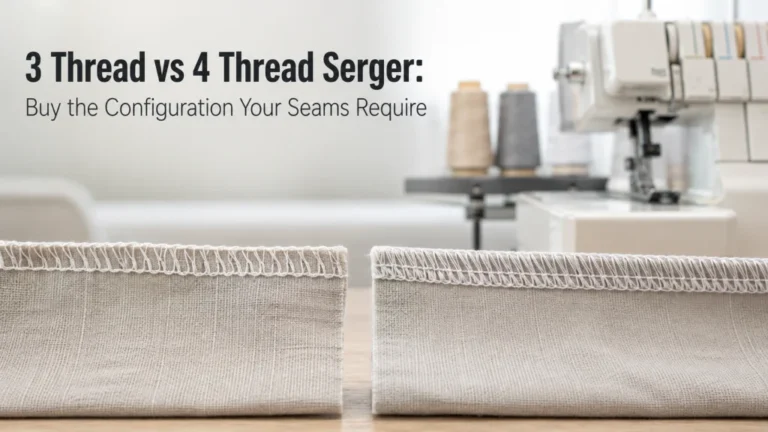
Buyers who specifically need to know whether three-thread or four-thread operation changes the purchase should resolve that requirement directly. The answer depends on the stitch operation and project context, not on the idea that a higher number is automatically stronger, more advanced, or more valuable. Manufacturer stitch charts and manuals should control the machine-specific part of that decision.
Continue to the three-thread and four-thread comparison when that distinction is central. Once the required configuration is written down, return to the broader shortlist and eliminate machines that cannot document it.
Separate knit-dominant buying from a general home-serger comparison
A buyer who primarily sews knits should not stop at a general “works with knits” label. Material stretch, seam construction, differential feed, presser-foot pressure where available, needle and thread conditions, and test setup can all change the result.
Use the serger criteria for knit-heavy sewing when stretch materials dominate the workload. That route keeps material-specific evidence from distorting a broad home-serger ranking.
Move to coverstitch or combination systems only when the required operation changes
A serger and a coverstitch machine are not interchangeable. If the missing operation is a cover hem or a combination of overlock and coverstitch functions, the machine-family decision has changed.
At that point, leave the ordinary serger shortlist and compare coverstitch and combination-system options. Do not buy a more expensive overlocker merely because it has more threads if the required stitch is outside the ordinary overlock job.
See more in this section
The broad serger decision gets easier when one unresolved requirement is separated from the rest. Use the next article that matches the question still keeping models on your shortlist.
| Topic | What you’ll find |
|---|---|
| Serger vs sewing machine | Decide whether adding an overlock system is justified before comparing machines. |
| Choosing a first serger | Prioritize learning workflow, documentation, threading visibility, and an appropriate first-machine feature set. |
| Air-threading sergers | Compare looper automation, needle-threading support, repeated setup effort, and the price premium. |
| Three vs four threads | Identify which documented stitch configurations your recurring work actually requires. |
| Sergers for knit-heavy sewing | Focus the buying brief on stretch materials, feed behavior, and disclosed material conditions. |
Keep the same written brief as you move between these comparisons. Only the unresolved requirement should change.
Final Thoughts: buy the serger workflow, not the badge
A useful serger shortlist begins with required operations, not model popularity. Confirm that overlock work is actually needed, write the thread configurations and material conditions, audit the complete threading path, and verify the manual, included essentials, and service route. Then eliminate any machine that cannot document a must-have requirement.
Premium convenience can be worth paying for when it removes a repeated burden, but it does not automatically improve every seam or every project. The best serger machine for a specific buyer is the one that satisfies the written brief with the fewest important unknowns, not the one carrying the most expensive threading system or the longest specification list.
Frequently Asked Questions
🧵 Do I need a serger if I already have a sewing machine?
Not automatically. Add one when recurring overlock, edge-finishing, or stretch-seam work justifies a separate specialist workflow rather than because a general ranking says every sewist needs one.
🪡 Is a 4-thread serger always better than a 3-thread serger?
No. The useful configuration depends on the stitch operation and project, so verify which setups the exact model manual supports and which ones your recurring work actually requires.
💨 Is air threading worth paying extra for?
It can be when frequent looper rethreading is a real ownership burden. Compare the complete threading process, including needle threading, and decide whether the reduced setup work justifies the price difference for your routine.
🧶 What does differential feed matter for on a serger?
It changes the relative fabric feed and can matter with stretch, fine fabrics, gathering, or edge distortion. Compare the documented adjustment range and your material needs rather than treating the feature as proof of fabric performance.
✂️ Should a serger have a rolled-hem setting?
Require it when rolled edges are part of your recurring work. If you rarely use that finish, the speed or convenience of the changeover should not outweigh more important requirements.
📖 What should I verify before buying a serger?
Verify the exact thread configurations, threading workflow, differential feed, required edge finishes, needle specification, included essentials, manual, warranty or service route, and any feature that materially changes your work. Treat untested fabric-performance claims as unknown rather than as specifications.
References and Sources
- Brother 1034DX specifications: Supports current pricing status, 3/4-thread product positioning, color-coded threading, differential feed, included feet, rolled-hem change, speed, and warranty details.
- Brother AIR1800 specifications: Supports current air-threading, 2/3/4-thread change, differential feed, rolled-hem controls, speed, dimensions, and warranty details.
- JUKI MO-1000 specifications: Supports 2/3/4-thread capability, air looper threading, automatic needle threading, differential feed, rolled hem, speed, accessories, manual, support route, and suggested retail price.
- Janome AirThread 2000D specifications: Supports 2/3/4-thread capability, one-push air threading, built-in needle threader, differential-feed range, rolled-hem change, dimensions, and current manual access.
- Janome warranty and service: Supports the current authorized-dealer warranty and service pathway for Janome machines in the United States.