A first serger should be chosen around the work you expect to do and the complete threading routine you are willing to repeat, not around a vague beginner label. The useful comparison separates initial threading, rethreading, stitch conversion, differential-feed control, documentation, service access, and ongoing consumables. Air-assisted threading can reduce one part of that burden, but it does not remove the rest of the model-specific setup. By the end, you should be able to reject a machine that does not fit the way you will actually use it.
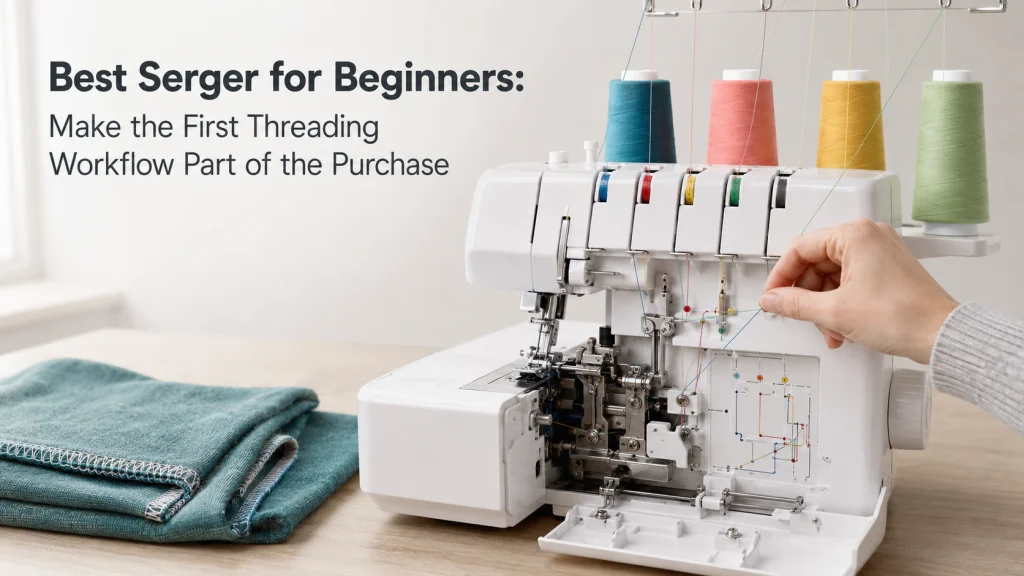
Beginner to serging is not beginner to sewing
The best serger for beginners is not automatically the cheapest machine or the one with the shortest feature list. A sewist who already understands seams and garment construction can still be completely new to loopers, multiple thread paths, cutting knives, differential feed, and stitch conversion. The purchase question is whether the machine’s workflow matches the buyer’s tolerance for setup and rethreading, not whether the buyer has sewn before.
Consider two first-serger buyers. One is comfortable following a color-coded diagram and would rather keep the machine mechanically simple; the other expects to change thread colors often and already knows a tedious rethread will make the machine sit unused. Those buyers can reasonably choose different levels of threading assistance even when their project lists are similar. This page stays with home sergers for US sewists and small makers, and does not cover coverstitch machines, combination systems, industrial overlockers, or beginner general-purpose sewing-machine recommendations.
Confirm that a serger is the next machine, not the first sewing machine
A serger is most useful when its trimming, edge finishing, multi-thread seam construction, or differential feed solves a job you actually have. It is not a universal replacement for a conventional sewing machine. Tasks such as buttonholes, many zipper applications, topstitching, and the broad range of straight and zigzag work still belong to a regular machine, so a buyer who does not already have those needs covered may be solving the wrong problem first.
Before shopping, separate “I want cleaner seam finishes” from “I need a machine that can do all of my sewing.” If the second statement is closer to your situation, use the specialist machine type comparison to confirm where a serger fits. If you already know you need an overlock system, the broader serger buying comparison covers the wider purchase decision.
Write the first-year serger jobs before comparing features
A feature only matters when it changes a task you expect to perform. Write down the jobs you realistically expect in the first year, including the materials you use and how often you expect to change thread color or stitch configuration. This prevents a common first-owner mistake: paying for a long feature list while overlooking the two or three operations that will happen every week.
- Finish or construct knit garment seams where stretch and edge control matter.
- Neaten woven seam allowances without treating the serger as a substitute for every construction seam.
- Use a rolled hem when the project genuinely calls for that finish.
- Handle fabrics that may need differential-feed adjustment to control stretching or puckering.
- Change thread colors often enough that rethreading effort becomes part of the ownership decision.
- Use two, three, or four threads only if those configurations match planned work rather than feature-count shopping.
That job sheet turns the purchase into observable requirements. A buyer who mostly finishes stable woven seam allowances may value fast thread changes less than someone moving between several knit garments and colors. It also gives you a reason to reject features that add cost but do not reduce work in your projects.
Decide the minimum thread configurations before comparing machines
Thread count should be treated as a task requirement, not a score. Many home sergers offer three-thread and four-thread overlock configurations, while some also support two-thread work. The useful question is which configurations your planned seams and finishes require, because added configurations can introduce more conversion steps.
A first-time owner who expects mostly four-thread construction and three-thread edge finishing does not automatically benefit from a larger stitch menu. Conversely, a buyer with a defined use for two-thread finishing should verify that capability before purchase rather than assuming every machine can be converted. If this is the unresolved decision, compare 3-thread and 4-thread setups before you spend time judging threading systems.
Audit the complete first-threading workflow
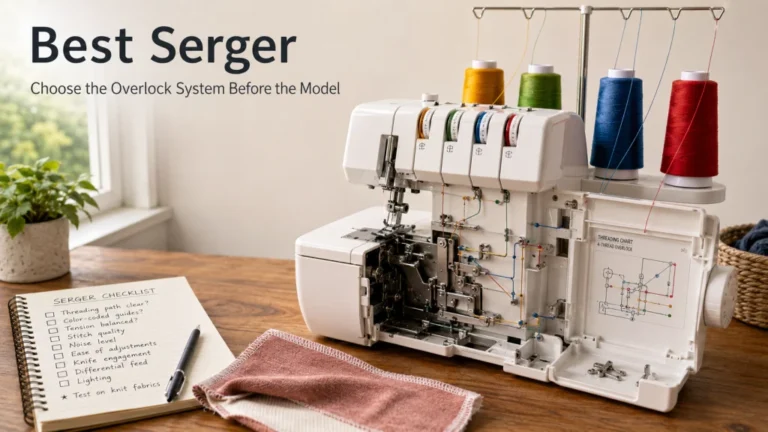
Initial threading is where many first-serger comparisons become too vague. “Color coded” can describe helpful markings, but it does not tell you how clearly each guide is visible, how the lower looper is accessed, whether the manual shows the correct threading order, or what happens when the machine is completely unthreaded. Audit the entire path from cone stand to needle rather than stopping at a marketing phrase.
Note: Current manufacturer documentation shows why the workflow must be checked model by model. Brother documents color-coded guides on the 1034DX, Janome lists color-coded guides and lower-looper access on the MOD-8933, and JUKI documents air-assisted looper threading on the MO-1000. None of those features alone proves universal ease.
Thread-path visibility
Start with the machine fully unthreaded in the manual or official video and trace every numbered or colored path. Look for places where a thread disappears behind a cover, changes direction, passes a tension point, or must be seated in a guide that is easy to miss. A good diagram should make the order and destination clear. If the path only makes sense after an unofficial workaround, treat that as a documentation weakness.
Looper access
Looper threading is often the part that feels least familiar to someone coming from a conventional machine. Check what opens, what moves into position, which tool or lever is used, and whether the manual shows the sequence clearly. Access matters because the real test is whether you can recover after a broken thread or full color change. Follow the exact manual for cover position, knife safety, power state, and any built-in threading mechanism.
Manual and video documentation
A printed color chart is helpful, but it should not be the only support. Verify that the current manual is downloadable before purchase and that official support material covers threading, stitch conversion, rolled hem setup, cleaning, and basic troubleshooting. Video is useful when it matches the exact model and control layout. A video for a visually similar machine is not proof that the threading order or conversion steps are the same.
Starting from a fully unthreaded machine
A machine delivered with threads already tied on can make the first setup look easier than the next one. The useful test starts after every thread has been removed and the owner must rebuild the path from the beginning. Independent testing is most useful when it discloses the starting state, who did the threading, and whether help was needed. Without those conditions, “easy to thread” is too subjective to carry the purchase decision.
| Workflow check | Evidence to look for | Reason it matters |
|---|---|---|
| Thread order | Exact manual sequence and numbered or color-coded path | Prevents a simple order error from being mistaken for a tension problem |
| Lower-looper access | Official diagram, lever, guide, or air-threading procedure | Shows how much manual manipulation is required during a full rethread |
| Needle threading | Exact needle path and any built-in needle-threader instructions | Looper assistance does not necessarily thread the needles |
| Recovery after breakage | Official rethreading or troubleshooting sequence | Reveals whether one broken thread creates a full reset |
The scorecard should be completed with the exact candidate machine in front of you, either physically or through its official documentation. That keeps “beginner-friendly” tied to observable steps instead of turning it into an uncheckable adjective.

The Brother 1034D is a 3 or 4 thread serger with color-coded upper thread guides and a lower looper threading system. It supports 4-thread overlock, 3-thread overlock, narrow hem, and rolled hem stitches for common serging tasks. Differential fabric feed provides additional control when working with thin or stretchy fabrics.
Check On AmazonIf you click this link and buy, we earn a commission at no additional cost to you.
Audit rethreading and stitch conversion separately
First threading and everyday rethreading are not the same ownership problem. A buyer may accept a slow first setup but dislike repeating cover opening, needle removal, thread rerouting, tension changes, and test stitching for later changes. Record recurring steps separately.
Do the same for rolled hems and any thread-count changes you expect to use. Check whether the stitch finger changes position, whether a converter or slider is involved, whether a needle must be removed, and which tension or cutting-width adjustments the manual specifies. More available stitches do not automatically create more useful growth if the owner avoids them because the conversion routine is poorly documented or too disruptive for the way they sew.
Treat air threading as an option, not an automatic requirement
Air-assisted threading can reduce the manual work of sending thread through the loopers, which may be valuable for someone who expects frequent complete rethreads. It does not mean the whole machine threads itself. Needles still have their own path, the stitch still has to be configured correctly, and the owner still needs to understand tension, thread order, conversion, cleaning, and troubleshooting for that exact model.
That makes air threading a workflow choice rather than a universal beginner requirement. If the looper path is the specific barrier that would stop you from using a serger, compare air threading systems as a separate purchase decision. If you are comfortable with a clearly documented manual path, do not assume you need to pay for a feature that solves a problem you do not have.
Verify differential feed and the rolled-hem workflow
Differential feed is not just another dial to count on a specification sheet. It changes the relationship between the front and rear feed movement so the machine can better manage materials that stretch or gather as they pass under the foot. For a first owner, the important evidence is the adjustment range, the manual’s explanation of normal settings, and whether the control is easy to return to a known baseline after experimenting on scraps.
Rolled hem deserves the same workflow check. Current home sergers may provide a quick conversion, but the exact steps vary by machine and can involve stitch-finger position, thread configuration, tension, stitch length, and cutting width. Do not assume “rolled hem capable” means “one control and done.” A useful beginner machine is one whose manual makes the conversion repeatable and whose controls let you return to the previous overlock setup without guesswork.
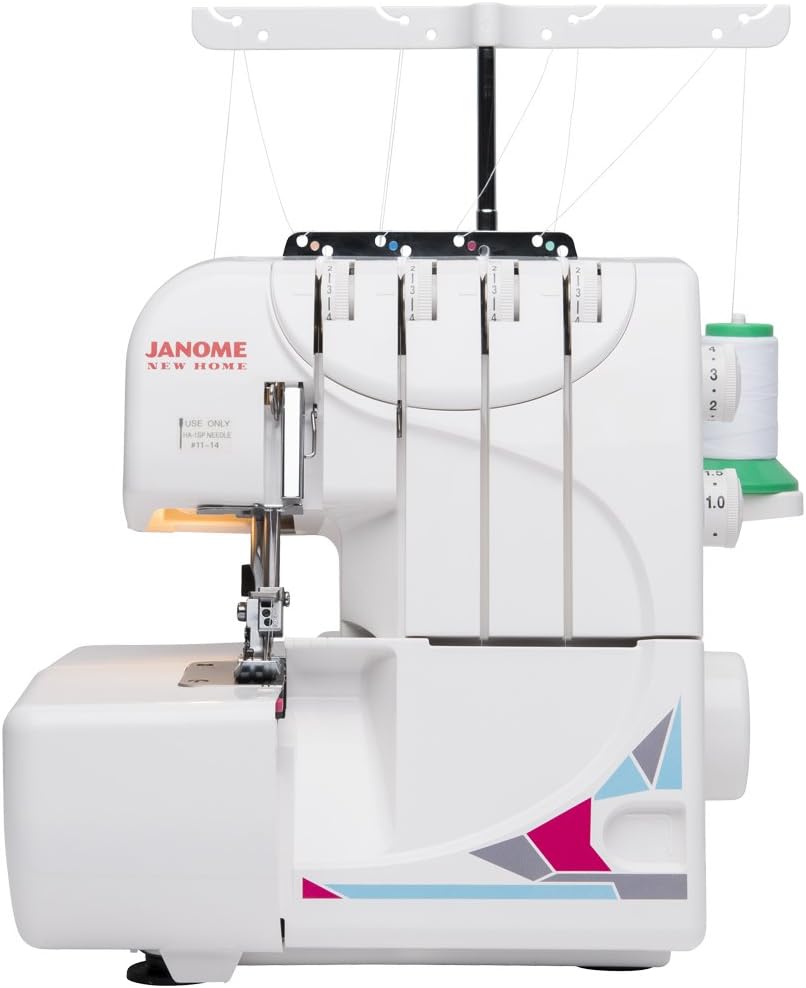
The Janome MOD-8933 is a 3 or 4 thread serger with lay-in tension dials and color-coded thread guides. Its lower looper is designed for accessible threading, while the machine also provides differential feed and a quick-change rolled hem system. These controls make it possible to evaluate threading, fabric feeding, and hem conversion as separate parts of the workflow.
Check On AmazonIf you click this link and buy, we earn a commission at no additional cost to you.
Check service, warranty, and replacement consumables
The purchase price is only the entry cost. Check the exact needle system, replacement knife availability, looper or other model-specific service parts, recommended cleaning and oiling instructions, and whether a qualified service path exists where you live. Also verify what the warranty covers, who performs warranty service, whether proof of purchase is required, and whether coverage depends on buying through an authorized channel.
Current US warranty structures differ by manufacturer, which is why a generic “long warranty” claim is not enough. JUKI’s home-machine warranty separates coverage periods by component and routes warranty service through the selling dealer, while Janome directs warranty service through authorized dealers and requires the purchase receipt when the machine is not registered. The practical question is not which number looks largest, but whether the parts and service you may actually need are available under the terms that apply to your purchase.
| Support item | What to verify before purchase |
|---|---|
| Manual | Current exact-model manual is accessible and covers threading, conversion, cleaning, and troubleshooting |
| Needles and knives | Exact compatible system or part is identified and realistically obtainable |
| Warranty | Coverage periods, exclusions, proof-of-purchase requirements, and service route |
| Local service | Authorized or qualified service is accessible before a fault makes the machine unusable |
Do not treat owner maintenance as permission for internal repair. Follow the exact manual for cleaning, oiling, knife handling, and replacement steps, and use qualified service for damaged cords, overheating, smoke, burning odor, sparks, exposed wiring, uncontrolled motion, hard mechanical lock, repeated hard needle strikes, or work the manual reserves for service personnel.
Set an evidence threshold for beginner-friendly claims
A useful claim should tell you what was tested or documented. Manufacturer pages can verify thread configurations, differential feed, rolled-hem capability, included controls, manuals, and warranty information. They cannot by themselves prove that a novice will find the machine easy, because “easy” depends on the starting state, the instructions available, the person doing the setup, and the task being attempted.
Independent testing becomes more useful when it discloses those conditions. For example, a test that deliberately removes the supplied threading before asking inexperienced users to rebuild the path tells you more than a review that simply sews on a factory-threaded machine. Community discussions are valuable for identifying repeated concerns such as threading fear, budget, service access, and long-term feature value, but they are not technical proof that one model will behave the same way for every owner.
Pick the machine described most often as easy and assume the label applies to every buyer.
Ask what exact threading, conversion, documentation, service, and project conditions support the ease claim.
This evidence threshold protects a first buyer from both marketing shorthand and overly confident owner anecdotes. It also makes a future comparison easier to update when a model, manual, or support arrangement changes.
Build a current shortlist by first-serger workflow
Because no specific product is being recommended here, build the shortlist as a filter rather than a ranking. Start with current US home sergers whose manuals, thread configurations, differential-feed information, rolled-hem procedure, and service terms can be verified. Then score each candidate against your first-year job sheet and expected rethreading.
| Candidate type | Keep it on the list when | Remove it when |
|---|---|---|
| Manual color-coded threading | The full looper and needle path is clear, accessible, and acceptable for your expected rethread frequency | You already know repeated manual rethreading will stop you from using the machine |
| Air-assisted looper threading | Looper threading is a genuine recurring barrier and the rest of the workflow also fits | You are paying mainly for air assistance while ignoring conversion, service, or project mismatch |
| Expanded thread configurations | You have identified a real first-year use for the extra configuration | The additional modes add complexity without a planned job |
| Simple 3/4-thread system | Your planned work fits those configurations and the conversion routine is clear | Your defined projects require a configuration the machine cannot provide |
A claim that a machine suits a first serger should survive this filter without a universal ranking. The “winner” can legitimately change when one buyer values low recurring setup burden while another values simpler mechanics, local service, or a narrower set of thread configurations.

The JUKI MO-80CB is a 2, 3, or 4 thread overlock machine with differential feed and rolled hem capability. A lever assists with threading the lower looper, while the free arm provides access for cylindrical pieces such as sleeves and pant hems. Adjustable cutting width, stitch length, and presser foot pressure provide additional controls for matching the setup to different sewing tasks.
Check On AmazonIf you click this link and buy, we earn a commission at no additional cost to you.
Show where each candidate stops being beginner-friendly for you
Every candidate should have a rejection condition. A machine with clear manual threading may stop fitting when you expect several complete color changes in one session. An air-assisted model may stop fitting when the added cost does not solve any other part of your workflow, or when local service is poor. A machine with many stitch options may stop fitting when the conversions are complex enough that you will stay on one stitch anyway.
This is a better decision boundary than asking whether a machine is beginner-friendly in the abstract. Write one sentence for each candidate: “I would reject this machine if…” and finish it with a workflow condition you can verify. That forces the comparison back to use, documentation, service, and repeated setup instead of feature accumulation.
Route threading-first buyers to the threading decision
If the entire purchase turns on how often you will rethread, stop broad comparison and examine threading systems directly. Compare what is assisted, what remains manual, whether the sequence works from a fully unthreaded state, and how the machine recovers after a broken looper or needle thread. The important distinction is not “automatic versus manual,” but which steps the mechanism actually removes.
That narrower comparison is especially useful for a buyer who already knows the planned stitch set and service situation are acceptable. It prevents air assistance from being treated as a substitute for checking the rest of the machine. The final choice should still follow the exact manual and manufacturer safety sequence, with no improvised powered threading, guard bypass, or sewing over pins.
Route thread-count uncertainty to the stitch decision
If you are still unsure whether you need three-thread, four-thread, or an additional configuration, solve that before comparing convenience features. A threading system cannot compensate for a machine that does not make the stitch configuration your work requires. Conversely, extra thread options have little value when the first-year job sheet never calls for them.
Once the required configurations are clear, the purchase becomes much cleaner: compare only machines that meet that minimum, then judge threading, conversion, differential feed, rolled hem, documentation, service, and ownership cost. This sequence keeps the decision from expanding every time a specification sheet introduces another feature.
See more in this section
If your shortlist is still broad, return to the wider comparison after the first-year job sheet is complete. If threading is unresolved, use the threading-focused comparison; if thread count is unresolved, settle the stitch configuration first. Each route answers a different purchase question.
The point is to reduce the decision until only verifiable differences remain. A first-serger purchase is easier to defend when you can name the jobs, the required thread configurations, the threading burden you accept, the service route you can access, and the documentation you will rely on before the machine ever reaches the table.
Final Thoughts: buy a machine you can confidently rethread
The first serger that fits you is the one whose repeated workflow you are willing to own. You should know how the exact machine is threaded from empty, how thread changes and planned stitch configurations work, how differential feed and rolled hem return to known settings, and where the manual sends you when a problem exceeds owner-level work.
Do not let price, stitch count, or one convenience feature stand in for that check. Use current exact-model documentation, realistic first-year jobs, service access, and a disclosed evidence standard. When those pieces line up, “beginner” stops being a marketing label and becomes a practical description of a machine you can actually learn, reset, and keep using.
FAQs
These questions focus on the decisions that usually remain after a first buyer has confirmed that a serger is the right next machine. The answer still depends on the exact model, planned stitches, material, documentation, and service situation.
🧵 Is a serger hard to thread for a beginner?
It can be unfamiliar, but difficulty varies by thread path, looper access, documentation, and whether the machine has an assisted threading system. Judge the exact model from a fully unthreaded state rather than from how it arrives in the box.
⚙️ Do I need air threading on my first serger?
No. Air-assisted looper threading is useful when manual looper rethreading is a recurring barrier, but it does not remove every threading, conversion, tension, or maintenance step.
🪡 Should my first serger have three-thread and four-thread stitches?
Choose thread configurations from the seams and finishes you actually plan to make. Do not assume more configurations are better unless you can name a real use for them.
🧶 Can I leave a serger threaded and tie on new thread?
Use only the rethreading method allowed by the exact machine manual. A shortcut that works on one model or for one thread path should not replace the documented procedure for another machine.
📖 How important is the manual when buying a serger?
Very important. The manual should explain threading order, stitch conversion, differential-feed settings, rolled hem setup, cleaning, troubleshooting, and the boundary between owner maintenance and service.
🔧 What should I check about serger service before buying?
Verify the warranty route, authorized or qualified service availability, proof-of-purchase rules, and access to compatible consumables and replacement parts. Check these before a fault makes the machine unusable.
If two candidates still look equal after these questions, compare the repeated steps rather than the headline features. The machine you can confidently rethread, convert, reset, and get serviced is usually the safer first-owner fit.
References and Sources
The sources below were used to verify current threading systems, thread configurations, differential feed, rolled-hem features, support, and warranty structure. Manufacturer claims are treated as documentation of configuration, not proof that a machine is universally easy for beginners.
- Brother 1034DX product documentation: verifies the current 3/4-thread configuration, color-coded threading guides, differential feed, rolled-hem change, included feet, and warranty listing.
- Brother 1034DX support page: verifies that exact-model manuals, warranty statements, support information, and compatible supplies are available through Brother support.
- JUKI MO-1000 product documentation: verifies 2/3/4-thread operation, air-assisted looper threading, needle-threading assistance, differential feed, rolled hem, and current listed accessories.
- Janome MOD-8933 product documentation: verifies 3/4-thread operation, color-coded guides, lower-looper access, differential-feed range, rolled-hem conversion, and current manual availability.
- JUKI home machine warranty: verifies current component coverage periods, household-use limitation, and the dealer-based warranty service route.
- Janome warranty information: verifies current US warranty-service steps, receipt requirements, authorized-dealer routing, and non-transferability.
- Better Homes & Gardens beginner machine testing: provides a disclosed example of testing a serger after deliberately unthreading it, illustrating why starting state and tester experience matter when judging threading ease.
Model configuration, manuals, availability, and warranty terms can change. Recheck the exact manufacturer page and manual for any machine still under consideration on the day of purchase.