A kids sewing machine can mean an enclosed craft system, a reduced mini threaded machine, or a normal domestic machine used with adult supervision. Choose first by the intended learning outcome, then verify the exact manual, needle-area design, start method, speed behavior, consumables, warnings, and adult role. Small size, a guard, battery power, or child-focused marketing does not prove suitability. The goal is to identify the right learning system before comparing products within that class.
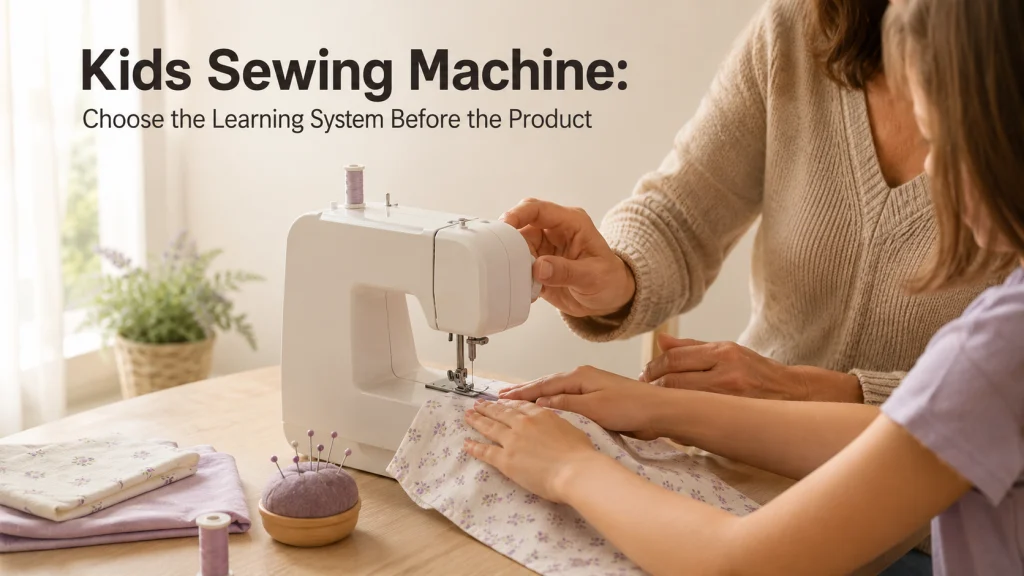
Two kids machines can teach completely different activities
Put two products labeled for children side by side and the shared label can hide the most important difference. One may use a pre-threaded cartridge and enclosed or restricted needle area to complete guided craft projects, while another may be a real threaded machine with a needle, upper thread path, bobbin system, presser foot, and ordinary fabric feed. Calling both a kids sewing machine does not make them interchangeable.
Start with the learning outcome instead of the product photo. A child who mainly wants a contained craft activity has a different use case from a learner who is expected to understand threading, bobbin handling, presser-foot control, seam guidance, and other skills that transfer to ordinary domestic sewing. That distinction is also why a search for the best sewing machine for kids should not begin with one ranked list of unlike machines.
Define the product classes before ranking anything
Retail labels such as “sewing machine for kids” or “child sewing machine” describe an audience more often than a technical system. Before comparing price or controls, identify what forms the stitch, how the machine starts, whether the needle area is accessible, what supplies it consumes, and whether the documentation treats it as a toy, craft product, or household sewing machine. The three classes below are a sorting tool, not a safety ranking.
Toy or enclosed craft system
This class is built around a contained activity rather than ordinary machine setup. A current retail example uses a pre-threaded cartridge and fabric sensors instead of conventional upper threading and bobbin setup. That can simplify the activity, but it may also tie the system to specific refills or project formats. Verify exactly what the enclosure, sensor, or guard changes in normal operation and what the product instructions still require from the adult.
Reduced mini threaded machine
A mini machine may use real thread and a real needle while reducing the body, work area, controls, or stitch selection. That makes it closer to ordinary sewing than a cartridge craft system, but it does not automatically make it a good bridge to a larger machine. Verify the thread path, bobbin, presser foot, start method, speed behavior, manual, warnings, and replacement support. Missing or unstable documentation is itself a reason to reject a candidate.
Full-size domestic machine under supervision
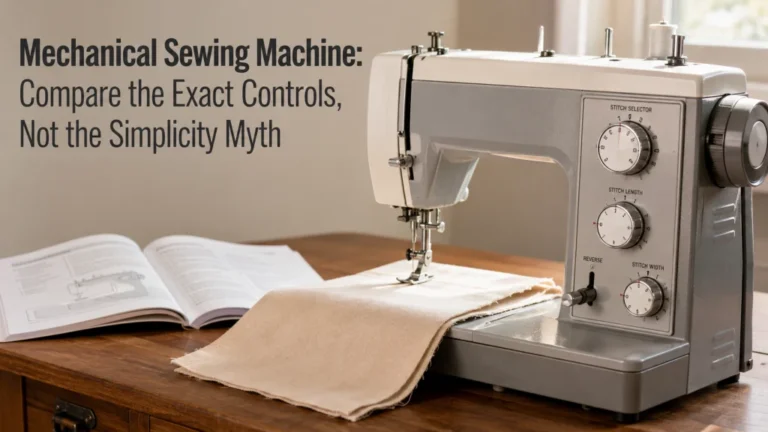
A household machine can teach conventional threading, bobbin installation, presser-foot use, stitch selection, fabric guidance, and deliberate stopping. It also remains a real powered machine with a moving needle. Current Brother safety documentation, for example, requires close attention when a machine is used by or near children and warns users to keep fingers away from moving parts. That exact manual language matters more than child-focused styling.
| Product class | What the learner mainly interacts with | First evidence to verify |
|---|---|---|
| Enclosed craft system | Guided projects, cartridge or contained stitch system | Age language, warnings, needle-area design, refill system |
| Reduced mini threaded machine | Thread, needle, compact controls, limited work area | Manual, stitch system, speed/start behavior, replacement parts |
| Full-size domestic machine | Ordinary machine setup and fabric handling | Household-machine safety instructions, controls, supervision needs |
Once the class is clear, the comparison becomes useful. The question is no longer which colorful machine has more features, but whether the whole learning system matches what the child or teen is meant to practice.

The Cool Maker Neon Stitch 'N Style Fashion Studio uses a pre-threaded cartridge instead of conventional upper threading. Smart-stitch fabric sensors control when the machine sews as fabric moves through the work area. The kit includes materials for eight guided fashion and accessory projects, making it a contained craft system rather than a conventional domestic sewing machine.
Check On AmazonIf you click this link and buy, we earn a commission at no additional cost to you.
Decide the intended learning outcome
Write down the intended result before shopping. “Make a small craft with an adult” is one outcome. “Learn the controls and setup used on an ordinary domestic machine” is another. A third might simply be “test whether machine sewing holds the learner’s interest before the household commits to a larger setup.”
This prevents a common mismatch: buying a simplified craft system for a learner who wants transferable machine skills, or buying a normal domestic machine when the adult is not prepared to supervise a real moving needle and powered mechanism. Neither product class is automatically wrong, but each can be wrong for the intended lesson.
Learning-goal worksheet: answer these questions before opening product tabs.
| Question | What the answer controls |
|---|---|
| Should the learner complete guided crafts or learn ordinary machine operation? | Craft system versus threaded machine |
| Who will handle threading, needle changes, jams, and setup? | Required adult role and control complexity |
| Should the skills transfer to a normal domestic machine later? | How important conventional threading, bobbin, and presser-foot skills are |
| What happens after the included projects or supplies are used? | Refill availability and long-term usefulness |
If the answers point toward ordinary domestic sewing, use the broader process to choose a sewing machine systematically rather than treating child-focused marketing as the deciding filter.
Write the adult supervision plan before choosing controls
Do not turn age into a universal readiness rule. Ask whether an adult can follow the exact instructions, remain close enough to intervene, control setup and maintenance tasks, and stop the session when operation leaves those instructions. Base the plan on the exact machine, not a generic age chart.
For example, an adult supervising a real domestic machine may decide that the adult alone plugs in the machine, installs or changes the needle, clears a jam, and handles any abnormal behavior. The learner’s role can be narrower, such as guiding stable fabric at a deliberately limited speed while the adult controls the session.
- Read the complete age, warning, and supervision language in the exact manual or product instructions.
- Decide who controls power connection, threading, bobbin setup, needle changes, and needle-area adjustments.
- Identify the exact start method and decide how the adult can stop the machine immediately.
- Record any rules about fingers near moving parts, unplugging, guards, covers, and adjustments around the needle.
- Define stop conditions before the session, including a damaged cord or plug, uncontrolled motion, abnormal heat, smoke, burning odor, a loose or damaged guard, a hard jam, or repeated hard needle strikes.
- Do not remove, bypass, or improvise around any guard or protective feature.
- Route any condition reserved for service personnel to qualified service rather than continuing the session.
This combined supervision and manual-warning checklist is more useful than assuming a machine is suitable because the box shows a child using it. Marketing can suggest an audience, but only the exact documentation tells you how that product is supposed to be operated.
Verify needle-area exposure, guard, start method, and speed behavior
Four details deserve separate checks because they affect how an adult can supervise actual operation. First, inspect how accessible the needle area is and what the manual says about fingers and moving parts. Second, identify any guard or enclosure and verify whether it is fixed, removable, or tied to a specific operating procedure.
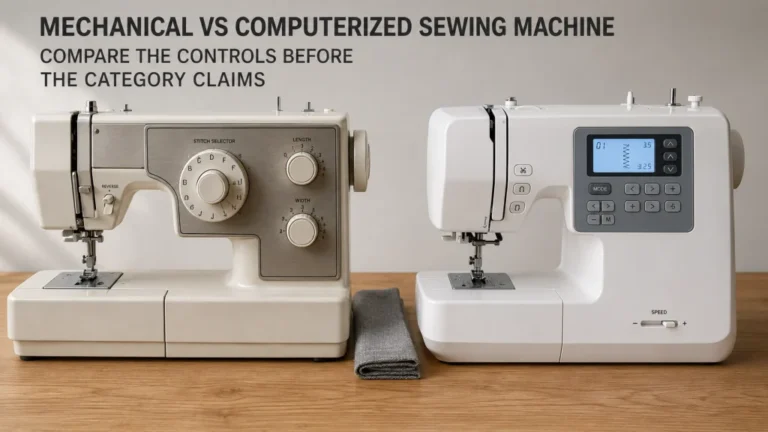
Third, confirm exactly how the machine starts. A household machine may use a foot controller, a start/stop button, or different behavior depending on whether the foot controller is connected. Fourth, verify whether speed can be limited at the machine, controlled only by pedal pressure, or not adjusted independently at all.
Key point: A guard does not replace supervision, and a low-speed setting does not change the need to follow needle-area warnings. Controls reduce or change one part of the operating task; they do not convert a real sewing machine into a toy.
Brother’s current documentation illustrates why model-level checking matters: some machines allow a speed controller to set the maximum speed used with the foot controller, while other models or modes behave differently. Never assume that a feature described on one machine applies to another just because both are computerized or marketed to beginners.
Verify standard versus proprietary thread, fabric, cartridges, and replacements
The purchase price is only the start if the learning system depends on special refills. Some craft products use pre-threaded cartridges and direct buyers toward matching refill kits. A conventional domestic machine instead depends on model-compatible bobbins, needles, presser feet, thread, and other ordinary sewing supplies, but those parts still have to match the exact machine.
Before buying, make a small consumables ledger. The goal is not to prefer “standard” at all costs, but to know whether the learner can continue once the included materials are used up and whether replacement items are clearly identified.
| Consumable or part | What to verify | Why it matters |
|---|---|---|
| Thread or cartridge | Ordinary thread path or proprietary refill | Controls color choice, replacement route, and transferable setup practice |
| Bobbin or lower-thread system | Exact class, format, or whether the system is enclosed | Visual similarity does not prove compatibility |
| Needle | Whether user replacement is allowed and which system is specified | Affects maintenance and future availability |
| Project materials | Included fabric only or documented use with other fabrics | Shows whether the system extends beyond the starter kit |
| Power | Battery type, adapter, cord, or household power requirements | Changes setup and supervision, not the basic need for safe operation |
A cartridge-based craft system may be perfectly aligned with a contained project goal even though it teaches less about conventional threading. The problem begins when a buyer expects one supply system to teach the skills of another.
Check whether the stitch and project result transfer to ordinary machine sewing
Transferability is not the same as whether a finished project looks good. A guided craft system can produce a satisfying result while deliberately hiding threading, bobbin management, presser-foot setup, or stitch selection from the learner. If the goal is creative activity, that may be fine. If the goal is learning a domestic machine, those missing steps matter.
Ask which actions the learner will repeat on a normal machine later. Guiding fabric in a controlled direction may transfer. Learning to start and stop deliberately may transfer. A proprietary cartridge that removes threading can be convenient, but it does not teach how to route upper thread, install a bobbin, or verify ordinary needle and thread compatibility.
Note: Do not call a craft system “educational” merely because the package uses learning language. Define the exact skill it practices, then decide whether that skill matches the household’s goal.
Instead of asking whether the product “teaches sewing,” name the specific skill it teaches and compare that skill with the learning goal.
Separate small physical size from simple controls
A smaller machine may fit a table more easily, but size alone says little about control logic. A mini threaded machine can still have a foot pedal, switches, threading points, tension controls, a bobbin area, and a moving needle that require careful setup. Conversely, a larger computerized machine may have a speed-limiting slider and a clearly documented start/stop system.
Use a control count rather than a size impression. Identify every action required to power on, start, stop, change speed, raise the presser foot, position the needle, reverse or secure stitching, wind or install a bobbin, and recover from a normal threading problem. A compact shell is useful only if the controls inside it match the learner and supervision plan.
A mini machine with vague instructions and no stable replacement-part information may be harder to own than a larger machine with a complete manual. Keep footprint and control clarity as separate buying questions.

The Magicfly Mini Sewing Machine is a compact threaded machine with high and slow speed settings. It can be operated with a button or the included foot pedal and supports AC/DC or battery power. An extension table, built-in light, bobbins, needles, and basic sewing tools are included, so its small size still comes with several controls and setup steps.
Check On AmazonIf you click this link and buy, we earn a commission at no additional cost to you.
Read the exact age, warning, and supervision language in the manual
Age labels should be reported, not converted into a universal readiness judgment. A toy or craft product may state a suggested age on a retail page, while a household sewing-machine manual may instead emphasize close attention when used by or near children. Those statements answer different questions and should not be merged into one “safe age.”
Read the warning section before relying on front-of-box age marketing. Compare its rules with the supervision and manual-warning checklist above, especially the instructions for moving parts, power connection, unplugging, needle-area adjustments, abnormal operation, and work reserved for service personnel.
Used machines deserve the same discipline. Check the exact model identification, current manual, missing guards or covers, power equipment, and the CPSC recall database before treating an older machine as suitable for supervised learning. If the documentation or protective parts are incomplete, resolve that evidence gap before putting the machine into the shortlist.
Set the evidence threshold for every child-use recommendation
A child-use recommendation needs a higher evidence threshold than “easy to use” in a review. For each candidate, verify the exact product class, stitch system, power method, needle-area design, speed control, start method, consumables, warnings, age language, and supervision requirements through the current manual or product record.
Then separate evidence types. Manufacturer documentation can establish how a control works or what a warning says. A current retailer can help confirm package contents or whether a cartridge refill is part of the system. Community discussions can show recurring confusion, such as parents asking whether to buy a toy or real machine, but they do not prove safety, durability, or material capacity.
Use the same standard when a listing claims a machine can handle many fabrics or “grow with” the learner. Unless the evidence shows the conditions, material stack, setup, and actual machine system, treat that language as a claim rather than proven capability.
Current options by product class and supervised-use situation
Current US retail results still mix craft toys, compact threaded machines, and normal domestic machines under child-focused searches. Because those are different systems, a useful shortlist should be organized by use situation rather than by model score. The table below intentionally avoids specific product recommendations.
Any candidate that survives this first filter still needs its exact manual, warnings, controls, consumables, and current availability checked before purchase.
| Supervised-use situation | Product class to investigate | Learning outcome | Main limitation to audit |
|---|---|---|---|
| Contained creative activity with minimal machine setup | Enclosed or cartridge craft system | Guided project completion and fabric direction | Proprietary supplies and limited transfer to ordinary setup |
| Compact introduction to a real threaded mechanism | Reduced mini threaded machine | Basic thread, needle, fabric, and start/stop interaction | Documentation, speed behavior, work area, parts, and capability |
| Transferable domestic-machine learning with an adult present | Full-size household machine | Ordinary threading, bobbin, presser-foot, stitch, and fabric-control skills | Real machine hazards, control complexity, supervision, and setup responsibility |
Once the supervised-use situation is clear, narrow the search within that product class and compare only candidates whose manuals, controls, consumables, and limitations can be verified. That keeps the next shopping step focused on products that actually fit the learning goal instead of sending unlike systems into the same ranking.
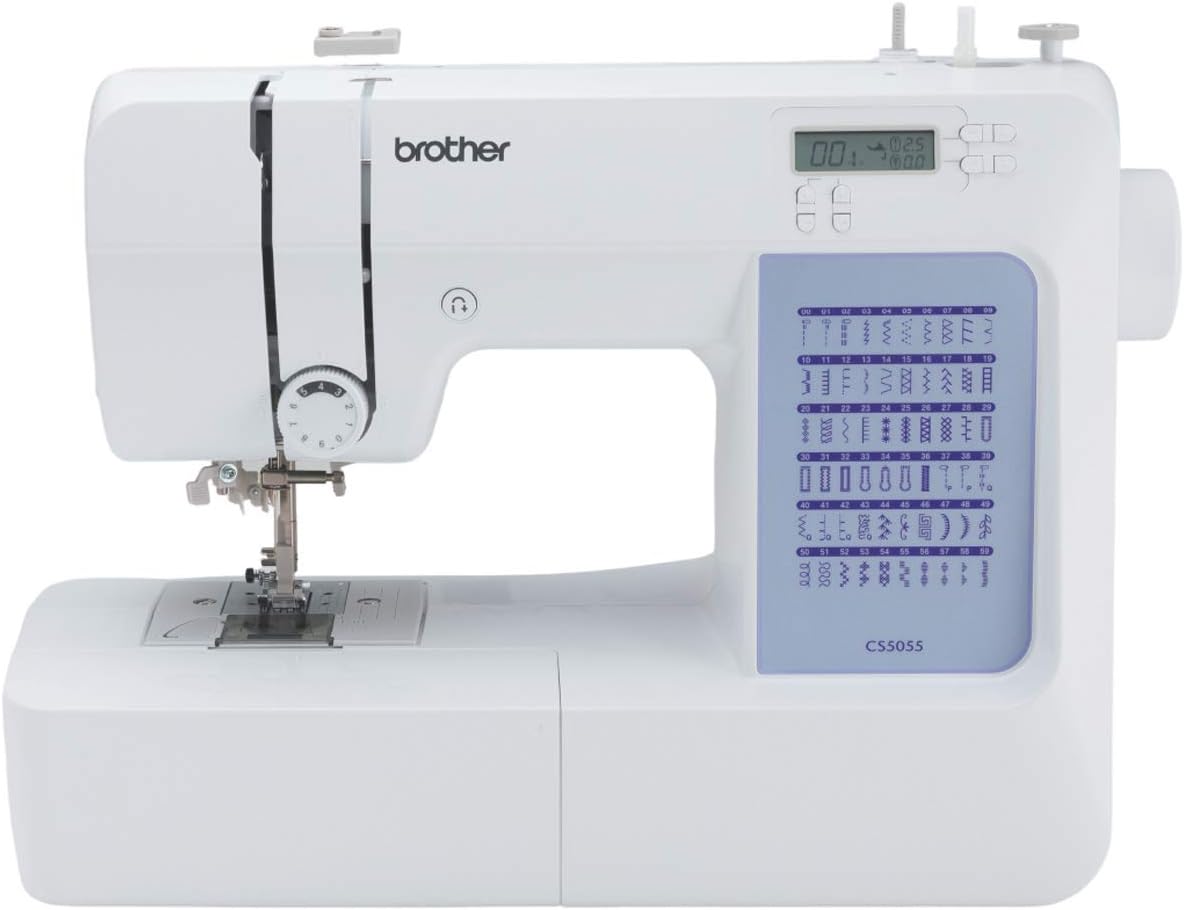
The Brother CS5055 is a full-size computerized domestic sewing machine with 60 built-in stitches and an LCD display. It includes an automatic needle threader, a Quick-Set top bobbin system, and seven sewing feet for conventional machine setup and project work. The machine also comes with an operational manual, allowing its controls and setup requirements to be checked against model-specific documentation.
Check On AmazonIf you click this link and buy, we earn a commission at no additional cost to you.
State what each option cannot teach or cannot sew
Every product class has a boundary. A cartridge craft system may not teach conventional threading or bobbin setup. A reduced mini machine may offer a real threaded mechanism but still have limited documentation, work area, control range, replacement support, or material capability. A full-size domestic machine may offer transferable skills while demanding more adult setup, clearer supervision, and stricter control of the needle area.
Do not infer fabric capacity from “real machine,” “mini,” “heavy duty,” stitch count, motor wording, frame material, or price. If a product claim says it can sew a specific material, look for a documented setup or test condition that identifies the machine, needle, thread, fabric, number of layers, stitch, and other relevant conditions.
A useful example is a bulky seam intersection. A machine that sews two layers of stable cotton does not automatically have proven capacity for a thick folded stack simply because both projects use woven fabric. Material thickness, seam bulk, needle choice, thread, presser-foot behavior, and feed conditions can change the result.
Writing the limitation beside the benefit keeps the shortlist useful and shows when a system no longer matches the learning or supervision plan.
Move to the adult beginner buying process when a supervised full-size machine is the right class
Once the decision reaches a normal domestic machine, stop shopping as though “for kids” were a machine specification. The next questions are the same ones that matter for any household machine: mechanical or computerized controls, speed behavior, stitch system, work area, needle and bobbin compatibility, presser-foot interface, documentation, parts, service access, and ownership cost.
The difference is that the adult role remains part of the fit. A machine can be a sensible beginner purchase for an adult and still be a poor choice for a child-use situation if the household cannot provide the supervision or control setup required by that exact model.
At that point, use the broader comparison framework to compare sewing machine buying options without assuming that more stitches, more automation, or a higher price proves better learning value.
That route also avoids duplicating adult beginner rankings here. This page answers which learning system makes sense for a supervised child or teen; the broader buying material handles the domestic-machine decision once that class has been chosen.
Final Thoughts: choose the learning system before the model
The label on the box is not the decision. First choose between a contained craft activity, a compact real threaded mechanism, and supervised use of a normal domestic machine. Then verify what the exact product documentation says about the needle area, starting and stopping, speed, consumables, warnings, age language, and adult supervision.
Use those checks to eliminate ambiguous candidates, then compare the remaining options inside the product class that matches the learning goal. The strongest purchase is one whose controls, replacement system, supervision requirements, and limitations are clear before anyone sits down at the needle.
Frequently Asked Questions
🧵 Is a kids sewing machine a real sewing machine?
Sometimes, but the label alone does not tell you. It can describe an enclosed craft system, a mini threaded machine, or a normal domestic machine marketed toward younger users, so identify the stitch system and manual before comparing it.
🪡 What age should a child use a sewing machine?
There is no universal age that this article can declare ready for every machine or learner. Follow the exact product’s age language, warnings, and supervision requirements, then decide whether the adult can provide the role that documentation requires.
🦶 Is a foot pedal easier than a start/stop button for a young learner?
Neither control is universally easier. Check whether the exact machine limits maximum speed, how the foot controller changes speed, whether the start/stop button is disabled when a pedal is connected, and which method the adult can supervise most clearly.
🛡️ Does a finger guard make a sewing machine safe for a child?
A guard is one design feature, not a substitute for the manual or adult supervision. Do not remove or bypass it, and do not infer that a guarded needle area makes the rest of the machine risk-free.
🧶 Can kids sewing machines use regular thread and bobbins?
Some can, while some craft systems use proprietary cartridges or refill formats. Verify the exact thread path, lower-thread system, bobbin class or cartridge, and approved replacements before buying supplies.
📖 Should I buy a mini machine or a full-size machine for a child?
Choose based on the learning goal and supervision plan, not size alone. A mini machine may be compact without being simpler, while a full-size machine may offer clearer documentation and transferable controls but require a larger adult role.
References and Sources
These sources support the safety, control, product-class, and buyer-question evidence used above.
- Brother sewing machine safety instructions: Supports the household-machine warnings about supervision near children, moving parts, needle-area precautions, damaged equipment, abnormal heat or odor, and service boundaries.
- Brother foot controller instructions: Verifies that start method and speed behavior can depend on the exact control configuration and model.
- Brother sewing speed guidance: Supports the example of a model with an adjustable sewing speed controller.
- Target craft sewing system listing: Provides a current retail example of a child-oriented craft system using a pre-threaded cartridge, fabric sensing, batteries, and a stated suggested age.
- Target learn-to-sew machine results: Helps confirm that current retail discovery also surfaces conventional threaded sewing machines under learn-to-sew shopping intent.
- CPSC sewing machine recall index: Provides the current US recall category to check when evaluating older or used sewing machines.
- Reddit young beginner machine question: Documents the real buyer confusion between a cheap mini product, a battery toy, and a machine intended to support actual sewing.
Manufacturer and product documentation control technical and safety claims. Community discussion is used here only to show the purchase question people are asking, not to establish safety, durability, or sewing performance.