When I look at a sewing machine for fashion design students, I start with the course requirements rather than a generic product ranking. The key questions are whether the program requires personal ownership, which stitches and feet are mandatory, what equipment the school already provides, and how quickly the student can recover from a machine problem near a deadline. School pages show that these requirements can differ substantially, so one machine cannot be assumed to satisfy every fashion program. The useful goal is to turn a syllabus or equipment page into a pass-fail buying checklist before spending money.
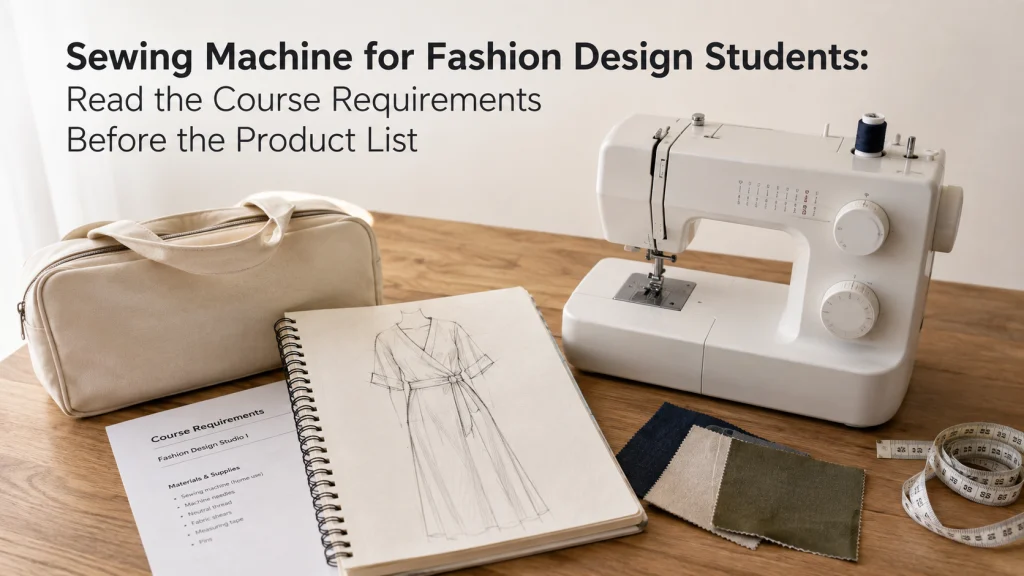
The course requirement outranks the product list
A search for the best sewing machine for fashion design students often starts with a list of machines. I would reverse that order when the purchase is for a specific college program. The first useful document is the current requirement from the school, department, course, or instructor because that document defines what must be available for assignments.
The difference is not theoretical. Texas Tech University states that Apparel Design and Manufacturing students in fashion studio courses must purchase or have their own sewing machine and identifies required stitch functions, while the School of the Art Institute of Chicago documents industrial straight-stitch, overlock, coverstitch, and specialty sewing equipment in its fashion facilities. A machine that makes sense for one of those situations may be unnecessary, incomplete, or inconvenient in the other.
Key point: I treat the program requirement as the acceptance standard. A retailer label, stitch count, price tier, or “fashion” wording does not prove that a machine satisfies a course.
Get the current written equipment requirement before shopping
Start with the latest department equipment page, syllabus, course supply list, orientation document, or written message from the instructor. I keep the exact source or a saved copy because equipment requirements can change between academic years. If the requirement is vague, ask whether the school expects ownership, regular access, or only access during scheduled class periods.
Do not turn a suggested brand list into a mandatory brand rule. Texas Tech lists required functions and notes that its suggested model list is not exhaustive, so the useful task is to verify that a candidate actually has the required functions.
| Requirement capture | What to record |
|---|---|
| Source | School, department, course, or instructor |
| Verification status | The current requirement was confirmed from the program source |
| Ownership status | Must own, must have regular access, or school provides access |
| Required functions | Exact stitches, feet, or machine type named by the program |
| Timing | When the machine or specialist system is needed |
| Approval question | Any substitution that still needs instructor confirmation |
This capture sheet keeps an old page or remembered classroom comment from driving a purchase. When documents conflict, I would get the current answer in writing before treating a substitute as acceptable.
Note: If the equipment page is undated, vague about ownership versus access, or inconsistent with a current syllabus, mark that item unresolved. Check the newest course materials, then ask the instructor or program contact one specific written question that names the course, term, and unclear requirement. Do not fill the gap with retailer wording or another school’s list.
Separate required ownership, regular access, and campus lab access
“You need a sewing machine” can mean three different things. A program may require the student to own one, require regular access without specifying ownership, or provide enough campus equipment that a personal machine mainly supports work outside lab hours. Those are different buying problems with different budgets and transport demands.
Kwantlen Polytechnic University currently says incoming and continuing fashion students need regular access to a sewing machine and then lists capabilities such as straight stitch, a regular stitching foot, and a zipper foot, with some functions recommended at later stages. SAIC, by contrast, publishes a substantial list of industrial and specialty equipment available through its facilities. KPU is a Canadian example, so it is not evidence of what a US school will accept; it is useful here only because it shows how different the access model can be.
| Access model | Buying implication | Question to confirm |
|---|---|---|
| Personal ownership required | The home machine must pass the written course requirements | Is a substitute model allowed if the functions match? |
| Regular access required | Borrowing, household access, or ownership may work if availability is reliable | How often will assignments require off-campus access? |
| Campus equipment provided | A personal machine may be a convenience rather than a duplicate of lab equipment | Which assignments must be completed outside scheduled lab time? |
I would write down which access model applies before comparing features. This helps avoid paying for specialist capability the school already provides or discovering that the home machine lacks a required function near a deadline.
Map requirements by course or year when the program publishes them
Some programs phase equipment in instead of requiring every system at the beginning. Texas Tech currently places the sewing machine in the first-year timeline and the serger in the second-year timeline for specified courses. That matters because a student may not need to buy every machine at once.
Build the timeline around the classes you are actually registered to take. A semester capability matrix separates what is mandatory now from what becomes relevant later.
| Official example | Timing | Published equipment status | Buying implication |
|---|---|---|---|
| Texas Tech | First year | Personal sewing machine listed | Verify the required domestic-machine functions before the first purchase |
| Texas Tech | Second year | Serger introduced later | Do not assume the specialist purchase is needed at entry |
| KPU | Incoming and continuing students | Regular machine access with listed capabilities | Confirm reliable access before assuming ownership is mandatory |
| KPU | Later-stage recommendation | Zigzag capability recommended for second year | Keep a recommendation separate from a current mandatory requirement |
I treat the matrix as a timing tool, not a cross-school standard. Copy the same structure using the student’s own current program documents before deciding what must be purchased now.
Straight and zigzag requirements
A course may name straight and zigzag stitches separately. Texas Tech currently requires both, while KPU lists straight stitch and places zigzag in a later recommendation, so the wording and timing matter.
A straight-stitch-only machine does not pass a written zigzag requirement because it looks faster or more professional. Treat the missing function as a pass-fail issue unless the instructor approves another route.
Stretch stitch and buttonhole requirements where specified
Stretch and buttonhole functions are not universal requirements. Texas Tech currently requires both, while KPU describes buttonhole as recommended but not necessary, so a nationwide rule would be unreliable.
Record the exact wording instead of translating “recommended” into “required” or the reverse. That distinction can change which machines remain eligible without saying anything about feature prestige.
Required presser feet
A course may specify feet even when the sewing machine itself is described broadly. KPU currently lists a regular stitching foot and zipper foot among the sewing-machine capabilities students should have. If a required foot is not included with a candidate, verify whether the exact machine accepts a compatible version before assuming it can be added later.
Generic foot names are not compatibility evidence. The useful proof is the exact machine’s manual, accessory chart, manufacturer parts listing, or another model-specific source that shows the interface and compatible part.
When the program introduces a serger or specialist system
A domestic sewing machine and a serger are not interchangeable categories merely because both can help construct garments. Texas Tech currently requires a serger later in its published timeline and specifies minimum overlock capability for that separate system. SAIC also lists overlock and coverstitch machines among its industrial lab equipment.
If the course specifically requires a serger, overlock, coverstitch, industrial machine, or another specialist system, do not claim that a domestic machine replaces it without written approval. That decision belongs to the program because the learning objective may involve the system itself, not merely the appearance of the finished seam.
Translate the next assignments into pass-fail capabilities
Once the written requirement is captured, look at the next real construction tasks and translate them into capabilities. If the course specifies a zipper foot, buttonhole function, stretch stitch, or specialist machine, each item becomes a check that a candidate must pass. Extra decorative stitches do not repair a missing required function.
Keep the assignment check narrow. A student constructing a woven skirt with a zipper has a different immediate need from a student entering a course that separately introduces overlock equipment. The goal is to avoid a preventable mismatch in the classes already on the schedule.
- List the next two or three assignments for which a home machine may be used.
- Mark every stitch, foot, buttonhole, material, or specialist system named in the instructions.
- Separate mandatory functions from convenience features.
- Flag any function that depends on an accessory that is not included.
- Ask for instructor confirmation where the required machine type is unclear.
This is also where a generic “heavy duty” label should lose its influence. Unless the program names a capability and the exact candidate documents it, the marketing label does not answer the course requirement.

The Brother XM2701 is a lightweight sewing machine with 27 built-in stitches, including blind hem, zigzag, stretch, decorative, and an automatic one-step buttonhole. It includes six quick-change presser feet, including zipper, zigzag, buttonhole, narrow hemmer, blind stitch, and button sewing feet. The machine also has a built-in needle threader, a top drop-in bobbin, automatic bobbin winding, and a free arm.
Check On AmazonIf you click this link and buy, we earn a commission at no additional cost to you.
Decide whether the machine stays home, travels to class, or serves both
A machine that stays on a dedicated table can be judged differently from one that crosses campus several times a week. If the school provides classroom machines, a home machine may not need to duplicate every industrial system in the lab. If students must bring their own machine, dimensions, weight, carrying method, and setup time matter.
Do not assume “portable” from a product photo. Verify the published dimensions and weight of any machine you are seriously considering, then add the foot control, power cord, required feet, needles, bobbins, and protective case or bag to the real transport load. A sewing machine for fashion students can be technically capable yet still be a poor class machine if moving it reliably is unrealistic.
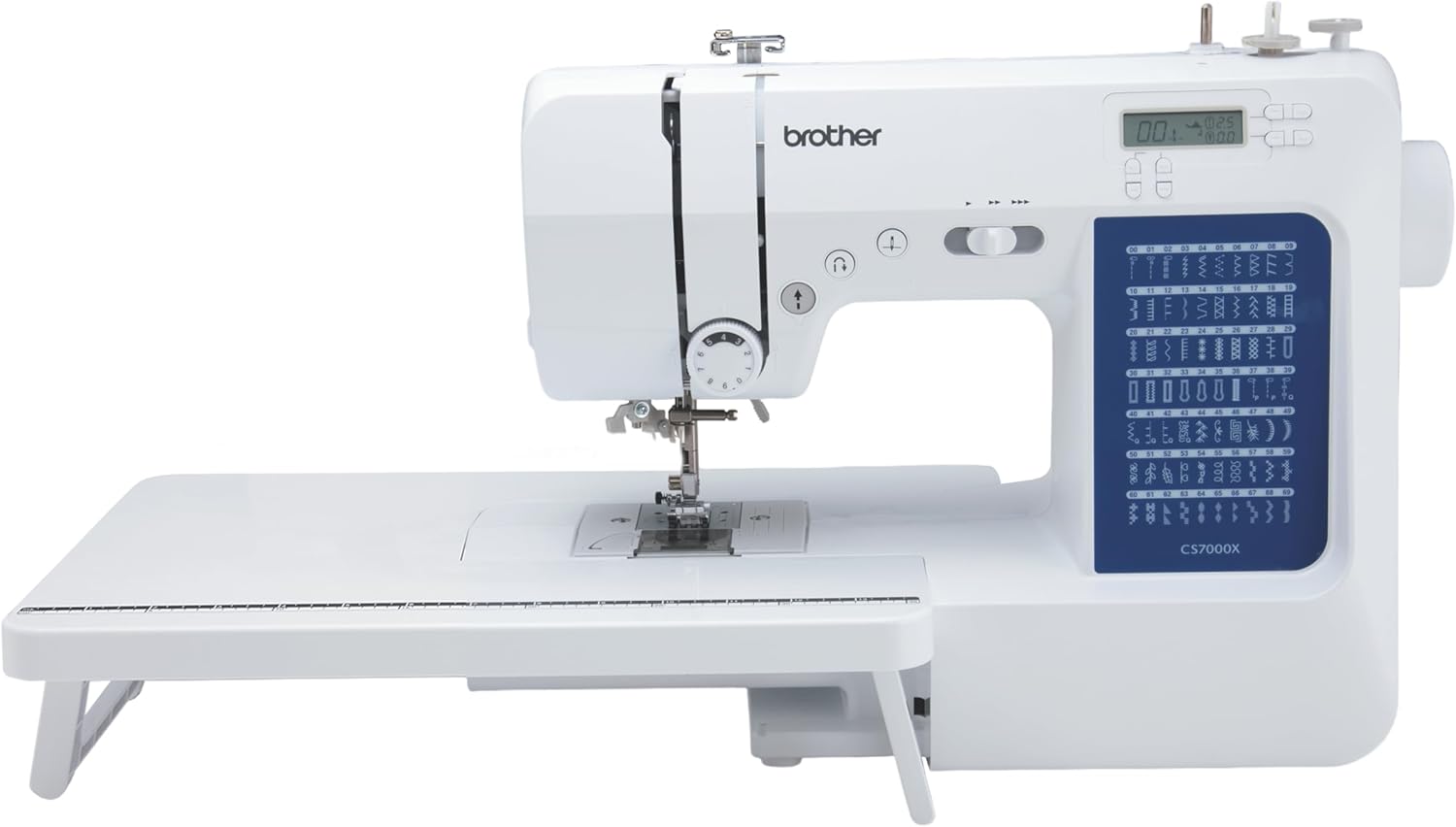
The Brother CS7000X is a computerized sewing and quilting machine with 70 built-in stitches and seven one-step auto-size buttonholes. It includes 10 presser feet, a quilt guide, a detachable wide table, and a protective hard case. The listing specifies a 14-pound weight and 16.26 by 6.65 by 12.21-inch dimensions, plus an LCD display, improved automatic needle threader, free arm, and fixed needle bar.
Check On AmazonIf you click this link and buy, we earn a commission at no additional cost to you.
Measure transport, storage, and setup burden under deadline conditions
Fashion coursework puts equipment into a schedule. A machine that takes a long time to unpack, set up, rethread, or move between storage and a work surface may consume time that a stationary home user would barely notice. Measure the actual route from storage to sewing position instead of treating portability as an abstract feature.
Deadline risk also includes what happens when the machine is unavailable. A realistic fallback may be campus lab access, checkout equipment, a loaner, local service, or another approved route. That does not automatically justify buying a second machine.
| Transport and deadline check | What to verify |
|---|---|
| Carry distance | Parking, transit, stairs, elevators, and classroom distance |
| Storage | Where the machine and accessories stay between sessions |
| Setup | Power, foot control, table space, lighting, and required accessories |
| Backup access | Campus lab, checkout equipment, household machine, or approved alternative |
| Deadline recovery | Service route and what happens if the machine is unavailable |
A small inconvenience repeated twice a week can matter more than a feature used once a semester. Put that burden beside the capability checklist so the buying decision reflects how the machine will actually be used.
Verify the manual, warranty, support, and service route
Before buying, find the exact manual for the candidate machine and confirm the controls, threading path, included functions, compatible accessories, routine cleaning instructions, and any owner-service boundaries that matter. A sales page is useful for identifying a model, but the manual is usually the stronger document for how that model is actually operated and maintained. If a required foot or function is unclear, resolve it before purchase.
Warranty length alone is not the same as usable support during a semester. Check who handles warranty claims, whether local service exists, whether shipping is required, and whether the student has another approved machine available during repair. Smoke, a burning odor, sparks, exposed wiring, overheating, uncontrolled motion, a hard mechanical lock, or repeated hard needle strikes are reasons to stop using the machine and follow the manual or qualified service route rather than pushing through an assignment.
Reject features the course does not require
More stitches do not automatically make a machine more suitable for coursework. Embroidery functions, large decorative stitch libraries, connectivity features, or specialized quilting controls may be useful to a particular owner, but they should not be treated as fashion-school requirements unless the program actually calls for them. Paying for an unused feature can also reduce the budget available for required feet, transport protection, needles, bobbins, or later specialist equipment.
The best sewing machine for fashion students is the one that passes the current requirement, fits the student’s access and transport situation, and leaves a workable plan for later needs. Feature count comes after those checks.
Set the evidence threshold for every recommendation
Every candidate should be supported by evidence that matches the claim. A school document proves what that school currently asks for, while a current manufacturer page or manual can verify an exact model’s functions, dimensions, or compatibility. Neither proves acceptance by a different program.
Do not rank a candidate from brand reputation, star ratings, “professional” wording, stitch count, frame claims, or price alone. Those details may belong in a broader ownership decision, but they do not establish course acceptance or material capability by themselves. If a claim cannot be traced to an appropriate current source, remove the claim or mark it as unresolved.
This evidence threshold gives the student a clear reason to reject a machine without treating product labels or brand prestige as curriculum evidence.
Build a current shortlist from the documented student brief
I would build the shortlist only after the requirement capture, access map, semester matrix, and transport audit are complete. At that point, compare exact current machines against the same pass-fail brief instead of letting price or feature count decide which models deserve attention.
Use four decision states. A machine in Pass can move to price and ownership-cost comparison. Hold means a required fact is still unverified. Reject means a mandatory requirement is missing. Confirm is reserved for a substitution or specialist-equipment question that only the program can approve.
| Shortlist status | Evidence condition | Shopping action |
|---|---|---|
| Pass | Mandatory functions, required feet, access needs, and transport constraints are verified | Compare total price, included required accessories, support, and service route |
| Hold | A manual, accessory fit, package item, dimension, or support detail is unresolved | Verify the missing fact before comparing value |
| Reject | A mandatory function or required interface is absent | Remove the machine even if the price or feature list is attractive |
| Confirm | The choice depends on substituting for named specialist equipment | Get written instructor or program approval before buying for that purpose |
When two or more machines reach Pass, the buying comparison finally becomes meaningful. Recheck the brief if the school requirement, package contents, warranty, service route, or current availability changes.
Show which official example requirements each candidate satisfies without implying national acceptance
Official program pages are examples, not a national approval system. A candidate that satisfies Texas Tech’s current function list or KPU’s published capability language is not automatically approved by another US program.
Use school examples only to demonstrate the test. Texas Tech publishes a personal-equipment timeline, KPU uses different access and capability language, and SAIC documents substantial school-provided specialist equipment. The comparison proves variation, not universal acceptance.
| Official example | What the page currently demonstrates | What it does not prove |
|---|---|---|
| Texas Tech University | Personal equipment timeline plus named domestic-machine functions | Acceptance by another program |
| Kwantlen Polytechnic University | Regular-access language plus a different capability list | A US nationwide standard |
| School of the Art Institute of Chicago | Substantial industrial, overlock, coverstitch, specialty, and checkout resources | That every student can avoid owning a machine |
When publishing or revisiting a shortlist, the safest wording is always school-specific and tied to the current published requirement. If the reader’s program is not one of these examples, the next step is to obtain that program’s requirement rather than borrow another school’s rule.
Ask the instructor before substituting a domestic machine for required specialist equipment
A domestic zigzag or overcasting stitch may finish an edge, but that does not prove it replaces a required serger exercise. If the course names an overlock, coverstitch, industrial straight-stitch, blindhem, or another specialist system, the learning objective may involve operating that system. Only the program can approve a substitute.
Use a short written question: identify the course, the required machine type, the machine you already have access to, and the specific function you hope to substitute. Do not buy a second system until the answer is clear, but do not assume that a domestic feature removes the requirement either. This is one of the places where asking first can prevent the largest unnecessary purchase.
Use a beginner-first comparison when self-directed first-machine learning is the main issue
Not every student question is really about school requirements. Someone who is simply learning machine sewing before a program begins may need a first-machine comparison based on controls, threading, setup, basic functions, support, and budget rather than a course-specific equipment audit. In that situation, the external requirement is not yet the main constraint.
If that describes the decision, use the broader process for how to choose a sewing machine by requirements and define the user’s own needs first. Return to the course-specific checklist as soon as a real program publishes its equipment expectations, because those written requirements can override a generic beginner preference.
Use an upgrade comparison when an owned machine fails a repeated course task
A student who already owns a working machine should not upgrade merely because a product list labels another machine “intermediate” or “professional.” First identify the repeated task the owned machine cannot perform, then check whether that limitation comes from missing capability, accessory compatibility, setup, material conditions, maintenance, or an actual machine fault. The problem needs to be defined before the replacement can be justified.
If the limitation is real and recurring, compare replacements around that evidence rather than around status. The broader page to compare sewing machines by real needs can help organize that decision, but the fashion program still controls whether the final choice satisfies coursework. An upgrade should solve a documented constraint, not simply add features.

The Janome JW8100 is a computerized sewing machine with 100 built-in stitches and seven one-step buttonholes. Its controls include an LCD screen, start and stop button, speed control slider, needle up and down control, and a removable free arm. The package includes a zipper foot, automatic buttonhole foot, hard cover, extra-wide extension table, even feed foot, quarter-inch foot, bobbins, needles, and basic sewing tools.
Check On AmazonIf you click this link and buy, we earn a commission at no additional cost to you.
Final Thoughts: Buy for the requirements you actually have
The safest way I know to choose a machine for fashion coursework is to make the school requirement the first filter, not the last check after shopping. Confirm ownership versus access, map the functions by course or year, account for transport and deadline recovery, and verify every candidate with model-specific documentation. When specialist equipment is named, get approval before treating a domestic substitute as equivalent.
That process may support a simpler machine or show that a later specialist purchase is genuinely necessary. Either result is tied to the student’s actual program rather than a national stereotype about what fashion students should own.
Frequently Asked Questions
🧵 Do fashion design students need to own a sewing machine?
Some programs require ownership, while others require regular access or provide substantial lab equipment. Check the current written requirement for your exact program and course before buying.
🪡 What stitches should a fashion student sewing machine have?
Use the stitches named by the current program requirement rather than a generic fashion-school checklist. Another program may require a different set or introduce functions at a different stage.
🦶 Do I need a zipper foot for fashion school?
Only treat it as mandatory when your program or course requires it. If it is required and not included with your machine, verify exact model compatibility before buying an accessory.
🧶 Can a zigzag stitch replace a serger for class?
Not automatically. If the course requires a serger or overlock system, ask the instructor whether a domestic substitute is accepted before relying on zigzag or overcasting stitches.
🎒 Should I prioritize a lightweight machine if I carry it to class?
Weight matters only after the machine passes the required capability checks. Verify the exact dimensions and weight, then consider the full carry load with the foot control, cord, accessories, and protective case.
🛠️ What should I check about service before buying?
Check the warranty route, local service availability, whether shipping is required, and what approved backup access you have during a repair. A long warranty is less useful during a deadline if the machine will be unavailable for an extended period.
References and Sources
- Texas Tech apparel equipment requirements: verifies the current ownership timeline, required sewing-machine functions, and later serger requirement used as a US program example.
- KPU Fashion Design program details: verifies the regular-access wording and sewing-machine capability list used to demonstrate that program requirements differ.
- SAIC Fashion Design facilities: verifies the published industrial, overlock, coverstitch, specialty, and checkout equipment available through the department.
These school pages are examples of different requirement and access models, not a universal equipment standard. Recheck the current page for the student’s own program before using any of these examples to make a purchase decision.