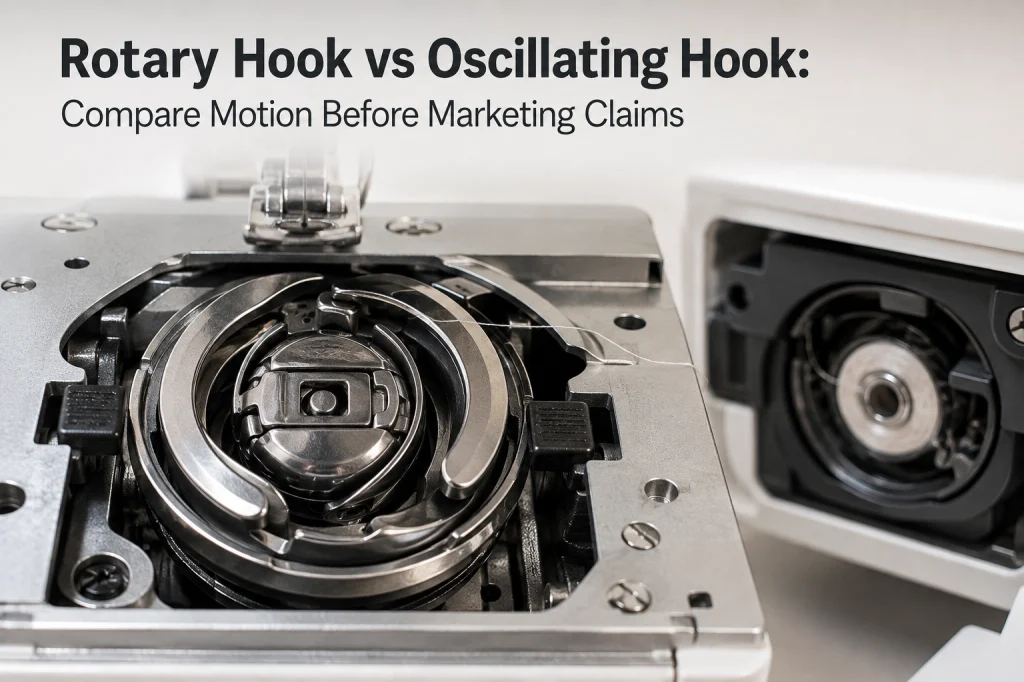
Rotary and oscillating hooks describe how the hook moves while carrying the upper-thread loop around the bobbin area, not where the bobbin is loaded or how powerful the whole machine is. A full rotary hook continues around a circular path, while an oscillating hook travels through an arc and reverses direction. Current machine specifications also show why bobbin access, hook axis, and hook motion must be read as separate fields. Once those fields are separated, you can compare a machine’s documented mechanism without turning the hook label into an unsupported claim about speed, noise, stitch quality, or heavy-material capacity.
Three machines break the usual two-column shortcut
A rotary hook vs oscillating hook comparison becomes misleading when bobbin access is treated as proof of hook motion. Janome currently identifies the HD-1000 Black Edition as using a front-loading vertical oscillating hook, while the Sewist 740DC is listed with a top-loading full rotary hook. Those two machines fit the familiar shortcut, but the 1600P-QC shows why that shortcut should not become a rule.
Janome specifies the 1600P-QC with a side-loading full rotary hook bobbin. That gives three documented layouts: front-loading plus oscillating motion, top-loading plus full rotary motion, and side-loading plus full rotary motion. The third machine does not prove that every access position can pair with every hook motion, but it does prove that bobbin access and hook motion are separate specification fields.
Define hook motion, hook axis, and bobbin access as separate fields
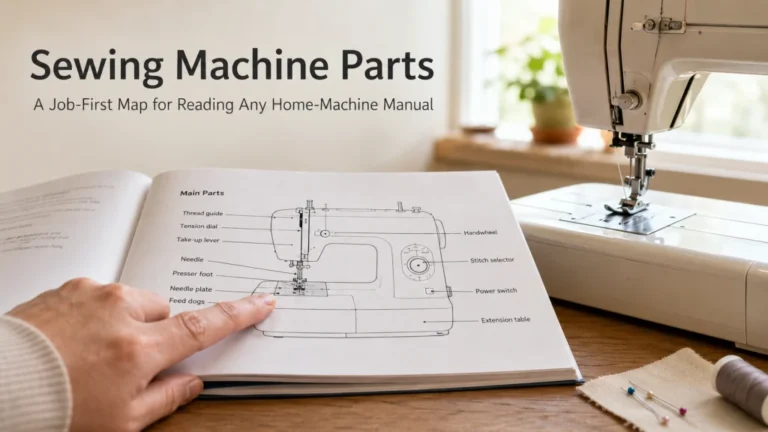
Three labels are often compressed into one description even though they answer different questions. Hook motion describes what the hook does during the stitch cycle, hook axis describes the orientation of that rotating or oscillating assembly, and bobbin access describes how the user reaches or inserts the bobbin. A product page may state all three, only one, or a combined phrase that needs to be unpacked.
| Field | Question it answers | Example wording | What it does not prove |
|---|---|---|---|
| Hook motion | How does the hook travel during the stitch cycle? | Full rotary, rotary, oscillating | Bobbin access, speed, noise, or material capacity |
| Hook axis | How is the hook assembly oriented? | Horizontal, vertical | Whether the hook reverses or rotates continuously |
| Bobbin access | Where does the user reach or insert the bobbin? | Top-loading, front-loading, side-loading | Hook motion by itself |
| Classification step | Motion field | Axis field | Bobbin access field |
|---|---|---|---|
| Read the exact machine documentation | Full rotary or oscillating | Horizontal or vertical | Top-loading, front-loading, or side-loading |
| What the field describes | How the hook travels | How the hook assembly is oriented | Where the user reaches the bobbin |
| Do not infer | Axis or access | Motion or access | Motion or axis |
This three-axis classification map keeps the fields from collapsing into one label. It also keeps the terminology connected to the broader sewing machine parts and mechanisms without making one component stand in for the entire machine. If a listing says only “top-loading bobbin,” it has told you how the bobbin is accessed, not necessarily enough to classify hook motion.
Review only the loop-capture phase before comparing motion
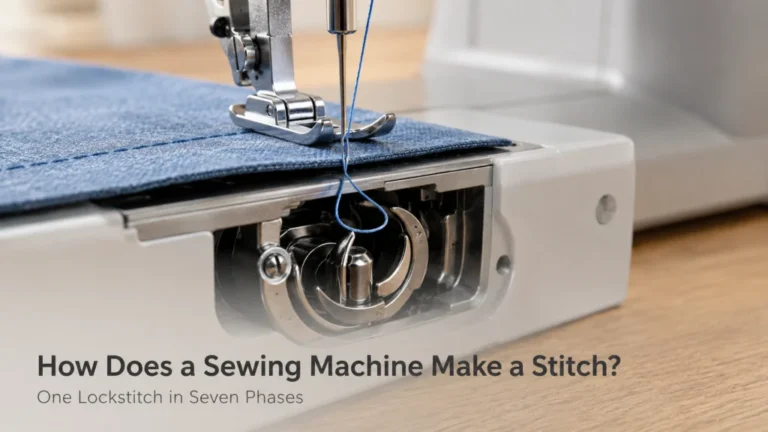
In a domestic lockstitch system, the needle descends with the upper thread, begins to rise, and a loop forms behind the needle. The hook point must meet that loop at the correct part of the machine’s designed stitch cycle, after which the upper thread is carried around the lower-thread area. That loop-capture job is the shared mechanical context for both rotary and oscillating systems.
The complete sequence involves more than the hook, including the take-up mechanism, tension path, needle, bobbin assembly, and feed cycle. For that full sequence, the more useful reference is the explanation of how a sewing machine makes a stitch. Here, the narrower question is what path the hook follows after it has engaged the upper-thread loop.
Trace one full rotary hook path
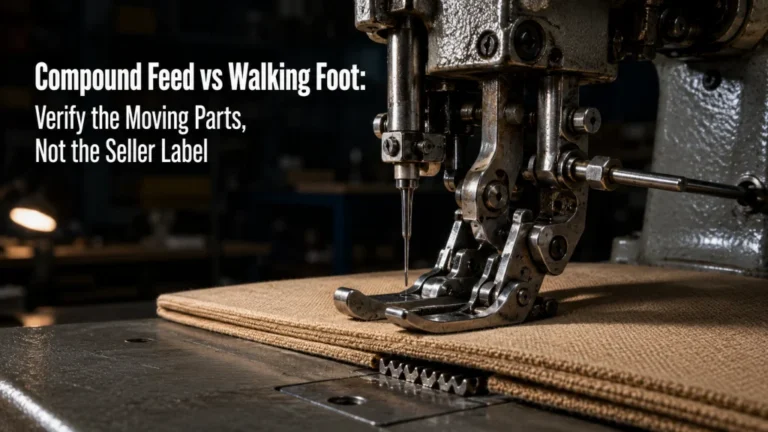
A full rotary hook continues around a circular path rather than reversing after each stitch. In the mechanism description published by Sailrite, the hook catches the upper-thread loop as the needle rises and carries that loop around the bobbin cage before continuing its rotation. The defining point for this comparison is the continuous direction of travel, not whether the bobbin is reached from above, the front, or the side.
A rotary hook sewing machine can therefore appear in more than one physical layout. Janome labels both the top-loading Sewist 740DC and the side-loading 1600P-QC as full rotary systems, even though their bobbin access and machine purposes are very different. That is exactly why the word “rotary” should stay attached to motion unless the manufacturer explicitly combines it with another field.
Trace the oscillating hook path and its reversal
An oscillating hook travels through an arc, carries the upper-thread loop around the lower-thread area, then reverses direction and returns for the next stitch cycle. The reversal is the key mechanical distinction from a full rotary path. It is not a statement about whether the machine is basic, advanced, durable, weak, quiet, or noisy.
| Loop-carrying stage | Full rotary motion | Oscillating motion |
|---|---|---|
| Upper-thread loop becomes available | Hook approaches on its circular path | Hook approaches within its travel arc |
| Hook engages the loop | Continues in the same rotational direction | Continues through the working part of the arc |
| Loop is carried around the lower-thread area | Completes the circular travel needed for the cycle | Reaches the end of its working travel |
| Preparation for the next stitch | Keeps rotating in the same direction | Reverses direction and returns |
The HD-1000 Black Edition is a clean domestic example because Janome identifies its hook as both front-loading and vertical oscillating. That combined specification answers several fields at once, but the motion field is still the word “oscillating.” When evaluating an oscillating hook sewing machine, keep any performance judgment separate until the complete model provides evidence for it.
Read full rotary, rotary, oscillating, and shuttle wording carefully
Manufacturer language is not perfectly standardized across every model family and era. “Full rotary” is a useful explicit label because it identifies continuous circular hook travel, while “rotary” may be used more broadly in product copy. “Oscillating” identifies reversing motion, and “shuttle” can appear in historical or generic descriptions without giving enough detail to classify a current machine by itself.
That makes the exact model page and manual more useful than a retailer’s shorthand. The broader explanation of how sewing machines work can establish where the hook fits into the lockstitch system, but the classification still needs model-specific documentation. If the wording is ambiguous, record it as ambiguous rather than translating it into a stronger claim.
Top-loading does not define all rotary hooks
Top-loading and full rotary commonly appear together on current domestic machines, which makes the association easy to memorize. Janome’s Sewist 740DC is one example: its specification says “Top Loading Full Rotary Hook Bobbin.” That is evidence for that exact model, not a definition that can be transferred to every rotary design.
The 1600P-QC breaks the shortcut because Janome specifies a side-loading full rotary hook bobbin. The access comparison belongs with top-loading and front-loading bobbin layouts, where access, visibility, insertion, and machine layout can be considered directly. For hook classification, the safer move is to read the hook field instead of judging by the cover plate or bobbin door.
Front-loading does not prove oscillating motion by itself
The HD-1000 Black Edition combines front-loading access with a vertical oscillating hook, but that pairing belongs to that exact machine specification. It is useful evidence for the HD-1000 Black Edition, not a universal decoding rule for every front-loading bobbin door. When a manufacturer states only the access position, keep the motion field unresolved until the hook type is documented separately.
That restraint matters because photographs can make two bobbin areas look mechanically similar while the underlying system differs. The related explanation of how a sewing machine bobbin works shows why the lower-thread assembly includes several parts and relationships, not one visual cue. Record “front-loading” as an access fact, then use the exact manual or specification to classify motion rather than filling the gap from appearance.

The Janome HD1000 Black Edition is a mechanical sewing machine with 14 built-in stitches and a four-step buttonhole. The product information lists an aluminum interior frame, front-loading bobbin system, automatic needle threader, and adjustable stitch length and width. Included accessories include a hard cover, four presser feet, needles, bobbins, and additional sewing accessories.
Check On AmazonIf you click this link and buy, we earn a commission at no additional cost to you.
Audit speed claims against the complete named machine
Rotary systems are often discussed alongside higher-speed machines, and some manufacturers make performance comparisons within particular product families. For a buying decision, rated speed should still be read as its own specification. Motor control, intended machine class, stitch functions, feed system, shaft design, needle system, and the manufacturer’s speed rating all contribute to the architecture being compared.
The Janome 1600P-QC shows why that separation matters. Janome lists it as a high-speed, straight-stitch-only machine with a side-loading full rotary hook and speeds up to 1,600 stitches per minute. Those facts belong to the 1600P-QC as a complete machine; another model cannot inherit the same speed merely because its hook follows a similar motion path.

The Janome 1600P-QC is a high-speed straight-stitch sewing and quilting machine rated for up to 1,600 stitches per minute. Its product details include a side-loading bobbin, automatic thread cutter, independent bobbin winder, and an extra-wide work area to the right of the needle. The machine also includes speed control and an ergonomic knee lift for presser-foot operation.
Check On AmazonIf you click this link and buy, we earn a commission at no additional cost to you.
Audit noise and vibration claims without invented measurements
Noise and vibration are easy to overstate because a mechanism explanation can sound like a laboratory test even when no comparative measurement exists. Sailrite describes its rotary systems as smoother and quieter at higher speeds than its oscillating examples, but that statement belongs to the machine families Sailrite is discussing. It should be read as a bounded manufacturer comparison, not as a decibel rating for every domestic machine with the same hook label.
A stronger comparison would name the machines, operating speed, surface, material, thread, needle, measurement method, and machine condition. If those conditions are missing, record noise and vibration as unresolved performance questions rather than filling the gap with mechanism folklore. Hook motion can be one part of the machine’s behavior without serving as a measurement of that behavior.
Reject stitch-strength and heavy-material claims based on hook type alone
A hook system has to capture and carry the loop correctly, but finished seam strength and usable material stacks depend on the whole setup. Needle system and size, thread type and size, stitch formation, tension balance, feed behavior, presser-foot pressure, available clearance, motor and drive design, and the material itself can all change the result. Hook architecture belongs in that system, not above it.
Different sewing machine hook types describe mechanism architecture rather than a strength rating. When a listing places “heavy duty” near a rotary or oscillating description, look for model-specific material guidance, compatible needle and thread information, feed details, and disclosed test conditions instead. If those details are absent, the material-capability claim remains unverified regardless of how impressive the hook terminology sounds.
Separate serviceability claims from owner maintenance instructions
Hook architecture can affect how a machine is built and serviced, but owner maintenance authority comes from the exact manual. Cleaning points, lubrication instructions, removable parts, and service limits can vary even between machines that use similar mechanism terminology. A broad claim that one design is “easier to maintain” is therefore less useful than the instructions written for the model on the table.
For normal ownership, follow the manual for the bobbin and hook area and stop when the procedure moves beyond user-serviceable work. This comparison is not a hook-removal, timing, or adjustment tutorial. Repeated hard needle strikes, a hard mechanical lock, smoke, overheating, a burning odor, sparks, damaged wiring, or uncontrolled motion are reasons to stop using the machine and move to qualified service rather than continue a mechanism experiment.
Read the specification and exact manual before classifying a machine
The fastest reliable identification method is documentary, not visual. Start with the exact model number, check the current manufacturer specification, then check the manual if the product page uses incomplete wording. A current support or accessory page can sometimes confirm the same architecture, but it should match the exact model family rather than a generic brand assumption.
- Record the exact model number before searching.
- Find the manufacturer’s hook-type wording and copy it without expanding the claim.
- Record bobbin access and hook axis separately if they are stated.
- Use the manual to resolve unclear terminology or owner-access instructions.
- Do not classify from a photo, generic accessory listing, or visually similar bobbin case alone.
If documentation still does not resolve the motion, leave the field open. For an unpowered machine, a manual may permit safe handwheel observation of the hook area, but do not remove guards or operate the machine powered with covers removed just to identify motion. The documentation is usually the cleaner answer and avoids turning a buying question into an unnecessary service procedure.
Build a claim ledger for a machine under consideration
A short claim ledger prevents one true specification from supporting five unrelated conclusions. Write the hook label in one column, then ask what additional evidence would be required for each performance statement. This is especially useful when a retailer page mixes mechanism terms with words such as fast, quiet, powerful, smooth, or heavy duty.
| Claim to check | What the hook label proves | Evidence still needed | Safe conclusion without it |
|---|---|---|---|
| Hook motion | Rotary or oscillating motion if explicitly stated | Exact manufacturer specification or manual | Classify only the documented motion |
| Maximum speed | Nothing by itself | Rated speed for the exact machine | Do not infer speed from hook type |
| Noise or vibration | Nothing quantitative | Comparable measured conditions | Do not claim a universal winner |
| Heavy-material capacity | Nothing by itself | Model-specific material, needle, thread, feed, and test evidence | Do not infer capacity from hook motion |
| Maintenance requirement | Only the mechanism label | Exact owner’s manual and service guidance | Follow the model manual |
For example, imagine a listing that says a machine has a “full rotary hook,” offers “smooth high-speed sewing,” and is suited to “heavy-duty” work. If the manufacturer documentation confirms the full rotary hook, record that as a mechanism fact. The speed wording still needs an exact rated speed, “smooth” needs comparable operating evidence, and the material claim needs model-specific guidance or testing conditions. One verified architecture term should not be allowed to carry three separate performance claims.
The ledger also makes model comparisons fairer. If one machine has a documented hook type and another does not, that is a documentation difference, not evidence that the first machine is automatically better. Compare only the fields that are actually supported for both machines.
Route access questions and fault symptoms to the right comparison
Hook motion answers a mechanism question, while bobbin access answers an ownership and layout question. If the decision is really about how the bobbin is inserted, how visible the bobbin area is, or what layout a machine uses, compare the documented access system instead of stretching a rotary-versus-oscillating label to cover it. That keeps the decision tied to the feature the user will actually handle.
Fault symptoms belong on a different path again. A jam, abnormal noise, repeated needle contact, or failure to form stitches can involve threading, needle condition, bobbin setup, debris, damage, timing, or other model-specific causes, so hook type alone is not a diagnosis. This article stops at identifying and interpreting the mechanism, not repairing it.
Final Thoughts: Let the hook label answer one mechanical question
A rotary hook moves continuously around its path, while an oscillating hook reverses after traveling through its arc. Keep that motion field separate from hook axis and bobbin access, then open new evidence columns for speed, noise, stitch quality, material capacity, and maintenance. The named examples show why a familiar bobbin layout is useful to recognize but unreliable as a substitute for the manufacturer’s mechanism wording.
For a machine under consideration, start by copying the exact hook term from the current specification or manual. Add each buying or ownership claim only when its own evidence is available, and leave unresolved fields unresolved. That approach turns a hook label into what it should be: one useful mechanical fact inside a much larger machine decision.
FAQs
⚙️ Which is better, a rotary hook or an oscillating hook?
Neither label proves that the complete machine is better. Compare the exact model’s speed, feed system, stitch functions, material evidence, support, and owner requirements instead of treating hook motion as a winner by itself.
🧵 How can I tell whether my sewing machine has a rotary or oscillating hook?
Check the exact model specification and manual first. If the documentation permits safe unpowered observation, continuous circular travel indicates rotary motion while a back-and-forth arc indicates oscillating motion, but do not remove guards or run the machine powered with covers removed just to identify it.
🪡 Is a rotary hook always top-loading?
No. Janome lists the Sewist 740DC as top-loading full rotary, but the 1600P-QC is listed as side-loading full rotary, so access position and hook motion are separate specifications.
🧰 Does front-loading mean the machine has an oscillating hook?
Not by itself. Janome documents the HD-1000 Black Edition as front-loading and vertical oscillating, but that verifies one model rather than a universal rule. Treat front-loading as an access description and use the exact manufacturer documentation to identify hook motion.
🔊 Are rotary hook machines always quieter and smoother?
No universal conclusion follows from the hook label alone. A meaningful comparison needs named machines and comparable operating conditions, because motor, speed, construction, surface, material, and machine condition can also affect noise and vibration.
🧱 Does hook type tell me whether a machine can sew heavy fabric?
No. Material capacity depends on the complete machine and setup, including the needle and thread combination, feed system, presser-foot conditions, material stack, drive design, and model-specific evidence.
References and Sources
- Janome HD-1000 Black Edition specifications: Verifies the front-loading vertical oscillating hook classification and related model specifications.
- Janome Sewist 740DC specifications: Verifies the top-loading full rotary hook classification for a current computerized domestic model.
- Janome 1600P-QC specifications: Verifies the side-loading full rotary hook classification and the model’s high-speed straight-stitch architecture.
- Sailrite hook mechanism comparison: Supports the rotary continuous-motion and oscillating reversing-motion descriptions while providing manufacturer-specific performance claims that should not be generalized to every machine.