A top-loading or front-loading label mainly tells you where you access the bobbin, not how the hook moves or how well the machine will sew. The useful comparison is physical: access path, bobbin orientation, case or holder arrangement, cover visibility, and what the exact manufacturer documentation says about the hook system. Those details can affect how easy it is to see the bobbin area or reach it around a project. Jam frequency, noise, heavier-material capacity, stitch quality, compatibility, and setup still require their own evidence. Compare the layout you can verify, then keep those other questions separate.
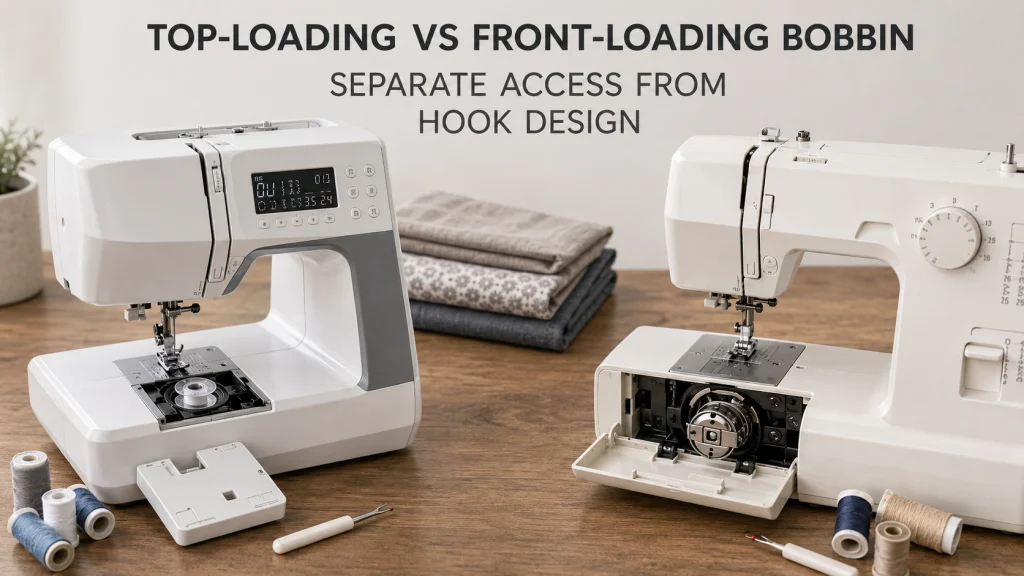
Two bobbin spec lines answer less than they seem to
The top loading vs front loading bobbin comparison looks simple until two real product pages are placed side by side. Brother describes the CS7000X with a “Quick Set Bobbin” feature, while SINGER lists a “Front Loading Bobbin” for the M1500. Those lines identify useful parts of the ownership experience, but they stop there. Hook motion, bobbin compatibility, jam resistance, stitch quality, and material capacity remain separate specifications or evidence questions.
That distinction matters before buying because several separate design questions are often compressed into one label. If you want to understand the lower-thread system itself before comparing access, start with how a sewing machine bobbin works. For this comparison, the goal is narrower: identify what the layout tells you, record what it does not tell you, and avoid turning a convenient access description into a performance ranking.
Define top-loading and front-loading as access descriptions
A top-loading layout gives access to the bobbin area from the machine bed near the needle plate. A front-loading layout gives access from the front or lower front area of the free arm or machine bed. That is the first field to record because it can usually be confirmed by the product page, the manual, or a clear manufacturer diagram without making any claim about performance.
Access location is not a complete description of the mechanism. Two machines can both be called front-loading and still differ in hook design, bobbin case details, free-arm construction, cover arrangement, and the amount of project material that sits around the access point. Treat the label as one coordinate in the machine layout, not as a shorthand verdict on the whole lower-thread system.
Separate drop-in from every other convenience label
“Drop-in” is commonly used for bobbins placed into a holder from above, but manufacturers may pair that basic layout with branded convenience terms. Brother’s CS7000X, for example, uses the term Quick Set Bobbin. The branded wording can describe an additional threading or setup feature, so it should not be treated as a universal synonym for every top-loading machine.
The same caution applies when a seller uses phrases such as easy-set, quick-set, jam-resistant, or easy-load around the bobbin area. Some of those terms may describe a documented feature on one model, while others may be marketing language without a measurable comparison. Record the exact manufacturer term first, then translate only the part you can verify into neutral language such as top access, visible cover, or retained holder.
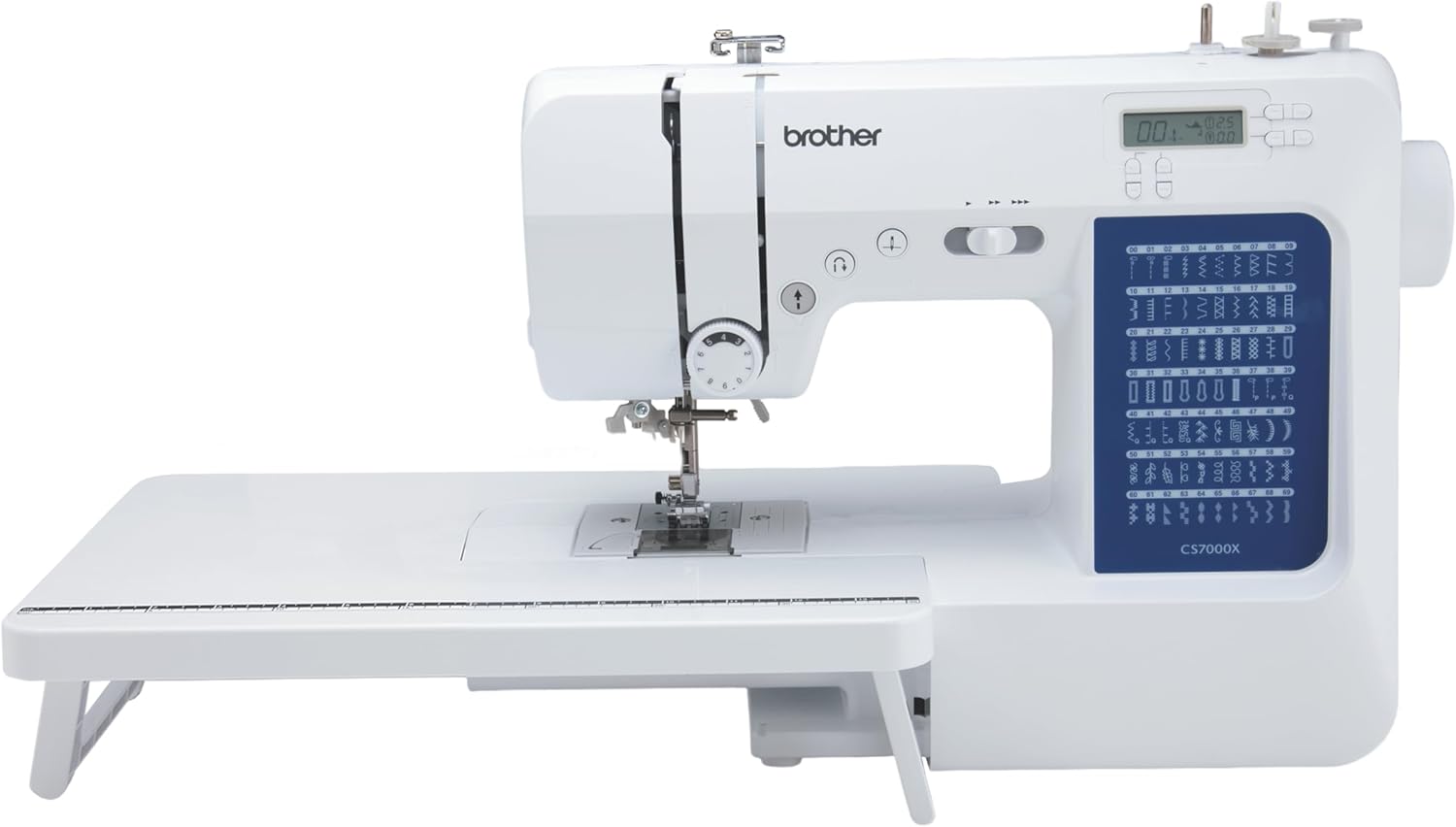
The Brother CS7000X is a computerized sewing and quilting machine with 70 built-in stitches and seven one-step auto-size buttonholes. Its Amazon listing describes a jam-resistant drop-in top bobbin, an improved automatic needle threader, and a fixed needle bar. It also includes a wide table, 10 sewing feet, a quilt guide, a hard protective case, and a trilingual user manual.
Check On AmazonIf you click this link and buy, we earn a commission at no additional cost to you.
Record bobbin orientation without inferring hook motion
Orientation is a second field. Many top-loading domestic machines position the bobbin horizontally, while many traditional front-loading designs position it vertically. Those associations can help you recognize a familiar layout, but they are clues rather than a hook classification. Leave hook movement as its own field until the manufacturer documents it.
Janome’s HD-1000 shows how precise documentation should look: Janome calls its system a “Front Loading Vertical Oscillating Hook Bobbin.” That single specification states access, orientation, and hook motion separately. When a different product page provides only one or two of those fields, leave the remaining field unknown until the manual or manufacturer documentation supplies it.
Record the case, holder, and cover as separate hardware details
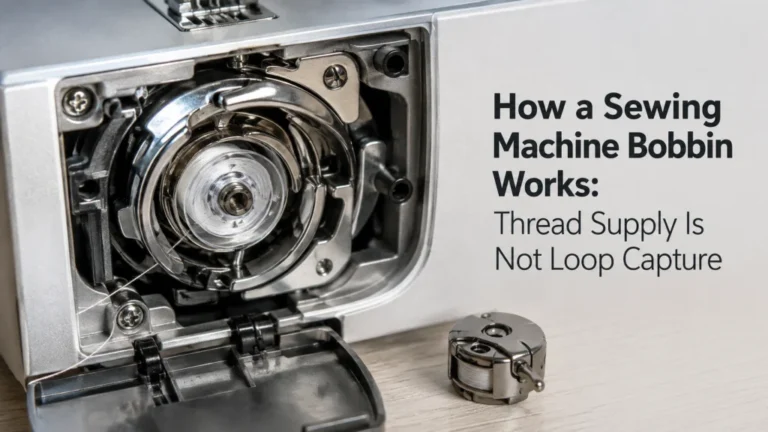
A front-loading machine often uses a removable bobbin case, and Janome lists a Bobbin Case Unit among the standard accessories for the HD-1000. A top-loading machine commonly retains the bobbin holder inside the machine and covers the area from above. These are useful ownership details because they change what you physically handle and what remains in the machine when the bobbin is accessed.
Do not use the presence of a removable case to guess the correct replacement part, bobbin class, or compatibility with another model. Those are model-specific questions. The broader sewing machine parts and functions reference can help you name the components, but fit still has to be verified against the exact machine documentation rather than by appearance.
Compare thread-level visibility as a documented ownership difference
Visibility is one of the few differences a buyer can often evaluate directly. A top-loading design with a transparent cover can let you see the bobbin area from above without opening that cover. A concealed front-loading compartment generally does not provide the same straight-down view while the machine is assembled for normal sewing.
Visibility still varies substantially from one top-loading model to another. Cover tint, lighting, bobbin opacity, the amount of thread remaining, and the exact geometry of the holder can all affect what you can actually see. If thread monitoring matters to you, inspect the exact machine or manufacturer imagery instead of assuming the access label makes the remaining thread obvious.
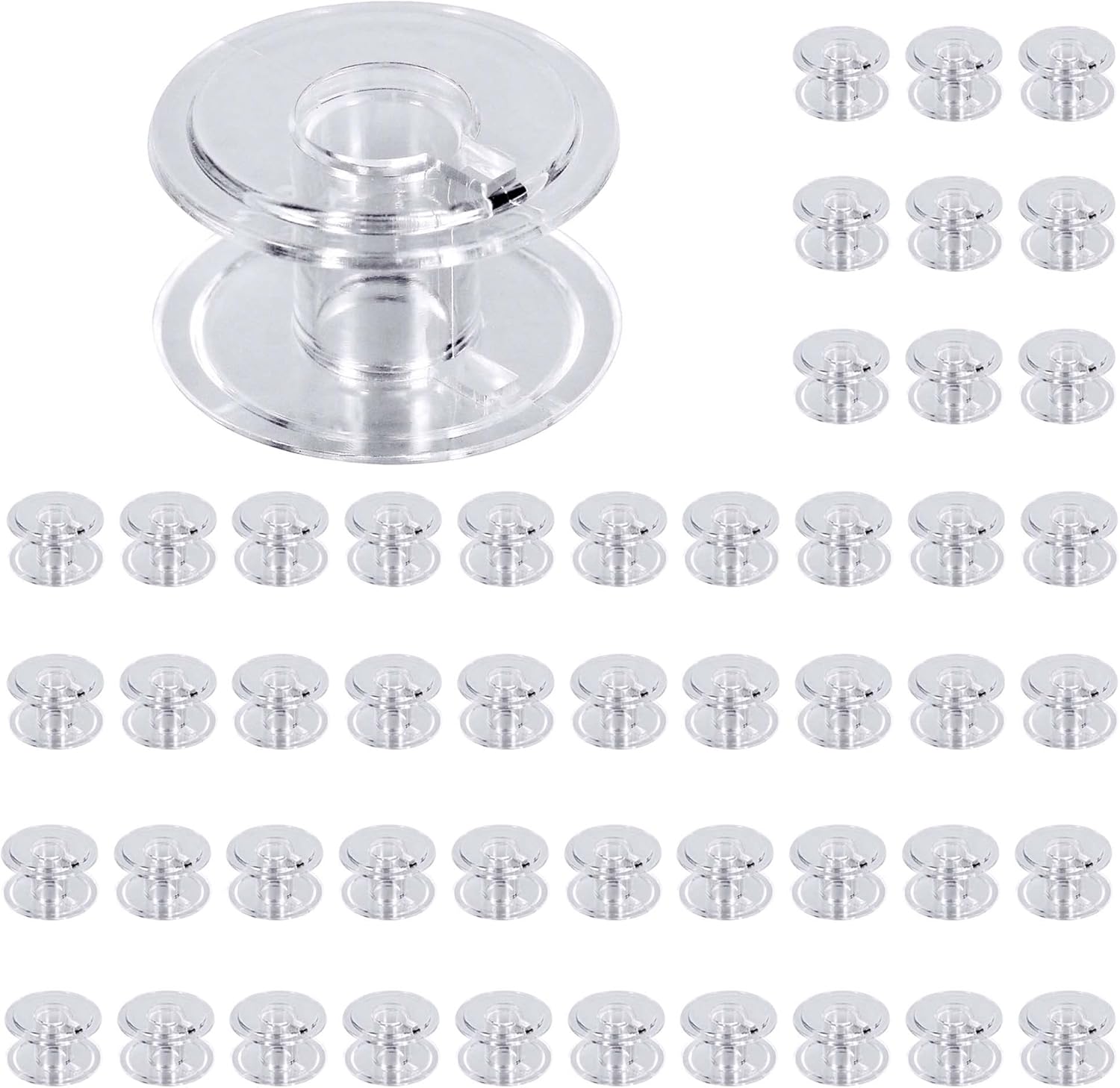
These SINGER Class 15 bobbins are a 50-count set of empty transparent plastic bobbins for home sewing machines that use this bobbin class. The transparent design makes the remaining thread visible, and the listing instructs users to match the bobbin class and style specified for the machine. SINGER also notes not to overfill the bobbins or add thread to a partially wound bobbin.
Check On AmazonIf you click this link and buy, we earn a commission at no additional cost to you.
Compare the access path and project obstruction
The access direction can matter when a large or awkward project is resting around the needle area. With top access, the relevant space is on the bed near the needle plate. With front access, the relevant space is lower on the free arm or front of the bed, and some machines require removal or movement of an accessory compartment before the bobbin area is exposed.
This is a layout observation, not an instruction to remove a bobbin while fabric is trapped under the presser foot or to work around a running machine. When comparing candidates, look at the manual illustrations and ask a simple ownership question: with the machine stopped and prepared as the manual requires, what has to be moved out of the way to reach the bobbin area? The answer can be model-specific even when two machines share the same broad access label.
Separate tension-component access from an instruction to adjust it
A removable bobbin case can make the lower-thread tension component physically accessible. Janome’s documentation for its front and side-loading bobbin case unit notes that the case also controls bobbin tension. That is a hardware fact, but it should not be converted into advice that a buyer ought to adjust lower tension during normal use.
For many home machines, lower-thread tension is not the first owner adjustment for an ordinary stitch problem, and an exact manual may reserve specific procedures or settings. A visible screw or removable case tells you the component is reachable; the manual determines whether owner adjustment belongs in normal use. If a seller presents “adjustable bobbin tension” as an advantage, check what the exact model manual actually expects the owner to do.
Classify rotary or oscillating hook motion independently
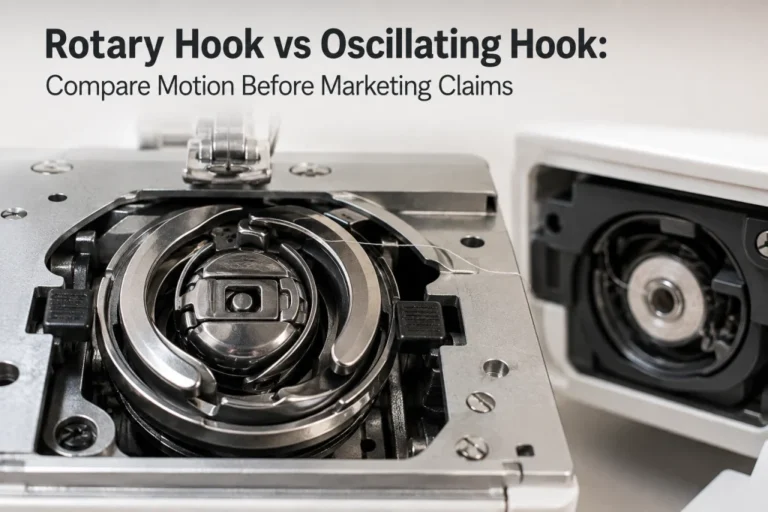
Hook motion deserves its own field because access direction and hook movement are separate specifications. Janome explicitly documents the HD-1000 as front-loading, vertical, and oscillating, which makes it a clean example of a common arrangement. BERNINA’s current 435 page, however, describes a front-load bobbin and separately identifies the hook system as the BERNINA Hook, not as an oscillating-hook specification.
That counterexample is enough to reject the rule “front-loading always means oscillating.” The same discipline applies in the other direction: do not assume a top-loading label supplies the hook classification unless the manufacturer says so. For the mechanical distinction itself, use the separate explanation of rotary and oscillating hook differences rather than trying to infer motion from the bobbin cover.
Audit jam-proof, quiet, durable, and heavy-duty claims
Search results and owner discussions often attach performance claims to the access layout: one system jams less, one runs quieter, one is stronger, one lasts longer, or one handles thick materials better. Those statements require evidence about the exact machines being compared. Access direction alone does not isolate the feed system, hook construction, needle and thread combination, motor behavior, frame design, tolerances, maintenance state, or material stack.
Use a rejection checklist when a buying page makes a broad claim:
- Does the claim name the exact machine models being compared?
- Does it describe the fabric, layer stack, needle, thread, stitch, and speed conditions?
- Is the result based on a disclosed test rather than the bobbin label alone?
- Does the manufacturer document the claimed feature or capability?
- Would the claim still make sense if two machines used different feed systems or hook designs?
If those questions cannot be answered, keep the claim out of the comparison. A top or front access label is useful information, but it is too small a piece of the machine to carry a conclusion about seam quality, noise, jamming, durability, or heavy-material performance.
Audit bobbin-capacity and material claims against exact specifications
Bobbin capacity is another area where broad layout claims become unreliable. A statement that “front-loading bobbins hold more” or “top-loading bobbins are smaller” tries to derive capacity from access direction instead of the exact bobbin system. Capacity depends on the bobbin dimensions and design specified for the machine, not simply on whether you reach it from the top or front.
Material capability is even farther removed from access location. A front load vs top load bobbin comparison leaves questions about bulky-seam feeding, slippery knits, and a particular needle and thread combination unanswered. Those outcomes depend on the complete sewing system, which is why how sewing machines work together is more useful for capability questions than a bobbin-access label by itself.
Beginner-friendly is a user and model judgment
Top-loading is frequently described as easier for beginners because the access point is visible from above and many current models pair that layout with clear covers or simplified threading paths. That can be a real convenience on a specific machine. The convenience cannot be stretched into a universal beginner ranking across every top-loading and front-loading model.
A beginner comparing machines should look beyond the access label to the actual manual diagrams, markings, lighting, free-arm arrangement, controls, included instructions, and the clarity of the bobbin-area path. Someone with limited hand mobility, reduced vision, or an existing habit from an older machine may value those details differently. “Beginner-friendly” becomes meaningful only when it names the feature and the person who benefits from it.
Read the exact manual for bobbin type, direction, and owner access
The product page is useful for screening candidates, but the manual is where a buyer can verify the actual owner workflow. Look for the specified bobbin type or class, the manufacturer diagram of the bobbin area, the stated access sequence, the thread direction, and any warnings about covers, power state, cleaning, or owner-serviceable parts. Do not transfer those instructions from another model just because the access layout looks familiar.
This is especially important when two bobbins or bobbin cases look nearly identical. Parts that look alike can still differ in class, dimensions, material, or the exact machine list, while generic labels such as top-loading, front-loading, horizontal, or vertical supply none of that fit evidence. If the manual and accessory documentation do not identify fit clearly, compatibility remains unverified rather than “probably the same.”
Product pages also mix mechanical terms, fit terms, and convenience wording. A short translation key keeps those labels in the right field:
- Class 15: a bobbin class designation. On the SINGER M1500 page, it is listed separately from the front-loading access specification, so record class and access as different facts.
- Quick Set: Brother uses this as feature wording for the CS7000X bobbin system. Treat it as a model-specific convenience label, not as a hook-motion term.
- CB Hook: BERNINA uses this as a hook-system name and distinguishes it from its Rotary Hook and BERNINA Hook systems. It belongs in the hook field, not the access field.
- Jam-resistant: this is claim wording, not a mechanical classification. If it appears on a product page, keep it attached to that exact model instead of translating it into a rule that one access layout jams less.
The practical habit is simple: copy the manufacturer’s exact term, decide which field it actually describes, and leave every other field unchanged until separate documentation fills it. That prevents a familiar phrase from quietly becoming a compatibility claim, hook classification, or performance verdict.

The Janome HD1000 is a mechanical sewing machine with 14 built-in stitches and a four-step buttonhole. It includes a built-in needle threader, adjustable stitch length and zigzag width, a removable free arm, and a three-piece feed dog system. The included accessories cover Class 15 bobbins, an assorted needle set, several sewing feet, an instruction book, foot control, and a power cable.
Check On AmazonIf you click this link and buy, we earn a commission at no additional cost to you.
Build a four-field layout evidence ledger
The cleanest way to compare two candidate machines is to keep access, orientation, case arrangement, and hook motion in separate columns. Fill a cell only when the manufacturer page, manual, or other exact documentation supports it. An empty cell is more useful than a guess because it tells you what still needs verification before you treat two layouts as equivalent.
| Field | Candidate A | Candidate B | Evidence to record |
|---|---|---|---|
| Access | Top, front, side, or unknown | Top, front, side, or unknown | Exact manufacturer wording or manual diagram |
| Orientation | Horizontal, vertical, or unknown | Horizontal, vertical, or unknown | Specification or clear technical illustration |
| Case or holder | Removable, retained, or unknown | Removable, retained, or unknown | Parts list, accessory list, or manual |
| Hook motion | Rotary, oscillating, named proprietary system, or unknown | Rotary, oscillating, named proprietary system, or unknown | Exact hook specification from the manufacturer |
After the four fields are documented, add separate notes for visibility and the physical access path. Keep performance claims outside this ledger unless you have model-specific evidence for them. The worksheet works because it prevents one familiar word, such as drop-in or front-loading, from silently filling in three other facts that were never documented.
Keep recommendations, setup, compatibility, and faults separate
This comparison stops at pre-purchase layout evidence. Choosing a specific machine requires a broader look at the projects, controls, workspace, budget, support, and other machine features. Bobbin winding and insertion belong to model-specific setup, while replacement bobbin or bobbin-case fit belongs to compatibility verification.
Jams, thread nests, hard needle strikes, abnormal noise, or a bobbin area that will not move normally are troubleshooting questions, not reasons to declare one access layout superior. Do not keep sewing through a hard jam or damaged part, and do not remove covers or adjust internal components beyond what the exact owner manual permits. Separating these decisions keeps a buying comparison from turning into an unsafe repair shortcut.
Final Thoughts: Compare what the access label actually tells you
Top-loading and front-loading are useful labels when they stay in their lane. They can tell you where the bobbin area is reached and, with model-specific documentation, help you compare visibility, obstruction, orientation, and whether a removable case is part of the normal layout. Hook motion, bobbin fit, stitch quality, noise level, jam rate, durability, and heavy-material ability all remain separate evidence questions.
For two machines on a shortlist, fill the evidence ledger before deciding that one bobbin system is “better.” If a field is missing, check the exact manual instead of completing the pattern from memory. That small discipline turns a vague layout preference into a comparison you can actually verify.
FAQs
These questions come up because access labels are often used as shortcuts for several different machine features. The short answers below keep the access question separate from hook design, compatibility, setup, and performance.
🧵 Is a top-loading bobbin better than a front-loading bobbin?
Not as a universal rule. Compare the exact machines for access, visibility, manual clarity, hook design, and the rest of the features that matter to your projects instead of ranking them from bobbin location alone.
👀 Can I always see how much thread is left with a top-loading bobbin?
No. A transparent top cover can improve visibility, but the actual view depends on the cover, lighting, bobbin, holder geometry, and the machine design.
⚙️ Does front-loading always mean an oscillating hook?
No. Some front-loading models are explicitly documented as oscillating, such as the Janome HD-1000, but access direction does not establish hook motion for every machine. Check the exact hook specification.
🪡 Does a drop-in bobbin mean the machine uses a rotary hook?
Do not assume it from the access label alone. If the manufacturer specifies the hook system, record that field separately; if it does not, leave the hook type unconfirmed.
🧰 Does a removable bobbin case mean I should adjust bobbin tension?
No. A removable case can make the tension component physically accessible, but that does not mean routine adjustment is required or recommended. Follow the exact model manual.
📖 What should I check in the manual before buying?
Check the bobbin type, access diagram, orientation, case or holder arrangement, hook specification when provided, and any owner-access instructions or warnings. Those details are stronger evidence than a seller’s generic layout label.
If your question is about a jam, incorrect insertion, replacement-bobbin fit, or tension adjustment, move to the documentation for that exact task rather than stretching this layout comparison beyond what it can prove.
References and Sources
These manufacturer pages are included because the article relies on their exact bobbin-access and hook-system descriptions. They support the named examples rather than serving as a general link collection.
- Brother CS7000X specifications: confirms the model’s Quick Set Bobbin feature and current US product documentation.
- SINGER M1500 specifications: confirms the M1500 front-loading bobbin specification and Class 15 bobbins listed with the machine.
- Janome HD-1000 specifications: identifies the front-loading vertical oscillating hook bobbin and lists the Bobbin Case Unit among standard accessories.
- BERNINA 435 specifications: documents a front-load bobbin while identifying the hook system separately as the BERNINA Hook.
Model specifications and documentation can change, so the exact machine page and owner manual should be checked again when the comparison is used for a purchase decision.