A walking foot and a dual-feed system can both add upper-side fabric transport, but they are not automatically the same mechanism or the same ownership decision. A removable walking-foot attachment, an integrated mechanical feed drive, and a digitally controlled motor-driven feed foot can differ in where motion comes from, how the feed engages, which presser feet work with it, and which stitches or needle positions remain available. The useful comparison is therefore to verify the drive source, engagement method, foot family, and documented restrictions on the exact machine. Neither label alone proves equal layer movement, material capacity, or compatibility with a specific project.
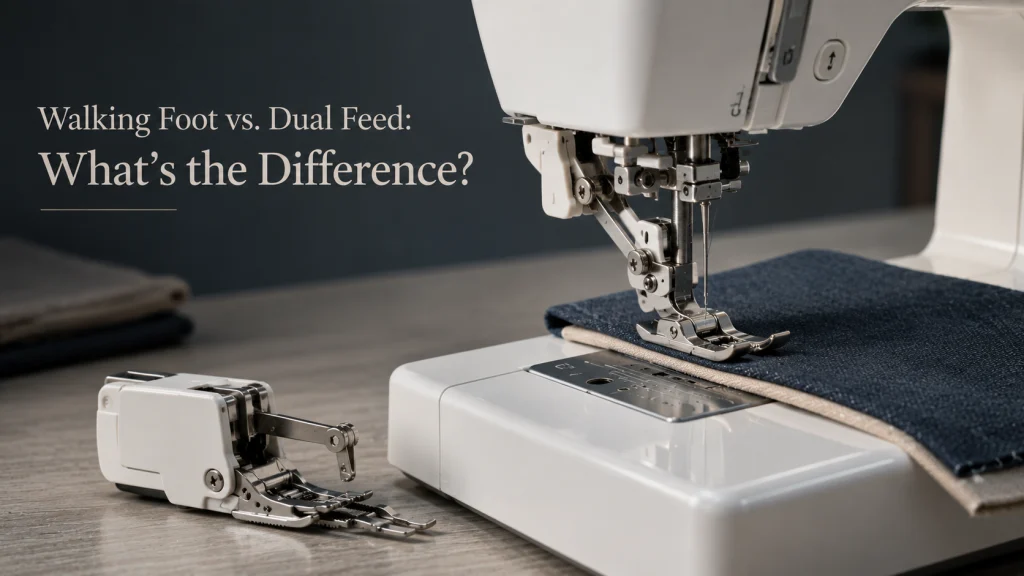
Two Upper-Feed Solutions Can Have Different Ownership Boundaries
A first-time buyer can reasonably look at two machines or accessories that both move fabric from above and assume the mechanisms are interchangeable. That is the core confusion behind walking foot vs dual feed. One system may be a removable attachment driven through the machine while another is integrated into the machine and designed to work only with a defined family of presser feet.
The difference matters before any compatibility or project question. A removable attachment can add upper transport to a machine that otherwise relies on its normal lower feed, while an integrated system is part of the machine’s own feed architecture. A third design can sit between those categories, such as Brother’s MuVit dual-feed accessory, which is removable but uses a digitally controlled direct motor rather than the conventional walking-foot arrangement.
| System type | Upper-feed drive | Ownership boundary |
|---|---|---|
| Removable walking or even-feed attachment | Attachment is mechanically driven while installed | Accessory must match the machine and carries its own stitch and motion limits |
| Integrated dual-feed system | Upper-feed drive is built into the machine architecture | Uses the machine’s documented engagement method and supported foot family |
| Motor-driven removable dual-feed foot | Dedicated powered accessory supplies upper transport | Removable like an accessory, but electronically tied to supported machine models |
This map is more useful than deciding from the label alone. It shows why “built-in walking foot” is too loose a phrase for systems whose drive source, electronics, and foot ecosystem differ materially.
Keep the Comparison Inside Domestic Machines
This article covers upper-feed solutions used on domestic sewing machines: removable walking or even-feed attachments, integrated dual-feed systems, and closely related driven accessory systems. It does not use industrial walking-foot terminology as a shortcut because industrial machines can combine lower feed, needle transport, driven upper feed, and alternating feet in architectures that do not map cleanly onto household accessories.
For the wider map of feed arrangements, compare sewing machine feed mechanisms. If a listing uses industrial terms such as compound feed, unison feed, or triple feed, move instead to verify compound feed and walking-foot motion. For the broader machine context behind both systems, understand how sewing machines work.
Define the Removable Walking or Even-Feed Attachment
A domestic walking foot is an accessory that replaces the ordinary presser-foot setup and adds a moving upper feed element while the machine’s lower feed dogs continue to transport from below. Brother describes its SA140 walking foot as a moving feed system that holds and moves fabric between the attachment’s upper feed dog and the machine’s lower feed dogs. The same page also notes that Brother walking feet differ by feed-dog width and shank arrangement.
Removability is one of the defining ownership traits. The upper-feed mechanism arrives with the attachment rather than being a permanent machine feature, and removing that attachment returns the machine to its normal presser-foot arrangement. A common beginner mistake is to treat “walking foot” as the name of any top-feeding system; it is safer to preserve the manufacturer’s exact term and verify how that device is driven.

The HONEYSEW Open Toe Walking Foot is a removable sewing-machine attachment supplied with a quilting guide. Its open-toe design keeps the stitching area visible while the walking mechanism helps feed multiple fabric layers through the machine. The listing identifies it for Brother sewing machines and for quilting and other layered sewing work.
Check On AmazonIf you click this link and buy, we earn a commission at no additional cost to you.
Define Integrated and Digital Dual Feed Without Treating Them as One Design
Integrated dual feed moves the upper-transport mechanism into the machine’s own design instead of adding a conventional walking-foot attachment. PFAFF identifies its Original IDT system as Integrated Dual Feed, while JUKI identifies Smart Feed on the DX-3000QVP as a dual-feed function that moves the upper layer together with the lower layer. Both are machine-specific upper-feed systems, but that shared purpose does not make their mechanical details or foot ecosystems identical.
Digital drive adds another variation. Brother’s SA209 Compact Dual Feed Foot is a removable accessory, yet Brother describes it as digitally controlled and direct-motor-driven. It therefore should not be flattened into either “ordinary walking foot” or “integrated dual feed” without qualification. The useful question remains where the upper motion originates and how the exact machine communicates with or drives that mechanism.
Note: Brand terms describe each manufacturer’s own implementation. “IDT,” “Smart Feed,” and “MuVit” should stay attached to the documented system that uses the name rather than becoming generic definitions for every dual-feed design.
This brand boundary prevents a feature comparison from drifting into invented equivalence. Similar top-layer transport goals can be achieved through different mechanical and electronic arrangements.
The JUKI HZL-F600 is a versatile household sewing and quilting machine with a broad stitch selection, automatic buttonhole functions, a built-in needle threader, and fabric-feeding controls suited to garment sewing and layered projects. Its box-feed mechanism is designed to move fabric consistently through the stitching area. This is a feature-rich computerized alternative to the unavailable mechanical PFAFF Select 4.2, not an identical machine. JUKI box feed is not PFAFF's integrated dual feed system. Compare the machine size, included accessories, electrical requirements, price, and preferred feeding features before choosing it.
Check On AmazonIf you click this link and buy, we earn a commission at no additional cost to you.
Compare Where the Upper-Feed Motion Comes From
Drive source is the cleanest way to separate systems that look similar in a product photo. A conventional walking-foot attachment is mechanically actuated while attached to the machine. An integrated system places the upper-feed drive within the machine design. A motor-driven accessory can be removable yet receive dedicated powered motion through a supported electronic connection.
That distinction changes what the owner needs to check. With a walking attachment, focus on the attachment interface and its movement restrictions. With an integrated system, look for the machine’s engagement instructions and the feet intended to work with that drive. With a powered accessory, the supported-model list and electronic connection become part of the system boundary. No drive source is automatically superior; it describes construction, not a guaranteed sewing result.
Compare Engagement and Removal
A removable walking attachment generally enters or leaves the setup as a complete accessory, which means using it changes the presser-foot assembly installed on the machine. An integrated system instead stays with the machine and is engaged or disengaged according to the machine’s documented control sequence. Upper feed can therefore become available without removing the integrated drive itself.
JUKI’s DX-3000QVP page explicitly tells the user to engage JUKI Smart Feed when the dual-feed function is wanted. PFAFF treats IDT as an integrated feature and lists several included feet specifically designated for use with the IDT system. Those examples show why engagement cannot be reduced to “attach a walking foot” across all domestic upper-feed systems.
This article stops at the architecture boundary. Installation steps, holder removal, screw position, powered connection, or adjustment belong to the instructions supplied for that machine or accessory and should not be copied from another model’s procedure.
Compare the Documented Presser-Foot Ecosystem
Integrated dual feed often works through a defined presser-foot family rather than every foot in the accessory catalog. PFAFF’s select™ 4.2 documentation lists multiple included feet specifically marked for use with the IDT system, while other included feet are not labeled that way. JUKI’s DX-3000QVP page similarly distinguishes several foot variants as being for JUKI Smart Feed.
A removable walking foot creates a different boundary because the accessory itself is the upper-feed foot. Brother’s SA140 page also makes clear that walking feet differ by feed-dog width and shank height, so the generic words “walking foot” do not prove fit. Treat the supported foot family as part of the feed-system specification, and do not infer compatibility from appearance or a generic accessory name.
Do Not Confuse Upper Feed With Lower-Feed or Presser-Pressure Controls
An upper-feed system adds a transport contribution from above the fabric. That is different from changing the state or height of the lower feed dogs, and it is also different from changing presser-foot pressure. Those controls can affect how fabric is held or advanced, but they do not turn a bottom-feed machine into a walking-foot or integrated dual-feed system.
This distinction is useful when reading feature lists. A machine can offer adjustable presser-foot pressure or a feed-dog control without having any driven upper-feed mechanism at all. Keep those settings separate from the walking-foot-versus-dual-feed question, and evaluate them only within the machine’s own operating instructions.
Check Stitch Width, Needle Position, and Plate Limits in the Exact Manual
Upper-feed hardware changes the clearance available around the needle, so stitch and needle-position limits are not optional details. Brother’s SA140 documentation states that the walking foot is not for reverse or side-to-side sewing and excludes built-in stitches that require feed movement other than forward motion. Brother’s walking-foot support also limits the covered attachment to straight or zigzag stitches and says reverse stitches cannot be sewn with it.
An integrated system can have a different allowed range because the machine and foot family were designed together, but that still does not create a universal dual-feed rule. A particular foot may have a narrow needle opening, a wider opening, or a model-specific center-position requirement. The exact manual must control stitch width, lateral needle position, and plate choice.
Needle-clearance boundary: Never assume that a stitch width or needle position is safe merely because the machine can select it. Verify clearance for the installed foot and needle plate before sewing, and stop if the documentation does not support the combination.
This is a mechanism limit, not a project recipe. The goal is to prevent a feed-system label from hiding a physical needle-path restriction.
Neither Label Guarantees Equal Layer Movement on Every Material
Manufacturers commonly describe walking or dual-feed systems in terms of controlling layers, reducing shifting, or feeding from above and below. Those descriptions establish intended function for the documented product, but they do not prove that every fabric stack will move perfectly together. Material friction, layer count, thickness transitions, presser-foot pressure, stitch geometry, and handling can all change what happens at the seam.
A slippery lining under a stable woven outer layer presents a different feed problem from several quilt layers crossing a bulky seam. The presence of upper transport is relevant in both cases, yet the label alone cannot predict the result. Without a controlled test on the exact machine, foot, stitch, needle, thread, and material stack, claims such as “zero shifting” should be treated as unsupported.
| Claim | What would count as proof | What the label alone proves |
|---|---|---|
| Feeds from above | Manufacturer documentation showing an active upper-feed element | Presence of upper transport on the named system |
| Works with a specific presser foot | Exact machine or accessory compatibility documentation | Nothing about cross-model fit |
| Prevents layer shifting | Controlled observation on the exact material stack and setup | Only the manufacturer’s intended feed function |
| Handles thick material | Model-specific material or clearance evidence under stated conditions | No universal material capacity |
| Allows a stitch or needle position | Exact manual and foot/plate clearance documentation | No universal stitch range |
This claim-versus-proof ledger keeps the comparison useful without turning architecture into a performance ranking.
Separate Feature Presence from Included Accessory and Compatibility Claims
A machine can advertise dual feed without including every foot that can use the system, and an accessory listing can describe a walking or powered dual-feed foot without proving that it fits the machine in front of you. Feature presence, package contents, and compatibility are three separate facts.
JUKI’s DX-3000QVP page names Smart Feed-specific versions of several feet, while Brother publishes explicit compatible-model lists for both conventional walking feet and the SA209 motor-driven dual-feed accessory. Those details show why a shopper should not infer an entire foot ecosystem from a single feature badge. This article deliberately stops before recommending a fit.

The SINGER Even Feed Walking Presser Foot has its own feed dogs that work with the sewing machine's feeding system to move fabric layers together. It is designed for quilting, sewing multiple layers, matching plaids or stripes, and working with fabrics that have nap or pile. The current listing identifies compatibility with SINGER CA, CB, EA, MA, and MB series sewing machines.
Check On AmazonIf you click this link and buy, we earn a commission at no additional cost to you.
Build a Four-Field Document Check Before Comparing Systems
A short document check is enough to prevent most label confusion. Use the exact manufacturer page and manual, then fill each field without borrowing a definition from another brand.
- Drive: Is upper transport mechanically driven through an attachment, integrated into the machine, or powered by a dedicated accessory motor?
- Engagement: Is the upper feed attached and removed as a unit, or engaged and disengaged through the machine’s own mechanism?
- Foot family: Which presser feet are explicitly documented for use with the upper-feed system?
- Restrictions: Which stitches, needle positions, plate combinations, reverse functions, or other movements are limited?
If one of those fields is missing, leave it unknown until the exact documentation resolves it. A product photo or seller phrase such as “built-in walking foot” is not enough to fill the gap.
Route Industrial Walking-Foot Language to the Moving-Parts Audit
Industrial listings often use “walking foot” for architectures that can include alternating feet, needle transport, compound feed, or unison feed. Those labels describe a different equipment context from a domestic walking-foot attachment or integrated household dual-feed system. Carrying one vocabulary set into the other without checking the components creates false equivalence.
If an industrial listing is part of the research, use the separate compound-feed and walking-foot comparison to identify lower feed, needle transport, driven upper feed, and alternating holding-foot motion. Then return to this domestic comparison only if the machine being evaluated is genuinely a household system.
Keep Fit Verification and Sewing Technique Outside the Mechanism Comparison
Knowing that a machine has integrated dual feed does not tell you whether a particular foot fits, and knowing that a compatible walking attachment exists does not tell you when a project should use it. Those are separate decisions that depend on the exact model, accessory interface, stitch, material stack, and construction task.
The distinction matters for quilting and slippery fabrics in particular. Those are common examples in manufacturer education because upper transport can be relevant, but the correct sewing method still depends on the actual fabric and seam. This article establishes only what the feed system is and which documented boundaries follow from its design.
Keep Machine Rankings and Model Selection Outside the Feed Label
A feed-system feature can matter in a machine comparison, but it should never decide the purchase by itself. Stitch range, work area, buttonhole system, speed control, presser-foot pressure, accessory availability, service access, and the rest of the machine specification can outweigh the convenience of one upper-feed implementation for a particular owner.
Likewise, an integrated system should not automatically be ranked above a removable walking foot. If an owner rarely needs upper transport, a removable attachment may meet the documented need. If upper feed is used frequently, integration may change convenience and foot availability, but the final decision still belongs to the complete machine and project requirements rather than the label alone.
Final Thoughts: Verify Drive, Foot Family, and Manual Boundary
The cleanest comparison comes from looking past the marketing shorthand and asking what kind of upper-feed system the machine actually has. A removable walking attachment, an integrated drive, and a motorized accessory may all help move the top layer, yet they create different limits around engagement, usable feet, needle clearance, and ownership.
Keep the conclusion narrow. Confirm the system in the manufacturer’s material, then treat performance, compatibility, sewing technique, and machine selection as separate questions. Similar feeding goals do not make the mechanisms interchangeable.
FAQs
🦶 Is a walking foot the same as dual feed?
No. A domestic walking foot is typically a removable upper-feed attachment, while dual feed may be integrated into the machine or implemented through another driven system. Verify the exact drive source and foot family before treating the labels as equivalent.
⚙️ What is the difference between dual feed vs walking foot?
The main difference is usually how upper transport is built and driven. A walking attachment adds the mechanism with the accessory, while an integrated system keeps the drive in the machine and engages it with supported feet.
🔌 Can a removable dual-feed foot have its own motor?
Yes. Brother’s MuVit system is an example of a digitally controlled, direct-motor-driven accessory foot. That is why removability alone does not tell you how the upper-feed mechanism is powered.
🧵 Can I use every stitch with a walking foot?
No. Brother documents restrictions on some walking-foot attachments, including limits on reverse and side-to-side sewing. Use the exact accessory and machine manual for the supported stitch range.
📏 Does integrated dual feed work with every presser foot?
Do not assume so. PFAFF and JUKI documentation identify foot families or foot variants intended for their integrated feed systems. Check the exact model’s supported feet before treating upper feed as available with every foot.
🪡 Does a walking foot or dual feed prevent fabric layers from shifting?
Upper transport is intended to help control layer feeding, but neither label guarantees zero shifting on every material. The result depends on the exact machine, foot, stitch, fabric stack, settings, and handling.
References and Sources
- Brother SA140 walking-foot documentation: Defines a removable domestic walking foot, notes fit differences between walking feet, and documents stitch and feed-motion restrictions.
- Brother SA209 Compact Dual Feed Foot: Confirms a removable dual-feed accessory that is digitally controlled and direct-motor-driven.
- JUKI DX-3000QVP Smart Feed documentation: Documents JUKI Smart Feed as a dual-feed function and identifies presser-foot variants intended for that feed system.
- PFAFF select 4.2 IDT documentation: Identifies the Original IDT system as Integrated Dual Feed and lists multiple included presser feet specifically designated for use with IDT.