Sewing machine feed mechanisms make more sense when you stop comparing labels and start identifying which parts actually contact and move the material. A feed-dog count, needle-feed label, unison-feed specification, or domestic dual-feed feature can describe different layers of the transport system rather than competing versions of one feature. The practical way to read a specification is to identify the lower feed, any moving upper element, whether the needle travels with the material, and how those motions are timed. This article stays at the mechanism and terminology level, not machine rankings, project-specific buying advice, setup changes, or fault diagnosis.
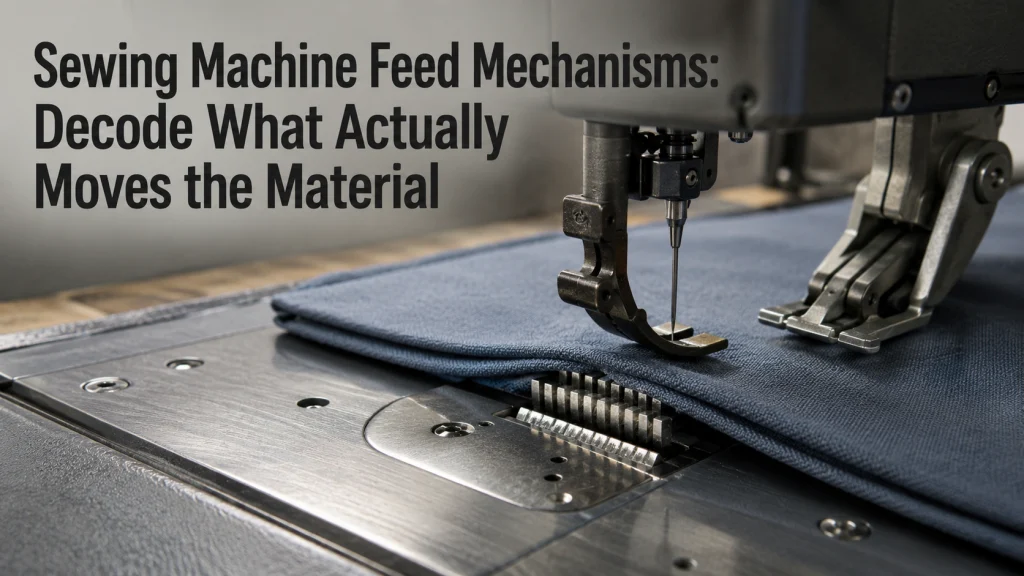
Four feed labels can describe four different things
Sewing machine feed mechanisms are easiest to decode when the label is treated as a clue, not a conclusion. A specification may say seven feed-dog points, needle feed, unison feed, or digital dual feed, yet those phrases do not identify the same moving parts or the same machine architecture. Brother, for example, lists seven feed-dog points on the BQ2500 while also describing a separate Compact MuVit Digital Dual Feed foot, which is a useful reminder that a lower-feed specification and an upper-feed feature can exist on the same domestic machine.
Note: This is a document-based terminology audit. It does not infer hidden linkages from product photos or turn manufacturer performance language into independent test results.
Industrial terminology can separate the architectures more explicitly. JUKI currently lists bottom feed, needle feed, top and bottom feed, and unison feed as four different feed systems within one industrial machine family. The useful question is not which label sounds stronger, but which surfaces touch the work, which surfaces move it forward, and whether the needle participates in that motion.
Separate the four axes hidden inside sewing-machine type labels
A machine can be described by several systems at once, so one label rarely tells you everything useful. Before reading any feed claim, separate stitch formation, control platform, bed geometry, and feed architecture. Mixing those axes can make unrelated machine descriptions look directly comparable.
This separation matters because the feed system answers only one question: how material advances through the sewing zone. It does not by itself tell you what stitch is formed, how controls are operated, how the work is physically supported, or what the machine can sew reliably. The broader machine workflow is covered in how sewing machines work together; here, the focus is the material-transport part of that workflow.
Stitch system
The stitch system describes how thread is formed into a seam, not how the material is transported. A lockstitch machine, overlocker, and coverstitch machine can use different feed arrangements even though each still needs some method of moving work past the needle. Treating stitch type and feed type as the same axis hides important mechanical differences.
Control platform
Mechanical, electronic, and computerized controls describe how the operator selects or regulates functions. They do not automatically change which parts contact the fabric. A computerized domestic machine can still rely primarily on bottom feed, while another computerized model may add a driven upper-feed device.
Bed geometry
Flat-bed, cylinder-bed, and post-bed describe the physical shape supporting the work around the needle area. That shape changes access and handling, but it is separate from the feed classification. JUKI’s industrial listings make this visible because the same page can identify a cylinder-bed machine and then specify bottom, needle, top and bottom, or unison feed as a separate field.
Feed architecture
Feed architecture identifies the moving elements that advance the material. This is the axis where bottom feed, needle feed, upper feed, unison feed, puller assistance, and differential feed belong. Once that axis is isolated, the terminology becomes much easier to compare without accidentally treating an unrelated feature as evidence of better feeding.
Define a feed mechanism by contact, motion, and timing
A useful definition of a feed mechanism has three parts. First, identify every component that touches the material near the stitch-forming area. Second, identify which of those components actually travels with the work instead of simply holding it down, and third, identify when that travel happens relative to needle penetration and presser-foot movement.
This prevents a common beginner mistake: assuming that anything called a foot is necessarily a feeding element. A standard presser foot can hold material against the lower feed while remaining stationary in the direction of sewing, while a driven upper-feed element may move forward and backward as part of transport. The name of the attachment is less reliable than the motion you can verify in the manual or specification.
- Contact: Which parts touch the top and bottom surfaces of the work?
- Motion: Which of those parts move forward with the material?
- Needle role: Does the needle only form the stitch, or does it also travel with the material while inserted?
- Timing: Which elements move together, alternate, release, or re-engage during the feed cycle?
Those four checks form the full analysis framework for understanding a feed architecture without opening covers or observing a powered machine at close range. They are meant to explain the mechanism itself. Later, the four-question specification checklist compresses this framework into a faster reading method for a model page or manual; if the documentation still does not make the motion clear, the feed architecture is not yet verified.
Use bottom or drop feed as the baseline
Bottom feed, often called drop feed in domestic sewing, uses the feed dog below the material as the primary moving transport surface. The presser foot supplies downward restraint while the lower feed dog rises, advances the work during the appropriate part of the stitch cycle, drops, and returns. More complex systems are easiest to understand as additions to, or changes from, that baseline.
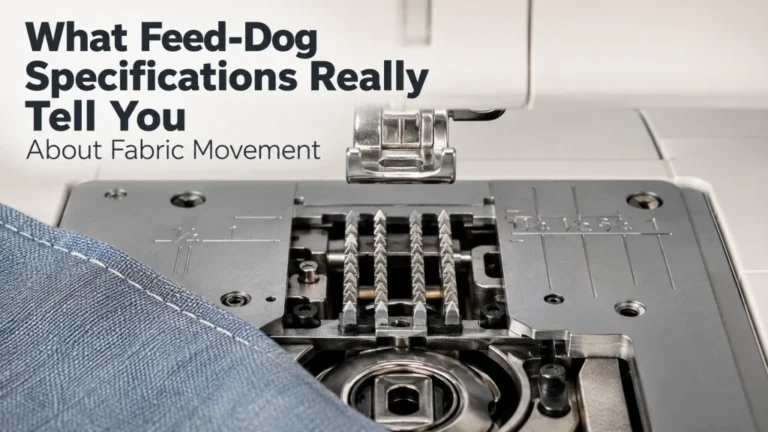
A feed-dog count does not change that basic classification. Seven feed-dog points may describe how many toothed contact areas are present, while a named feed path such as box feed may describe how a manufacturer controls the lower feed dog’s movement. For part identity and the feed dog’s role as a component, use sewing machine parts and functions; this article stays with the architecture those parts create together.
Read feed systems through a moving-component register
The cleanest crosswalk records the lower feed, upper contact, and needle transport role. It lets you compare types of sewing machine feed without assuming identical vocabulary.
The descriptions below are architectural categories, not guarantees about what a particular machine can sew. Exact motion still needs to be checked against the model manual, product specification, or technical documentation because the same broad retail label can be applied to different mechanisms.
Bottom feed only
The lower feed dog is the primary moving element that advances the work. The standard presser foot holds the material against the feed dog but does not normally travel forward with it. The needle’s main job is stitch formation rather than transporting the work during penetration.
Bottom and needle feed
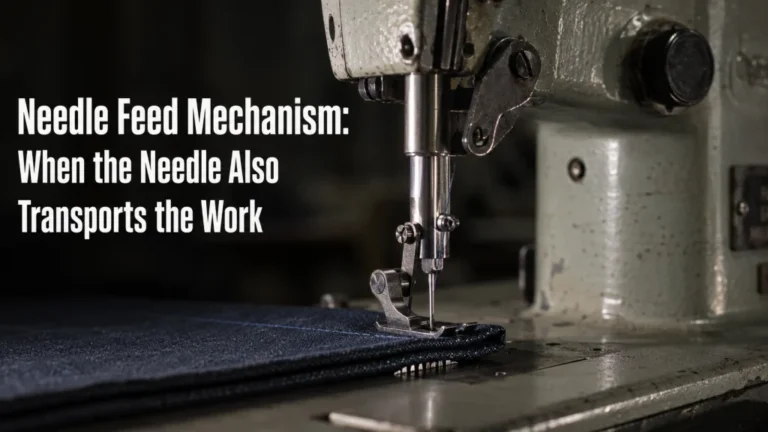
Needle-feed architecture adds forward material transport through the needle while it is in the work, synchronized with the lower feed. JUKI distinguishes this from bottom feed in its industrial specifications, rather than treating it as a stronger version of the same label. The important distinction is that the needle now participates in controlling the material’s position during part of the feed cycle.
Alternating top and bottom feed
Top and bottom feed adds an active upper feeding element to lower feeding. On industrial machines, upper feet may alternate in vertical contact so one element can hold or step while another part of the system advances the work. The presence of a moving upper foot does not automatically mean the needle also feeds.
Compound, triple, and unison feed
These terms are where vocabulary becomes risky. JUKI’s TSC-441U identifies unison feed as a system that adds top and bottom feed to needle feed, so the needle and upper mechanism both participate beyond ordinary lower feeding. Other sellers may use compound, triple feed, or compound walking foot for similar three-element transport, but the names should not be declared universal synonyms without checking the exact machine.
Puller and roller assistance
Puller and roller systems add another driven contact point to help move material through or away from the sewing zone. Placement, drive method, and synchronization vary enough that the label alone does not establish whether the device is the primary feed or an assisting feed. For specification reading, record the added contact point and its relationship to the lower feed instead of assuming every roller system works the same way.
| Feed label | Primary lower movement | Upper movement | Needle transports material? | What the label can establish |
|---|---|---|---|---|
| Bottom or drop feed | Feed dog | No forward upper feed required | Normally no | Lower transport is the baseline mechanism |
| Needle feed | Usually lower feed works with the needle | No moving upper feed implied by the term alone | Yes | The needle participates in material advance |
| Top and bottom feed | Lower feed | Driven upper feed | Not necessarily | Material receives active transport from both sides |
| Unison or compound-type system | Lower feed | Driven upper feed | Often yes, verify exact model | Multiple transport elements are coordinated |
| Puller or roller assist | Model-specific | Additional driven contact may be present | Model-specific | An extra transport element exists, but its role needs verification |
The register is deliberately conservative. If the manufacturer only says “dual feed” without identifying the moving parts, that phrase belongs in the unverified column until the manual or technical description shows what actually travels with the material.
Keep differential feed inside its specialist-machine boundary
Differential feed is not simply another name for upper feeding. On an overlocker or serger, the important idea is that sections of the feed system can move material at different relative rates, changing how the fabric is delivered through the stitch-forming area. JUKI’s household MO-50eN, for example, lists adjustable differential feed and a differential-feed ratio as a distinct machine function.
Key point: “Feeds from more than one place” is not a sufficient definition. Differential feed, dual feed, top and bottom feed, and unison feed can involve different moving elements and timing relationships.
That makes differential feed a separate comparison axis from a domestic walking-foot attachment or an industrial unison-feed lockstitch system. This article does not turn that distinction into serger setup instructions, gathering instructions, or stretch-fabric settings. If a specification says differential feed, identify the specialist stitch system and the related feed motion before comparing it with a lockstitch machine.

The JUKI MO-50E is a three or four thread serger with adjustable differential feed and lay-in thread tensions. It includes a built-in rolled hem, an automatic lower looper threader, and a retractable upper knife. The machine also uses color-coded threading guides and provides separate controls for stitch length and differential feeding.
Check On AmazonIf you click this link and buy, we earn a commission at no additional cost to you.
Separate domestic integrated dual feed from industrial top and bottom feed
Domestic integrated dual-feed systems usually appear as a machine-specific upper-feed feature working with the machine’s normal lower feed. Brother’s BQ2500 is a useful terminology example because its specification separately lists seven feed-dog points and a Compact MuVit Digital Dual Feed foot. Those two entries describe different parts of the same machine rather than two competing feed classifications.
An industrial top and bottom feed specification is usually describing the machine’s core feed architecture, not merely naming a removable domestic accessory. That difference is why a domestic “dual feed” label should not be translated automatically into “industrial walking foot,” “compound feed,” or “unison feed.” The correct comparison begins with motion, attachment method, and needle participation.
A first-time buyer can easily miss this distinction because retail pages often emphasize the benefit before the mechanism. Separating the upper-feed device from the machine’s baseline lower feed keeps the comparison mechanical rather than promotional.

The JUKI DU-1181N is a single-needle industrial lockstitch machine built around a top and bottom feed mechanism. Its specifications include a maximum sewing speed of 2,000 stitches per minute and a maximum stitch length of 9 mm. The machine also uses a horizontal-axis double-capacity hook and an automatic lubricating system.
Check On AmazonIf you click this link and buy, we earn a commission at no additional cost to you.
Translate brand-specific terms without declaring universal synonyms
Names such as Box Feed, Smart Feed, MuVit, AcuFeed, and other branded terms can sit at different levels of a specification. When a page says Box Feed, for example, do not infer an upper-feed or needle-feed architecture from the name alone. Read the manufacturer’s mechanism description first, then record the moving parts it actually documents.
The safe translation method is to keep the manufacturer’s name in one column and the verified moving components in another. If two brands use different names for comparable motion, you can say the documented mechanisms appear similar in that specific respect. If the documentation does not establish the same moving parts and timing, do not collapse the names into one supposedly standard term.
Decode a current specification in four questions
The earlier contact, motion, needle-role, and timing framework explains what a feed architecture is. This four-question version is the practical reading pass: start with the exact model page or manual, then reduce its terminology to the few facts needed to place the system in the crosswalk. It is especially useful when one specification mixes a feed-dog count, branded name, and upper-feed device.
Do not fill gaps with visual similarity. Two machines can both show toothed upper feet in photos while using different needle motion, alternating-foot timing, or drive arrangements. If the manufacturer does not document a point, mark it unknown rather than upgrading the claim based on appearance.
- What moves underneath? Identify the lower feed dog, multiple lower feeds, wheel, or another lower transport element.
- What moves above? Identify a stationary presser foot, driven upper foot, alternating feet, roller, or another powered contact surface.
- Does the needle move with the material? This separates needle-feed participation from systems where the needle only rises and falls for stitch formation.
- What remains unspecified? Record unknown timing, attachment details, feed ratios, and model-specific implementation instead of guessing.
This checklist also keeps branded language in proportion. A feature name can be useful evidence that a mechanism exists, but only the documented components and motion tell you where it belongs in the crosswalk.
Feed labels do not prove capacity, layer control, or stitch quality
A feed architecture can explain how a machine attempts to control material, but it does not prove the material stack the machine can sew well. Real capacity also depends on the machine’s needle system, presser-foot clearance, stitch system, motor and drive characteristics, thread range, hook or looper design, settings, material behavior, and the exact seam geometry. A feed label alone therefore cannot establish that a machine is suitable for heavy canvas, thick leather, slippery laminates, or any other named material.
Safety boundary: Verify feed motion from documentation. Do not place fingers near powered moving parts, remove guards or covers for observation, bypass safety devices, or make feed-height or timing adjustments that the exact model manual reserves for service.
The same caution applies to feed-dog count and manufacturer performance language. More contact points do not automatically mean more useful traction, and an upper-feed system does not guarantee zero layer shift in every stack. The mechanism tells you what to investigate next, not the final performance verdict.
Follow needle-feed questions into the needle’s transport role
Once a specification confirms that the needle travels with the material, the next useful question is how that motion is synchronized with the lower feed and what it changes mechanically. That is narrower than the general taxonomy here, because it requires following the needle bar through the transport portion of the stitch cycle rather than merely classifying the feed label.
For that deeper mechanism, continue with how a needle-feed mechanism moves material. Keep the distinction clear: needle feed can be one part of a broader combined system, so seeing the word “needle” does not by itself prove an alternating upper-feed mechanism is present.
Treat industrial walking-foot terminology as a separate terminology problem
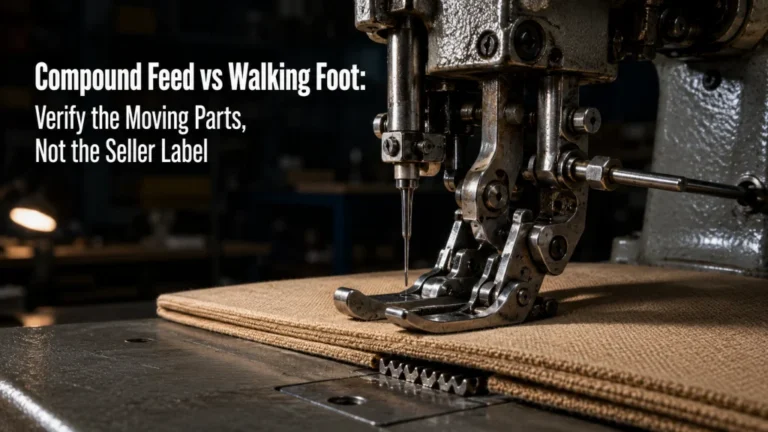
Walking foot is especially dangerous as a universal label because it can be used broadly for machines with active upper feeding even when the needle’s role differs. Some descriptions use it for top and bottom feed, while others reserve compound walking foot for systems that add needle-feed participation. The visible stepping motion of alternating feet is therefore not enough to classify the full transport architecture.
The detailed distinction belongs in compound feed versus walking-foot terminology, where the moving feet, needle, and lower feed can be compared directly. The practical rule here is simpler: never turn “walking foot” into “compound feed” unless the exact machine documentation establishes the additional transport elements.
Keep domestic walking-foot attachments and integrated dual feed separate
A domestic walking-foot attachment and an integrated dual-feed system may both add movement above the fabric, but that does not make them the same interface or mechanism. One may be driven through a removable attachment that follows needle-bar motion, while another is built into the machine or uses a dedicated drive and matched foot system. Compatibility and available feet can also be model-specific.
Those ownership and interface questions are covered in walking foot versus dual feed. This taxonomy only supplies the first step: identify whether the upper transport is an attachment, an integrated machine feature, or part of the machine’s fundamental feed architecture before comparing names.
See more in this section
The terminology becomes easier once each label is traced to specific moving parts. These three articles narrow the classification to the mechanism or terminology that needs closer inspection.
| Topic | What you’ll find |
|---|---|
| Needle Feed Mechanism | How needle motion participates in transport and how it differs from lower feed alone. |
| Compound Feed vs. Walking Foot | How industrial terminology changes when upper feet, lower feed, and needle movement are combined. |
| Walking Foot vs. Dual Feed | How a domestic attachment differs from an integrated upper-feed system and why the interface matters. |
Use the article that matches the unresolved part of the specification instead of treating every feed-related term as one comparison.
Final Thoughts: Verify moving parts before trusting the label
The most reliable way to compare feed terminology is to reduce every claim to moving components. Identify the lower transport element, the upper contact that actually moves, the needle’s role, and the timing relationship. Once those are known, terms such as bottom feed, needle feed, top and bottom feed, unison feed, differential feed, and domestic dual feed stop looking like one long list of competing features.
What remains unknown matters just as much. A feed label does not prove material capacity, clean layer control, stitch quality, accessory fit, or suitability for a project, so those questions need their own evidence. For this stage of research, the correct next move is simply to classify the architecture accurately and refuse to let a familiar name stand in for a verified mechanism.
FAQs
Feed terminology is confusing because domestic and industrial specifications often describe different levels of the transport system. These short answers keep the focus on what the label actually proves.
If a model page uses a term differently from the descriptions below, follow the exact model documentation. Manufacturer-specific implementation takes priority over a generic label.
⚙️ What is the most common sewing machine feed mechanism?
Bottom or drop feed is the common baseline on domestic machines: feed dogs below the fabric provide the primary forward transport. The exact feed-dog path, count, and control can still vary by model.
🪡 Is needle feed the same as compound feed?
Not automatically. Needle feed establishes that the needle participates in material transport, while a compound or unison system may add a moving upper-feed element as well. Verify the exact moving components on the model.
🦶 Is every walking-foot machine a compound-feed machine?
No. Walking-foot language can describe more than one upper-feed arrangement, and some systems do not use the needle as a forward transport element. Check the manual or technical specification before treating the terms as equivalent.
🧵 Does a seven-point feed dog mean the machine feeds better?
The count only tells you how many feed-dog contact points the specification lists. It does not by itself prove traction, layer control, material capacity, or stitch quality across different fabrics and seam stacks.
🔄 Is dual feed the same as differential feed?
No. Domestic dual feed commonly adds active feeding from above, while differential feed changes the relative delivery of feed sections on machines such as overlockers. The mechanisms solve different transport problems.
📖 How can I tell what feed system a machine actually has?
Start with the exact model page and manual. Identify what moves below the fabric, what moves above it, whether the needle travels with the work, and which points the documentation leaves unspecified.
References and Sources
These sources are included because the article depends on current manufacturer terminology and documented feed-system distinctions. They support the specific examples used above rather than serving as a general link list.
- Brother BQ2500 specifications: Confirms seven feed-dog points and the separate Compact MuVit Digital Dual Feed feature on one domestic model.
- JUKI industrial feed-system comparison: Distinguishes bottom feed, needle feed, top and bottom feed, and unison feed within one machine family.
- JUKI DLN-9010A needle-feed documentation: Confirms a needle-feed mechanism working with the bottom feed on an industrial lockstitch model.
- JUKI MO-50eN differential-feed specifications: Confirms adjustable differential feed as a distinct function on a household overlocker.
Model names are used here only as evidence anchors for terminology. They are not recommendations, rankings, or claims that the listed machines are suitable for a reader’s material or project.