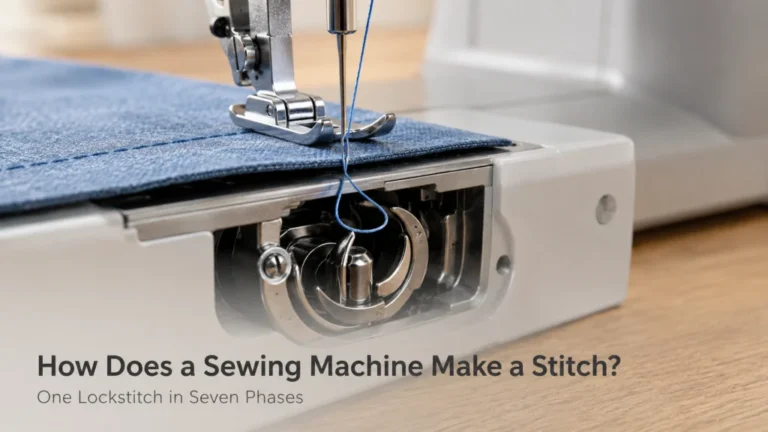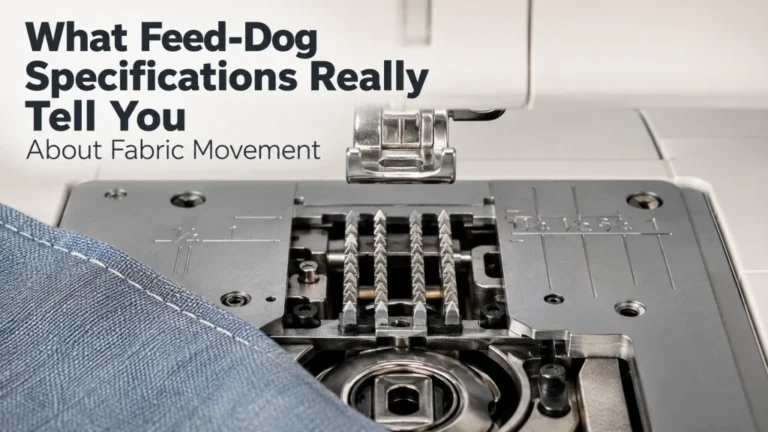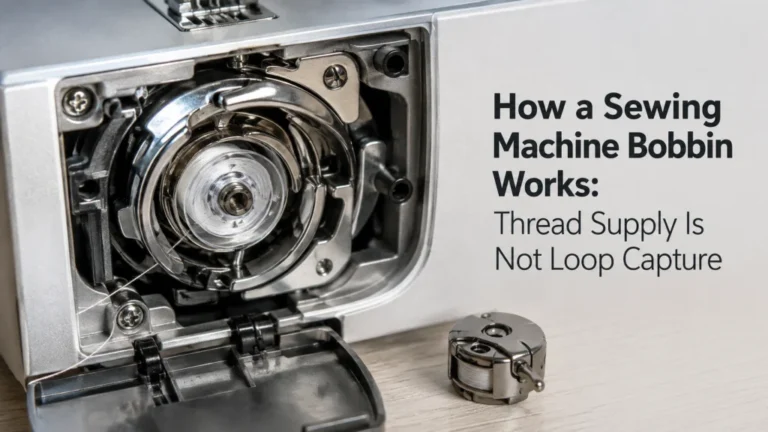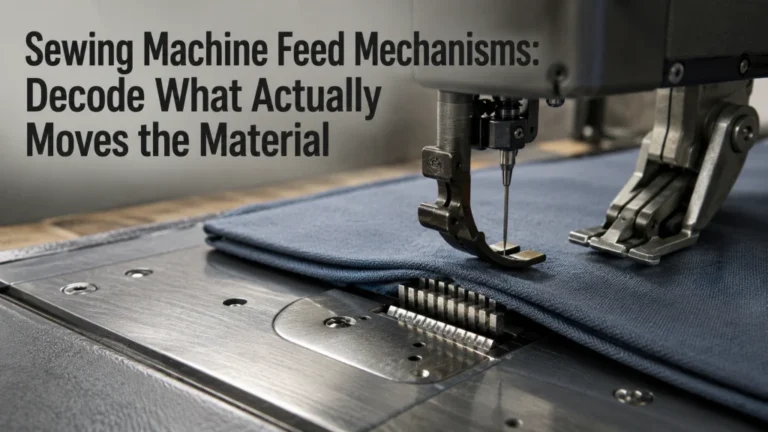
A needle feed mechanism does more than move a needle up and down to form a stitch. During the material-advance part of the cycle, the needle stays engaged as it moves together with the material while the lower feed advances in coordination, so the needle itself becomes one of the transporting elements. That is different from bottom-only feed, and it is also different from a system that adds a driven upper feeding element. The useful way to read a needle-feed specification is to identify exactly which components move the material, then keep performance claims separate from that mechanism label.
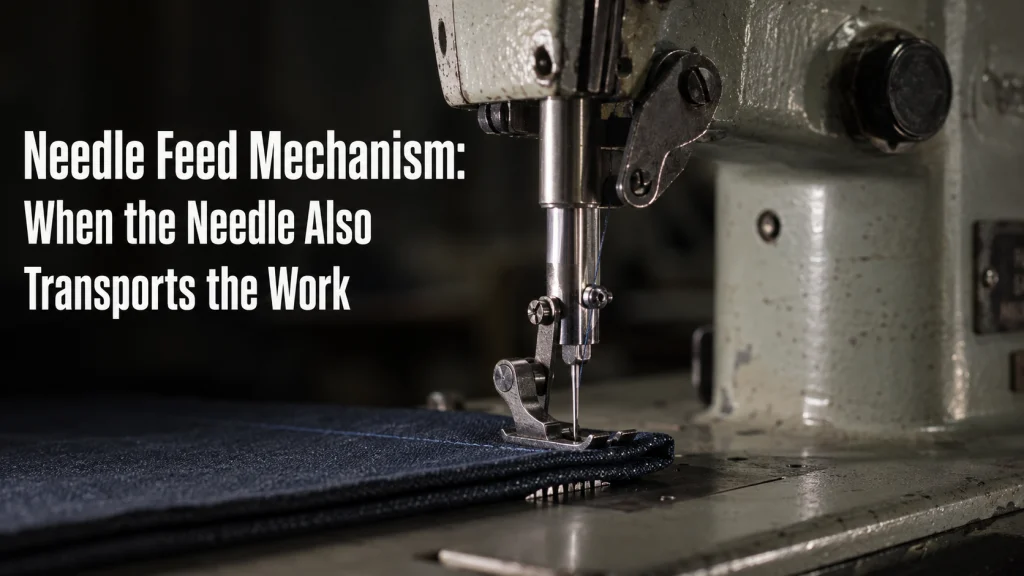
Needle-feed and unison-feed are not interchangeable labels
The needle feed mechanism can be easy to misread when industrial sewing specifications place several feed terms close together, but those terms do not describe the same set of moving parts. A manufacturer can identify one machine as needle-feed while identifying another as unison-feed, which is a strong reason not to treat either label as a loose synonym for “the machine feeds well.” The simplest way to understand how needle feed works is to freeze the material-advance phase and ask which components are actually carrying the work forward.
That distinction also prevents a common first-time buyer mistake. Seeing “needle feed” in a specification does not merely mean the needle penetrates the fabric, because every ordinary lockstitch machine needs needle penetration to form the stitch. Here, the important point is transport: the needle is still in the material while it participates in forward or reverse material movement. For the wider architecture around that motion, it helps to compare sewing machine feed mechanisms before assigning a familiar label such as walking foot.
Define needle feed by transport, not by needle penetration
A needle feed mechanism is defined by the needle’s transport role during the feed phase. The needle descends and penetrates the material, then its bar has controlled fore-and-aft movement so the penetrated needle can travel with the work while lower feeding motion occurs. Once that advance is complete, the needle clears the material before the mechanism returns for the next cycle.
That sequence matters because the same needle has two jobs at different moments: it participates in stitch formation and, for part of the cycle, material transport. Those jobs should not be collapsed into one vague idea of “the needle moving.” If the larger relationship between stitch formation and machine motion is unfamiliar, understand how sewing machines work first, then return to the transport phase described here.
Name the participating components before judging the feed system
Mechanism labels become easier to read when each part is assigned one job instead of being grouped under “the feed.” In a needle-feed-only architecture, the moving needle and lower feed element are the transport pair that matter for this discussion. The presser foot still has an important control and holding role, but that does not automatically make it a driven upper-feed component.
The component map below is intentionally narrow. It describes the transport roles that distinguish needle feed from bottom-only feed and from systems with an added driven upper feed. It does not describe every linkage inside a machine, and it is not a service diagram.
| Component | Role during material advance | What the role does not prove |
|---|---|---|
| Needle and moving needle bar | While still in the material, the needle moves along the feed direction with the work. | It does not prove that an upper foot is powered or that the machine uses a full compound system. |
| Lower feed element | It advances the work from below in coordination with the needle-feed motion. | It does not by itself show how much layer control the machine can provide on a particular material stack. |
| Holding presser foot | It controls and holds the work at the needle area according to the machine’s design. | A presser foot being present does not mean that it is a driven walking or upper-feed element. |
For example, two industrial machines can both have a visible presser foot and still use different feed architectures. The deciding evidence is not the foot’s appearance but the manufacturer’s description of which components are driven during feeding. That is why a component-by-component reading is more reliable than identifying the system from a photograph alone.
Moving needle bar
The needle bar must do more than its ordinary vertical stroke if the needle is going to participate in transport. During the relevant phase, the bar’s controlled fore-and-aft motion carries the penetrated needle along the feed direction. That is the mechanical feature that separates a true transport role from ordinary needle penetration. It is also why a specification that explicitly names needle feed carries more information than a photo showing a needle in fabric.
Lower feed element
The lower feed still matters because the needle is not acting as a lone conveyor. In documented needle-feed designs, lower feeding motion is coordinated with needle motion so the work is advanced as a system. The exact geometry, feed locus, and adjustment range remain model-specific, so this article does not assign one universal movement path to every machine using the label. A useful mental model is coordinated bottom-and-needle transport, not “the needle pulls everything by itself.”
Holding presser foot
The presser foot can be easy to misread because it is directly above the work and visibly touches it. In a needle-feed-only arrangement, contact does not automatically mean powered forward transport. A holding foot can manage pressure and fabric control while the needle and lower feed provide the transport motion discussed here. If the upper foot itself is positively driven to advance the work, the feed architecture has changed and needs a different description.
Follow one documented advance phase
Looking at one feed phase is more useful than trying to memorize names. Manufacturer descriptions of needle-feed machines identify coordinated needle-bar and bottom-feed motion, so the sequence below records only the motion needed to understand that claim. It avoids internal adjustment instructions because timing and linkage service belong in the exact machine documentation or qualified service procedures.
This ledger also shows why a stationary photograph can be misleading. A still image might capture the needle down, but it cannot tell you whether the needle remains stationary in the horizontal direction or travels with the material. The sequence is what reveals the transport role.
| Phase | Needle state | Lower feed state | Transport meaning |
|---|---|---|---|
| Penetration | The needle enters the material. | The lower feed is positioned for the advancing portion of the cycle. | Needle contact establishes the condition for needle-assisted transport. |
| Advance | The penetrated needle travels with the work. | The lower feed advances in coordination. | Needle and lower feed are both participating in material movement. |
| Clear and reset | The needle clears the material before the return movement. | The feed mechanism resets for the next stitch cycle. | The return motion occurs without dragging the penetrated needle backward through the work. |
A practical example is a stack of two layers that can shift relative to one another as it advances. The mechanism label tells you that the penetrated needle participates in transport with the lower feed during the advance phase. It does not, by itself, tell you how much relative layer movement will occur on that exact fabric, with that exact pressure, stitch length, needle, thread, and machine condition.
The needle penetrates the material
Penetration alone is not the identifying feature, but it establishes the contact needed for the next part of the cycle. At this point the needle is physically engaged with the material rather than hovering above it. The important question is what happens before the needle clears again. If there is coordinated horizontal transport while the needle remains engaged, the needle has become part of the feed action.
The needle and lower feed travel together
This is the defining part of the sequence. Highlead’s description of its GC0518 states that the needle bar and bottom feed mechanism move in time, which is useful model-specific evidence of the coordinated motion meant by the label. That wording supports the mechanical relationship on that machine, not a universal promise about every material or every needle-feed design. The evidence is strongest when the exact machine documentation uses equally clear feed-system language.
The needle clears before reset
After the advancing portion is complete, the needle must leave the material before the system returns to its next starting position. This is what keeps the return movement from simply pulling the engaged needle back through the work. The precise cam, linkage, and timing geometry can vary between machine families. For an owner, understanding the sequence is enough; changing those relationships is outside normal mechanism education.
How stitch length relates to the feed movement
Stitch length belongs in the same motion picture because each stitch includes a defined amount of material advance. On a needle-feed machine, the lower feed and the engaged needle have to carry out that advance in coordination, so stitch length is connected to how far the feed system moves the work during each cycle. The feed architecture does not create one universal stitch-length range: official specifications show different maximum stitch lengths on different needle-feed models. Treat the stated stitch-length range as a model-specific specification, and treat changes to feed adjustment or timing as a separate setup or service question rather than something the needle-feed label answers by itself.
Needle feed vs. drop feed: compare only the transport role
In a bottom-only arrangement, the lower feed advances the material while the needle’s job is stitch formation rather than horizontal transport of the penetrated work. In needle feed, the needle joins the lower feed during the advancing phase. That difference is the cleanest answer to needle feed vs drop feed without repeating every detail of lower feed-dog motion.
Consider two otherwise similar-looking flat-bed machines. On the bottom-only machine, seeing the needle down at one instant does not mean it is helping carry the material forward. On the needle-feed machine, the specification should establish that the needle bar has the additional feed motion. The comparison is about participating components, not about which machine is “better.”
What changes when driven upper feed is added
Adding a positively driven upper feeding element changes the component set. Now transport can involve the lower feed, the needle, and an upper foot or other upper-feed element, depending on the exact design. JUKI’s unison-feed documentation, for example, separately discusses upper and lower feed relationships and a walking-foot/presser-foot alternating movement mechanism, which is more than the needle-feed-only component set described earlier.
The point is not to force every manufacturer’s terminology into one dictionary. The point is to notice when the documentation adds a driven upper participant. Once that happens, the reader needs to verify the complete feed architecture rather than assuming the words “needle feed” fully describe it.
This boundary matters when a listing uses several familiar terms in the same paragraph. Count the driven participants first, then interpret the label. That approach is less error-prone than deciding that any visible alternating foot must mean the same thing as needle feed.
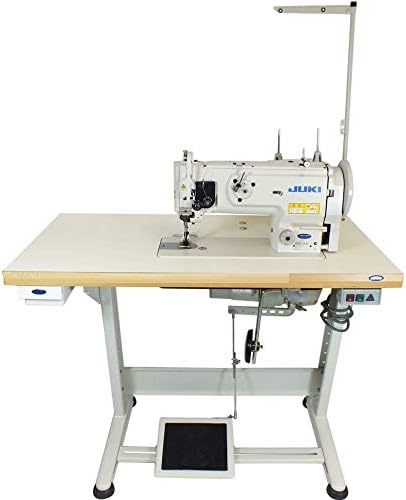
The JUKI DNU-1541S is a one-needle unison-feed industrial lockstitch machine with a double-capacity hook and built-in safety mechanism. The Amazon listing specifies speeds up to 2,500 stitches per minute, a maximum stitch length of 9 mm, and alternating vertical movement from 2.5 to 6.5 mm. The package also includes a 550-watt DC servo motor, sewing table, and lamp.
Check On AmazonIf you click this link and buy, we earn a commission at no additional cost to you.
Why needle feed does not automatically mean compound feed
Needle feed describes the needle’s participation in transport. Compound-feed language is commonly used when multiple feeding actions are combined, but the exact components still need to be confirmed from the machine’s documentation. A listing that says “needle feed” and nothing more does not prove that a driven walking foot is part of the system.
This is another place where first-time industrial-machine shoppers can get tripped up. A machine may have a substantial presser-foot assembly and still not use the same upper-feed arrangement as a machine explicitly documented with driven upper feeding. Treat the feed-system field and mechanism description as evidence, and treat visual resemblance as a clue at most.

The Consew P1206RB is an industrial lockstitch machine that combines drop feed, needle feed, and a walking foot. Its Amazon listing specifies a maximum speed of 3,000 stitches per minute, a maximum stitch length of 7 mm, and a 135 x 17 needle system. It also includes reverse stitching, a large horizontal-axis hook, adjustable upper thread tension, and an oil pump system with adjustable flow.
Check On AmazonIf you click this link and buy, we earn a commission at no additional cost to you.
Read needle-feed wording in an exact model specification
An exact specification is more useful than a marketplace title because it ties the feed label to a model identity. JUKI’s LH-3568A specification identifies the feed system as “Needle-feed.” That is a concrete evidence anchor: it proves how JUKI classifies the feed system on that model, but it does not prove that every machine advertised with similar wording has the same internal arrangement.
Verification should stop at what the source actually establishes. If a manufacturer’s page names the feed system but does not explain the motion, use the manual, parts documentation, or another manufacturer description for the mechanical detail. Do not fill the gap with an assumption based on a product photo or a seller’s use of the word “walking.”
- Match the exact model or model family before reading the feed-system field.
- Look for explicit wording such as needle feed, bottom feed, top and bottom feed, or unison feed.
- Check whether the manufacturer describes which components move during feeding.
- Separate the mechanism label from claims about material thickness, speed, layer control, or seam quality.
- If a manual and a sales listing use different wording, give priority to the exact manufacturer’s technical documentation and resolve the model identity before drawing a conclusion.
For example, a listing that says only “industrial walking machine” is not enough to establish needle feed. The useful evidence is a model-specific feed classification plus a mechanism description that identifies the driven components. That same checklist works in reverse when a machine looks ordinary but the official specification identifies needle feed.
What the label does not prove about thickness, speed, or layer control
At a high level, needle-feed architecture appears in industrial lockstitch work where relative movement between layers during feeding is an important design concern, including long seams and material stacks that can creep or feed unevenly. Coordinating needle motion with the lower feed gives the mechanism a reason to exist in those situations, but that is an explanation of the transport architecture, not a recommendation for a particular machine or material. The exact application still depends on the model and on the documented sewing conditions.
A feed-system label tells you about architecture, not total capability. It does not establish how thick a material stack the machine can sew, how well it will control a particular slippery combination, what stitch quality it will produce at a chosen speed, or whether it is suitable for a particular project. Those outcomes depend on the exact machine, material stack, needle and thread combination, pressure and feed settings, condition, and other documented limits.
This distinction prevents a technical description from turning into a buying promise. If one manufacturer says a particular needle-feed model is intended for a certain application, that claim belongs to that model and its stated conditions. It cannot be transferred automatically to another machine simply because both use the words “needle feed.”
Key point: Use the feed label to identify which components participate in transport. Use exact specifications, manuals, and documented test conditions to judge capability.
Suppose a sewist is comparing two machines because both listings mention reduced ply shift. The feed architecture can explain why the machines may control layers differently, but the label alone cannot quantify the result on that sewist’s fabric stack. That performance question needs model-specific evidence rather than a mechanism name.
When compound and walking-foot terminology needs a separate comparison
If the question changes from “Does the needle transport the work?” to “Which upper and lower components are driven together?” the terminology needs a broader comparison. That is where phrases such as walking foot, compound feed, triple feed, and unison feed can overlap or diverge depending on the manufacturer and machine family. Keeping those questions separate makes the needle-feed definition more precise instead of burying it under every industrial feed term.
For that broader terminology boundary, compare compound feed and walking feet using the exact driven components rather than the name alone. The practical handoff is simple: this article answers whether the needle itself helps transport the work; the comparison page handles what additional upper-feed motion changes the system description.
Keep machine selection and project fit separate from the mechanism
Understanding the motion does not answer whether someone should buy a needle-feed industrial machine. Selection requires a different set of evidence: the actual material and layer stack, seam type, workspace, required speed and control, needle and thread range, service access, parts support, budget, and the tasks the machine must perform. A mechanism explanation should not quietly turn those variables into a recommendation.
The same boundary applies to project fit. Knowing that the needle participates in transport can help explain why the architecture exists, but it cannot promise that a particular machine will handle leather, canvas, coated fabric, lightweight slippery cloth, or any other material to a desired standard. Verify those claims against the exact model documentation and realistic sewing conditions instead of treating “needle feed” as a material-capacity label.
Final Thoughts: record which component actually transports the material
The useful definition of a needle feed mechanism is mechanical and narrow: during material advance, the needle remains engaged with the work and shares the transport phase with the lower feed. That is the feature to look for in an exact specification or manufacturer description. Ordinary needle penetration is not enough, and the presence of a presser foot does not prove driven upper feed.
When terminology gets messy, write down three things: what moves from below, whether the penetrated needle moves with the work, and whether a powered upper element also advances the material. That short record separates bottom-only feed, needle feed, and broader multi-element systems without turning the mechanism label into a claim about performance, capacity, or purchase suitability.
FAQs
🪡 Does needle feed mean the needle pulls the fabric?
Not by itself. In a needle-feed mechanism, the penetrated needle participates in transport while lower feeding motion is coordinated with it, so it is better to think of the needle as one member of the feed action rather than the only force moving the work.
⚙️ What is the main difference between needle feed and drop feed?
In bottom-only drop feed, material advance comes from the lower feed while the needle is not the horizontal transport element. With needle feed, the penetrated needle travels with the material during the advancing portion of the cycle.
🦶 Is every needle-feed machine a walking-foot machine?
No. Needle feed establishes the needle’s transport role, while a driven upper or walking-foot action must be verified separately from the exact machine documentation.
📖 How can I verify that a machine really has needle feed?
Start with the exact manufacturer model page or manual and find the feed-system classification. If possible, confirm it with a mechanism description that identifies coordinated needle-bar and lower-feed motion rather than relying on a marketplace title or photograph.
🧵 Does needle feed guarantee that fabric layers will not shift?
No. The mechanism can change how the work is transported, but the actual result depends on the exact model, fabric and layer stack, needle and thread, settings, machine condition, and other sewing variables.
References and Sources
These technical sources are included because the article depends on exact manufacturer feed-system wording and a documented description of coordinated needle and lower-feed motion.
- JUKI LH-3568A specification: Verifies JUKI’s needle-feed classification for the exact model family used as the specification example.
- Highlead GC0518 mechanism description: Describes the needle bar and bottom feed mechanism moving in coordination on a needle-feed machine.
- JUKI PLC-2700V unison-feed specification: Verifies separate unison-feed wording and documents driven upper-feed components in that system.
Together, these sources establish the terminology boundary used here. They do not establish universal material capacity, seam quality, or performance for every machine carrying a similar feed label.