Compound feed vs walking foot is not a reliable comparison if you start with the seller label alone. In industrial and portable-machine listings, similar words can describe different combinations of lower feed, needle transport, driven upper feed, and alternating presser-foot motion. The practical way to identify the system is to verify which components move the work in the exact manufacturer documentation. That component audit also shows what the feed architecture can explain and what it cannot prove about material capacity, seam quality, or project fit.
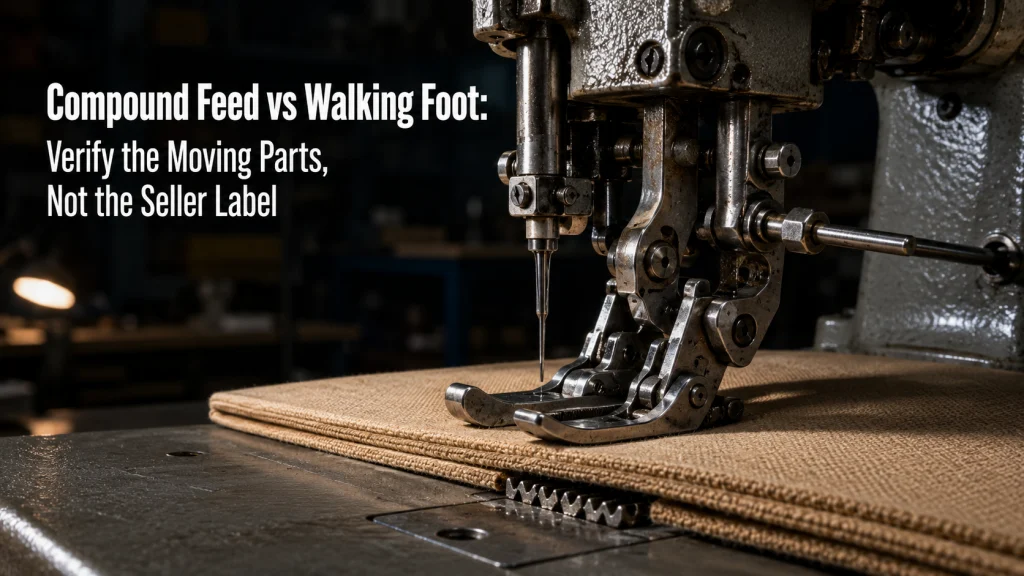
The Same Seller Word Can Hide Different Moving Parts
Search listings for an industrial machine and the vocabulary quickly gets messy. “Walking foot,” “compound walking foot,” “compound feed,” “triple feed,” “unison feed,” and “top and bottom feed” can appear close together even when the documented feed motions are not identical. That is why compound feed vs walking foot is better treated as a moving-parts audit than as a vocabulary contest.
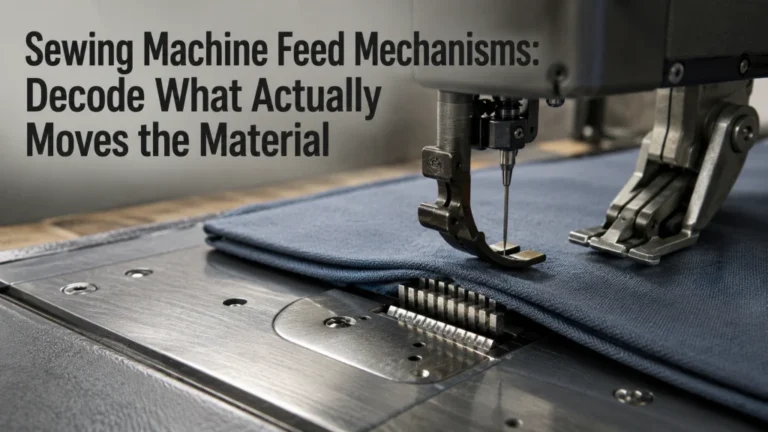
The decisive question is not which label sounds more capable. Ask what advances the material while the stitch is being formed: the lower feed dog, the penetrated needle, a driven upper foot, or some combination of them. Then ask whether a second presser-foot element alternates between holding and clearing the work. Once those motions are documented, the seller wording becomes easier to interpret and much harder to overread.
Define the Comparison as Industrial Feed Architecture
This comparison covers industrial and portable-machine feed systems in which an upper component is mechanically driven as part of material transport. It does not cover a domestic walking-foot attachment that rides on a household machine, nor does it cover integrated domestic dual-feed systems. Those use related language but belong to a different mechanism and ownership context.
The broader family of lower, needle, upper, and combined feed architectures is mapped in compare sewing machine feed mechanisms. For the machine-level explanation behind all of those systems, understand how sewing machines work provides the wider mechanical context without turning this terminology question into a buying guide.
Establish Four Components to Verify
A seller title can compress several mechanisms into one phrase, so start with four separate checks. The goal is not to decide whether one architecture is “better.” It is to record which parts contact and transport the work during the feed phase, then attach the correct label only as far as the exact documentation supports it.
The four-component audit below is deliberately mechanical. If one row cannot be verified from a manufacturer page, manual, parts diagram, or other exact documentation, leave it unknown rather than filling the gap from a product photo.
| Component | Audit question | What a yes answer establishes |
|---|---|---|
| Lower feed | Do the feed dogs or another lower feed element advance the work? | Material transport is occurring from below. |
| Needle transport | Does the needle remain in the work while the needle bar moves with the feed stroke? | The needle participates directly in transport. |
| Driven upper feed | Does an upper foot or upper feed element actively advance the work? | Material transport is also occurring from above. |
| Alternating holding foot | Does a second foot alternate between holding the work and clearing for the feeding element? | The presser-foot system has alternating roles during the cycle. |
Lower Feed
Lower feed identifies the transport contribution from beneath the material. On many lockstitch machines this is provided by a feed dog moving through a controlled feed cycle. Its presence does not tell you whether the needle or an upper foot also advances the work, so “has feed dogs” is only the first row of the audit.
Needle Transport
Needle transport exists when the needle participates in moving the work instead of only penetrating it for stitch formation. The useful evidence is documented needle movement during the feed phase, not the simple fact that every lockstitch machine has a needle bar. If this is the only upper-side transport contribution, the system belongs closer to needle feed than to a multi-component compound system.
Driven Upper Feed
A driven upper feed actively advances the material from above. Depending on the design, that role may be assigned to a walking foot, inner foot, roller, or another driven element. The term “walking foot” by itself still does not tell you whether the needle joins that transport motion.
Alternating Holding Foot
Some industrial presser-foot assemblies alternate roles as the machine cycles. One element can hold the work while another advances or clears it, then the roles change as the feed sequence continues. Alternation is important evidence about the upper mechanism, but it should not be confused with proof that the needle also transports the material.
Once these four rows are separated, the naming problem becomes much smaller. A listing that says “walking foot” can now be checked for needle participation, while a listing that says “compound” can be checked for the upper and lower motions it actually documents.
Map a Driven Walking-Foot System Without Needle Feed
Sailrite’s published terminology provides one documented example of “walking foot” that does not require needle transport. Its comparison describes the upper walking foot and lower feed dog gripping and advancing the work while the needle is out of the material. That is a top-and-bottom transport pattern, but the needle is not part of the feed stroke in that description.
A simplified motion sequence therefore looks like this: the needle clears the work, the driven upper foot and lower feed advance the material, and the needle returns to form the next stitch after the feed motion. The important distinction is timing. The upper foot is genuinely driven, yet the needle is not carrying the work during the advance phase.
| Phase | Driven upper feed | Lower feed | Needle |
|---|---|---|---|
| Release and prepare | Upper feeding element prepares to advance | Lower element enters its feed phase | Clears the material |
| Advance | Moves the work from above | Moves the work from below | Remains out of the transport role |
| Stitch | Returns to the next holding or feed position | Resets for the next cycle | Penetrates to form the next stitch |
This sequence is a source-labeled example, not a universal definition for every machine sold as a walking foot. If another manufacturer documents needle participation, the four-component audit changes and so should the terminology you use for that exact machine.

The Consew CP206RL is a portable single-needle walking foot machine with a horizontal oscillating hook and reverse stitching. Its listing includes a built-in 110V AC motor, a link-type thread take-up lever, and a longer arm. A foot pedal is included with the machine.
Check On AmazonIf you click this link and buy, we earn a commission at no additional cost to you.
Map a Compound or Triple-Feed System With Needle Participation
In Sailrite’s terminology, “compound walking foot” adds needle participation to the feed system. Its description has the needle moving with the inner presser foot while the outer presser foot alternates its holding role. JUKI provides a manufacturer-side example of the same broader idea on the TSC-441U, where the company states that a top-and-bottom feed mechanism is added to the machine’s needle-feed system and labels the result “Unison feed.”
The motion audit is therefore different from the walking-foot-only example. During the feed portion, lower feed, needle transport, and driven upper transport participate together, while the alternating foot system manages holding and clearance. Sailrite also uses “compound feed” and “triple feed” around this architecture, but those names should remain attributed to that source rather than treated as a vocabulary rule for every manufacturer.
| Phase | Needle | Driven upper feed | Lower feed | Holding-foot role |
|---|---|---|---|---|
| Engage | Enters the material | Engages the work | Moves into the feed stroke | Transitions as the feeding elements take control |
| Advance | Moves with the material | Advances from above | Advances from below | Alternates to avoid blocking the feed motion |
| Reset | Clears before the next cycle | Returns for the next engagement | Resets below | Resumes the holding role as documented by the design |
The key evidence is not that three words appear in a listing. It is that the exact documentation shows multiple transport components participating in the same feed architecture.

The Consew 206RB-5 is an industrial walking foot machine with a compound triple-feed system. Its listing specifies a maximum stitch length of 10 mm, a 14 mm high foot lift, a large bobbin, and adjustable walking motion. The package includes the sewing machine head, table, stand, servo motor, and required mounting hardware.
Check On AmazonIf you click this link and buy, we earn a commission at no additional cost to you.
Explain Unison Feed Only Through Exact Manufacturer Documentation
“Unison feed” is a good example of why manufacturer attribution matters. JUKI’s TSC-441U page places Bottom feed, Needle feed, Top & bottom feed, and Unison feed side by side as four distinct feed-system entries. The same page explains its Unison model by saying that top-and-bottom feed is added to a needle-feed system, which gives a direct component-level basis for that label on that model family.
PFAFF also labels the 1245 as a Unison-feed machine, and its product page separately mentions a top-feed lift and unison feed. That page does not, by itself, spell out every row of the four-component audit in the same way JUKI’s comparison does. So the correct research move is to preserve PFAFF’s label, then use the exact manual or parts documentation if you need to prove the complete motion sequence rather than borrowing JUKI’s definition.
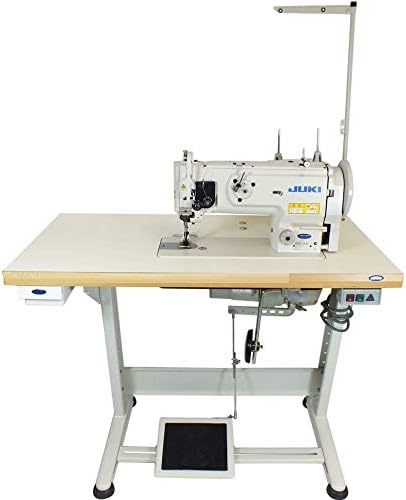
The JUKI DNU-1541S is a one-needle unison-feed lockstitch machine with a double-capacity hook and a built-in safety mechanism. Its listing specifies a maximum speed of 2,500 stitches per minute, a 9 mm maximum stitch length, and 2.5 to 6.5 mm alternating vertical movement. The package includes a sewing table, 550-watt DC servo motor, LED lamp, knee lifter, thread stand, and bobbin winder.
Check On AmazonIf you click this link and buy, we earn a commission at no additional cost to you.
Top and Bottom Feed Is Not Enough Information
“Top and bottom feed” confirms that the work is driven from both sides, but it does not automatically establish needle transport. JUKI’s own TSC-441U family page makes this distinction unusually clear because TSU-471U is labeled Top & bottom feed while TSC-441U is labeled Unison feed, with the latter adding the top-and-bottom mechanism to needle feed.
That single comparison is a strong reason not to equate every driven upper feed with compound feed. Two machines can both move material from above and below while differing in whether the needle joins the transport stroke. If the specification never addresses the needle’s motion, keep that row of the audit unresolved.
The wording is easy to overread because “top and bottom” sounds comprehensive: a buyer may reasonably assume that every major feeding element is already accounted for. Mechanically, though, the phrase only tells you where transport force is coming from above and below. It does not answer the separate question of whether the needle stays engaged with the work during the feed phase. Treat needle transport as its own audit row, and leave it unknown until the exact documentation confirms it.

The JUKI DU-1181N is a single-needle straight-stitch industrial machine with top and bottom feeding. Its listing specifies a maximum sewing speed of 2,000 stitches per minute, a maximum stitch length of 9 mm, and a DB X 1 needle. The complete unit includes the machine head, table, stand, motor, sewing light, and drawer.
Check On AmazonIf you click this link and buy, we earn a commission at no additional cost to you.
Separate Needle-Feed-Only Machines
A needle-feed machine can use the needle as a transport element without adding a driven upper walking foot. JUKI’s same four-method comparison includes a separate TSN-421U Needle-feed entry, which helps keep this architecture distinct from its Unison-feed model. That is exactly why “needle feed” should not be used as an automatic synonym for a complete compound system.
For the phase-by-phase explanation of that narrower architecture, see how needle feed transports material. Keeping that mechanism separate prevents this comparison from collapsing every machine with needle participation into one industrial feed label.
Read the Exact Specification, Manual, and Parts Documentation Before Accepting a Label
Start with the exact model number, not the family nickname used in a marketplace listing. A manufacturer product page can establish the official feed-system label and may describe the participating components, but some pages stop at a marketing or application summary. When the motion is still ambiguous, move to the model manual and parts documentation rather than filling the gap from a photograph.
A parts diagram is especially useful for confirming whether the machine has separate inner and outer presser-foot elements, a driven upper-feed linkage, and the components associated with needle-feed motion. It still should not be used to invent timing relationships that the documentation does not state. The goal is verification of architecture, not reverse engineering or adjustment.
- Record the exact manufacturer and model number.
- Write down the feed-system label exactly as the manufacturer uses it.
- Verify whether lower feed advances the work.
- Verify whether the needle remains in the material during transport.
- Verify whether an upper foot or other upper element is mechanically driven.
- Check whether separate presser-foot elements alternate holding and feeding roles.
- Use the manual or parts documentation when the product page leaves any row unclear.
- Leave an unknown component unknown rather than deciding from a seller title or photo.
This checklist also creates a clean research record. If a later listing calls the same model “walking foot” while the manufacturer calls it “unison feed,” you can compare the words against documented motion instead of choosing whichever label appears more often.
Use a Source-Labeled Terminology Register
The safest terminology table records who used the term and what that source actually documented. It should not pretend that one company’s naming system governs the entire industrial sewing market. The examples below are useful precisely because their labels overlap imperfectly.
Notice that the register separates words from motion. That makes it possible to use a manufacturer’s term accurately without turning it into a universal definition.
| Source | Term used | Documented motion or feature | Do not infer |
|---|---|---|---|
| JUKI TSC-441U family | Unison feed | Top-and-bottom feed added to a needle-feed system | That every manufacturer defines unison feed identically |
| JUKI TSU-471U | Top & bottom feed | Upper feed and lower feed are present | Needle transport merely from the label |
| PFAFF 1245 | Unison feed | Official page labels the machine Unison feed and specifies top-feed lift | The complete four-component motion sequence from that page alone |
| Sailrite comparison | Walking foot | Driven upper foot and lower feed advance while the needle is out of the work | That all machines sold as walking foot use this exact sequence |
| Sailrite comparison | Compound walking foot, compound feed, triple feed | Needle and inner foot participate in transport with alternating outer-foot action | That these three labels are universal synonyms across brands |
This is the practical answer to the naming collision. Keep the source attached to the term until the exact machine documentation proves the moving parts.
Feed Architecture Does Not Prove Material Capacity or Seam Quality
A compound or unison architecture tells you something important about how the machine transports work, but it does not establish the maximum material stack, needle and thread range, motor capability, presser-foot clearance, hook capacity, stitch quality, or durability for an unspecified model. Those are separate claims that need model-specific specifications or documented testing conditions.
Official product pages often associate these feed systems with upholstery, leather goods, bags, seat belts, and other demanding industrial work. Treat those as applications for the named models, not as proof that every machine carrying a similar feed label can handle every material in those categories. Architecture is one part of capability, not a substitute for the rest of the specification.
Keep Domestic Walking-Foot and Dual-Feed Terminology Separate
A household walking-foot attachment can use a moving upper component, but its mechanism, mounting interface, and relationship to the machine’s built-in feed are not the same research question as an industrial feed architecture. Integrated domestic dual feed adds another layer of terminology that can look similar in marketing language while using a different mechanical arrangement.
For that distinction, compare walking foot and dual feed in the domestic context. Keeping the terms separated by machine system prevents a useful industrial comparison from turning into accessory compatibility advice.
Keep Model and Project Decisions Outside the Terminology Audit
Once you know the feed architecture, you still have not answered whether a particular machine fits a particular project. Bed shape, hook size, needle system, available feet, stitch length, clearance, speed control, service access, parts availability, and the actual material stack can all change the decision. Those belong to model and project research rather than to this mechanism comparison.
The same limit applies in the other direction. A machine should not be rejected merely because a seller used a less fashionable feed term if the exact documentation shows the transport architecture you need. Name the moving parts first, then make any later machine decision from the complete specification rather than the label.
Final Thoughts: Name the Moving Parts Before Naming the System
“Walking foot” and “compound feed” are useful terms only when they are attached to documented motion. Verify lower feed, needle transport, driven upper feed, and alternating holding-foot action, then preserve the manufacturer’s own label for the exact machine. That approach handles walking foot, compound walking foot, triple feed, unison feed, and top-and-bottom feed without pretending the industry uses one universal vocabulary.
The practical stopping point is simple: if the seller label and the manufacturer documentation do not line up, trust the documented components and keep unresolved motion unresolved. Feed architecture can then inform later research without becoming a shortcut for material-capacity claims or a model recommendation.
FAQs
⚙️ Is compound feed the same as a walking foot?
Not universally. Some sources use walking-foot language for driven upper feed without needle transport, while compound systems can add needle participation and alternating foot action. Verify the exact machine’s moving parts before treating the terms as synonyms.
🪡 What makes a feed system triple feed?
The term is commonly used by some sellers and suppliers for systems combining lower feed, needle transport, and driven upper feed. Because naming varies, confirm those three transport contributions in the exact documentation rather than relying on the phrase alone.
🦶 Does a walking foot always mean the needle moves with the fabric?
No. A driven walking-foot system can move material from above while the lower feed moves it from below and the needle remains out of the transport phase. Needle participation must be verified separately.
🔍 How can I tell whether a machine has compound feed?
Check the exact manufacturer specification, manual, and parts documentation for lower feed, needle transport, driven upper feed, and alternating presser-foot motion. Do not decide from a listing title or photograph alone.
📖 Does unison feed always mean the same thing?
Do not assume so across manufacturers. JUKI documents one Unison-feed architecture as top-and-bottom feed added to needle feed, while another manufacturer’s use of the term should be verified from its own documentation.
🧵 Does compound feed guarantee better stitching on thick material?
No. Feed architecture affects transport, but material capacity and seam results also depend on the exact machine, needle and thread range, foot clearance, material stack, settings, and other specifications.
References and Sources
- JUKI four feed-system comparison: Separates bottom feed, needle feed, top-and-bottom feed, and unison feed and explains the added feed components on the Unison model.
- PFAFF 1245 product page: Confirms PFAFF’s official Unison-feed label and top-feed information for this model without defining a universal industry standard.
- Sailrite feeding-mechanism comparison: Provides source-specific definitions for walking foot and compound walking foot, including whether the needle participates in transport.