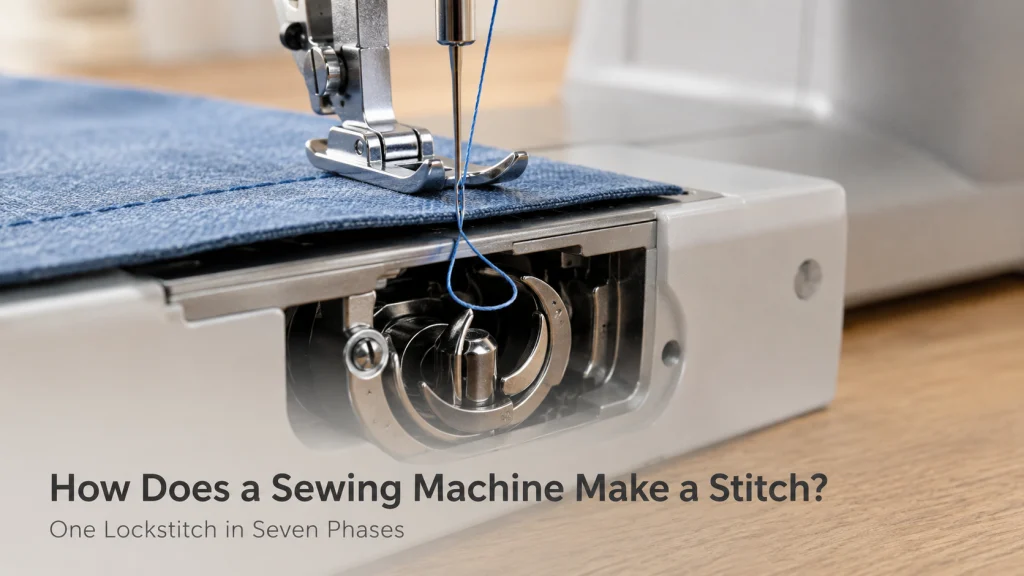
A domestic lockstitch is formed by a timed sequence, not by the needle simply grabbing bobbin thread. The needle carries upper thread through the material, a loop forms as the needle begins to rise, the hook or shuttle enters that loop, and the upper thread passes around the lower-thread assembly before take-up removes slack and the feed system advances the material. The exact hook path can differ between rotary and oscillating systems, but the jobs remain recognizable. By following one stitch phase by phase, you can separate loop capture, lower-thread supply, stitch seating, and fabric feed without turning a mechanism explanation into a repair procedure.
Pause the machine at the bottom of the needle stroke
Freeze the cycle with the needle near its lowest point and the material still held in place. The important question is not simply how a sewing machine makes a stitch, but which component must move next, which thread it handles, and which events must wait. At this instant the needle has already carried the upper thread through the material, yet the stitch is not complete and the fabric should not already be advancing to the next stitch position.
This narrow view is useful because a whole-machine explanation can make several motions look simultaneous even though their order matters. The broader sewing machine mechanism overview connects the needle, hook, take-up, tension, feed, and drive systems, while this article stays with one repeatable two-thread lockstitch from penetration to the next feed movement.
Define the two-thread lockstitch and the machines covered
A lockstitch uses an upper thread carried by the needle and a lower thread supplied from a bobbin or shuttle assembly. Those two threads interlace within the material as the machine completes its cycle. The Smithsonian’s records of early lockstitch mechanisms show the same basic principle in different architectures: a needle-thread loop is engaged by a lower stitch-forming mechanism so the second thread can become part of the interlacing.
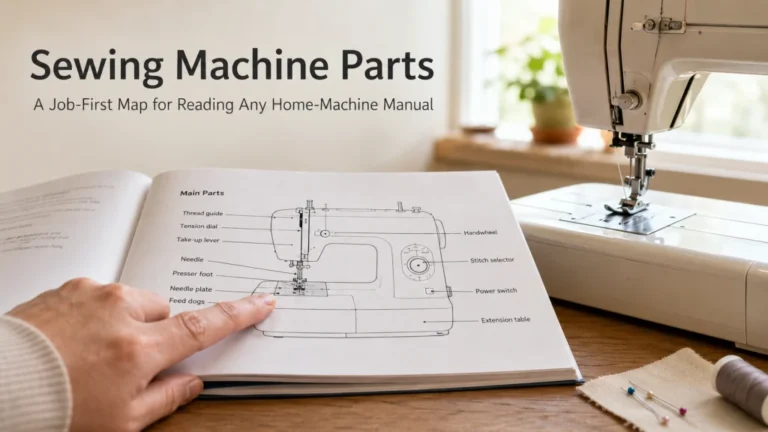
The scope here is a standard domestic-style two-thread lockstitch and the bounded differences between rotary and oscillating hook paths. It does not cover chainstitch, overlock, coverstitch, embroidery formation, threading instructions, tension adjustment, skipped-stitch diagnosis, or internal timing correction. For a wider component map, the main sewing machine parts article explains where these assemblies sit and what each one does.
Name the five participating jobs before anything moves
It helps to separate the mechanism into jobs rather than treating the bobbin area as one mystery box. The needle carries upper thread through the material. The hook or shuttle captures the upper-thread loop, the lower-thread assembly supplies the second thread, the take-up system removes the extra upper-thread slack, and the feed system repositions the material only after the stitch-forming event is far enough along.
These jobs overlap in time, but they are not interchangeable. A bobbin can supply lower thread without being the part that enters the needle-thread loop, and the feed dogs can move material without creating the interlacing themselves. That distinction is the foundation of accurate sewing machine stitch formation language.
| Part or system | Main job in one lockstitch | What it does not do |
|---|---|---|
| Needle | Carries upper thread through the material | Does not directly fetch the bobbin thread |
| Hook or shuttle | Enters or carries through the upper-thread loop | Is not the lower-thread supply itself |
| Bobbin or lower-thread assembly | Supplies the lower thread for interlacing | Does not replace the hook’s capture job |
| Take-up system | Removes upper-thread slack and helps seat the stitch | Does not move the fabric to the next stitch |
| Feed system | Advances the material for the next penetration | Does not form the thread loop |
When you keep those jobs separate, the seven phases become much easier to follow. The rest of the cycle is mainly a question of when each job becomes active and what must remain stationary while it happens.
Phase 1: the needle carries upper thread through the material
The cycle begins with the needle descending through the material while carrying upper thread through its eye. The presser system keeps the material controlled around the needle area, and the needle continues toward the bottom of its stroke. At this point the lower thread has not been pulled up by the needle, and no hook capture has happened yet.
A first-time owner can easily imagine that the needle must somehow touch or pick up the bobbin thread below the needle plate. That is not how the two-thread lockstitch is formed. The needle’s immediate job is to place upper thread below the material so a loop can become available to the hook or shuttle during the next part of the cycle.

This 20-count SINGER set includes regular-point machine needles in sizes 80/12, 90/14, and 100/16. The assortment is made for domestic sewing machines and gives you multiple sizes for different woven-fabric weights. It is a practical match for stitch formation because the needle is the part that carries the upper thread through the material.
Check On AmazonIf you click this link and buy, we earn a commission at no additional cost to you.
Phase 2: initial needle rise creates the upper-thread loop
After reaching the lower part of its stroke, the needle begins to rise. Friction between the material, needle, and thread means the thread does not instantly retreat in exactly the same path as the needle. That small difference allows a loop of upper thread to form on the side presented to the stitch-forming mechanism.
Sailrite’s mechanism explainer describes this loop forming as the needle starts upward, with the needle geometry and thread friction helping establish the loop that the hook can enter. The key sequence point is simple: loop creation follows penetration and initial rise. The machine still has not advanced the material to the next stitch position.
Phase 3: the hook or shuttle enters the upper-thread loop
Once the loop has formed, the hook point or shuttle path reaches it at the synchronized moment designed into the machine. The stitch-forming part engages the upper-thread loop and begins carrying or opening that loop around the lower-thread assembly. This is the capture event people often describe imprecisely as the bobbin grabbing the needle thread.
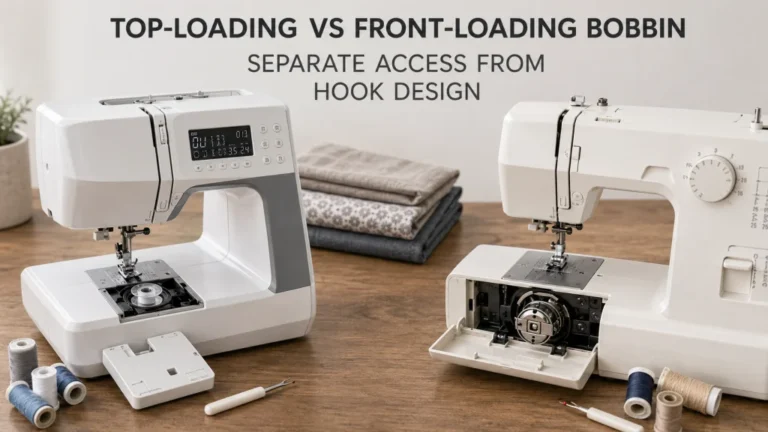
The distinction matters because the hook and bobbin have different mechanical jobs. The hook or shuttle interacts with the loop; the bobbin provides lower thread. If you want the lower assembly described separately, how the sewing machine bobbin works follows the bobbin, case, and lower-thread supply without turning them into the loop-catching part.
Phase 4: upper thread travels around the lower-thread assembly
After capture, the upper-thread loop must travel far enough around the lower-thread assembly for the two-thread interlacing to become possible. In a rotary-hook arrangement, the hook carries the loop along a circular path around a stationary or contained bobbin-case area. In shuttle-based or oscillating layouts, the geometry and direction of travel differ, but the upper loop still has to pass in relation to the lower-thread source.
A still image cannot show this phase well because the decisive information is the loop path. The captured upper thread must clear the lower-thread assembly in the way that the machine’s mechanism allows, setting up the release and take-up phase that follows. The exact geometry varies with the hook or shuttle architecture, so diagrams should be read as mechanism-specific rather than universal.
Phase 5: the hook releases and take-up removes slack
As the loop completes its required path, the hook or shuttle releases the upper thread. The upper thread now contains more slack than the finished stitch needs, so the take-up mechanism begins drawing that excess thread back through the upper path. The resulting pull helps bring the interlacing toward its seated position within the material.
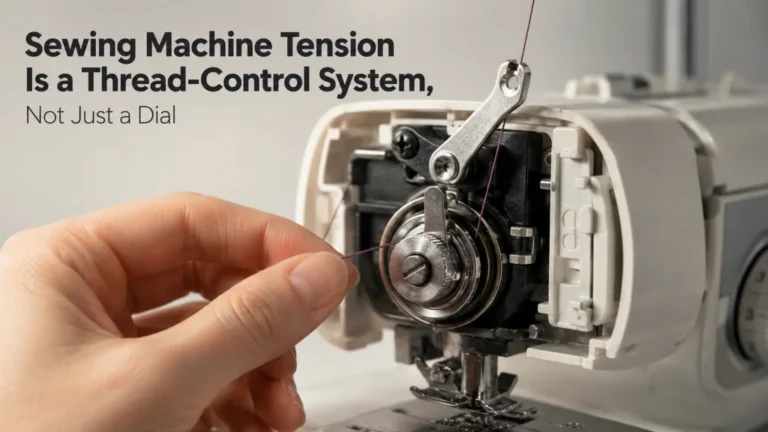
This is the point where the sewing machine thread tension system becomes relevant, but only as controlled resistance and thread management. This article does not prescribe a tension setting. The cycle only needs us to recognize that take-up and controlled thread resistance help remove slack after loop passage.
Phase 6: the interlacing seats inside the material
With the upper loop released and slack being removed, the upper and lower threads settle into their lockstitch relationship. On a normally formed stitch, the visible result is not produced by tying a conventional knot at the surface. It is an interlacing of the two thread systems, with its exact seated position affected by the machine setup, material, thread, and stitch conditions.
The useful mechanism point is that seating comes after loop capture and loop passage. Calling every interlacing a knot hides the actual order and makes it harder to understand which part acted when. At this phase the material still has one more job waiting: it must be moved to establish the next stitch length.

This Gütermann Sew-All set includes 20 spools of 100 m thread in assorted colors. Sew-All is a 100% polyester universal thread designed for machine and hand sewing across a wide range of fabrics and seam types. It fits naturally here because both the upper and lower thread systems must interlace to form a lockstitch.
Check On AmazonIf you click this link and buy, we earn a commission at no additional cost to you.
Phase 7: feed advances the material for the next penetration
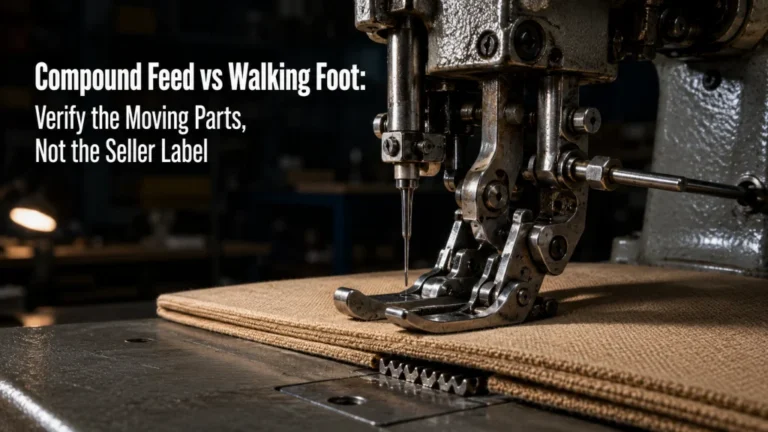
Once the stitch-forming sequence has progressed far enough, the feed system advances the material by the amount set for the next stitch. On many domestic machines, feed dogs rise into contact with the underside of the material, move it, drop away, and return as the cycle repeats. The exact feed motion varies with machine design, but its role is different from loop capture.
This separation explains why fabric movement cannot simply occur whenever the motor is turning. The needle, hook, take-up, presser system, and feed motion must remain synchronized so material movement does not conflict with the stitch-forming phase. The sewing machine feed dog mechanism article follows that material-advance job in more detail.
Track what has not happened yet at each phase
A phase ledger makes the lockstitch mechanism easier to read because it records both the active motion and the event still waiting. That second column prevents several common shortcuts, such as saying the bobbin catches the upper thread or assuming the fabric is already feeding as soon as the needle begins to rise.
| Phase | Motion | Thread handled | Still pending |
|---|---|---|---|
| 1 | Needle descends through material | Upper thread | Loop formation and capture |
| 2 | Needle begins to rise and a loop forms | Upper thread | Hook or shuttle entry |
| 3 | Hook or shuttle engages the loop | Upper thread loop | Loop passage around lower-thread assembly |
| 4 | Loop travels around lower-thread assembly | Upper thread in relation to lower thread | Release and slack removal |
| 5 | Hook releases and take-up draws thread | Upper thread | Final seating |
| 6 | Interlacing seats in the material | Upper and lower threads | Material advance |
| 7 | Feed repositions material | No thread is captured by feed | Next needle penetration |
Read the rows as a sequence rather than as seven isolated definitions. One completed stitch becomes the setup for the next because the feed phase places fresh material under the needle, then the needle descends and the same jobs repeat.
Separate moving parts from seated parts during the cycle
Not every component moves through the same distance or in the same direction. The needle bar moves vertically, the hook or shuttle follows its designed capture path, the take-up lever changes the available upper-thread length, and the feed system cycles through its material-advance motion. Other pieces may stay seated while thread passes around or through them.
| Component or system | What moves or stays seated | What to track in the cycle |
|---|---|---|
| Needle and needle bar | Move down, reach the lower part of the stroke, then reverse upward | The direction change that allows the upper-thread loop to form |
| Hook or shuttle | Moves through its designed rotary, oscillating, or shuttle path | The moment it enters and carries the upper-thread loop |
| Bobbin and case area | May remain seated or move according to the documented mechanism | Lower-thread supply and the path the upper loop must clear |
| Take-up system | Changes position to release and then recover upper-thread slack | Slack removal after loop passage |
| Feed system | Cycles through rise, advance, return, or an equivalent documented feed motion | Material movement after stitch formation has progressed far enough |
When comparing a diagram or animation with this map, keep three checks separate:
- Follow the needle’s change of direction instead of treating its whole stroke as one event.
- Track loop handling separately from lower-thread supply and from fabric feed.
- Use the exact machine documentation when covers, case style, or hook orientation change what is externally visible.
This map is especially useful when a transparent animation makes the whole mechanism look like a single rotating system. The machine is coordinated, but the jobs remain distinct, and that distinction is what lets you read mechanism descriptions without assigning one part another part’s function.
Rotary and oscillating systems change the path, not the basic job sequence
A rotary hook travels continuously around its axis, while an oscillating or half-rotary arrangement reverses direction through a bounded arc. Historical Smithsonian records also document the earlier reciprocating-shuttle route and the later rotary-hook approach, showing that lockstitch formation has been implemented with more than one lower mechanism architecture. The path can change substantially without changing the need to coordinate needle-loop formation with lower-thread interlacing.
That architectural difference should not be turned into a quality ranking by itself. Hook type alone does not prove stitch quality, durability, material capacity, or suitability for a particular project. For a focused comparison of motion architecture, see rotary and oscillating hook differences.
Why the bobbin does not perform the hook’s job
The bobbin is a thread supply component. Depending on the machine, it may sit in a removable bobbin case, a drop-in arrangement, or another documented lower-thread assembly, but its core role in this cycle is to provide the second thread. The component that has to meet the upper-thread loop is the hook, shuttle, or equivalent stitch-forming part defined by that machine’s architecture.
Lower-thread terminology: Bobbin, bobbin case, hook, shuttle, and shuttle race are not interchangeable names. A manual may group some of them in a lower-thread area, but visual proximity does not make them the same component or give them the same mechanical job.
This vocabulary matters whenever you compare diagrams. If one source says a hook enters the loop and another describes a shuttle carrying lower thread through it, first identify the mechanism family. Do not flatten both descriptions into the inaccurate statement that the bobbin catches the needle thread.
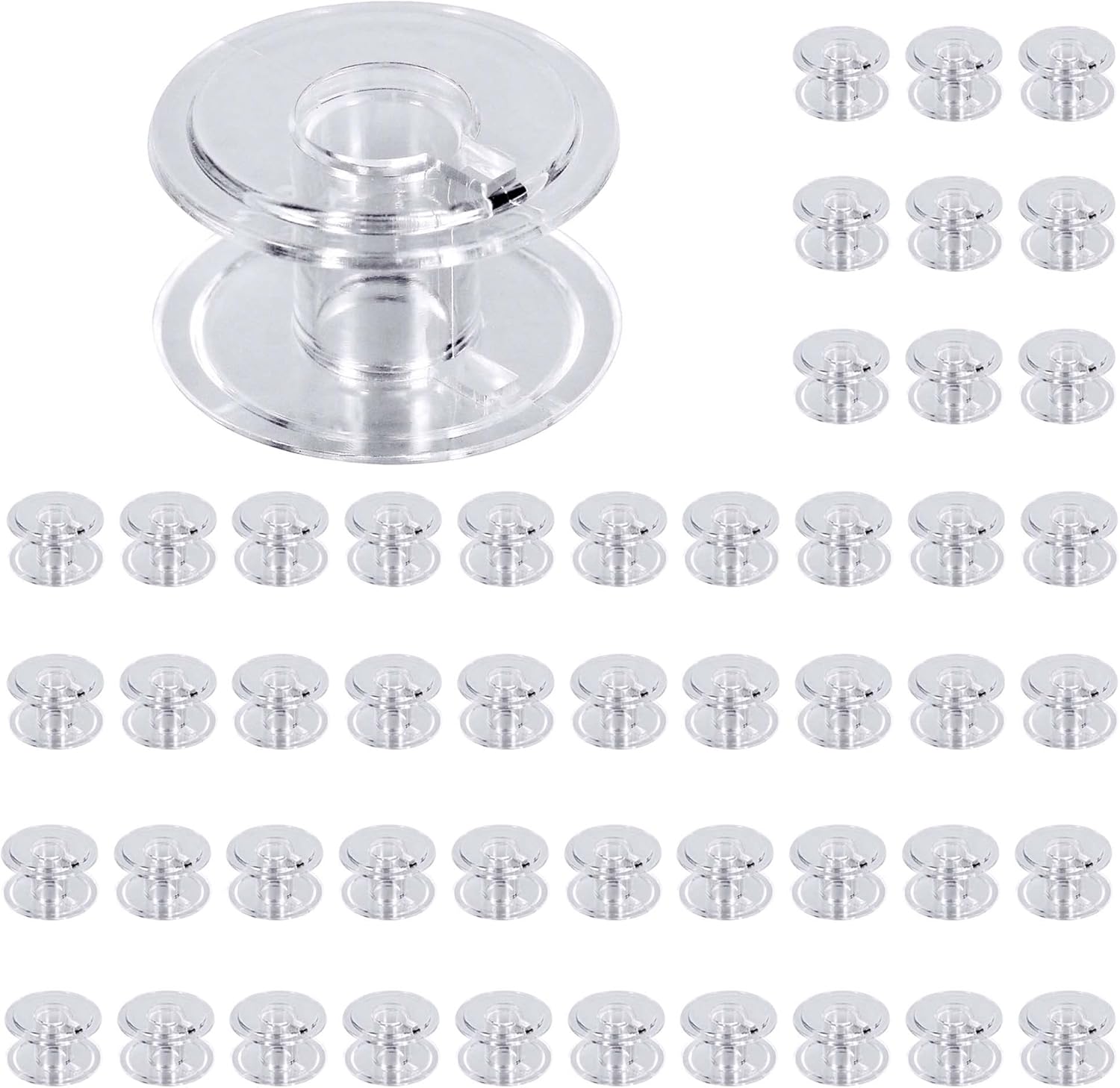
This SINGER set contains 50 transparent plastic Class 15 bobbins for compatible domestic sewing machines. The clear bobbins make the remaining thread easy to see and serve as lower-thread carriers in machines that use this bobbin class. They fit this section because the product directly represents the lower-thread supply component being explained.
Check On AmazonIf you click this link and buy, we earn a commission at no additional cost to you.
Timing means synchronization, not an invitation to adjust the machine
In this mechanism context, timing means the relative positions of moving parts at specific moments in the cycle. The needle must present a usable loop when the hook or shuttle reaches it, take-up must remove slack after the loop has traveled around the lower-thread assembly, and feed movement must occur in coordination with needle and presser action. That is enough to understand why phase order matters.
Safety and service boundary: Do not use this explanation as an internal timing-adjustment procedure. Follow the exact machine manual for owner-level observation and maintenance, keep powered observation within the manufacturer’s instructions, and use qualified service for a hard mechanical lock, repeated hard needle strikes, damaged wiring, overheating, smoke, sparks, or work the manual reserves for service personnel.
Understanding synchronization can help you read a diagram or a mechanism claim, but it does not tell you which screw, shaft, gear, or clearance should be changed on a specific machine. That belongs to model-specific service information, not to a general stitch-formation explanation.
Use the cycle to read mechanism claims, not diagnose a fault
The seven phases give you a way to test whether an explanation is mechanically coherent. If a diagram says the bobbin rises to grab the upper thread on a machine whose documented lower system uses a stationary bobbin and rotary hook, the terminology is suspect. If an animation shows the fabric advancing while the needle is still deeply engaged in a fixed-needle domestic setup, it may be simplifying or misrepresenting the feed phase.
What the cycle does not do is identify the cause of a skipped stitch, jam, feed problem, or thread break from symptoms alone. Those problems can depend on the exact machine, needle, thread, material, presser setup, threading, feed state, damage, maintenance history, and service condition. Use this mechanism sequence as a reference for what should happen, not as permission to jump from one symptom to an internal repair conclusion.
Final Thoughts: follow needle, loop, hook, take-up, then feed
A domestic lockstitch becomes much easier to understand when the cycle is read in order. The needle carries upper thread through the material, initial rise creates a loop, the hook or shuttle enters that loop, the upper thread travels around the lower-thread assembly, take-up removes slack, the interlacing seats, and feed advances the material for the next penetration.
The most useful boundary is also the simplest: the bobbin supplies lower thread, but it is not automatically the component that captures the needle-thread loop. Keep the five jobs separate, verify architecture against the exact machine documentation, and treat timing as synchronization unless the manufacturer specifically provides an owner-level procedure for something more.
Frequently Asked Questions
These questions focus on the phase order and terminology that commonly become blurred when people first study a lockstitch mechanism. They do not replace model-specific threading, troubleshooting, maintenance, or service instructions.
🧵 How does a sewing machine stitch two threads together?
The needle carries upper thread through the material, then a hook or shuttle engages the loop that forms as the needle starts to rise. The upper loop passes in relation to the lower-thread assembly, after which take-up removes slack and the two threads seat as a lockstitch.
🪡 Does the needle grab the bobbin thread?
Not in the standard mechanism described here. The needle creates and presents an upper-thread loop; the hook or shuttle handles that loop, while the bobbin supplies lower thread.
⚙️ When does the hook catch the thread loop?
The capture occurs after the needle has reached the lower part of its stroke and begun to rise enough for an upper-thread loop to form. The exact relative positions depend on the machine’s documented mechanism.
🧶 Is a lockstitch the same as tying a knot?
No. A lockstitch is better described as an interlacing of upper and lower thread systems within the material. Calling every interlacing a knot can hide how the mechanism actually forms the stitch.
🔄 Does a rotary hook make a different type of lockstitch?
Not simply because it rotates. Rotary and oscillating systems can use different paths to perform the loop-handling job while still producing the same general two-thread lockstitch class.
📏 When does the fabric move to make the next stitch?
The feed phase occurs after the stitch-forming sequence has progressed far enough for the material to be repositioned safely. The exact feed path and stitch-length control depend on the machine design.
If a real machine is behaving abnormally, move from this general sequence to the exact manual and symptom-specific troubleshooting path. A correct mechanism description tells you the intended order, not the cause of every failure.
References and Sources
The mechanism sequence above is grounded in technical descriptions of needle-loop creation, hook or shuttle interaction, lockstitch architecture, and rotary-hook construction. Historical records are used to establish the mechanism distinction, not to imply that an early machine represents every current domestic design.
- Sailrite sewing machine mechanism explainer: supports the sequence in which initial needle rise creates an upper-thread loop that is then engaged by the hook or shuttle.
- Smithsonian Allen Wilson sewing machine record: documents reciprocating-shuttle and rotary-hook approaches to forming a lockstitch with needle and lower thread.
- US2246010A lockstitch sewing machine patent: provides a primary technical record of a rotary-hook component cooperating with a needle in lockstitch formation.
These sources establish the mechanical framework used here. Exact owner procedures, service limits, and externally visible parts should still be checked against the documentation for the specific machine in front of you.