The bobbin is the lower-thread supply in a common domestic lockstitch system, but it is not the part that performs every action below the needle plate. Loop capture belongs to the hook or shuttle, while the case or holder and its thread-control path manage how the lower thread leaves the bobbin. The exact arrangement depends on the machine: Janome, for example, documents the Sewist 740DC as a top-loading full rotary hook model and the Toile Romance as a front-loading vertical oscillating hook model. Once those jobs are separated, it becomes much easier to read a manual or specification without confusing the bobbin, case, holder, hook, shuttle, and race.
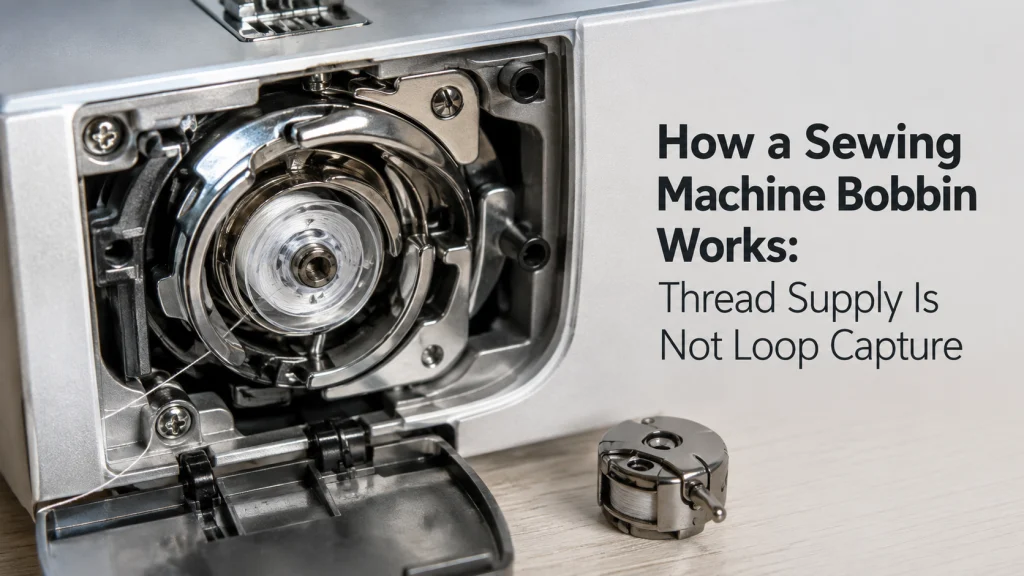
The bobbin supplies the lower thread, but it does not catch the upper thread
Understanding how a sewing machine bobbin works starts by correcting one common shortcut: the bobbin does not reach out and catch the upper thread. The bobbin is a small thread supply positioned in the lower part of a lockstitch machine. During stitch formation, other components guide the upper-thread loop around or past the lower-thread system so the two threads can interlock. If you are asking what a bobbin is on a sewing machine, its core mechanical job is therefore much narrower than the job of the whole assembly around it.
That distinction matters because several parts sit close together and can look like one mechanism when viewed through a bobbin cover or front access door. A beginner may see the bobbin, a surrounding case, and a moving metal hook within the same opening and reasonably call all of it “the bobbin.” For a broader map of those components, sewing machine parts and their jobs separates the major mechanisms before you trace what each one does. Here, the focus stays on the lower-thread assembly itself.
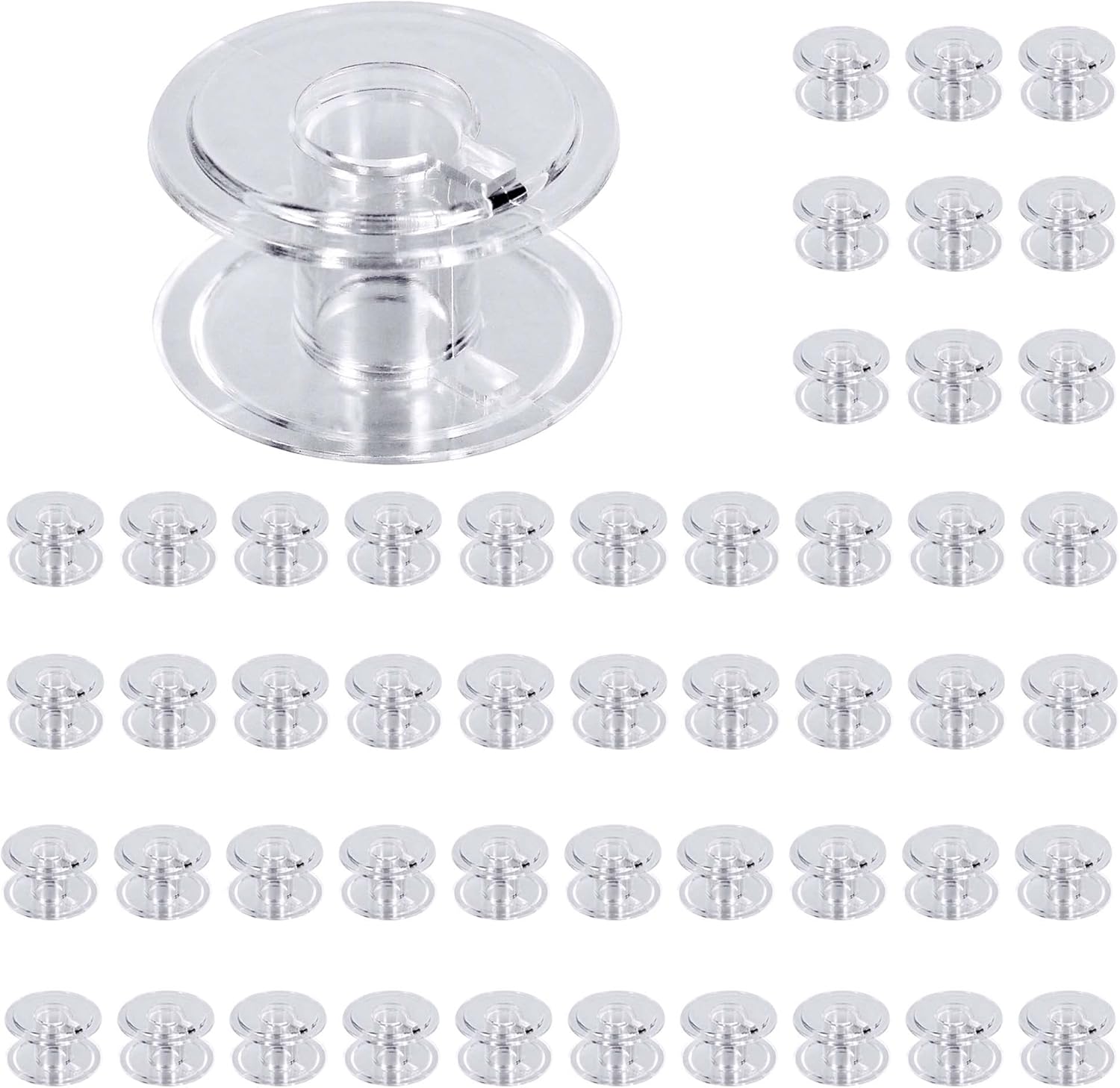
This set includes 50 transparent plastic Class 15 bobbins for compatible sewing machines. The bobbins hold the lower thread and their clear construction makes the remaining thread easy to see. Always confirm that your machine specifically uses this bobbin class and style before replacing the original bobbin.
Check On AmazonIf you click this link and buy, we earn a commission at no additional cost to you.
Name the surrounding lower-thread parts before describing motion
The sewing machine bobbin mechanism often gets described as if several separate jobs belonged to one part. A useful way to read the area below the needle plate is to identify five things: the bobbin, the case or holder, the lower-thread control path, the hook or shuttle, and the race or track that supports the moving relationship. Manufacturers do not always use identical terminology, so the exact manual for the machine has priority over a generic diagram.
The job map below is intentionally functional rather than universal. It tells you what question to ask about each component without claiming that every domestic machine packages or moves those parts in the same way.
| Part | Primary job in the lower-thread system | What not to assume |
|---|---|---|
| Bobbin | Stores and supplies the lower thread | That the bobbin itself captures the upper-thread loop |
| Case or holder | Seats and supports the bobbin according to the machine design | That “case” and “holder” name the same part on every model |
| Tension spring or thread-control path | Applies controlled resistance as lower thread leaves the bobbin | That this article is an instruction to change a tension screw |
| Hook or shuttle | Engages the upper-thread loop as part of lockstitch formation | That every hook follows the same motion path |
| Race | Provides the designed running path or supporting relationship for the hook assembly | That it should be removed or disassembled for explanation |
This vocabulary prevents a simple naming error from turning into a mechanical misunderstanding. Comparing a bobbin case with the bobbin is not merely about two names for the same object: one stores the thread, while the surrounding part manages how that thread supply is seated and presented within the machine. The hook or shuttle is another component again, and its motion deserves its own label.
Bobbin
The bobbin is the compact spool that carries the lower thread. It contributes thread to each stitch as the machine works, but the bobbin is not a miniature hook. Its size, material, and fit can be model-specific, which is why visual similarity is not evidence that two bobbins are interchangeable. Compatibility belongs to a separate fit question, not to the bobbin’s basic mechanical role explained here.
Case or holder
The case or holder supports the bobbin in the position required by a particular lower-thread design. On some machines the bobbin is placed into a removable case; on others it sits in a holder reached from the top of the bed. The important point is not to force one name onto both arrangements. Use the exact terminology in the manual and parts information for the model in front of you.
Tension spring or thread-control path
Lower thread does not simply spill off the bobbin without control. The surrounding path applies resistance so the lower thread can participate consistently in stitch formation. That explains why the thread-control feature is mechanically important, but it does not make tension adjustment part of this article. If a manual provides a specific lower-thread path or service boundary, follow that model documentation rather than a generic screw-turning rule.
Hook or shuttle
The hook or shuttle is the component associated with capturing or carrying the upper-thread loop through the lower-thread portion of the stitch cycle. Historical lockstitch machines and modern domestic machines can accomplish this with different motions and layouts. That is why “the bobbin catches the thread” is an imprecise explanation even when it sounds intuitive. For the full stitch sequence, see how a sewing machine makes a stitch.
Race
The race is part of the designed running relationship for the hook assembly. Depending on the machine, the manual may use terms such as hook race, race, or another model-specific name for the surrounding path and support. Recognizing the term is useful when reading documentation, but recognition is not permission to remove the assembly. Disassembly, internal timing work, and service procedures stay outside this mechanical overview.

This SINGER bobbin case is designed for compatible Class 15 front-loading sewing machine systems. It supports the bobbin in the lower-thread assembly and is intended for use with SINGER Class 15 bobbins. Because bobbin cases are system-specific parts, confirm that your machine uses a Class 15 front-loading configuration before purchasing a replacement.
Check On AmazonIf you click this link and buy, we earn a commission at no additional cost to you.
Follow the lower thread through one lockstitch
A lockstitch uses an upper thread and a lower thread that interlock. The Smithsonian’s description of Walter Hunt’s sewing-machine patent model captures that basic two-thread principle: one thread passes through a loop in the other. Modern domestic machines differ greatly from early patent models in construction, but the evidence is useful for one narrow point here: the lower thread is part of an interlocking two-thread stitch, not an isolated strand that the bobbin somehow pushes through the fabric.
On a common domestic machine, the needle carries the upper thread through the material and creates the opportunity for a loop to form below. The hook or shuttle engages that upper-thread loop, while the lower thread is supplied from the bobbin through its controlled path. The threads become linked as the stitch cycle is completed and the upper thread is drawn back into position. A fuller explanation belongs in how sewing machines work as a system; here, the useful takeaway is simply that storage, control, and capture are separate jobs.
Separate loop capture from lower-thread delivery
Loop capture and thread delivery happen in the same small area, which is why they are easy to merge mentally. The hook or shuttle interacts with the upper-thread loop. The bobbin supplies lower thread, and the case or holder presents that supply through the designed thread-control path. Describing all of those actions as “the bobbin catching the thread” removes the distinction that actually helps when reading a parts diagram or manual.
Consider a first-time owner watching the handwheel turn with the machine unpowered. A metal component may visibly move around the bobbin area while the bobbin itself appears merely seated inside the assembly. The useful observation is not “my bobbin moves” or “my bobbin stays still” as a universal rule. The useful question is which documented component is moving on this exact model, and whether the manual calls it a hook, shuttle, holder, case, or another term.
What rotates, oscillates, or remains seated depends on the model
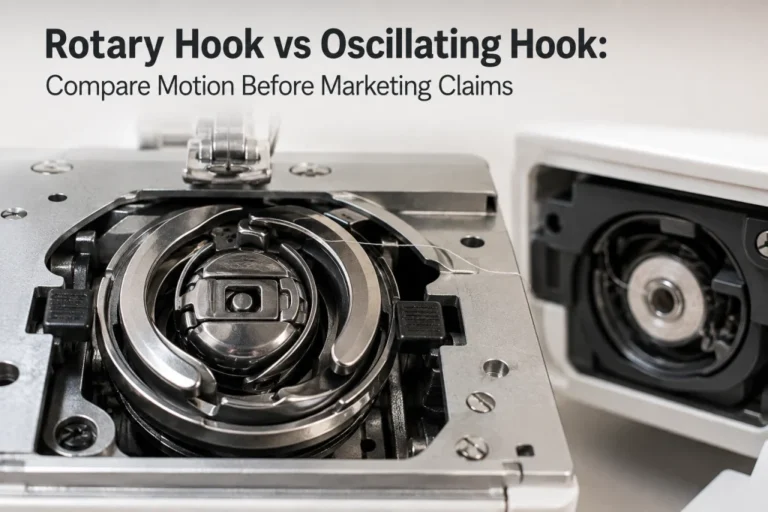
Official specifications show why one universal motion description is risky. Janome documents the Sewist 740DC as a top-loading machine with a full rotary hook. The company documents the Toile Romance as front-loading with a vertical oscillating hook and separately identifies a bobbin case among its standard accessories. Those labels document different lower-thread architectures without requiring us to infer that every component inside either assembly moves the same way.
The matrix below records only what the manufacturer wording supports. It is not a teardown, a timing diagram, or a claim about unlisted models.
| Documented model | Manufacturer hook wording | Access wording | Safe mechanical conclusion |
|---|---|---|---|
| Janome Sewist 740DC | Top Loading Full Rotary Hook Bobbin | Top loading | The documented system combines top access with a full rotary hook architecture |
| Janome Toile Romance | Front Loading Vertical Oscillating Hook Bobbin | Front loading | The documented system combines front access with a vertical oscillating hook architecture |
The distinction is enough to reject statements such as “every bobbin case is stationary” or “all lower assemblies spin continuously.” To go deeper into the movement itself, rotary and oscillating hook motion isolates that comparison without turning it into a shortcut for judging the whole machine.
Top-loading and front-loading describe access, not a quality ranking
Top-loading and front-loading tell you where the lower-thread system is accessed. On the Sewist 740DC, Janome combines top loading with a full rotary hook specification. On the Toile Romance, Janome identifies a front-loading bobbin and a vertical oscillating hook. Those two examples show that access orientation and hook motion can be described together, but neither label by itself proves that one machine will produce better stitches or last longer.
For an owner trying to understand the mechanism, access wording mainly helps locate the parts. For a buyer, it can also affect how the bobbin area is reached and viewed during normal setup. A dedicated comparison of top-loading and front-loading bobbin layouts handles that purchase-facing distinction. This article stops at identifying what the layout tells you mechanically.
Read hook-type and bobbin-system wording on a specification sheet
A specification sheet can be useful if you read each term as evidence for one thing only. “Top loading” describes access orientation. “Full rotary hook” identifies a hook architecture. “Front loading vertical oscillating hook bobbin” combines an access description with a different hook-motion description. None of those phrases, by itself, tells you which replacement bobbin fits, how to wind it, how to insert it, or how to correct a fault.
Use a short checklist when the terminology is compressed into one product-spec line:
- Identify the exact machine model before interpreting the lower-thread description.
- Separate access words such as top-loading or front-loading from motion words such as rotary or oscillating.
- Check whether the manufacturer calls the supporting part a case, holder, or another model-specific term.
- Use the parts list or manual when a component name matters more than a marketing summary.
- Do not turn hook type into a prediction of stitch quality, reliability, or material capacity.
This approach keeps a specification useful without asking it to prove more than it actually states. If a manufacturer changes terminology across model families, the exact model page and manual are the better reference than a generic diagram copied from another machine.
The published layout does not prove reliability or stitch quality
A rotary label is not a reliability certificate, and a front-loading or top-loading label is not a stitch-quality score. Stitch results depend on a larger system that includes the exact machine, needle, thread, material, presser foot, feed behavior, settings, condition, and setup. A specification can tell you what architecture the manufacturer documents, but it cannot replace evidence about actual performance under defined conditions.
The same restraint applies to durability. A full rotary hook description does not establish a service life, and an oscillating hook description does not establish that a machine is inherently less capable. Without controlled comparative evidence tied to exact models and conditions, those broader claims remain unsupported. For this topic, the mechanical labels should remain mechanical labels.
Winding and insertion are setup questions, not mechanism definitions
Knowing what the bobbin does does not tell you how to wind or insert it on a particular machine. Direction, threading path, release method, and insertion steps can vary, so those actions should follow the exact model manual. Mixing setup instructions into a mechanism explanation creates a subtle problem: readers may carry a correct mechanical idea into the wrong physical procedure.
This article therefore stops before step-by-step winding or insertion. If you are standing at the machine with an empty bobbin or an open bobbin area, switch from mechanism learning to the model’s setup instructions. The lower-thread job map still helps because you know what each part is supposed to do, but the procedure belongs to a different question.
Bobbin and case fit require exact compatibility evidence
Two bobbins can look nearly identical and still not be interchangeable. The same warning applies to bobbin cases and holders: a generic name, similar diameter, or apparently matching shape does not establish fit. Compatibility should be verified against the exact machine model, manufacturer parts information, manual, or a current compatibility listing that identifies the component precisely.
That boundary is especially important because this mechanical article names parts without recommending replacements. A reader who understands the difference between a bobbin and its case is better prepared to ask the right fit question, but the answer still requires model-specific evidence. Do not use the Sewist 740DC or Toile Romance examples here as a compatibility chart for any other machine.

These genuine Brother SA156 clear plastic bobbins come in a pack of 10 and measure 7/16 inch deep. Brother publishes a specific machine compatibility list for the SA156, making the part number useful when verifying fit instead of relying on appearance alone. Check your exact Brother model against that compatibility information before using these bobbins.
Check On AmazonIf you click this link and buy, we earn a commission at no additional cost to you.
Loops, jams, strikes, and damage belong to symptom-led troubleshooting
A useful mechanism map can help you describe where a problem appears, but it does not diagnose the cause. Thread loops near the bobbin area, a jam, abnormal noise, a displaced case, or a hard needle strike can involve setup, threading, part condition, compatibility, timing, or other model-specific factors. Jumping directly from “the problem is near the bobbin” to “the bobbin is the cause” is exactly the kind of naming shortcut this article is meant to prevent.
Do not remove the hook, disassemble the race, alter internal timing, or make an unidentified tension adjustment just because you can name the parts. Follow the exact model manual for owner-level checks. Stop and use qualified service for a hard mechanical lock, repeated hard needle strikes, or any work the manufacturer reserves for service personnel.
The distinction keeps mechanical understanding from turning into speculative repair. It also makes a future troubleshooting description more useful because “upper thread is wrapping around the hook area” is more precise than “the bobbin is broken.”
Use the question itself to choose the next path
The lower-thread area attracts several different questions because setup, fit, motion, and faults all happen around the same opening. Separating those intents keeps one explanation from becoming a mixture of procedures that require different evidence. The safest next step depends on what you are actually trying to learn or do.
Choose the right path:
- Mechanism: identify the bobbin, case or holder, thread-control path, hook or shuttle, and race, then trace the job of each part.
- Setup: use the exact model instructions for winding and insertion.
- Compatibility: verify the exact bobbin or case against manufacturer model and part information.
- Faults: follow a symptom-led troubleshooting path and respect the manual’s service boundary.
That routing is the practical value of understanding the mechanism. Once thread storage, lower-thread control, and loop capture are separate in your head, the next question becomes much easier to classify without guessing at a repair or buying an unverified part.
Final Thoughts: identify supply, control, and capture separately
The simplest accurate answer is that the bobbin stores and supplies the lower thread. The case or holder supports that supply and provides the designed thread-control path, while the hook or shuttle handles the upper-thread loop as part of lockstitch formation. Those jobs happen close together, but they are not interchangeable.
When a manual or product page uses unfamiliar lower-thread terminology, start with the exact model and label each job before you infer motion. A top-loading full rotary example and a front-loading vertical oscillating example already show why one universal diagram can mislead. From there, move to setup, compatibility, or troubleshooting only when that is the question you actually need to solve.
Frequently Asked Questions
🧵 What is the main function of a sewing machine bobbin?
The bobbin stores and supplies the lower thread used in a lockstitch. The hook or shuttle, not the bobbin by itself, handles the upper-thread loop during stitch formation.
🪡 Does the bobbin catch the top thread?
Not by itself. In common domestic lockstitch systems, the hook or shuttle engages the upper-thread loop while the bobbin supplies the lower thread that becomes interlocked with it.
⚙️ Does every sewing machine bobbin system move the same way?
No. Manufacturer terminology documents different architectures, including full rotary and vertical oscillating hook systems. Check the exact model rather than assuming the bobbin, case, holder, or hook follows one universal motion pattern.
🧰 Is a bobbin case the same thing as a bobbin?
No. The bobbin is the thread-carrying spool, while a case or holder supports and presents that bobbin within the machine’s lower-thread system. The exact part name and design are model-specific.
📖 Does top-loading mean the machine has a rotary hook?
Do not infer hook motion from access wording alone. For example, Janome explicitly documents the Sewist 740DC as top-loading with a full rotary hook, so both facts are supported for that model because the manufacturer states them.
🔧 Should I adjust the bobbin-case screw to understand how the mechanism works?
No. You do not need to change lower-thread tension to identify the parts and their jobs. Follow the exact model manual for any adjustment, and keep service-only work outside an owner-level mechanism check.
References and Sources
- Janome Sewist 740DC specifications: Confirms the model’s documented top-loading access and full rotary hook terminology.
- Janome Toile Romance specifications: Confirms the model’s front-loading access, vertical oscillating hook terminology, and listed bobbin case unit.
- Smithsonian Walter Hunt patent model: Supports the basic two-thread lockstitch principle used to distinguish lower-thread supply from loop interaction.