Sewing machine feed dogs are the toothed parts below the presser foot that advance fabric during ordinary machine feeding, but their job makes sense only when they are viewed as part of a timed system. In a common domestic drop-feed arrangement, the feed dogs rise, contact the fabric, travel through the feed stroke, then drop and reset while the needle and presser foot perform different jobs in the same stitch cycle. Published terms such as 3-piece, 4-piece, 7-piece, reverse, and drop feed describe parts or feature states, not a guaranteed level of feeding quality. The useful reading of a specification is therefore to identify what the machine is designed to do, then leave material handling, pressure choices, accessory fit, and fault diagnosis to the separate questions they actually are.
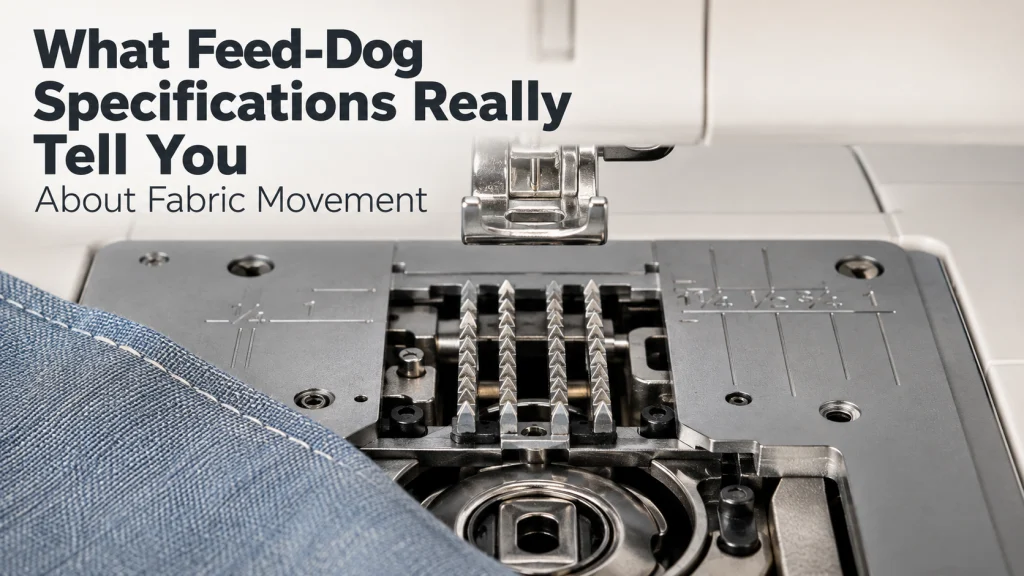
Locate feed dogs relative to the needle plate and presser foot
A common question about sewing machine feed dogs starts when two fabric layers do not appear to travel identically. One sewing-community thread described the bottom layer creeping ahead of the top, a useful example of reader confusion but not proof of a fault. Because the lower layer meets the moving feed teeth first, the mechanism should be understood before any symptom is diagnosed.
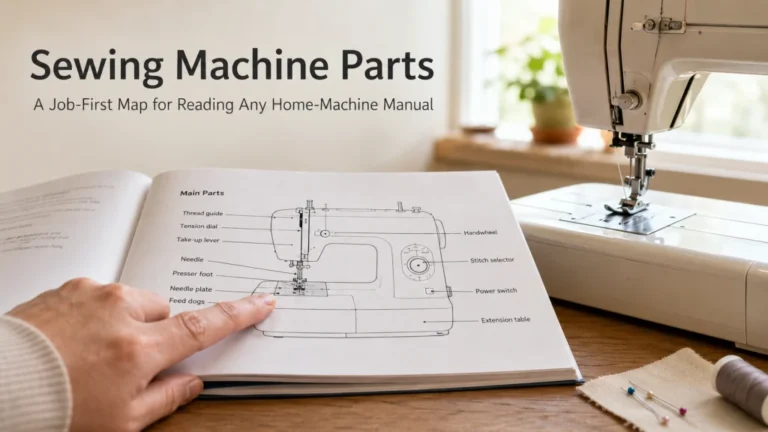
On a common domestic machine, the feed dogs sit below the needle plate and rise through its slots during the feeding part of the cycle. The presser foot sits above the fabric, while the needle forms the stitch through its own opening. A first-time owner may assume the needle pulls the project rearward, but in normal drop-feed sewing the lower feed mechanism supplies the controlled advance while the foot supports contact from above.
Warning: Do not remove the needle plate, reach near moving parts while the machine is powered, or attempt feed-height or timing adjustments just to observe this mechanism. Use the exact model manual for any owner-access procedure, and leave internal feed adjustment or timing work to qualified service when the manual does not make it user-serviceable.
That physical layout is the starting point for understanding how sewing machine parts work together. Once the location is clear, the next question is not which part is “strongest,” but what job the feed system performs during each stitch.
Define the job of the feed system in one stitch cycle
The feed-dog function in a sewing machine is to create controlled fabric advance between stitch-forming events. That advance must be coordinated with the needle rather than happening continuously. The mechanism therefore follows a repeating path that contacts the fabric during the feeding portion of the cycle.
Feed dogs should not be treated as an isolated “grip” feature. Their effect depends on contact from above, commanded feed travel, needle position, and whether the feed dogs are in their normal working state. A feed-system specification describes architecture, not how every fabric stack will behave in a real project.
Key point: Think of feed as timed motion, not a conveyor belt that runs continuously. The machine advances the fabric during a defined portion of each stitch cycle, then the feed dogs release and reset for the next one.
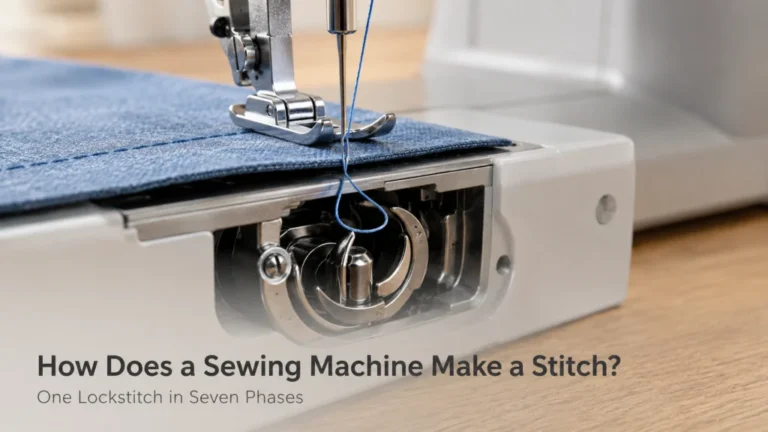
This timing belongs inside the broader explanation of how a sewing machine makes a stitch. The feed system moves the work to the next stitch location, while the stitch-forming components handle the thread interaction itself.
Follow the four motions of common drop feed
Technical descriptions of four-motion drop feed break the cycle into four recurring actions: rise, feed, descend, and return below the plate. Domestic machines can package the linkage differently, but this model explains how feed dogs work at owner level and why the teeth are visible during only part of the cycle.
The ledger below is intentionally mechanical rather than diagnostic. It describes the role of each phase without assigning a universal direction to every linkage detail or suggesting that an owner should alter feed timing. Exact service geometry remains model-specific.
| Feed phase | What happens at the fabric | What the phase tells you |
|---|---|---|
| Rise | The feed teeth come into their working position through the needle-plate slots. | The feed dogs are moving into contact range rather than advancing fabric continuously. |
| Engage and travel | The teeth contact the underside while the presser foot supports contact from above, and the feed stroke advances the work. | Fabric movement comes from coordinated contact and travel, not from the needle acting as a puller. |
| Drop | The feed dogs descend below the plate and release the fabric. | The work is no longer being advanced by the teeth during this part of the cycle. |
| Reset | The feed mechanism returns below the plate to its next starting position. | The machine is preparing for another controlled feed stroke. |
Read the four rows as one loop, not as four independent features. A normal feed cycle is useful precisely because the machine repeats the contact, travel, release, and reset sequence in coordination with the rest of the stitch mechanism.
Rise into working position
The feed dogs first move upward so their teeth can reach the underside of the fabric through the needle plate. Their visible height at a random handwheel position does not tell the whole story because they are designed to move in and out of view during the cycle. This is why a quick glance at the plate can be misleading if the machine is not positioned at the part of the cycle where the feed dogs should be raised.
Engage fabric against presser-foot pressure
Once in working position, the feed teeth need the fabric to be held against them from above. The presser foot supplies that hold-down relationship, allowing the lower teeth to act on the material instead of simply brushing beneath it. This explains the partnership between the two components without turning the discussion into a presser-foot-pressure setting tutorial.
Travel the commanded distance
During the feeding part of the cycle, the mechanism moves through the stroke that advances the fabric toward the next stitch location. The amount of travel is tied to the machine’s stitch-length control system rather than to feed-dog piece count. That connection matters because a feed specification and a stitch-length specification describe different aspects of the same coordinated movement.
Drop and reset below the plate
After the feeding stroke, the teeth move below the needle plate so they can return without dragging the fabric backward. That release is what lets the mechanism reset for another cycle. The exact linkage path may be described differently across machines, but the useful owner-level idea is consistent: contact during feed, release during reset.
Coordinate fabric movement with needle clearance
The fabric cannot be advanced normally while the needle is holding it in place through the needle plate. For ordinary drop-feed sewing, the machine coordinates the needle and feed system so meaningful fabric advance occurs when the needle is clear enough for that movement. This is a timing relationship built into the machine, not an adjustment a home owner needs to experiment with.
A simple sequence keeps the roles straight without pretending every model has identical internal geometry:
- The needle completes the stitch-forming portion of its travel and withdraws from the material.
- The feed dogs rise into effective contact with the underside of the fabric.
- The feed stroke advances the fabric while the presser foot maintains contact from above.
- The feed dogs descend and reset as the machine prepares for the next stitch cycle.
The important takeaway is coordination, not a service-timing measurement. If a machine owner suspects the needle and feed mechanism are no longer correctly timed, that belongs to fault diagnosis and service rather than to this mechanism overview.
Connect feed travel to stitch spacing without turning it into a settings lesson
Stitch length and feed travel are connected because the work must move farther between needle penetrations to create wider stitch spacing along a straight seam. A longer commanded feed step generally means the material advances farther for each stitch cycle, while a shorter step keeps successive needle penetrations closer together. That is a mechanism relationship, not a recommendation for a particular number.
For example, a decorative operation using closely spaced stitches and an ordinary straight seam with visibly wider spacing can ask the feed system to advance different distances even on the same machine. The correct setting still depends on the stitch, fabric, thread, project, and exact model. This article stops at explaining why feed travel and stitch spacing are linked; choosing stitch length for a material belongs with sewing setup and technique.
Explain reverse as a change in feed direction at a high level
Reverse is easier to understand once feed travel is separated from needle motion. On a machine with reverse sewing, the feed system changes the direction of material advance while the needle continues forming stitches. The result is successive stitch locations moving in the opposite travel direction.
This high-level explanation is enough for reading a basic reverse feature on a domestic machine. It does not assume every machine uses the same lever, button, electronic control, or internal linkage. The exact operating procedure belongs to the model manual, particularly when reverse behavior differs by stitch type or machine mode.
Understand why the presser foot supports feed but is not the feed dog
The feed dogs act from below, while the ordinary presser foot holds material down from above. Both touch the same fabric stack, but their roles are different. In standard domestic drop feed, the presser foot is not simply another set of feed dogs above the material.
This matters when reading product language. A machine can list a feed-dog system and a separate presser-foot feature because those specifications describe different parts of the fabric-control system. If the question becomes how much presser-foot pressure a particular material needs, that is no longer a feed-dog specification question and should be handled as a setup decision for the exact machine and project.

This snap-on zig zag foot is listed as part XC3021051 with alternate references including SA175 and SA176. Its wide needle opening supports straight, zig zag, decorative, heirloom, and stretch stitches. The listing provides explicit compatibility lists for many Brother, Babylock, Janome, Simplicity, and Singer models, so match the exact machine to the published list before purchase.
Check On AmazonIf you click this link and buy, we earn a commission at no additional cost to you.
Decode 3-piece, 4-piece, and 7-piece wording on manufacturer pages
Manufacturer pages often reduce feed architecture to a short buyer-facing line. Janome currently lists the Toile Romance with a 3-piece feed dog, the C30 with a 4-piece feed dog, and the Sewist 740DC with a 7-piece feed dog. Brother uses the same kind of count-based specification on the SM8270, where its specification table lists seven feed-dog points. The wording differs slightly between manufacturers, but both are documenting feed-system architecture rather than publishing a universal performance score.
At a safe interpretation level, the number identifies the feed-dog pieces, points, or elements used in the manufacturer’s description. It helps distinguish stated architecture between exact models, but it does not reveal every variable affecting real fabric movement or establish that a larger count feeds better.
- Confirm the wording on the exact manufacturer’s page or manual for the exact model.
- Separate feed-dog count from stitch width, maximum stitch length, presser-foot features, and accessory compatibility.
- Check whether the same documentation also lists drop feed or another feed-related feature state.
- Do not treat a larger number as proof of stronger grip, straighter seams, better layer matching, or greater material capacity.
- If feeding performance matters for a particular fabric stack, look for evidence that actually tests or documents that condition.
Note: The Janome and Brother examples above are specification examples only. They show that current manufacturer documentation uses count-based feed-dog wording across more than one brand; they are not a controlled comparison and do not establish a performance ranking.
That distinction is the practical value of reading the specification carefully. The number can identify a design description, while the performance question remains open until evidence addresses the actual material, machine setup, and test conditions.
Know why piece count alone does not prove better real-world feeding
Piece count looks like an easy comparative number, but it leaves out tooth geometry, contact distribution, commanded feed travel, fabric friction, layer behavior, machine condition, and the behavior of the complete system under load. Those missing variables prevent 3-piece, 4-piece, or 7-piece wording from becoming a performance score by itself.
Two machines can publish different feed-dog counts without proving a performance difference. Unless evidence controls the material, layers, presser-foot condition, needle and thread, stitch setup, and measurement method, the supported conclusion is simply that the feed-system specifications differ.
“Seven feed-dog pieces means this machine will handle difficult fabric better than a three-piece system.”
“The manufacturer lists seven feed-dog pieces on this model. That describes its feed-system architecture, but material performance needs separate evidence.”
This is the same evidence discipline used when reading stitch counts, frame claims, motor wording, or other machine specifications. A useful spec tells you what is documented; it should not be stretched into a result the documentation never demonstrated.
Explain drop feed as a feature state with model-manual boundaries
Drop feed means the normal feed dogs can be taken out of their ordinary fabric-advancing role for certain operations on machines designed to provide that feature. The important word is state: the feed dogs have not become a different type of feeding system merely because the machine lets the user lower them. What changes is whether the normal lower feed teeth are available to advance the fabric automatically.
Brother’s support instructions show why exact model documentation matters. For a group including the SE600, SE625, SE630, SE700 and SE725, Brother says raising the feed dogs requires moving the position switch and then turning the handwheel toward the user or using the needle-position control. Other Brother models use a darning plate because their feed dogs are not lowered by a position switch.
Key point: A spec line that says “drop feed” confirms a feature state is provided. It does not tell you the exact control location, re-engagement sequence, or whether another model uses a darning plate instead. Verify the manual or support page for the exact machine before acting.
That model-specific difference is exactly why generic instructions are risky even for a simple owner control. The safe reading of the spec is “this machine documents a way to remove normal feed-dog action for supported operations,” followed by the exact model procedure.

This feed dog cover darning plate is listed as part XC6063021 for Brother sewing machines. The Amazon listing names supported models including BM2700, GS2700, LX3817, XM-3700, and many others. It is a model-specific accessory, so match the exact machine to the published compatibility list before purchase.
Check On AmazonIf you click this link and buy, we earn a commission at no additional cost to you.
Distinguish standard drop feed from walking, needle, box, and compound feed
Standard domestic drop feed uses a lower mechanism that rises through the needle plate, advances the material, drops, and resets. Other systems can add feeding action from the needle, an upper foot, or combined mechanisms. Those names describe different architectures, not premium versions of the same feed-dog count.
This article does not compare which feed system is best for leather, quilting, multiple slippery layers, industrial work, or any other task. A walking-feed or compound-feed decision requires its own discussion of machine type, material stack, control, ownership cost, workspace, maintenance, and service. Differential feed is also intentionally outside this article: Brother documents it on sergers as a system that controls the relative movement of front and rear feed dogs, so it is not another name for a 3-piece, 4-piece, or 7-piece domestic feed-dog specification. Here, the boundary is simply to recognize that a domestic feed-dog count should not be used as shorthand for every feeding architecture found across sewing machines.
Keep technique and pressure settings separate from feed-dog specifications
Understanding the mechanism does not tell you which pressure, stitch length, or handling method to use for every material. Stable woven cotton, stretch knit, bulky seam intersections, and slippery layers can place different demands on the same feed system. Those decisions involve the material, presser-foot contact, needle and thread choice, stitch setup, and project support.
That is why the earlier community report about the bottom layer moving faster than the top should remain a reader question here rather than becoming a diagnosis. The observation helps explain why someone wants to understand lower feeding, but it does not identify the cause. When the task is choosing or changing settings for a material, use the machine’s documented controls and a technique-specific process rather than trying to infer the answer from feed-dog count.
Route attachments and feeding faults to the right next question
Feed-dog knowledge explains the lower mechanism, but it cannot verify whether a particular presser foot fits or explain every feeding failure. Accessory fit depends on the exact machine and attachment interface. Fabric that will not advance, abnormal noise, repeated hard needle strikes, or a mechanism that will not re-engage belongs to symptom-led troubleshooting and, when appropriate, service.
The scope router below keeps those questions from being mixed together. It is especially useful when a search for “feed dogs” starts as a mechanism question but turns into a settings, compatibility, or repair problem.
| Your question | Use this route |
|---|---|
| What are the feed dogs doing during a normal stitch? | Mechanism: use the rise, contact, travel, drop, and reset model in this article. |
| What pressure or handling method should I use for this fabric? | Settings and technique: check the exact machine controls, fabric stack, needle, thread, stitch, and project conditions. |
| Will an even-feed, walking, or other presser-foot attachment fit? | Accessory compatibility: verify the exact machine model, shank or holder interface, and manufacturer compatibility evidence. |
| Why is the fabric not feeding or why are the dogs not coming up? | Troubleshooting: follow the exact model manual first, then use symptom-led checks without forcing the mechanism. |
If the current question is broader than feed dogs, understanding the complete sewing-machine mechanism gives the wider system context. Keeping each next step in its proper scope avoids using one specification to answer a compatibility, technique, or repair question it was never designed to answer.

This SA107 X80927001 walking foot is listed for low-shank sewing machines. Its built-in feeding system moves and holds fabric between the upper and lower feed dogs to help control multiple layers and slippery fabrics. The listing says it fits most brands of low-shank machines and is intended for layered sewing and matching prints or plaids.
Check On AmazonIf you click this link and buy, we earn a commission at no additional cost to you.
Final Thoughts: Read motion, contact, travel, and release before judging the spec
Feed dogs make more sense when the specification is tied to the movement underneath the fabric. The common drop-feed cycle rises into contact, advances the work, releases it, and resets in coordination with the needle and presser foot. Stitch spacing relates to feed travel, while reverse changes feed direction at a high level.
For a buyer or owner, keep the evidence narrow. A 3-piece, 4-piece, or 7-piece label describes the published feed architecture, while a drop-feed line documents a supported feed state. Neither proves better layer matching, greater material capacity, or the correct response to a fault, so those questions still depend on the exact machine, material, accessory, symptom, and manual.
Frequently Asked Questions
These questions stay within the same mechanism and specification boundary as the main article. A feeding symptom may begin with the same vocabulary, but it needs a different diagnostic process.
🦷 What are sewing machine feed dogs?
They are the toothed parts below the presser foot that rise through the needle plate and help advance fabric during ordinary machine feeding. In a common drop-feed cycle, they contact the fabric for the feed stroke, then drop below the plate and reset.
🧵 Does the needle pull the fabric through the machine?
Not in the ordinary drop-feed action described here. The lower feed mechanism provides the controlled fabric advance, while the presser foot supports contact from above and the needle forms stitches in coordination with that movement.
📏 Do feed dogs affect stitch length?
Feed travel and stitch spacing are mechanically related because the work must advance between needle penetrations. The exact stitch-length control and usable range are model-specific, so check the machine manual rather than treating feed-dog count as a stitch-length setting.
🔢 Is a 7-piece feed dog automatically better than a 3-piece feed dog?
No. The number is a published description of feed-system architecture, not proof of better feeding, layer matching, stitch quality, or material capacity. A performance comparison needs evidence under defined machine, fabric, setup, and test conditions.
⬇️ What does drop feed mean on a sewing machine?
It means the machine provides a documented way to take the normal feed dogs out of their ordinary automatic fabric-advancing role for supported operations. The control and re-engagement procedure vary by model, and some machines use a darning plate instead of a feed-dog position switch.
⚙️ Why are my feed dogs not moving the fabric?
That is a troubleshooting question rather than a mechanism-definition question. Check the exact model manual for the feed state and normal owner checks, and do not force the mechanism or attempt internal feed-height or timing work that the manual reserves for service.
When an answer depends on a control, feature state, or fault, the exact model manual remains the next authority to check.
References and Sources
The mechanism description and feed-system examples below are tied to technical or manufacturer documentation rather than inferred from marketplace labels.
- ScienceDirect sewing-machine feed overview: Supports the four-motion drop-feed sequence of rise, feed, descend, and return used in the mechanism explanation.
- Janome Toile Romance specifications, Janome C30 specifications, Janome Sewist 740DC specifications, and Brother SM8270 specifications: Verify current manufacturer use of 3-piece, 4-piece, and 7-piece or 7-point feed-dog wording across more than one brand.
- Brother feed-dog support instructions, Brother darning-plate support instructions, and Brother differential-feed support instructions: Verify that drop-feed controls differ by model and that differential feed on the documented sergers controls front and rear feed dogs as a separate feed-system concept.
- Reddit sewing-machine question thread: Provides the reader-reported example of the bottom fabric appearing to move faster than the top; it is used as a question, not as proof of mechanism or diagnosis.
These sources support the mechanism and specification claims used above. They do not establish that one feed-dog count produces better real-world feeding than another.