A domestic sewing machine may accept some heavier threads while rejecting others that look similar on the spool. The answer depends on the thread’s labeled size system, construction, upper path, needle clearance, bobbin guidance, and the documentation for the exact machine. A larger needle addresses only the needle-eye part of that chain. Record each published limit and treat anything the manufacturer does not address as unknown rather than automatically acceptable.
One Domestic Machine Can Have Several Separate Thread Restrictions
Can you use thick thread in a sewing machine? There is no model-free yes or no answer because one machine can publish separate rules for thread type, size, needle clearance, spool delivery, and bobbin use. Singer’s support information for the Heavy Duty 6800C permits specified bonded nylon and bonded polyester only up to #69/Tex 70 while excluding waxed or coated thread. It also treats heavy upper thread and bobbin thread as separate decisions.
The word thick describes appearance, not a complete compatibility specification. A spool can be heavy because of size, construction, coating, or multiple plies, and each characteristic can create a different restriction. The broader fabric, thread, and needle relationship still matters, but this page focuses on whether the documented domestic-machine path permits the thread. Start with the exact model before thinking about settings, technique, or a test seam.
Define Thick Thread by Its Labeled System and Construction
Before comparing a spool with a machine limit, transcribe the label exactly. Record whether the size is stated as weight, Tex, ticket, denier, a commercial number such as #69, or another system. Also record construction words such as bonded, coated, waxed, cotton, polyester, nylon, topstitching, or hand quilting. Do not convert the label unless the source identifies the construction and conversion basis well enough to support it.
A 12 wt cotton thread, a Tex-labeled bonded thread, and an unlabeled decorative thread can all look substantial without representing the same machine demand. SCHMETZ documentation shows why the system name matters because weight numbers move in the opposite direction from Tex and denier measurements. The same printed number therefore cannot be compared until its unit is known. Preserving the original unit keeps the machine’s published limit connected to the actual spool.
Start With the Exact Machine Manual and Official Support Page
The model number is the first compatibility field, not a detail to fill in later. Search the manual and official support material for thread, needle, bobbin, topstitching, cone, bonded, coated, and any construction term printed on the spool. If a support answer lists covered models, keep that scope attached to every limit you record. A limit for one machine family should not become a domestic-machine rule because another machine has a similar marketing label.
Brother support illustrates this because its thread ranges are attached to specific lists of supported machines. One Brother answer for listed home sewing and embroidery models gives a 30 to 90 weight range and warns against thread of 20 weight or lower. That range is evidence for the machines covered by the answer, not every Brother model. The useful evidence is the named model scope plus the stated unit.
Separate Allowed, Excluded, and Undocumented Thread Constructions
Put every proposed thread into one of three evidence states. Allowed means the manufacturer names the construction or range for that machine, excluded means the documentation warns against it, and undocumented means the source does not answer the question. Silence is not permission. If a manual discusses ordinary sewing thread but says nothing about a bonded or coated construction, record the missing evidence instead of upgrading the spool to allowed.
The three states should come directly from the wording of the documentation rather than from how familiar a thread name sounds. A listed construction or range can be recorded as allowed only within the conditions attached to it, while an explicit warning belongs in the excluded row. A construction the source never addresses stays undocumented even when a retailer groups it beside permitted thread. This method keeps missing evidence visible instead of quietly converting it into permission.
| Evidence state | Meaning | Next decision |
|---|---|---|
| Allowed | The named model documentation permits the construction or size within stated conditions. | Continue checking the remaining restrictions. |
| Excluded | The named model documentation prohibits or warns against the construction or size. | Stop the compatibility decision. |
| Undocumented | No verified model-specific answer was found. | Keep the result unknown. |
Keep the exact model, unit, and thread description beside every ledger entry. A thread can pass one row and fail another when upper-thread permission and bobbin guidance differ. Treat manufacturer wording such as do not use, not recommended, or a stated maximum as a real boundary. Once a combination is excluded, setup advice for that same combination is no longer relevant.
Check the Upper Spool and Guide Path Without Giving Setup Steps
The upper-thread path contains more than the needle eye. The spool must deliver thread in a manner the machine supports, and the thread must travel through the normal guides and take-up path without being forced. If official documentation names a vertical delivery method, external stand, or another approved feed arrangement, record that instruction only as a delivery condition. Delivery guidance does not authorize a different thread construction or a larger size than the same machine permits elsewhere.
Ask whether the manufacturer addresses the spool form and thread construction you actually have. A cone that cannot sit on the normal spool pin is not automatically compatible because an external stand exists. Likewise, a stiff or coated thread should not be pulled through guides merely to see whether it can be made to fit. Record the official delivery guidance first and leave detailed threading procedures to the exact manual.
| Path gate | Question to verify |
|---|---|
| Spool delivery | Is this spool form and feed method documented? |
| Upper guides | Is the thread construction permitted through the normal path? |
| Needle | Can an allowed needle provide adequate eye and groove clearance? |
| Bobbin | Does the model permit the same thread below, or specify something else? |
Check Needle Eye and Groove Clearance as a Separate Gate
Even when the machine permits a thread construction, the needle still needs suitable clearance. SCHMETZ explains the relationship through the needle eye and gives a rule of thumb that the eye diameter should be about 40 percent larger than the thread diameter. The groove also supports the thread as the needle moves through material. A thread that can barely be pulled through the eye has not passed a meaningful clearance check.
The labels must be decoded before comparison when the thread uses weight, Tex, or another sizing system. The separate article on how to decode thread weight against needle size covers that numbering issue without making a machine-capability claim. After the size relationship is understood, confirm that the required needle type and size are allowed for the exact machine. Needle clearance cannot override a restriction on construction, upper path, or bobbin use.
Separate Upper-Thread Capacity From Bobbin-Thread Guidance
A heavy thread documented for the needle side may have different bobbin guidance. Some official machine instructions permit a heavier upper thread while calling for a different thread below, so upper-path approval must stay separate from bobbin use. Other manuals publish bobbin information only for particular functions or material combinations. The safe reading is simple: approval on top does not automatically carry to the bobbin system.
Write the two decisions on separate ledger lines even when a source allows the same thread in both positions. One line records upper-thread construction and size, while another records the bobbin requirement or limit. This also keeps bobbin winding procedures outside the capability decision. If the manufacturer publishes no bobbin guidance for the proposed heavy thread, mark that part of the combination unresolved.
Treat Cones and External Stands as Delivery Questions, Not Permission
Large cones create a visible equipment problem, which makes spool support easy to confuse with thread compatibility. An external stand can change how a cone feeds, but it cannot change a prohibited coating, excessive size, unsuitable needle requirement, or restrictive bobbin rule. Treat any approved stand or alternate feed method as one row in the capability record rather than as a general solution. The spool still has to clear every other restriction published for the machine.
If a manual does not mention cone feeding or an external stand, do not assume that placing the cone behind the machine creates an approved path. First confirm whether the thread itself is inside the published construction and size boundaries. Then check whether the spool-delivery method is documented for the model. An accessory can support a permitted combination, but it cannot manufacture permission for an undocumented one.
Treat Bonded, Coated, Waxed, Hand-Quilting, and Specialty Threads Separately
Specialty labels are construction information, not interchangeable synonyms for heavy. Bonding, coating, waxing, fiber choice, and twist can change how a thread behaves even when two spools look similar in diameter. A machine document may distinguish among those constructions instead of treating every substantial-looking spool as one category. Preserve the exact construction term because a rule for one specialty thread does not automatically extend to another.
When the spool uses a specialty term the manual never addresses, keep that exact wording and mark the construction unknown. Do not substitute a nearby label such as upholstery, heavy duty, outdoor, or topstitching unless the manufacturer connects those terms. A marketplace can group products by selling purpose while machine documentation separates them by construction and size. Capability comes from the documented combination, not from the shelf category.
Record a Published Maximum Only for the Named Model and Unit
A maximum is useful only when the machine model, thread construction, and sizing unit stay attached to it. One official source may publish a ceiling in Tex or a commercial thread number, while another may describe a permitted range in weight. Those values answer different, model-bounded questions and cannot be pasted into one generic scale without verified conversion evidence. Keep the source wording intact so the limit cannot drift away from the machine it describes.
If you are asking what size thread your sewing machine can use, begin with the model number and the unit used in its documentation. Another machine can publish a different range, and the size system may run in a different numerical direction. Preserve the manufacturer’s original unit even if a verified conversion is later added for reference. The original value remains the evidence controlling the decision for that machine.
Mark No Published Limit as Unknown, Not Safe by Default
Many manuals list ordinary fabric, thread, and needle combinations without naming the heaviest specialty thread the machine accepts. That absence is still a result because the capability boundary has not been documented in the source checked. Do not turn no warning found into approved, especially for bonded, coated, waxed, stiff, or unusually large thread. Record unknown and note which manual or official support material was searched.
Unknown is different from impossible. It means the available owner documentation does not justify a yes, and this article does not replace missing guidance with an improvised test. Look for model-specific support or ask the manufacturer or qualified service source about the exact construction and size. If the evidence remains unavailable, stop before threading the machine.
Unknown-evidence stop: Do not force an undocumented heavy thread through the path or needle to create compatibility proof. Do not use a needle size the model documentation excludes, and stop after a hard strike, jam, abnormal motion, unusual sound, heat, smoke, or exposed damage. A physical fit at rest does not establish safe powered operation. When evidence stops, the owner-level capability check stops with it.
State What a Larger Needle Does Not Establish
A larger approved needle can provide more eye and groove clearance for a larger thread. It cannot make a prohibited coating acceptable, enlarge an internal guide, change a bobbin system, or expand a model’s published thread maximum. It also cannot prove seam strength, stitch quality, or long-term suitability. Treat the needle as one gate rather than a master key for every thick-thread question.
If the documentation excludes the thread construction, there is no reason to search for a needle that might force it through. If the thread is allowed but the machine’s permitted needle range cannot provide the required clearance, the combination still fails the documented check. One compatible component cannot cancel another restriction. Capability requires every relevant boundary to agree.
Keep Tension, Bobbin Winding, and Stitch Settings Outside the Capability Decision
Once a thread is documented as permissible, ordinary setup can still depend on material, stitch, needle, and thread. Tension, stitch length, bobbin winding, spool placement, and sample-sewing procedures are configuration questions, not proof that the machine accepts the thread. Changing a setting cannot convert an excluded construction into an approved one. Keeping capability separate from setup prevents adjustment advice from being mistaken for permission.
The same boundary applies when an online answer says to loosen tension, lengthen the stitch, or wind a different bobbin. Those steps may matter for a documented combination, but this article ends before that procedure begins. If the thread has not cleared the model, construction, upper-path, needle, and bobbin checks, settings are premature. First establish that the combination belongs in the machine, then follow the exact manual.
Treat Jams, Shredding, Strikes, and Abnormal Motion as Fault Symptoms
A capability investigation belongs before sewing, not after a failure appears. If the machine jams, shreds thread, strikes the needle plate or foot, binds, makes an abnormal sound, or moves unpredictably, the question has become symptom-led troubleshooting. Do not keep feeding thicker thread through the machine to discover which restriction caused the symptom. Stop operation and use the model’s troubleshooting or service guidance.
The same rule applies to heat, smoke, a burning odor, sparks, exposed wiring, or a hard mechanical lock. Those signs are outside an owner-level thread compatibility check and should not be investigated by changing thread, needle, tension, or spool hardware. A known strike or jam also overrides the idea of continuing because the spool appears acceptable. Protect the machine and user first, then address the fault through the appropriate service path.
Build a Restriction Ledger Before Deciding Whether to Proceed
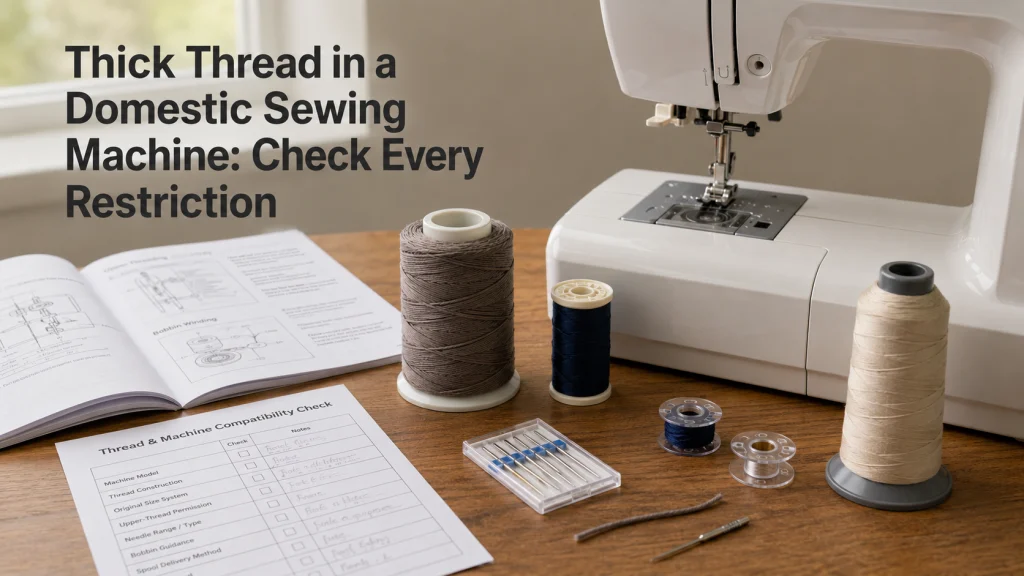
A short ledger keeps the answer tied to evidence instead of memory. Start with the exact model, then copy the spool’s fiber, construction, size, sizing system, spool form, and specialty wording without rewriting the label. Add separate rows for upper-thread permission, needle range, bobbin guidance, and spool-delivery notes. For system context, the overview of how sewing machine mechanisms work explains why those boundaries exist without changing the compatibility result.
The decision can proceed only when every relevant row has evidence that agrees with the proposed combination. An excluded construction ends the check, while an undocumented row stays unresolved. This also makes two machines easy to compare without assuming that a shared brand name or heavy-duty label means shared capacity. The finished record should show which source supports each decision and where uncertainty remains.
| Restriction field | What to record | Evidence |
|---|---|---|
| Machine identity | Exact domestic model number | Machine label, manual, official model page |
| Thread label | Fiber, construction, original size and unit | Spool or thread specification |
| Upper thread | Allowed, excluded, or undocumented | Exact manual or official support |
| Needle | Permitted type and size range | Exact manual plus sizing evidence |
| Bobbin | Same thread, different thread, limit, or unknown | Exact manual or official support |
| Spool delivery | Normal pin, approved alternative, stand, or unknown | Exact manual or official support |
- Copy the spool label before converting any size number.
- Confirm that every support page covers the exact model.
- Keep upper-thread and bobbin restrictions separate.
- Record excluded and undocumented findings instead of omitting them.
- Stop before setup when any required capability field remains unresolved.
Worked example: Suppose a spool is labeled bonded polyester, Tex 60, and cone format, with no brand-specific machine claim on the label. The manual for the identified domestic machine lists ordinary polyester thread and an allowed needle range, while official support documents cone delivery but says nothing about bonded construction or heavy thread in the bobbin. The ledger can therefore mark the machine identity and spool-delivery method as documented while leaving construction, needle clearance, and bobbin use unresolved. That result is not a tentative yes, because several required gates still lack evidence. The example ends at unknown rather than moving on to threading, settings, or a test seam.
Final Thoughts: One Documented Path Must Clear Every Boundary
Thick thread is usable only when the exact domestic machine’s documentation supports the complete combination. Identify the original thread unit and construction, confirm the upper path, match a permitted needle with adequate clearance, and check bobbin guidance separately. A published maximum must stay attached to its named model and sizing system. If any required restriction is excluded, the decision ends there.
If a required limit is missing, record unknown rather than converting silence into permission. A larger needle, external stand, or different bobbin thread addresses only the boundary the manufacturer documents it for. That approach is less convenient than a universal chart, but it keeps evidence separate from experimentation. The useful answer is the combination the documented sewing path supports, not the thickest thread the machine can be made to move.
FAQs
Heavy-thread questions sound simple because the spool and needle are easy to see. The answer still changes with construction, size unit, model, needle range, bobbin guidance, and delivery method. Keep those variables separate so one approved detail is not mistaken for full compatibility. Follow the exact machine documentation when it gives a narrower instruction.
These answers help interpret evidence before use. They do not replace a model-specific manual or support page. If the machine already jams, strikes, sounds abnormal, or shows another fault, stop this capability check. Resolve compatibility before powered operation begins.
🧵 What size thread can my sewing machine use?
Use the range published for the exact model and keep the original sizing unit attached. A weight range cannot silently become Tex, ticket, denier, or a commercial thread number. Check whether the range also applies to the construction you have. If no model-specific maximum is published, the maximum remains unknown.
🪡 Will a larger needle let me use thicker thread?
A larger approved needle may provide more eye and groove clearance. It does not override limits on coating, construction, upper path, bobbin use, or permitted needle range. The needle must itself be allowed for the exact machine and suitable for the material. Treat it as one compatibility gate, not proof for the whole combination.
🧶 Can I put the same heavy thread in the bobbin?
Only when the exact machine documentation supports that use. Some model guidance separates a heavier upper thread from a lighter bobbin thread. Upper-thread permission therefore does not automatically transfer to the bobbin system. If bobbin guidance is missing, record that part of the combination as unresolved.
🧰 Does an external thread stand make cone thread compatible?
No, a stand addresses spool delivery rather than every thread restriction. The thread still must meet the machine’s construction, size, needle, upper-path, and bobbin requirements. Use a stand only when that delivery method fits the documented combination. It cannot turn an excluded or undocumented thread into an approved one.
⚠️ What if my sewing machine thread seems too thick for the path?
Do not force it through guides, tension components, or the needle. Recheck the spool’s original size system and construction against the exact model documentation. If the evidence excludes the thread or does not address it, stop before use. A physical struggle while threading is not a compatibility test.
📖 What if the manual gives no thick-thread limit?
Record the limit as unknown and check official model support for a more specific answer. If the manufacturer still gives no guidance for the construction and size, do not borrow a maximum from another model. Manufacturer or qualified service guidance may resolve what the owner’s documentation leaves open. Until then, the evidence does not support that undocumented combination.
References and Sources
These sources support exact claims about construction, size limits, needle clearance, and bobbin guidance. Singer and Brother evidence stays within its named model scope. SCHMETZ supports sizing direction and needle-eye clearance only. None establishes a universal domestic-machine maximum.
- Singer Heavy Duty 6800C support: identifies acceptable and excluded thread constructions, the #69/Tex 70 bonded-thread ceiling, bobbin guidance, and cone-delivery guidance for the named model.
- Brother fabric, thread, and needle combinations: provides thread and needle ranges plus a prohibition on 20 weight or lower for the listed supported models.
- SCHMETZ thread sizing guide: explains the direction of weight, Tex, and denier systems and the relationship between thread diameter and needle-eye clearance.
Community reports are not used to prove machine capability. Retailer descriptions are also excluded from the technical limits. If manufacturer guidance changes, recheck the affected restriction. Keep each claim tied to its model, unit, construction, and documented scope.