A sewing and quilting machine should preserve your ordinary sewing functions while adding only the quilting capability your actual projects require. Start by recording regular sewing jobs, then define quilt size and whether the machine will be used for piecing, walking-foot quilting, free-motion quilting, or some combination of those stages. Published work-area dimensions, wide tables, quilting feet, and feed controls can verify features, but they cannot prove that a large quilt will be comfortable to maneuver. The buying decision stays in the general domestic category until straight-stitch-only, frame-based, stitch-regulated, or longarm requirements become central.
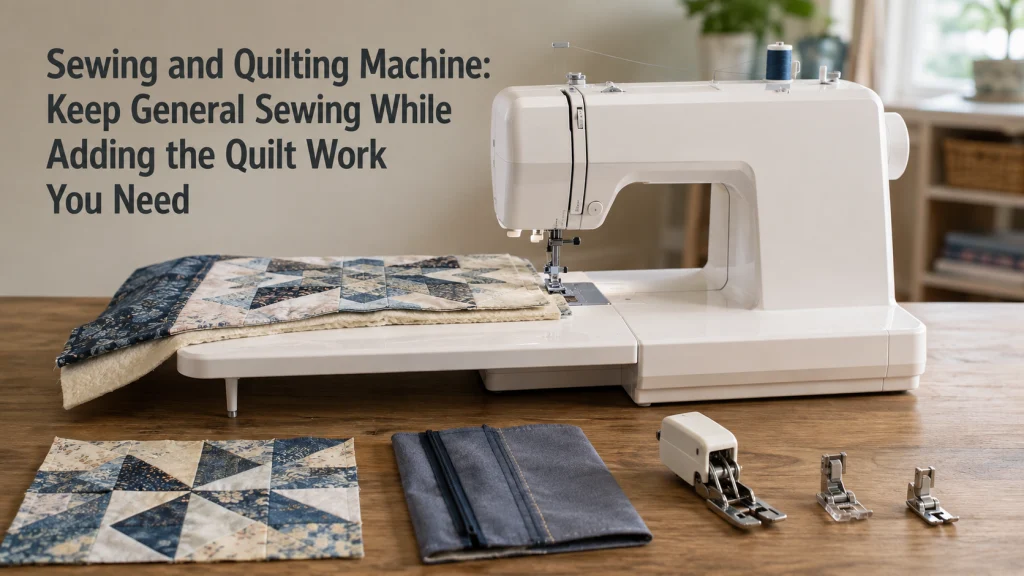
Quilting Can Mean a Small Addition or a Different Machine System
Two people can ask for a sewing and quilting machine while describing different workloads. One may piece small quilts, sew clothing, make repairs, and occasionally quilt a layered project on the same domestic machine. Another may quilt large bed-size sandwiches repeatedly and care more about maneuvering room or a frame than buttonholes and utility stitches. Those buyers should not be pushed into the same machine class simply because both use the word quilting.
The first buyer is still shopping for a versatile domestic machine, so quilting capability should be added to an ordinary sewing brief. The second may be approaching a specialist decision where straight-stitch-only architecture, a frame, stitch regulation, or longarm space changes the comparison. If broad home sewing is still the starting point, first choose a machine for home projects and then add the quilt stages that matter. The best sewing and quilting machine here is the class that can perform both defined jobs without giving up an essential one.
| Decision axis | Regular sewing | Quilting |
|---|---|---|
| Core operation | Utility seams, closures, hems, repairs, project sewing | Piecing, layered quilting, or both |
| Stitch range | Keep the utility stitches and buttonholes you actually use | Add only quilting functions required by the planned stage |
| Space | Normal project clearance | Needle-side work area plus support for quilt bulk |
| Controls | Controls that improve everyday sewing | Feed, speed, or needle-stop functions when the quilt stage uses them |
| Exit point | Stay with a domestic comparison | Leave when specialist architecture becomes the requirement |
A domestic candidate survives only if it still handles the normal sewing brief and the quilt stages assigned to it.
Keep the Normal Sewing Requirement Visible
Write the ordinary sewing checklist before comparing quilting features. Include straight and zigzag utility, stitch adjustment, buttonholes, zipper work, hems, free-arm access, and other functions that appear in regular projects. A machine can look attractive for piecing and still fail as a one-machine solution if it removes a function you use often. This matters when search results mix versatile domestic machines with equipment built around a narrower stitch set.
A first-time buyer can easily assume that anything marketed for quilting will also behave like a normal household sewing machine. That is not a safe assumption because specialist quilting machines may prioritize straight stitching, larger work space, or another dedicated architecture instead of broad utility sewing. Keep the checklist beside every finalist and reject any machine class that drops a required operation before you compare extra quilting features. For the broader baseline behind that checklist, compare sewing machines by actual requirements rather than using stitch count as a proxy for versatility.
- Utility stitches used in ordinary projects
- Buttonhole and zipper requirements
- Stitch adjustment needed for non-quilting work
- Free-arm access if narrow items matter
- Required presser-foot compatibility
- Manual, support, maintenance, and service access
When quilting ability is similar, favor the candidate that preserves more of your normal sewing without extra workarounds.
Record Quilt Size and the Stages Done on the Machine
Quilting is not one machine operation. Piecing joins units before the quilt sandwich exists, walking-foot quilting moves a layered sandwich with the machine feed engaged, and free-motion quilting changes how the material is moved under the needle. A machine may feel generous during piecing and much more restricted when a bulky layered quilt must pass beside the needle. Record both the largest quilt you realistically expect to make and which stages you intend to complete on this machine.
Size should describe the test, not predict the result. Batting loft, quilt density, material beside the needle, and the support surface can all change how a project moves even when finished dimensions are identical. A buyer who makes baby quilts and table projects has a different space problem from someone planning repeated bed-size work. Write the expected project range down so an occasional future ambition does not outweigh the work you will repeat.
| Quilt stage | Material at the machine | Buying evidence to record |
|---|---|---|
| Piecing | Fabric units and seam allowances | Straight-stitch control, foot compatibility, support for blocks |
| Walking-foot quilting | Top, batting, and backing | Foot compatibility, work area, support surface, realistic layered test |
| Free-motion quilting | Layered sandwich moved by the operator | Feed-dog control, compatible foot, speed behavior, maneuvering test |
The worksheet prevents piecing capability from being mistaken for finished-quilt handling. It also shows whether a feature belongs to every project or only to one stage. Once the quilt stages are separated, the physical-space and control questions become much easier to judge.
Piecing
Piecing usually places much less bulk inside the machine than quilting the finished sandwich. Straight-stitch placement, seam consistency, visibility, and the compatible foot or guide matter more here than a claim about handling a large quilt. An extension table can support blocks and larger pieced units, but it does not enlarge the opening inside the machine. A general domestic machine can remain a strong piecing candidate as long as it also keeps the utility sewing functions in your first checklist.
Walking-Foot Quilting
Walking-foot quilting keeps normal feed involved while an even-feed or walking-style attachment helps move the layered project from above. The important buying questions are exact foot compatibility, the quilt layer stack, the space available around the needle, and the surface supporting the project. A foot included in the box proves that the accessory is supplied, not that a large quilt will move easily through the machine. Test or audition the same representative sandwich on each finalist if this stage is a meaningful part of the workload.
Free-Motion Quilting
Free-motion quilting changes the feeding relationship because the operator guides the quilt instead of relying on normal feed-dog advancement. Some domestic machines provide a drop-feed mechanism and dedicated quilting feet for this workflow. Those features establish that the machine supports the setup, but they do not tell you how your quilt will handle. Keep control, stitch quality, and usable space unknown until a representative layered audition answers them.
Measure Work Area From the Needle and Separate It From Table Support
Work area matters because part of a quilt must pass beside the needle during many domestic-machine quilting paths. Record the manufacturer’s stated needle-side or internal work area when published, and do not substitute overall machine width for that measurement. A larger opening can provide more physical room for quilt bulk, but it does not tell you how a particular sandwich will compress or move. Treat the dimension as a physical specification rather than a comfort rating.
An extension table solves a different problem. It increases the supported surface around the machine so blocks or quilt layers are less likely to hang immediately beside the needle, but it does not increase internal clearance through the machine body. This is why two listings can both advertise a wide table while offering different internal work areas. Record table support and needle-side space in separate columns so one accessory does not inflate the other measurement.
Published workspace:
A manufacturer dimension can establish the physical space the machine provides around the sewing area.
Tested usable space:
A disclosed audition shows how a specific quilt size, batting, layer stack, and support arrangement actually move through that space.
Keep the published dimension and the observed result separate so workspace does not become an invented capability claim.
Verify Drop Feed, Speed Control, and Needle-Stop Functions on the Exact Machine
Drop feed, adjustable speed, and needle-stop behavior can change a quilting workflow, but none should be assumed from the words computerized or quilting. Feature sets vary by exact model even within the same broad domestic class, so the product page or manual should be checked before a control is added to the comparison sheet. A related machine in the same series is not enough evidence that the function carries over. If the exact documentation is silent, leave the item unresolved until the machine can be checked directly.
Give each control weight only when it changes a stage you actually perform. Drop feed matters when the free-motion workflow requires lowered feed dogs, while it contributes little to a buyer who only pieces. A speed limiter can help when a lower maximum speed improves control during detailed work, and a needle-down stop can reduce handwheel use at pivots or during repositioning. These features change workflow, but they do not need to become universal requirements.
Note: Manufacturer documentation for current domestic sewing-and-quilting machines treats feed controls, speed adjustment, needle-stop behavior, and included quilting feet as specific machine features. Verify them from the exact machine documentation instead of assuming that the marketing category guarantees a standard control set.
The control audit establishes whether the mechanism exists, while the audition shows whether it helps your workflow.
Check the Included Table and Quilting Feet Without Treating Accessories as Performance Proof
Included accessories are purchase facts, not a reason to assume the machine will suit every quilt stage. Domestic machines sold for sewing and quilting may bundle a wide table, piecing foot, walking foot, quilting foot, or quilt guide, but the package varies by model. Separate included items from compatible optional accessories, then match each one to the stage it is meant to support. An accessory that never appears in your workload should not make a candidate score higher.
Compatibility also needs stronger evidence than a familiar accessory name. Walking feet, free-motion feet, and other quilting attachments can depend on the machine’s shank, holder, stitch width, or explicit model list, so a generic-looking foot is not enough. Use the manual or manufacturer compatibility information before counting an optional accessory as part of the setup. If a required foot or table costs extra, include that cost when comparing the complete ownership package rather than the machine price alone.
More feet and a larger bundle look better even when several items do not support the buyer’s actual sewing or quilting stages.
Count only the included or verified compatible accessories required for the operations already written into the buying brief.
Accessory evidence should establish what is supplied and what fits, then stop before making claims about quilt handling.
Build the Same Sewing-and-Quilting Audition for Every Finalist
A good audition tests both halves of the purchase instead of showing only a clean line of piecing. Start with the utility seams you use, then add a representative piecing sample and the layered quilting stage that matters. Keep fabric, batting, thread, needle, foot, sample size, and support conditions consistent across finalists. Record the exact setup and result rather than relying on memory after several machines have been tested.
When you cannot audition before purchase, separate documented capability from unknown performance. The manufacturer can establish that a machine includes a certain foot, offers drop feed, provides a stated work area, or has a speed-control function, but that evidence cannot tell you whether your bed-size sandwich feels manageable. Mark those handling questions unknown until you have direct evidence from the real machine and a representative project. This prevents a detailed specification sheet from being rewritten as pretend hands-on experience.
| Audition task | Keep constant | Record |
|---|---|---|
| Regular utility sewing | Fabric, needle, thread, stitch | Required functions, control, feeding |
| Piecing | Units, seam target, foot | Placement, visibility, repeatability |
| Walking-foot sample | Layer stack, batting, foot, support | Movement, bulk, usable space |
| Free-motion sample | Layer stack, foot, feed state, speed | Control, maneuvering room, repeatability |
| Largest realistic sample | Same support arrangement | What was tested and what remains unknown |
The audition can also record two ownership details without becoming a tension-setting lesson. Watch whether the chosen layer stack maintains stable stitch balance with the machine’s normal recommended setup, and note repeated looping or imbalance. Also record how often the bobbin must be changed because capacity affects interruption frequency even though it does not prove stitch quality. Treat both as exact-machine observations rather than universal rules for tension values or quilt size.
Follow the exact manual during the audition and stop for damaged electrical parts, uncontrolled motion, overheating, smoke, burning odor, hard jams, or repeated hard needle strikes. The goal is to qualify the purchase, not force abnormal machine behavior.
Build a Versatile Domestic Shortlist by Quilt Stage and Regular-Sewing Need
A useful shortlist can be built without naming a product before the workload is defined. The first level can cover regular sewing plus piecing, the second can add walking-foot quilting, and the third can add bounded free-motion work while keeping normal domestic utility. Each level should add only the functions required by the next quilt stage. This keeps a sewing machine for quilting inside a domestic comparison until the workload demands another system.
For piecing-focused use, prioritize the ordinary utility functions first, then straight-stitch control, verified foot compatibility, and support appropriate to the units you handle. Add a walking-foot workflow when layered feed-assisted quilting is planned, and add documented free-motion support only when that stage belongs to the projects you will repeat. Work area becomes more important as the quilt sandwich grows, but published dimensions still need a realistic handling test before they become performance evidence. The best sewing machine for quilting within this scope is the one that clears both the normal-sewing column and the defined quilt-stage column.
| Workload | Domestic baseline | Do not overvalue |
|---|---|---|
| Regular sewing plus piecing | Full utility sewing, controlled straight stitching, verified piecing setup | Quilting features unrelated to piecing |
| Add walking-foot quilting | Piecing baseline plus verified foot compatibility and layered audition | Foot inclusion as proof of quilt handling |
| Add bounded free motion | Utility sewing plus documented free-motion setup and realistic space test | Drop feed or workspace as proof of quilting quality |
If no finalist clears every preference, protect the functions that affect the workload most often.
Mark Untested Bed-Size Maneuverability as Unknown
Do not turn a throat-space or work-area number into a promise about bed-size quilting. A large quilt sandwich has bulk, friction, batting loft, and changing material that must be supported or repositioned as quilting progresses. A larger internal opening can provide more room, but the project still has to be managed around the machine. Maneuverability is therefore an observed result, not a value calculated from one dimension.
If you have not moved a representative large sandwich through the finalist, write untested instead of large-quilt capable. Published dimensions can still help compare physical space and rule out obviously tighter options, but they cannot tell you how much compression, repositioning, or support your project will require. Community discussions repeatedly separate piecing from the harder problem of handling the layered quilt through domestic-machine space. That distinction belongs in the buying brief without turning into a universal maximum quilt size.
Warning: Do not force bulky material through restricted machine space or continue through repeated hard needle strikes, abnormal jams, overheating, smoke, burning odor, or uncontrolled motion. Stop and reassess the setup or machine class instead of treating resistance as a normal part of the test.
An unknown tells you what still needs an audition and when a specialist comparison may be justified.
Exit the Domestic Shortlist When the Quilting Architecture Changes
The domestic comparison should stop when the buyer prioritizes a specialist quilting system over normal utility sewing. Current manufacturer lineups separate straight-stitch mid-arm machines from longarm systems with different throat space, frame or table configurations, and stitch-regulation options. Those machines solve a different buying problem even when they are associated with quilting. Ranking them beside versatile household machines would make unlike architectures look directly comparable.
The boundary is not whether the buyer is serious about quilting. A home sewist who pieces, makes garments, performs repairs, and does bounded layered quilting can still need a versatile domestic machine at the center of the setup. The comparison changes when straight-stitch-only operation is acceptable or desirable, a frame is part of the intended workflow, stitch regulation becomes a core requirement, or longarm-style space is the reason for buying. At that point, preserve the domestic shortlist and start a separate specialist-system decision instead of contaminating both.
| Requirement | Versatile domestic comparison | Specialist-system comparison |
|---|---|---|
| Regular utility sewing remains essential | Primary fit | May remove required utility functions |
| Piecing and bounded layered quilting | Often appropriate | Only if another specialist need controls the purchase |
| Straight-stitch-only architecture is acceptable | Not required | Evaluate separately |
| Frame operation is central | Outside this comparison | Evaluate separately |
| Stitch regulation or longarm architecture is central | Outside this comparison | Evaluate separately |
This boundary keeps domestic and specialist machines tied to the jobs they are designed to perform.
Final Thoughts: Keep Both Jobs in the Buying Brief
A strong sewing-and-quilting purchase begins with two requirement lists that remain visible together. One protects the ordinary sewing functions you use, while the other defines quilt stage, realistic project size, physical work area, feed controls, accessories, and the handling checks that still matter. Manufacturer information can establish what a machine includes and how its controls are meant to operate, while an audition tells you how the actual setup behaves with your project. Keeping those two kinds of information separate makes the shortlist more useful without repeating the same warning in every section.
Start with the quilting stage you will actually repeat rather than buying for the broadest possible future. Mark large-quilt comfort unknown until it has been tested, and leave the domestic comparison when straight-stitch-only, frame-based, stitch-regulated, or longarm requirements become central. A versatile domestic machine can cover ordinary sewing, piecing, and bounded quilting for many home sewists without becoming a specialist quilting system. Keep both jobs in the buying brief, and the right machine class becomes easier to identify.
FAQs
🧵 Can I use one machine for regular sewing and quilting?
Yes, if the machine keeps the utility sewing you need and supports the quilt stages you plan to perform. Separate piecing, walking-foot quilting, free motion, and large-quilt handling instead of treating quilting as one feature.
🧩 Do I need a special machine just for quilt piecing?
Not necessarily. Piecing can fit a general domestic workload when straight-stitch control, foot compatibility, and ordinary sewing needs are covered.
🦶 Does an included walking foot prove a machine will quilt well?
No. An included walking foot supports a documented workflow, while quilt handling still depends on the layer stack, work area, support surface, and audition.
🌀 What should I verify for free-motion quilting?
Check the exact machine’s free-motion procedure, feed-dog control, required foot, and any speed or needle-stop functions you expect to use. Keep control and maneuverability untested until you try a representative sample.
📐 Does more throat space guarantee easier quilting?
No. More physical space can help, but batting loft, quilt bulk, support, quilting path, and repositioning still affect handling.
🧰 When should I stop comparing general sewing-and-quilting machines?
Change the comparison when straight-stitch-only architecture, a frame, stitch regulation, or longarm-style space becomes central. Those requirements describe a specialist quilting system rather than a versatile domestic machine.
References and Sources
- Brother domestic sewing-and-quilting documentation: Verifies utility sewing, buttonholes, adjustable speed, drop feed, a wide table, and quilting feet on a current domestic machine.
- JUKI versatile domestic-machine documentation: Verifies broad utility sewing, buttonholes, needle-position control, drop feed, quilting feet, and a wide table on a household machine.
- JUKI straight-stitch quilting documentation: Verifies a separate straight-stitch mid-arm quilting and piecing class.
- Handi Quilter longarm systems: Verifies that frame, throat-space, and stitch-regulation requirements belong to a distinct longarm-system comparison.