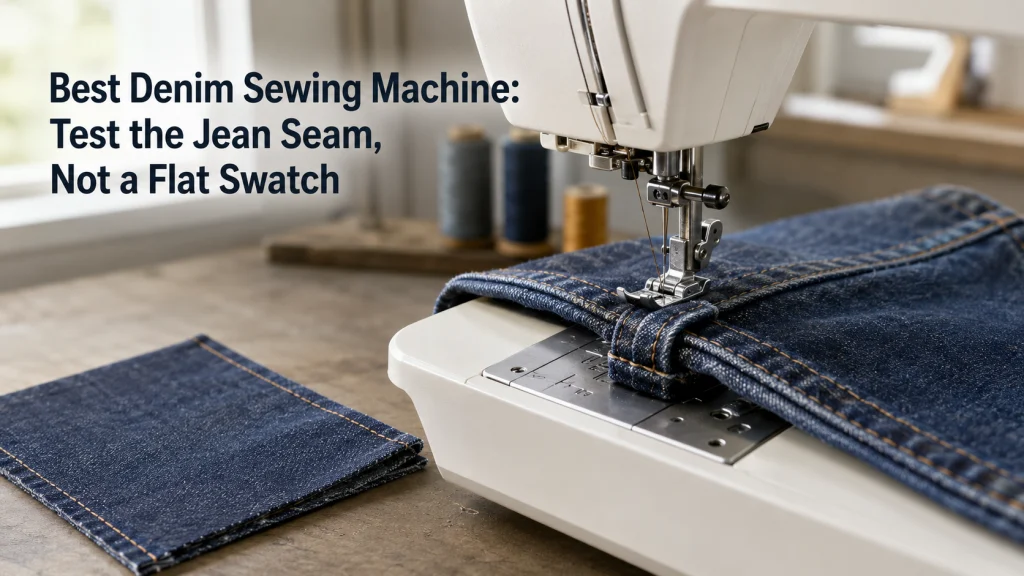
The best denim sewing machine should be judged against the hardest denim seam you expect to sew repeatedly, not against a flat swatch or a heavy-duty label. Denim weight, stretch content, fold geometry, utility-stitch needs, and workload can change the buying decision. Manufacturer denim claims can narrow the field, but they do not prove an untested jean hem or seam intersection. Define the recurring work first, then separate documented claims, matching tests, and unknowns.
A Flat Denim Swatch Is Not a Jean Hem
The best denim sewing machine is not proven by two flat layers under a level presser foot. A folded hem or crossed seam can create a short ridge where several allowances meet. That ridge changes clearance, feed contact, foot angle, and resistance at one small part of the seam. If that intersection recurs in your work, a flat test answers only the easier condition.
Start from the denim project rather than from a strong-sounding machine specification. Record the fabric construction, stretch, folds, seam intersections, required stitches, and how often the difficult area appears. Then compare documentation or legitimate testing with that exact brief. The question is whether the evidence matches the seam that controls your purchase, not whether denim appears in marketing copy.
A useful comparison keeps those two conditions separate instead of turning them into one denim rating. The machine may handle both, one, or neither, and only disclosed evidence can establish which. A reviewer who shows only a flat swatch has not demonstrated a folded jean hem. That distinction is the foundation for every comparison that follows.
Define the Denim Work Before Comparing Machines
Hemming jeans, upcycling garments, constructing denim clothing, and sewing utility pieces create different demands. One project may contain a single bulky hem, while another repeats reinforced intersections. Denim-first buying therefore needs a work profile before a shortlist is useful. Record both the hardest seam and the ordinary sewing the machine must still perform.
Use known information rather than guesses. Record weight only when supplied, note stretch, count layers at the difficult point, and describe the folds. Add the utility stitches and access features that matter. This creates conditions that can be compared with manufacturer claims or a repeatable scrap test.
Garment Denim Versus Heavier Utility Denim
Garment denim varies in weight, finish, softness, and density, while utility denim can be firmer or combined with reinforcement. The fabric name alone does not tell you how much resistance the seam will create. A soft garment panel can become bulky after several folds, while a firm utility piece may stay comparatively flat. Record the construction that actually reaches the needle.
Stretch Versus Rigid Denim
Stretch content changes the project even when the material still looks like ordinary denim. A domestic machine may need suitable utility stitches as well as enough control for bulky intersections. That makes a straight-stitch-only system a poor general-purpose fit for some denim wardrobes even if it handles a firm seam. Keep stretch requirements in the buying brief instead of treating penetration as the only test.
Flat Layers Versus Folded Seam Intersections
Count flat layers and folded intersections separately. The same nominal layer count can behave differently when folds form a compact ridge and the foot approaches at an angle. A waistband junction, hem, patch edge, or crossed seam should be described by geometry as well as layer count. Never convert a flat-layer result into proof of a raised transition.
Repair, Upcycling, and Repeated Garment Construction Frequency
Frequency determines how strongly denim should control the purchase. One occasional hem is different from repeated garment reconstruction or regular denim sewing. If the difficult seam appears rarely, broad domestic versatility may matter more. If it appears throughout normal projects, matching that seam deserves much greater weight.
| Denim-work field | What to record |
|---|---|
| Material | Construction, known weight, stretch content, and finish when relevant |
| Flat stack | Layer count under normal flat sewing |
| Hardest transition | Folds, crossed allowances, reinforcement, and local geometry |
| Domestic functions | Straight stitch, zigzag, buttonholes, free arm, and other required functions |
| Frequency | Occasional repair, regular upcycling, or repeated garment construction |
The work profile prevents a generic strength contest between machines. It also makes demonstrations more useful because every candidate can be judged against the same seam. If two reviews use different denim and different geometry, their results are not directly comparable. Consistent conditions matter more than dramatic-looking stacks.
List the Domestic Functions That Still Matter Beyond Penetration
A home sewing machine for denim usually must remain useful for ordinary garment work. Many projects need zigzag, buttonholes, zipper work, free-arm access, or other utility functions. Manufacturer pages often document these features alongside heavier-fabric claims. Their presence proves the function exists, not how it performs on every denim seam.
Write the required functions down before comparing denim evidence. A machine that crosses a difficult stack but omits a stitch you regularly need can still be the wrong purchase. Conversely, a feature-rich machine remains unproven if the hardest jean seam has never been tested. Keeping function and material evidence separate protects both sides of the decision.
Straight-Stitch Control
Most denim projects rely heavily on straight stitching, so controllable operation matters more than headline speed. The machine should let the user approach a seam transition predictably within the controls described in its manual. A higher maximum speed does not prove better behavior at a bulky ridge. Treat speed as a specification, not as denim-capacity evidence.
Zigzag and Utility Stitches
Zigzag and utility stitches may matter for stretch areas, repairs, patches, or edge-related construction. The exact requirement comes from the project rather than from a universal denim checklist. If the machine will serve mixed household sewing, those functions can be important beyond denim. Verify them before narrowing the search to stronger but more specialized systems.
Buttonhole and Free-Arm Needs Where Relevant
Buttonholes and free-arm access are easy to overlook when thickness dominates the search. They matter only if the garments or alterations actually use them, but required functions should be verified on the exact machine. A product page can document their presence without proving performance on a thick waistband or cuff. Keep function availability separate from seam-capacity claims.
- Controlled straight stitching at ordinary domestic speeds
- Zigzag or other utility stitches required by the project
- Buttonhole capability when garment construction needs it
- Free-arm access when cuffs or pant legs make it useful
- Compatible feet or accessories required by the exact machine
This checklist keeps a denim search from turning into a one-feature purchase. A machine should first remain suitable for the work around the difficult seam. Only then does denim evidence become the deciding comparison. That order is especially important for a first or only domestic machine.
Separate Denim-First Buying From the Heavy-Duty Product Label
A denim-first purchase begins with garment or repair work that repeatedly uses denim, while a heavy-duty product label begins with how a manufacturer positions a machine. That difference changes the comparison criteria. A buyer making jeans may need buttonholes, zigzag, free-arm access, and controlled straight stitching in addition to a machine that can manage bulky intersections. A buyer focused on a broader range of heavy materials may prioritize a different mix of controls and evidence.
Use the label to locate candidates, not to define the winner. Read the exact material wording, stitch functions, feed features, included feet, and operating guidance for each model, then compare those facts with the denim-work profile already written down. This turns branding into one input among several instead of a shortcut for capacity. The strongest candidate is the one whose documented functions fit the whole denim job and whose remaining uncertainties are practical to verify before purchase.

The SINGER Heavy Duty 4411 Pink is a mechanical sewing machine with 11 built-in stitches providing 69 stitch applications. Amazon lists a metal frame, a four-step buttonhole, four included presser feet, and a maximum sewing speed of 1,100 stitches per minute. Its listing also states increased motor power and specifically names denim, canvas, and leather among the thick fabrics it is designed to sew.
Check On AmazonIf you click this link and buy, we earn a commission at no additional cost to you.
Audit Feed, Presser-Foot, and Slow-Control Features Without Inferring Capacity
Feed-related features are most useful when they can be tied to a specific part of the denim job. A longer or differently arranged feed system may be intended to improve fabric movement, adjustable presser-foot pressure changes how the foot loads the material, and a nonstick or specialty foot may address a surface condition. Record the manufacturer’s stated function rather than translating every feed feature into a claim about thickness. That makes two machines easier to compare even before a matched denim test exists.
Control at lower speed is a separate ownership question from raw penetration. A machine that lets the user approach a bulky junction predictably may be easier to manage during garment construction, but slower operation does not create missing mechanical capacity. Never compensate by forcing denim, pulling the work, or driving through a hard strike. Stop for repeated stalls, jams, needle deflection, strikes, abnormal heat, smoke, burning odor, or uncontrolled motion, then follow the exact manual or service path.

The Madam Sew Open Toe Walking Foot is a low-shank presser-foot attachment with its own moving feed system for controlling multiple fabric layers. Amazon lists compatibility with most low-shank Brother, Singer, Janome, Babylock, Kenmore, Husqvarna Viking, and other domestic machines. Its open-toe design keeps the stitching area visible while the upper feed action is intended to reduce shifting, puckering, and misalignment.
Check On AmazonIf you click this link and buy, we earn a commission at no additional cost to you.
Read Exact Manufacturer Denim Claims and Manual Boundaries
Manufacturer documentation is most useful when it names denim or heavyweight fabrics on the exact model and then explains the machine functions around that claim. The Brother ST150HDH is a useful example because its US page mentions denim and heavyweight layers while documenting a 7-point box-feed design. That combination tells you what the manufacturer is claiming about the material context and which feed feature it highlights for the model. It still does not reproduce your exact folded hem, waistband junction, stretch content, or repeated workload.
Use that same reading method for every candidate instead of copying conclusions from one model to another. Check the product page for material wording, then use the manual or support material to confirm the operating boundaries that affect thick fabric, including any warnings tied to fabric, thread, or needle combinations. The purpose of this section is to show how to read manufacturer evidence, while the shortlist below is where the current candidates are compared side by side. A published claim can qualify a machine for further consideration without becoming proof of the hardest denim seam.
Define a Useful Denim Test Sample
A useful denim test tells the reader exactly what was sewn. Record the machine, denim identity, known weight when available, stretch content, layer arrangement, fold geometry, seam intersection, and setup. State whether the machine crossed the transition under normal control or required unusual assistance. Without those details, a claim that a machine handled denim is too broad for a buying decision.
A representative scrap should reproduce the recurring seam rather than chase a maximum thickness. The purpose is to see whether the documented setup handles that condition normally and repeatably. Record stop conditions as carefully as successful stitches. Pulling, forcing, repeated hand assistance, needle deflection, or strikes should never be converted into a positive capacity result.
Material Identity
Record the denim construction instead of judging by color or appearance. Include fabric weight only when it is genuinely known. Note stretch, coating, or unusual finishing when those details affect the sample. An unknown weight can remain unknown without making the rest of the record useless.
Layer Count and Fold Geometry
Count layers where the needle actually enters and describe how the stack was formed. A hem, waistband junction, patch edge, and crossed allowance can create different transitions from the same number of layers. Photograph or sketch the fold when words are not precise enough. Never merge a flat-layer result and a raised intersection into one number.
Needle, Thread, Foot, and Stitch
A test record needs the complete setup if someone else is expected to interpret it. Record the already-verified needle, thread, presser foot, stitch, and relevant controls used on the exact machine. Those details should come from the manual and project requirement, not from a generic denim rule. The result then remains tied to known conditions.
Repetitions, Assistance, and Stop Conditions
One clean pass is weaker evidence than a repeatable result. Record repetitions only when they are genuinely observed and note any unusual operator assistance. Include stalls, jams, deflection, strikes, feeding changes, or stitch problems rather than reporting success alone. Useful evidence explains the boundary as clearly as the pass.
| Test field | Record | Do not substitute |
|---|---|---|
| Denim | Construction, stretch, and known weight | A visual guess about heaviness |
| Geometry | Flat layers, folds, and intersections separately | One generic layer count |
| Setup | Verified needle, thread, foot, stitch, and controls | Generic denim settings |
| Result | Repeatability, assistance, feed behavior, and stops | A simple pass label |
This test record gives reviews, demonstrations, and owner observations a common structure. A result can still be useful when it is not an exact match, but the mismatch must remain visible. Evidence becomes stronger as the material and seam geometry approach your own denim profile. Anything less should stay supporting context rather than proof.

SCHMETZ Jean & Denim Needles are household sewing-machine needles made for thick woven fabrics including denim, twill, and canvas. The assorted card contains five needles, and Amazon lists compatibility with domestic sewing machines. The listing describes a medium ball point and optimized blade designed to limit deflection when working through heavy fabric and multiple layers.
Check On AmazonIf you click this link and buy, we earn a commission at no additional cost to you.
Current Domestic Shortlist by Documented Denim Requirement
Three domestic models show how to build a denim shortlist without treating manufacturer language as a full performance test. The Brother ST150HDH has explicit denim wording plus computerized stitches and multiple buttonhole styles. The Brother ST371HD pairs heavier-fabric positioning with a simpler mechanical feature set, while the SINGER 4423 combines denim and canvas positioning with adjustable presser-foot pressure. None should be ranked for your hardest seam until its geometry and test conditions are known.
The table below is an evidence shortlist, not a universal ranking. It shows what each manufacturer documents and what the product page does not establish. Choose candidates whose domestic functions match your projects, then use the unknown column to decide what still needs a demonstration, support answer, or return-window check. The unresolved question then becomes specific to your denim work.
| Model | Documented denim or heavy-material evidence | Domestic functions that may matter | Still unknown for your project |
|---|---|---|---|
| Brother ST150HDH | Manufacturer states denim and multiple layers of heavyweight fabrics; 7-point box-feed design is documented | 50 built-in stitches, five one-step buttonhole styles, nine included feet | Your exact denim weight, folded hem geometry, repeated intersections, and workload |
| Brother ST371HD | Manufacturer states layers of heavier fabrics; metal needle plate and heavyweight needles are listed | 37 built-in stitches, one-step buttonhole, six feet, free arm | A matched jean-seam transition and repeatability under your setup |
| SINGER 4423 | Manufacturer positions it for denim and canvas and documents additional power for thick fabrics | Adjustable presser-foot pressure, one-step buttonhole, broad stitch-application range | Your fold geometry, feed behavior at the hardest junction, and repeated workload |
Before paying, ask the seller or manufacturer support team about the remaining question instead of asking whether the machine sews denim in general. Describe the denim, folded seam, required stitches, and the unverified point, then ask whether a model-specific demo or support answer exists. If you plan a return-window check, read the retailer conditions first and keep the test within the operating manual. That turns an unknown into a buying task without testing the machine to failure.
Use Unknowns to Decide What to Verify Next
An unknown should lead to a specific next question. If a product page confirms the stitches you need but says nothing about a folded waistband intersection, more general feature lists add little. The useful next evidence is a model-specific answer or test that approaches that intersection. This keeps research focused on the actual buying risk.
Unknowns also help distinguish a tolerable uncertainty from a deal breaker. A buyer who sews denim only occasionally may accept an unverified edge case when the machine otherwise fits everyday work, while a buyer constructing denim garments repeatedly may require much stronger evidence before purchase. Make that threshold explicit in the denim-work profile. The same missing test can therefore lead to different decisions without either buyer pretending the evidence says more than it does.
Use the Heavy-Fabrics Guide When Denim Is Only One Example of a Broader Bulk Problem
Denim should control this purchase only when it is the recurring material behind the difficult work. If the same machine must handle fleece stacks, padded projects, heavy woven fabrics, bindings, and other bulky combinations, the problem is broader than denim. Use the heavy-fabric machine evaluation to compare clearance, penetration, feed, and stitch requirements across those stacks. A denim test should not become proof for unrelated materials.
This boundary keeps material evidence honest. Compression, surface friction, coatings, reinforcement, and seam shape can make two thick materials behave differently. Keep this page for denim-led garment and upcycling work. Move to the broader framework when denim is only one example of a larger bulk problem.
Return to the All-Fabrics Guide When Denim Is Occasional Rather Than Dominant
An occasional pair of jeans should not automatically dictate the entire machine purchase. If most projects use ordinary wovens, knits, quilting cotton, or mixed household fabrics, denim may be only one edge condition. The all-fabrics machine decision keeps versatility, controls, stitches, workspace, and broader ownership needs in view. The denim seam profile can still test the occasional hard case without controlling everything else.
First-machine buyers may need an even broader starting point. The sewing machine buying criteria help define machine type, controls, support, and ownership requirements before one material becomes the tie-breaker. That reduces the risk of buying around a dramatic seam that appears rarely. A general-purpose machine should fit the actual distribution of work.
Move to Specialist Equipment When Denim Production Changes the Machine Class
Industrial denim equipment answers a different purchasing problem from a general-purpose home machine. Manufacturer production pages separate jeans work into operations such as bottom hemming, pocket setting, belt-loop attaching, buttonholing, and multi-layer feeding. Those systems show how specialized the equipment becomes when throughput and process consistency are primary goals. They do not prove that a home sewist needs industrial equipment simply because the project uses denim.
Change machine class when production workload, specialized feed architecture, dedicated operations, thread requirements, or process consistency matter more than domestic versatility. Do not transfer an industrial performance claim to a domestic machine with similar marketing language. The reverse also matters because a domestic machine may offer zigzag, buttonholes, and free-arm access that a specialized system does not. Let recurring work determine the architecture.
Final Thoughts: Qualify the Hardest Denim Seam Before Buying
A useful denim purchase ends with machines that meet the required domestic functions and a short list of unresolved questions. The work profile identifies the functions, while the evidence table shows which seam conditions still need proof. That is enough to move from broad research to a focused demonstration or support question. You do not need a universal winner when one candidate clearly fits your recurring work better.
Keep denim at the center only when it truly dominates your sewing. Broader heavy-material work belongs in the heavy-fabric comparison, occasional denim belongs inside the wider all-fabrics decision, and production-oriented jeans work can require a different machine architecture altogether. The final purchase should therefore match both the hardest repeatable denim seam and the ordinary functions used around it. A qualified shortlist with clearly stated unknowns is a stronger buying result than an unsupported ranking.
FAQs
👖 What should I look for in the best denim sewing machine?
Define the hardest recurring denim seam, then verify the domestic functions, feed features, controls, and model-specific denim evidence that match it. Do not treat a flat swatch or heavy-duty label as proof of a folded jean seam.
🧵 Can a regular home sewing machine sew denim?
Some domestic machines are explicitly documented for denim or heavier fabrics, but the answer still depends on the exact model, material, seam geometry, setup, and workload. Verify the machine documentation and keep untested seam transitions unknown.
📏 How many layers of denim should a machine handle?
There is no useful universal layer count because flat layers and folded intersections create different conditions. Use disclosed evidence that matches the material and seam geometry instead of comparing raw layer numbers.
⚙️ Does a metal frame prove a machine is better for jeans?
No. Frame construction is a legitimate specification, but it does not by itself prove feeding, stitch formation, clearance, or performance across your hardest denim intersection.
🦶 Should I test a machine on a folded denim hem before buying?
If a legitimate demonstration is available, a representative scrap seam is more informative than a flat swatch because it reproduces the transition that may control the purchase. Operate within the exact manual and stop if the machine stalls, jams, deflects the needle, strikes hard, overheats, or behaves abnormally.
🏭 When does denim work need specialist equipment?
Consider a different machine class when production workload, specialized feed architecture, dedicated operations, or process consistency becomes more important than domestic versatility. Denim as a fabric does not automatically require industrial equipment.
References and Sources
- Brother ST150HDH specifications: Verifies denim and heavyweight-fabric wording, built-in stitches, buttonholes, included feet, and the documented feed design.
- Brother ST371HD specifications: Verifies heavier-fabric wording, built-in stitches, buttonhole function, included feet, and free-arm capability.
- SINGER 4423 specifications: Verifies denim and canvas positioning, thick-fabric power wording, presser-foot pressure control, and buttonhole functionality.
- Brother thick-fabric safety guidance: Supports the warning that unsuitable setup on thick fabrics such as denim can cause needle and stitch problems.
- JUKI jeans manufacturing systems: Establishes the specialist industrial boundary through dedicated jeans processes and production-oriented systems.