A sewing machine for all fabrics is only a useful idea when “all” means the fabrics you actually sew, not every material a manufacturer can name. The strongest general-purpose choice is the machine that covers your recurring lightweight fabrics, ordinary wovens, knits, denim, and bulky seam conditions without making the common work awkward. The deciding factor is usually the hardest material or seam condition that appears often enough to matter, not a rare project at the edge of the machine’s intended use. This article shows how to define that fabric envelope, translate it into machine requirements, reject weak matches, and recognize when a specialist system is the better answer.
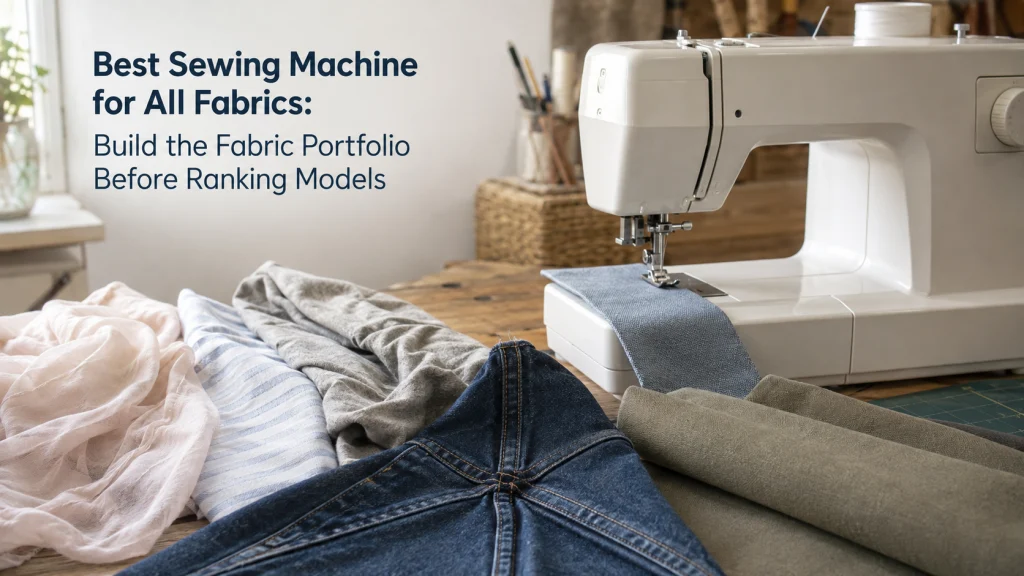
Best Sewing Machine for All Fabrics Starts With Your Fabric Portfolio
The phrase best sewing machine for all fabrics sounds as if one model should win across every possible material. That is not a useful buying standard. A home sewist who alternates among quilting cotton, jersey, denim, and the occasional bulky seam has a different problem from someone who mostly sews canvas bags or stretch garments. The first job is to define the materials and seam conditions that recur in your own work.
That portfolio-first approach also keeps this decision separate from a broad search for the best machine across budgets, controls, project types, and buyer profiles. If you are still deciding what kind of machine ownership experience you want, it makes more sense to compare sewing machines across broader buyer needs first. Once the material mix becomes the controlling question, the fabric portfolio becomes the filter.
Define What a General-Purpose Domestic Machine Must Cover
An all purpose sewing machine should be judged by the jobs it needs to repeat, not by a promise that it can touch many materials once. For mixed home sewing, that usually means stable wovens, some stretch fabric, ordinary layers, and whichever denser or bulkier seam appears often enough to influence the purchase. The machine need not be optimized for every job, but recurring work should not feel like an exception.
Material names can hide very different demands. A single denim layer is not the same test as a folded jeans hem, and a stable sweatshirt knit does not behave like a thin elastic jersey. Likewise, occasional canvas layers are a different ownership decision from repeated upholstery, marine canvas, or leather work that may justify another machine architecture.
Build the Recurring Fabric Portfolio Before Comparing Machines
Write down actual materials before looking at machine feature lists. Group them by how they behave under the presser foot, then note the thickest seam intersection, the stretchiest fabric, the lightest fabric, and any layer stack that comes up repeatedly. That gives you a usable buying brief instead of a vague wish for versatility.
The worksheet below is intentionally simple. Its purpose is to reveal which material conditions are routine, which are occasional, and which ones could force you into a different type of machine.
| Portfolio group | What to record | Why it matters |
|---|---|---|
| Lightweight or delicate fabrics | Slipperiness, tendency to pucker, edge distortion, number of layers | Shows whether low-force feeding and fine control matter |
| Ordinary woven fabrics | Typical garment, quilting, or craft layers | Defines the machine’s everyday baseline |
| Knits and stretch fabrics | Stretch direction, recovery, thickness, seam type | Shows whether stretch-capable stitches and predictable feeding are recurring needs |
| Denim | Flat layers, folded hems, seam intersections, repair work | Separates ordinary denim sewing from repeated bulky transitions |
| Heavy or multilayer work | Material identity, stack thickness, stiffness, dense transitions | Tests whether a domestic general-purpose machine still fits the job |
Once the list is visible, the phrase “all fabrics” becomes much less mysterious. You are no longer asking one machine to prove a universal claim. You are asking whether it covers a defined set of recurring material behaviors.
Lightweight and Delicate Recurring Fabrics
Thin fabrics expose control problems that heavier swatches can hide. The useful question is whether straight-stitch setup, feeding, and presser-foot behavior stay manageable on your lightest recurring material, not how many stitches the machine lists. If lightweight sewing is common, include that fabric in the audition rather than assuming a machine aimed at heavier work will handle it well.
Ordinary Woven Garment and Craft Fabrics
Ordinary woven cotton and similar stable fabrics establish the everyday baseline. They show whether a candidate remains sensible for the work you do most often instead of being chosen entirely around an extreme. A machine that addresses the hardest material but feels cumbersome for routine seams may be the wrong general-purpose compromise.
Stretch and Knit Fabrics
Knits change the decision because fabric can stretch while feeding and while the seam forms. The machine needs the utility stitch options and control your knit projects require, not an enormous decorative library. A common first-time buyer mistake is assuming any zigzag makes every knit easy to sew, even though recovery, feed behavior, seam purpose, needle, thread, and presser-foot choice still affect the result.
Denim and Repeated Seam Intersections
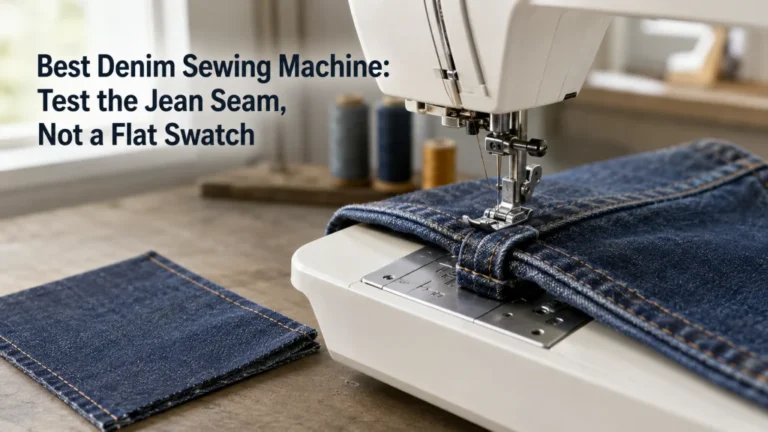
Describe denim by the seam condition, not just the fabric label. Flat layers are easier than a folded hem or bulky intersection, so recurring transitions belong in the buying brief because they expose clearance, feeding, and low-speed control limits. If denim is only occasional, it should not automatically dominate the machine choice.
Heavy or Multilayer Stacks
Heavy material is where a general-purpose domestic decision can become a specialist one. Stiffness, stack height, seam geometry, thread requirements, and frequency matter more than a fabric name. A few successful stitches do not prove suitability for repeated heavy work, and normal use built around bulky or stiff assemblies may require different machine architecture.

The SCHMETZ Sewing Machine Needles Combo Pack contains nine needles for domestic sewing machines. The assortment covers Universal 12/80, Jersey/Ball Point, Microtex, and Jeans/Denim needle categories. It combines several fabric-specific needle types in one package for sewing across different material groups.
Check On AmazonIf you click this link and buy, we earn a commission at no additional cost to you.
Record Frequency So a Rare Edge Case Does Not Control the Purchase
The hardest material deserves weight only if it appears often enough to matter. A recurring jeans hem, bag strap intersection, or stretch garment seam can justify eliminating machines that do not handle that condition well. A one-off costume material or unusually thick repair is different because buying around that single edge case can make the machine less suitable for everything else.
Use frequency as a decision rule rather than a vague impression. A material can be difficult and still be too rare to define the machine.
- Recurring: the material or seam condition appears often enough that weak performance would repeatedly interrupt normal sewing.
- Occasional: the condition matters, but it should be tested rather than assumed to control the whole purchase.
- Rare edge case: the job is unusual enough that a borrowed machine, specialty service, alternate construction method, or different system may be more rational than optimizing the main machine around it.
This distinction is especially useful when a buyer wants the best all purpose sewing machine but has one intimidating project in mind. The correct machine is usually the one that fits the recurring envelope first, then handles reasonable edge cases without being pushed beyond what its documentation and real testing support.
Convert Each Material Into a Machine Requirement
Fabric names are only shorthand. The machine has to manage feeding, stitch formation, clearance, speed control, and thickness transitions. Translating the portfolio into those requirements keeps feature counts from distracting you from the actual material problem.
The matrix below turns common material conditions into practical questions. It does not prescribe one universal feature set because the right answer still depends on the exact fabric, seam, needle, thread, foot, and machine.
| Material condition | Machine requirement to investigate | What to verify |
|---|---|---|
| Light or slippery fabric | Predictable low-force feeding and useful pressure control where available | Manual controls, presser-foot behavior, sample result |
| Stretch fabric | Suitable utility or stretch stitches and stable feeding | Stitch chart, manual, sample seam behavior |
| Bulky seam transition | Clearance, level feeding, and controlled penetration at low speed | Presser-foot lift information, feed design, audition sample |
| Mixed everyday work | Easy control changes without sacrificing basic sewing | Control layout, stitch access, setup burden |
| Repeated heavy stack | Documented material intent plus convincing real-world evidence | Manufacturer wording, independent test conditions, your own sample |
Do not infer these requirements from price, a metal-frame description, maximum speed, motor wording, or a “heavy duty” badge alone. Those details may be relevant, but none of them proves how a specific material stack will feed and stitch.
Feed and Presser-Foot Control
Feeding matters more as the portfolio spreads across light, stretchy, and bulky materials. Check the manual for presser-foot pressure, feed-dog control, compatible feet, and mechanisms intended to improve layer handling. A feature matters only if it addresses your condition, and a representative sample under documented settings is stronger evidence than a generic label.
Required Utility and Stretch Stitches
Count only stitches that serve recurring projects. Straight stitch, zigzag, useful stretch stitches, buttonholes, and relevant length or width adjustment can matter more than a large decorative library. Buyers moving between wovens and knits should confirm what the manual provides instead of treating total stitch count as a versatility score.
Clearance and Bulky Transitions
Bulky transitions differ from simply sewing dense fabric. The presser foot must climb a ridge while feeding stays stable and the needle clears the stack. Check documentation for lift, foot behavior, and relevant accessories, then test the seam shape you expect to sew. Do not force material if the needle deflects, strikes, or the machine repeatedly stalls.
Slow Control and Repeatability
Maximum sewing speed says little about control at a difficult seam. Mixed-material work benefits from predictable slow sewing and controls that make setups repeatable. Buyers who are undecided can compare mechanical and computerized sewing machines before narrowing the material shortlist. The goal is to match control behavior to the work, not declare one control type superior.
Let the Hardest Recurring Material Eliminate Weak Candidates
After the portfolio is written, identify the hardest material condition that repeats. That condition becomes an exclusion test. If a candidate cannot provide credible evidence for that recurring job, it should leave the shortlist even if it looks excellent on easier fabrics.
The key word is recurring. One difficult edge case should not automatically disqualify an otherwise strong general-purpose machine, but a problem you expect to encounter repeatedly should. This keeps the decision anchored to actual use instead of a broad versatility claim.
Choose the machine with the most stitches, the strongest-sounding motor language, or the broadest material promise and assume the hardest fabric is covered.
Identify the hardest recurring seam condition, verify the controls and documented material intent that matter to it, then require a representative sample before treating the candidate as proven.
If the hardest recurring condition changes the type of feed system, needle system, thread range, machine clearance, or duty cycle you need, the answer may no longer be a general-purpose domestic machine. That is a useful result, not a failure of the shortlist.

The SINGER Heavy Duty 4423 provides 23 built-in stitches with 97 stitch applications. It has a full metal frame, a top drop-in bobbin, adjustable presser-foot pressure, and a maximum sewing speed of 1,100 stitches per minute. Its product listing highlights increased piercing power for thick seams and positions the machine for heavier materials such as denim and canvas.
Check On AmazonIf you click this link and buy, we earn a commission at no additional cost to you.
Audit Every All-Fabric and Heavy-Material Claim
Manufacturer pages can be useful, but different statements carry different weight. A listed stitch, feed design, presser-foot control, included accessory, voltage requirement, or warranty term is a documented specification. A claim that a machine handles lightweight silk, denim, or multiple heavy layers is a manufacturer claim unless it is supported by disclosed test conditions.
That distinction prevents marketing language from becoming performance proof. It also gives you a clean way to mark what still needs an audition instead of pretending uncertainty is a flaw in the research.
Note: Official manufacturer pages show why the evidence categories must stay separate. One page pairs a lightweight-to-heavyweight material claim with a seven-point feed design and included specialty feet, another combines a heavy-material claim with adjustable presser-foot pressure, and another documents functions such as a straight-stitch slide plate and automatic presser-foot lift. Those are useful specifications or manufacturer statements, but none proves that one machine will sew every fabric in a buyer’s portfolio.
| Evidence status | What it can support | What it cannot prove by itself |
|---|---|---|
| Documented specification | The machine has a listed function, dimension, control, accessory, or warranty term | That the feature solves your material problem |
| Manufacturer material claim | The brand positions the machine for named fabrics or layer types | Performance on your exact fabric, seam geometry, needle, and thread |
| Independent observation | Performance under disclosed test conditions | Performance outside those conditions |
| Your representative sample | How the machine behaves on the material and seam you actually plan to sew | Long-term durability or every other fabric condition |
| Unknown | A clear reason to test or ask for documentation | Permission to assume the best-case outcome |
A strong shortlist can contain unknowns. Naming them keeps the final decision evidence-based.

The Brother ST150HDH is a computerized sewing machine with 50 built-in standard, utility, and decorative stitches plus five auto-size buttonholes. It includes nine sewing feet, heavyweight needles, an LCD screen, an advanced needle threader, and a drop-in top bobbin. The listing also describes longer 7-point feed dogs with a box-feed design and positions the machine for lightweight silks through heavyweight layers and denim.
Check On AmazonIf you click this link and buy, we earn a commission at no additional cost to you.
Define the Material Samples You Still Need for an Audition
A useful machine audition recreates the conditions that can actually eliminate a candidate. Bring the lightest recurring fabric, the stretchiest recurring fabric, the thickest normal stack, and the hardest seam transition that belongs to your real projects. If the machine only looks impressive on a dealer’s easy sample, you still do not know whether it fits your portfolio.
Keep the sample test repeatable enough that two candidates can be compared fairly. Record the fabric, number of layers, seam geometry, needle type and size, thread, presser foot, stitch, and any control settings that materially change the result.
- Test a normal seam before testing the extreme seam.
- Use the same material stack and seam shape across candidates.
- Do not hide a feeding problem by pulling the fabric from behind the needle.
- Stop if the needle deflects or strikes, the machine repeatedly jams or stalls, or the material clearly exceeds safe owner-level use.
- Mark any unresolved condition as unknown instead of assuming it will be fine later.
The audition is not a durability test and should not be treated as one. It is a controlled way to determine whether the machine can handle the material envelope that matters to you without immediately revealing a deal-breaking weakness.
Build a Shortlist Around the Fabric Envelope, Not a Universal Ranking
Model names should enter your private shortlist only after the requirements are defined. Start with general-purpose domestic candidates that document the controls your portfolio needs, remove those lacking credible evidence for the hardest recurring condition, and keep unresolved edge cases visible for testing.
This differs from ranking machines from best to worst. The same machine can suit a woven-and-knit portfolio yet be a weak fit when bulky denim intersections recur. A portfolio match is more useful than a universal winner because it explains why a candidate survives.
| Shortlist question | Pass condition | Reason to reject or test further |
|---|---|---|
| Does it cover ordinary everyday fabrics comfortably? | Normal seams are within the machine’s intended use and controls feel practical | The machine is optimized around an extreme while everyday work becomes awkward |
| Does it cover the hardest recurring material? | Documentation is credible and a representative sample is acceptable | Only marketing language supports the claim |
| Does it cover knits if they recur? | Required utility stitches and feeding behavior are verified | Stretch capability is assumed from a generic zigzag alone |
| Does it handle bulky transitions you actually sew? | The representative seam feeds and clears without forcing | Needle deflection, repeated stalls, or unstable feeding appears |
| Are the rare extremes still reasonable? | They can be handled occasionally without distorting the main purchase | The edge case really requires a different machine architecture |
This approach also makes ownership cost easier to judge. Compare the purchase price with the accessories the portfolio actually requires, likely maintenance or service needs, and whether a second machine would still be needed for recurring work. A cheaper candidate can become the more expensive ownership choice if it needs extra equipment or regularly pushes a material problem into paid service.
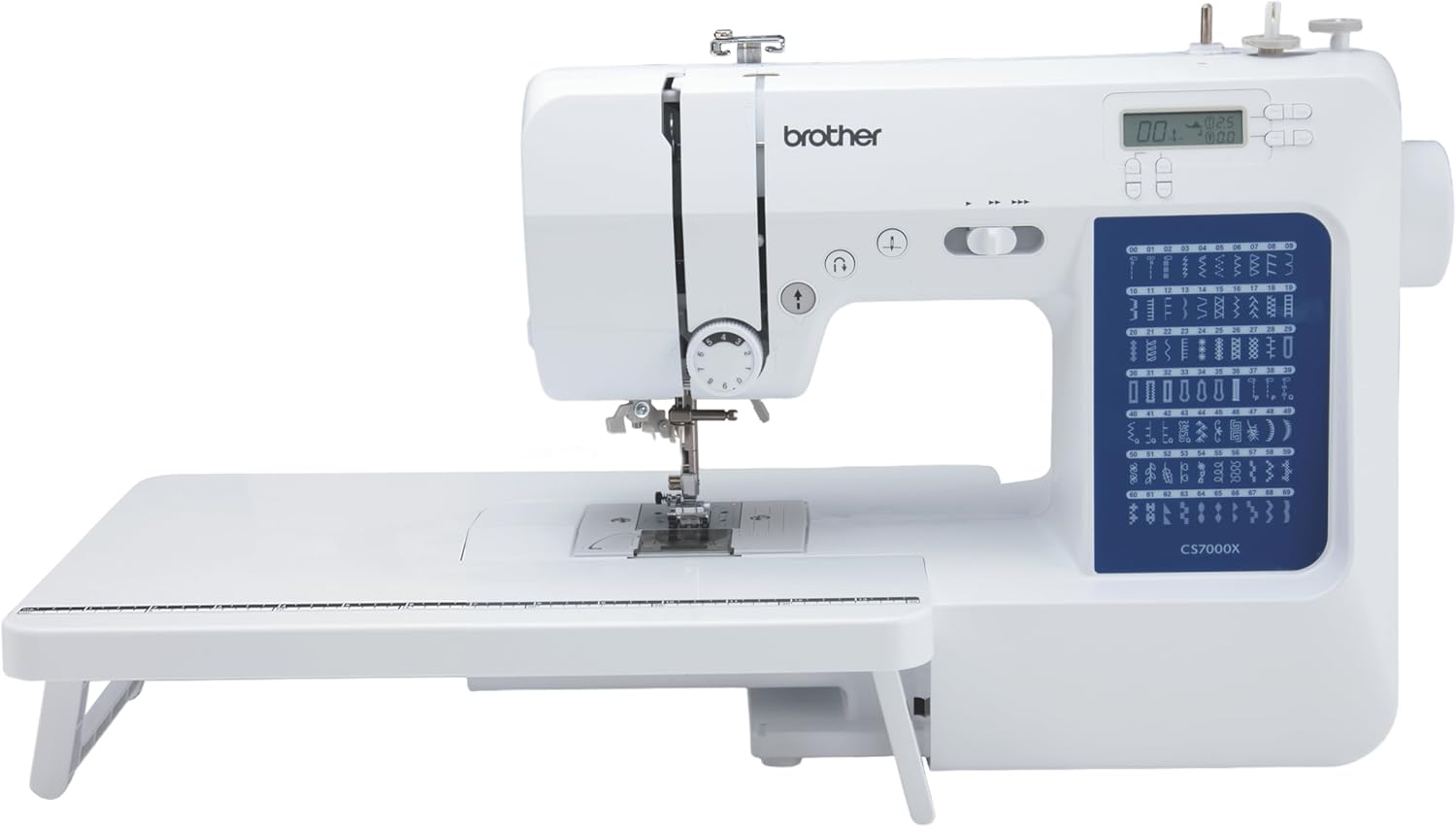
The Brother CS7000X is a computerized sewing and quilting machine with 70 built-in stitches, including utility, decorative, heirloom, quilting, and seven one-step buttonholes. It includes 10 presser feet, a quilt guide, a detachable wide table, a protective hard case, and an improved automatic needle threader. The machine also uses a fixed needle bar and provides a larger needle-to-arm workspace for larger projects.
Check On AmazonIf you click this link and buy, we earn a commission at no additional cost to you.
Know When One Material Should Take Over the Decision
A mixed-fabric article stops being the right tool when one material dominates the workload. If thick stacks and bulky seams are routine, the buying decision should focus on feeding, clearance, and repeated heavy work. If denim is decisive, the seam intersections and garment construction you actually sew deserve their own test. If stretch behavior drives most projects, knit handling and stitch behavior should lead the decision instead.
The shift usually becomes visible before you need a specialist machine. Watch for a recurring material that repeatedly determines which needle and thread system you need, which foot or feed arrangement you reach for, how much clearance you require, or whether the machine must slow down significantly at common seam transitions.
- One material keeps eliminating otherwise suitable candidates: the portfolio is no longer truly balanced.
- The hardest seam appears in normal projects, not rare repairs: it deserves more weight than an occasional edge case.
- Your required needle, thread, feed, or clearance falls outside ordinary domestic use: the machine type may need to change.
- You are planning repeated work that the manual does not clearly support: do not treat a one-off successful sample as proof of suitability.
This boundary matters most with recurring leather, stiff canvas, upholstery assemblies, marine work, or similar jobs. Those requirements can change feed architecture, needle and thread systems, clearance, duty expectations, and service needs enough that a general-purpose domestic comparison is no longer the right frame. Do not force a domestic machine to remain the answer simply because the original search started with “all fabrics.”
Compare Material-Specific Machine Decisions
Once one material becomes the deciding factor, use the narrower comparison that matches it. These pages separate recurring heavy stacks, denim-first buying, and knit-dominant work so the evidence can be evaluated against a more specific job.
| Topic | What you will find |
|---|---|
| Sewing Machine for Heavy Fabrics | How to evaluate recurring bulk, multilayer stacks, feeding, clearance, and the point where heavier work changes the machine decision. |
| Best Denim Sewing Machine | How to make denim seam intersections, hems, repeated layers, and denim-first projects the controlling buying criteria. |
| Sewing Machine for Knits | How stretch behavior, feeding, utility stitches, and knit-dominant sewing change the shortlist. |
The narrower page should take over only when that material truly dominates. If your work remains mixed, keep using the portfolio method and make the hardest recurring condition one filter among several.
Final Thoughts: Choose for the Recurring Fabric Envelope
The useful version of an “all fabrics” machine is not a machine that claims to sew everything. It is a general-purpose domestic machine that fits the materials you actually repeat, survives the hardest recurring seam condition with credible evidence, and still feels sensible for the ordinary work that fills most of your sewing time.
Write the portfolio first, separate routine work from rare extremes, translate each material into a machine requirement, and keep unknowns visible until a representative sample resolves them. If one material changes the required machine architecture, follow that requirement instead of forcing a general-purpose answer.
FAQs
🧵 Can one domestic sewing machine really handle all fabrics?
It can cover a broad home-sewing portfolio, but “all fabrics” should not be taken literally. Judge the machine against your recurring materials, seam geometry, needle and thread needs, and the hardest condition you expect to repeat.
👖 Should denim be the hardest test for a general-purpose machine?
Only if denim is one of your hardest recurring materials. Test the actual condition that matters, such as a folded hem or bulky intersection, because flat denim layers are a different demand.
🧶 Do I need special stitches if I sew knits?
You need stitch options that suit the knit seams you actually make, not the largest possible stitch library. Check the manual for the available utility or stretch stitches and test feeding on a representative knit.
⚙️ Does a heavy-duty label prove a machine can sew thick fabric?
No. Treat the label as positioning, then verify the exact feed system, controls, material wording, manual guidance, and representative sample result before relying on it.
🪡 What should I bring when testing a sewing machine?
Bring the lightest, stretchiest, thickest, and most difficult recurring seam samples from your own portfolio. Keep the needle, thread, layers, seam shape, and settings documented so candidates can be compared on the same job.
🧰 When should I stop looking for one general-purpose domestic machine?
Reconsider the machine type when repeated work requires feed architecture, clearance, needle and thread systems, or duty levels that ordinary domestic machines do not document for that job. The recurring requirement should control the decision, not the wish to keep everything on one machine.
References and Sources
These manufacturer sources are included because the article specifically distinguishes documented specifications from material-capability claims. They support the evidence-status examples without turning those examples into product recommendations.
- Brother ST150HDH product documentation: Documents the manufacturer’s material-range wording, seven-point feed design, included specialty feet, stitch count, and workspace specifications used as an evidence example.
- SINGER Heavy Duty 4423 product documentation: Supports the distinction between a heavy-duty marketing position, listed machine features, warranty language, and material claims.
- JUKI HZL-DX7 product documentation: Documents specific control and needle-plate functions used to illustrate why verified features are not the same as universal material performance.
The sources establish what the manufacturers document. They do not prove performance on any reader’s exact fabric stack, seam geometry, needle, thread, or project.