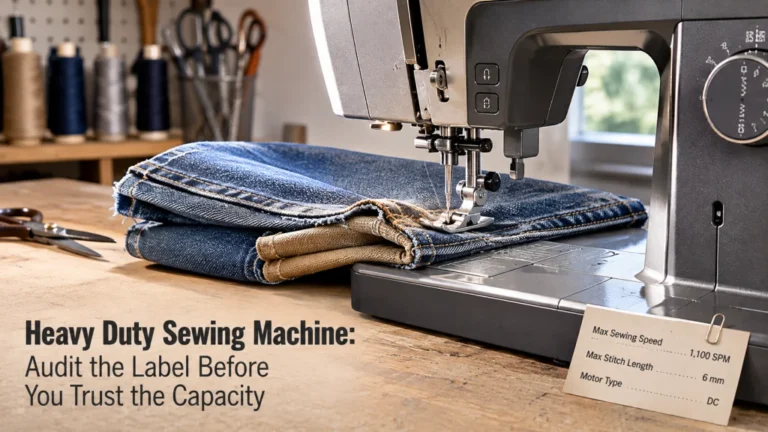
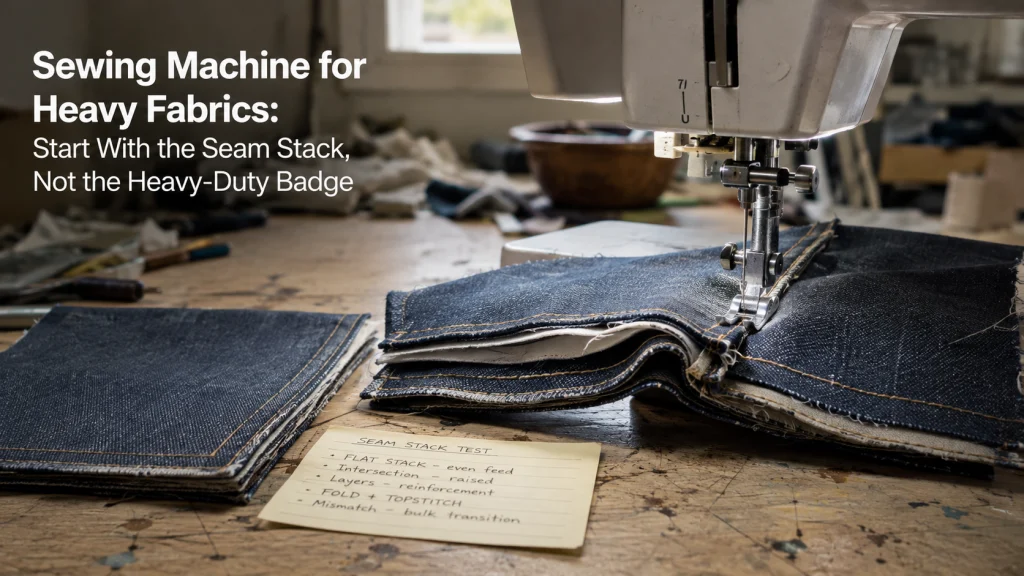
A sewing machine for heavy fabrics should be chosen around the hardest material stack you expect to sew repeatedly, not around a heavy-duty label alone. Fabric type matters, but layer count, compressed bulk, seam intersections, reinforcement, feed behavior, and workload can change the demand far more than a single fabric name suggests. Manufacturer specifications can identify useful features, yet they do not prove that a domestic machine will handle an untested bulky seam or reinforced stack. The practical goal is to describe the work first, separate the machine requirements, and treat any unverified capacity as unknown.
Thick Fabric Is Not a Usable Machine Specification
Two buyers can ask for a sewing machine for heavy fabrics while describing different mechanical problems. One may have compressible fleece layers that remain broad and even under the presser foot. Another may cross a reinforced seam where folded fabric creates an abrupt ridge. The first mainly challenges steady feeding, while the second adds a sudden clearance and feed transition. Success on one stack therefore does not prove success on the other.
The first buying step is to stop describing the job as merely heavy, thick, or durable. Write down the hardest recurring seam, including its material, layers, compression, reinforcement, and frequency. Note whether the difficult point is an even stack or a brief, much thicker transition. That gives you a condition that documentation or disclosed testing can actually address. It also prevents the first-time mistake of treating a heavy-material claim as proof for every bulky construction.
Define the Exact Recurring Material Stack
A useful material-stack brief is more specific than a fabric list. Record the base material, then add lining, batting, interfacing, folded seam allowances, binding, or reinforcement present at the hardest point. Note whether the difficult area stays evenly thick or forms a short hump that the presser foot must climb. Those differences matter because a domestic machine can behave normally on a flat sample and struggle at a seam transition.
Do not invent a layer limit because another sample looks similar. A flat stack does not automatically represent denser fibers, firmer coatings, stiff reinforcement, or a different seam shape, even when overall thickness seems close. If documentation or testing does not match your recurring stack closely enough, mark the condition as unverified. That is less convenient than a simple number, but it is a safer basis for comparison.
Fabric Identity and Construction
Record material construction as well as the common fabric name. Soft fleece, dense woven cloth, coated textiles, and padded assemblies can create different resistance even when all are called thick. Note whether the material compresses, stays firm, feels slick, or gains stiffness from backing. That separates bulk from density, surface control, and seam geometry.
Layers and Compressed Thickness
Count layers at the actual seam rather than only the main fabric pieces. Two panels can become a much larger stack where allowances fold back, lining overlaps, or reinforcement doubles. If thickness is measured, record whether the stack is loose or lightly compressed. The goal is not a universal limit, but a repeatable description for later comparison.
Seam Intersections, Bindings, and Reinforcements
The hardest point is often a short transition rather than the long seam beside it. Crossed seams can tilt the presser foot, while binding and reinforcement can add several local layers. Include those points in any demonstration sample used to evaluate a machine. A flat swatch alone does not test the seam shape that may decide whether the machine fits the work.
Frequency and Session Length
Workload changes the decision even when the stack stays the same. One bulky corner on an occasional cushion cover differs from reinforced joins repeated through a series of bags or covers. In the first case, heavy sewing is an edge condition; in the second, it is routine work. Manufacturer material wording should not be stretched into an unsupported claim about continuous workload or long-term durability. Repeated heavy work therefore deserves closer scrutiny of machine class, service expectations, and documented use.
- Base fabric and construction
- Number of layers at the hardest seam
- Any batting, lining, interfacing, binding, or reinforcement
- Whether the stack is flat, compressible, or an abrupt hump
- How often that hardest seam occurs in normal use
- Whether a documented or witnessed test matches the same conditions
Once this sheet exists, a vague request for a thick-fabric machine becomes a defined comparison problem. Specifications and demonstrations can then be matched to the actual stack instead of to a general idea of strength. Ask whether the evidence covers the condition that matters most. If it does not, capacity remains unknown until better evidence appears.
Separate Four Machine Requirements
Heavy material capacity is easier to judge when it is split into separate requirements instead of one idea called power. The machine needs enough physical room for the stack, appropriate needle penetration, controlled feeding, and stable stitch formation with the thread system the project requires. Failure in any one area can stop the seam even when the other three look adequate. That is why one headline specification rarely gives a complete answer.
Use these four requirements as a matrix when reading documentation or watching a demonstration. Record what the manufacturer documents, what a matched test shows, and what remains unknown for your stack. Do not let evidence from one column prove another: a clearance feature does not establish feed performance, and a feed feature does not establish stitch support. Keeping the categories separate prevents one useful specification from being mistaken for proof of the whole sewing task.
Physical Clearance
Clearance asks whether the project can be positioned under the presser foot without forcing it. Extra lift can help with placement, but fitting a stack beneath the foot does not prove the machine can sew it. A bulky intersection may also change the foot angle and effective feed contact. Treat clearance as an entry condition, not a complete heavy-material rating.
Needle Penetration Without Forcing
Penetration concerns whether the machine can drive the correct needle through the specific stack under normal operation. Motor claims can matter, but they are not tests of every material, seam shape, or needle-and-thread combination. Repeated stalls, strong needle deflection, hard strikes, or a mechanical lock are reasons to stop. Owner-level evaluation should never depend on pulling the work or overriding normal controls.
Feed and Layer Control
Feed behavior determines whether the assembly moves consistently as thickness and surface conditions change. Feed design and presser-foot pressure control can be useful, but their presence does not prove performance on an untested seam. A flat stack may advance normally while a reinforced junction does not. Look for evidence that matches the material and the transition.
Stitch Formation and Thread Envelope
The final requirement is stable stitch formation with the thread and material system the project uses. Heavy material does not automatically justify a particular thread size, needle size, or tension setting. If the project needs a thread range or stitch configuration outside the machine’s support, extra motor language cannot fix that mismatch. The complete stitch system must fit, not only the fabric under the foot.
| Requirement | What to verify | What does not prove it |
|---|---|---|
| Clearance | The real stack fits under normal documented presser-foot operation | An extra-high lift claim by itself |
| Penetration | Matched material and seam evidence under normal operation | Motor wording alone |
| Feed | Controlled movement across the actual layer transition | Feed-dog count or a generic fabric claim alone |
| Stitch formation | The required stitch, needle, and thread system is supported | Maximum speed or stitch count |
The matrix explains why two machines can differ even when both are marketed for heavier home sewing. One may document feed control while another emphasizes speed or lift, and neither difference proves a universal winner. Match the evidence to the failure mode you need to avoid. If a required column lacks matching evidence, keep it marked unknown.
Separate Heavy-Fabric Intent From the Heavy-Duty Product Label
A heavy-fabric buyer starts with a material problem, while a heavy-duty label starts with market positioning. Current US manufacturer pages may describe stronger motors, metal interior frames, higher speed, special feed arrangements, adjustable presser-foot pressure, or heavier-material use. Those features can be relevant, but none eliminates the need to compare documentation with the buyer’s layer stack, seam transition, thread requirement, and workload. A product label therefore belongs after the work is defined, not before it.
This distinction matters because the label can quietly become the proof. A first-time buyer may assume heavy duty means automatic suitability for every thick project, even though the term does not disclose a universal layer count or seam shape. Start with the stack specification and use the label only as a cue to inspect exact documentation. If the documentation does not match the work, the label supplies no missing capacity evidence.

The SINGER Heavy Duty 4423 is a mechanical sewing machine with 23 stitches covering 97 stitch applications. Amazon lists a maximum sewing speed of 1,100 stitches per minute, 50% more power for denim and canvas, and a metal frame. The listing also includes adjustable presser-foot pressure, a stainless-steel bed plate, and a top drop-in bobbin.
Check On AmazonIf you click this link and buy, we earn a commission at no additional cost to you.
Audit Manufacturer Material Claims on Exact Models
Manufacturer pages establish what a company claims about a specific machine and which features it documents. Current US pages for machines aimed at heavier work include explicit material wording and model-specific support features. Those statements are stronger evidence than a generic retailer summary, but they still need to be read literally. They do not automatically define your layer count, reinforcement, seam hump, thread system, or workload.
Record the exact wording and keep it separate from your interpretation. Check the product page, manual, accessory information, and support material for anything that narrows the claim or changes normal operation. Do not transfer a statement from one machine to another simply because the names look related. The strongest claim is the one whose stated conditions resemble your seam-stack brief closely enough to show what is established and what remains unknown.

The Brother ST150HDH is a computerized Strong & Tough machine with 50 built-in stitches, including five auto-size buttonholes. Amazon lists nine sewing feet, heavyweight needles, an advanced needle threader, a drop-in top bobbin, and an LCD screen. Its product content also describes start/stop and reverse buttons, variable speed control, and sewing across multiple layers of heavyweight fabrics and denim through lightweight silks.
Check On AmazonIf you click this link and buy, we earn a commission at no additional cost to you.
Reject Motor, Frame, Speed, and Lift as Standalone Capacity Proof
Motor wording is often treated as a shortcut for thick-fabric capacity, but the motor is only one part of the sewing system. More power may help under some conditions without proving how a machine feeds a stepped seam. A metal internal frame can add structure without proving that feed behavior matches a bulky intersection. Record these specifications, but do not turn them into universal performance tests.
The same limit applies to speed and presser-foot lift. Maximum stitch rate describes operating speed, not reliability across the hardest seam. Extra lift can help position thicker work, but clearance does not prove successful sewing. Turning any one feature into a guaranteed layer capacity without a matching test goes beyond the evidence.
Define What a Useful Independent Test Must Disclose
An independent test is useful only when you can tell what was actually tested. It should identify the machine, material construction, layer arrangement, seam shape, reinforcement, needle, thread, presser foot, stitch, and relevant operating conditions. A statement that a machine went through thick fabric easily cannot be transferred to a different stack. Without disclosed conditions, a dramatic demonstration may provide less decision value than a modest but precise documented claim.
Look for failure information as well as a successful pass. Useful testing reports whether feeding stayed controlled, whether the machine stalled, whether the needle deflected or struck, and whether stitch formation changed at the transition. It should also distinguish a flat stack from a raised seam intersection because those conditions stress different parts of the system. If those details are missing, treat the observation as context rather than a capacity rating.
| Evidence item | Useful disclosure | Decision value |
|---|---|---|
| Manufacturer claim | Exact model and exact material wording | Documents what the maker states |
| Independent test | Machine, material, layers, seam shape, setup, and result | Supports only closely matched conditions |
| Community report | Owned machine, project, symptom, and relevant setup | Reveals real buyer problems, not universal capacity |
| Unknown | No matched documentation or disclosed test | Do not infer a capacity claim |
This ledger keeps weak comparisons from gaining authority through repetition. When reading retailer reviews or owner comments, sort useful observations into the same columns instead of accepting “sews thick fabric” at face value. Community reports can reveal clearance, feeding, or seam-transition problems, but they should identify what deserves verification rather than set a universal limit. Model documentation or closely matched tests should support the buying judgment.
Build a Domestic Shortlist by Documented Heavy-Fabric Requirement
A useful shortlist does not need to begin with named products. Start with the requirements your seam-stack brief makes non-negotiable, then remove any domestic candidate whose documentation cannot answer a required question. One buyer may need evidence around multilayer feeding, while another may care more about occasional bulky clearance combined with normal household sewing. The list should shrink because evidence fits the work, not because one machine collects the most heavy-sounding specifications.
For each candidate, use three evidence states: documented, tested under matching conditions, and unknown. Manufacturer wording belongs in the documented column, a disclosed demonstration of the same stack belongs in tested, and everything else remains unknown. Do not turn a nearby fabric example into a match simply because the machine otherwise looks attractive. This keeps the shortlist usable during later manual checks or in-person demonstrations.
| Shortlist requirement | Documented | Matched test | Unknown |
|---|---|---|---|
| Hardest recurring stack fits under documented operation | Record exact source wording | Record matching sample conditions | Leave unsupported claims unfilled |
| Feeds the actual seam transition | Record feed-control features only | Require a similar raised or reinforced seam | Do not infer from flat fabric |
| Supports needed stitch and thread system | Use exact manual or model specification | Confirm only if test setup is disclosed | Do not extrapolate |
| Fits recurring workload | Use published use and service information | Require meaningful repeated-use evidence | Do not infer durability from frame wording |
Buying nothing can remain a valid outcome. If the current machine handles normal work and the difficult stack is rare, replacement may not be justified. If the hardest stack appears throughout every project, the domestic list may narrow quickly. Once a few candidates survive the evidence checks, compare them against the same stack sheet instead of restarting with broad “heavy-duty” claims. That turns the framework into a practical buying shortlist rather than a reason to postpone the decision.

The Brother ST371HD is a Strong & Tough sewing machine with 37 built-in stitches, including an auto-size buttonhole. Amazon lists an automatic needle threader, a jam-resistant drop-in top bobbin, six sewing feet, a needle set, and a free arm. Its product description also lists a metal needle plate and heavyweight needles for sewing materials ranging from thick outdoor fabrics to lightweight silks.
Check On AmazonIf you click this link and buy, we earn a commission at no additional cost to you.
Mark Every Untested Seam Stack as Unknown
Unknown is a useful result in a category where capacity claims are easy to overstate. If a manufacturer documents heavy-fabric use but does not describe your reinforced seam, the general claim is documented while your exact stack is not. If a reviewer sews a flat stack but never crosses the hump that causes your current problem, the test still does not answer your question. Keeping that limit visible protects the buying decision from false certainty.
This rule also prevents false layer-count comparisons between machines. Several soft layers on one machine cannot be ranked directly against fewer dense or reinforced layers on another unless the conditions are comparable. Compression, coatings, seam geometry, and thread system can change the challenge even when the visible thickness looks similar. When conditions do not line up, state what each source proves and leave the direct capacity comparison unresolved.
Use the Denim Guide When Denim Seam Intersections Dominate
Denim deserves its own buying path when hems, flat-felled seams, waistband intersections, repairs, and repeated denim construction define the hardest work. The difficult point is often where several folded seam allowances meet rather than across the flat body of the fabric. That makes denim-specific evidence more useful than a broad statement that a machine works with heavyweight material. The buyer can then evaluate the recurring seam instead of treating all heavy fabrics as equivalent.
If denim is the recurring constraint, use the denim sewing machine buying criteria rather than turning this page into a denim technique or needle article. The reverse is also important: one occasional pair of jeans should not redefine a household machine purchase if most projects use a broader material mix. Keep technique, needle selection, and troubleshooting in their own topics. Let the hardest recurring job, not the most dramatic one-off seam, control the buying route.
Return to the All-Fabrics Guide When Heavy Fabric Is Only an Occasional Edge Case
A buyer who only occasionally crosses a bulky seam has a different priority from someone who builds heavy stacks repeatedly. Choosing around the rarest condition can sacrifice controls, stitch options, workspace, ease of use, or budget factors that matter far more often. In that situation, start with the all-fabrics sewing machine decision and treat heavier work as one requirement among several. The seam-stack method can still define the edge case precisely without letting it dominate the purchase.
For buyers who have not narrowed the machine type, the broader sewing machine buying framework establishes the overall domestic decision first. This avoids a common first-machine mistake: buying for an imagined worst case while overlooking the projects handled most often. A versatile domestic machine can be the better ownership choice when heavy fabric is occasional and documented limits are respected. The goal is to match the machine to the real distribution of work, not maximize apparent strength.
Move Beyond a General Domestic Machine When the Feed Architecture or Workload Demands It
There is a point where comparing general-purpose domestic machines stops answering the buyer’s problem. Repeated firm, reinforced, bulky assemblies may require a feed architecture, thread system, workspace, control range, or duty expectation that belongs to a more specialized machine class. Reach that boundary from the seam-stack brief and missing requirements, not from the assumption that every heavy material needs specialized equipment. A domestic machine remains appropriate when its documented capability matches the work and workload.
Move beyond the general domestic category when required features or repeated conditions lack supporting evidence. Do not compensate by forcing material, pulling the work, overriding controls, or continuing through stalls, hard needle strikes, abnormal heat, smoke, burning odor, damaged electrical parts, or uncontrolled motion. Follow the exact manual for operation and owner-service limits, and use qualified service beyond those boundaries. The correct outcome may be a different machine class or no purchase until the requirement is better defined.
Final Thoughts: Buy for the Hardest Repeatable Seam, Not the Thick-Fabric Label
The strongest buying brief describes the seam a machine must handle repeatedly, not the features that sound most powerful. Define fabric construction, layer stack, compression, reinforcement, seam transition, stitch system, and workload before comparing domestic candidates. Then verify clearance, penetration, feed, and stitch formation independently so that missing evidence stays visible instead of being hidden by one strong specification. More unknowns on the page are better than invented layer counts or unsupported promises.
Use manufacturer documentation for exact model claims, disclosed testing for matched conditions, and community reports to identify problems worth verifying. If heavy material is occasional, keep the wider ownership decision in view; if denim dominates, use the more specific buying path. When the required feed architecture, thread support, or workload exceeds general domestic capability, change the machine class rather than chase stronger-sounding specifications. The right decision begins with the repeatable seam and ends where the evidence ends.
FAQs
🧵 What should I look for in a sewing machine for heavy fabrics?
Start with your hardest recurring material stack, then verify clearance, penetration evidence, feed control, and the stitch and thread system the project needs. Features such as motor wording, metal framing, high speed, or extra presser-foot lift can matter, but none proves your exact seam by itself.
📚 How many layers of thick fabric can a domestic sewing machine handle?
There is no useful universal layer count because fabric density, compression, coatings, reinforcements, seam geometry, needle, thread, and machine design all change the load. Use only model-specific documentation or disclosed testing that closely matches your actual stack.
⚙️ Does a stronger motor mean a machine can sew thicker seams?
A stronger motor can be a relevant specification, but it does not prove clearance, controlled feeding, supported thread range, or performance at a raised seam intersection. Treat motor information as one part of the evidence rather than a complete capacity rating.
🦶 Does extra presser-foot lift prove a machine is good for bulky projects?
No. Extra lift may help position a bulky stack under the foot, but the machine still has to penetrate, feed, and form stitches correctly once sewing begins.
🧰 When should I stop looking at general domestic machines?
Reconsider the machine class when your recurring stack requires feed architecture, thread support, workload, or operating conditions that domestic candidates do not document or demonstrate under matching conditions. Do not force the project through a machine to compensate for a missing capability.
References and Sources
- SINGER Heavy Duty specifications: Supports the discussion of manufacturer claims involving motor power, sewing speed, adjustable presser-foot pressure, metal framing, heavyweight fabrics, and extra presser-foot lift.
- Brother Strong & Tough specifications: Supports the discussion of manufacturer wording around multiple layers of heavyweight fabrics and documented feed-system design.
- Brother heavy-fabric specifications: Supports the distinction between model-specific heavy-fabric claims and unsupported universal layer limits.
- SewHelp multilayer seam discussion: Illustrates the recurring owner problem of feed difficulty at a thick seam transition, used as community context rather than capacity proof.