A heavy duty sewing machine label is a bundle of manufacturer claims, not a shared capacity standard. Before comparing motors, metal construction, speed, presser-foot lift, or named materials, define the seam stack you actually need to sew and how often you will sew it. Then separate published specifications from manufacturer performance wording and from behavior that has been independently tested under disclosed conditions. If a domestic machine has no evidence for the real seam requirement, the correct result can be no purchase rather than forcing a winner.
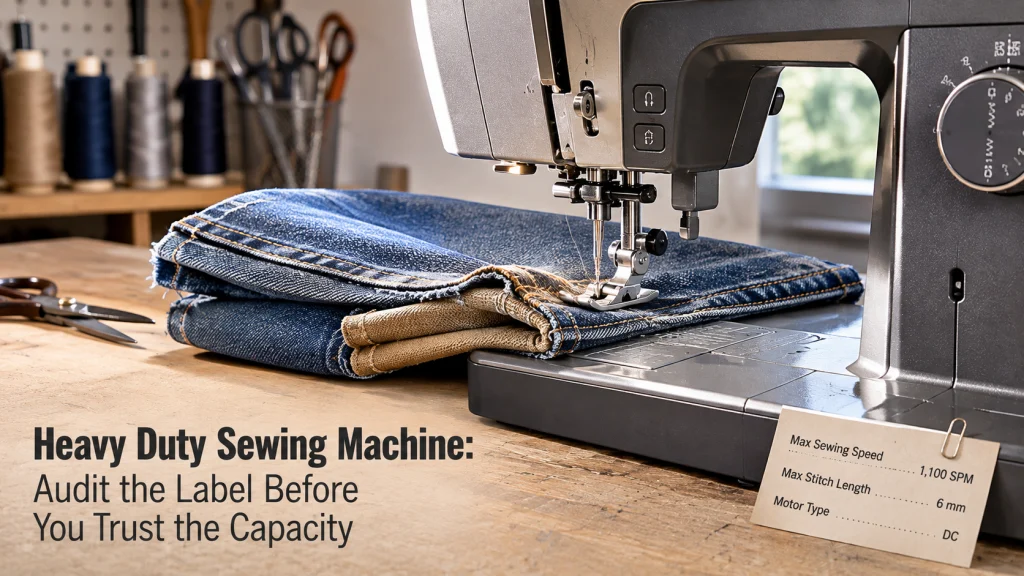
Heavy duty is a claim bundle, not a shared test result
Put three domestic machines carrying heavy-duty language beside each other and the evidence does not line up into one common capacity class. SINGER’s Heavy Duty 4423 page publishes a metal interior frame, adjustable presser-foot pressure, extra-high presser-foot lift, a high-performance motor, and a maximum speed of 1,100 stitches per minute, while also describing use from denim to canvas. The SINGER Heavy Duty 4452 page adds its own power and named-material wording, including denim, leather, and vinyl. Janome’s HD-1000 page takes a different route, listing an all-aluminum interior frame and body, a three-piece feed dog, extra-high presser-foot lift, and a maximum speed of 860 stitches per minute.
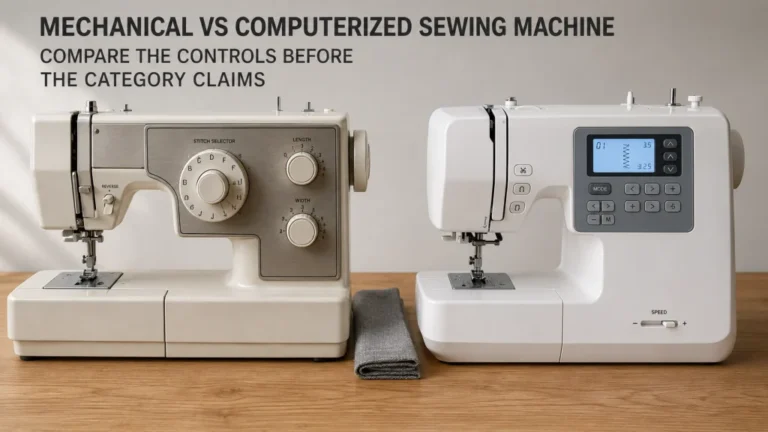
None of those specification bundles, by itself, tells you that the machines have passed the same seam test. That is the core buying problem with a heavy duty sewing machine: the badge is useful as a search category, but capacity still has to be proved claim by claim. If you are still deciding whether mechanical or computerized controls fit your workflow, settle that first with the mechanical versus computerized control comparison so the heavy-duty label does not override a more basic control decision.

SINGER Heavy Duty 4432 is a mechanical sewing machine with 110 stitch applications and a one-step buttonhole. It has a heavy-duty metal frame, adjustable presser-foot pressure, a stainless steel bedplate, and a built-in needle threader. The machine also uses a top drop-in Class 15 bobbin and includes general-purpose, zipper, buttonhole, and button-sewing feet along with other sewing accessories.
Check On AmazonIf you click this link and buy, we earn a commission at no additional cost to you.
Write the actual seam stack and frequency before choosing the product class
Start with the hardest seam the machine must sew repeatedly, not with a fabric name alone. “Denim” could mean a flat two-layer seam on a lightweight garment, a folded hem with several layers meeting at a side seam, or a bulky intersection where seam allowances stack on top of each other. Those are different mechanical demands even though the material label is the same.
Frequency matters too. A home sewist who occasionally repairs a jeans hem has a different requirement from a small maker sewing dense layered seams for long sessions. The buyer should record the actual material, layer arrangement, seam construction, bulky transitions, stitch type, expected needle and thread system, and how often the hard section appears. That requirement becomes the test target against which every heavy-duty claim is judged.
| Requirement field | What to record | Why it changes the decision |
|---|---|---|
| Material identity | Actual fabric or material, not just “heavy” | Different fibers, coatings, density, and surface behavior change needle and feed demands |
| Layer stack | Flat layers plus folded or overlapped sections | A flat stack can be much easier than the real seam intersection |
| Bulky transition | Hem, strap, binding, seam allowance, or folded edge | The machine must climb and feed through the height change, not only pierce a flat sample |
| Frequency | Occasional repair, repeated project step, or sustained production-like use | Repeated workload can change whether a domestic architecture is still the right class |
| Stitch requirement | Straight stitch, zigzag, topstitching, or another required stitch | A machine that handles one straight seam is not automatically suited to every required operation |
This sheet also prevents invented layer-count claims. If a manufacturer does not publish a matching stack and no controlled test reproduces yours, mark capacity as unknown instead of converting a broad material claim into a number.
Separate domestic heavy-duty marketing from specialist or industrial architecture
A domestic machine sold as heavy duty is still a domestic sewing system unless the manufacturer documents a different architecture. Metal framing, higher published speed, stronger-motor wording, extra presser-foot lift, or a thick-material claim does not convert a household machine into an industrial sewing system. The drive system, feed architecture, duty pattern, needle system, presser-foot design, workspace, service expectations, and intended operating environment can be fundamentally different.
This boundary matters when the real requirement is repeated thick leather, dense webbing assemblies, heavy upholstery seams, or another stack that calls for specialist feeding or industrial construction. Do not force a domestic winner because the search began with “heavy duty.” If the required architecture changes, leave the domestic comparison rather than stretching a marketing badge beyond its documented evidence.
| Domestic heavy-duty evidence | What it can support | What it does not prove |
|---|---|---|
| Metal or aluminum construction | Documented construction detail | Industrial duty cycle or verified thick-seam capacity |
| Higher maximum speed | Published top sewing speed | More torque at low speed or better feeding over a bulky transition |
| Extra-high presser-foot lift | More insertion clearance when the foot is raised | That the feed system can advance every material stack placed underneath |
| Named thick-material claim | The manufacturer’s stated intended use | A matched independent test of your seam construction |
The safest classification is based on documented machine architecture and workload fit, not on adjectives. A domestic model can be a useful machine without being treated as an industrial substitute.
Build the claim ledger before you compare candidates
For each candidate, copy the exact claim into a ledger and label what kind of evidence it is. A numerical speed specification is different from “powerful motor.” An interior-frame statement is different from a durability test. A manufacturer saying a model is designed for denim or canvas is useful context, but it is not the same as a disclosed test using your material, needle, thread, seam intersection, stitch, and repetition count.
This is where many comparisons go wrong. Several strong-sounding phrases get stacked together and then converted into a single conclusion such as “handles anything thick.” Keep the claims separate so each one earns only the conclusion it actually supports.
Power or piercing wording
SINGER describes the 4423 with a high-performance motor and publishes stronger-motor wording relative to a standard machine motor. The 4452 page also uses enhanced-power and needle-piercing language. Those statements should remain attributed to SINGER unless a matched independent test measures performance under disclosed conditions. Do not convert a percentage-power claim into a universal layer count, leather grade, torque value, or guarantee that the machine will not stall.
Maximum speed
Maximum stitch speed is one of the easier specifications to compare because manufacturers may publish a number. SINGER lists up to 1,100 stitches per minute for the 4423, while Janome lists 860 stitches per minute for the HD-1000. That difference tells you about maximum published speed, not about piercing force, slow-speed control, seam quality, feed behavior, or performance at a bulky intersection.
Frame and construction
SINGER describes the 4423 as having a heavy-duty metal interior frame. Janome describes the HD-1000 as having an all-aluminum interior frame and body. These are real construction details, but construction material is not a capacity test. A buyer can value chassis design, stability, or serviceability without pretending that a metal frame proves a specific stack will sew successfully.
Lift, pressure, and feed aids
The SINGER 4423 publishes adjustable presser-foot pressure and an extra-high presser-foot lifter. Janome lists extra-high presser-foot lift and a three-piece feed dog on the HD-1000. These features are relevant because presser-foot clearance, pressure control, and feed design affect how material enters and advances through the machine, but none of them alone proves success on the buyer’s hardest seam.
Named material claims
Material wording needs the strongest labeling discipline. SINGER describes the 4423 around heavy-duty projects from denim to canvas and the 4452 with wording that includes denim, leather, and vinyl. Treat those as manufacturer claims about intended use. Without a disclosed test that matches material identity, thickness, layers, seam geometry, needle, thread, foot, stitch, and repetition, do not turn the wording into a broader capacity promise.
Read the exact manual for operating and material boundaries
Product pages sell the capability story; the manual tells you how the machine is actually supposed to be set up and operated. Before purchase, verify the needle system, threading and bobbin requirements, presser-foot controls, stitch-width and length limits, cleaning instructions, owner-accessible maintenance, warnings, and any model-specific conditions that affect thick materials. If the product page makes a broad claim but the manual places a narrower operating boundary around the setup, the narrower instruction controls how the owner should use the machine.
Also check what the manual does not authorize. A heavy-duty badge does not justify forcing the handwheel, pulling material behind the needle, overriding feed behavior, increasing tension without diagnosis, or improvising internal adjustments. The machine still depends on the correct needle, thread, presser foot, stitch, and material handling for the exact seam.
Compare mechanical and computerized controls only after the requirement is fixed
Heavy-duty searches often mix mechanical and computerized domestic machines, but control type is a separate decision from material capacity. A mechanical candidate may offer direct dials and fewer electronic functions, while a computerized candidate may add speed limiting, needle stop control, direct stitch selection, or other electronic conveniences. None of those controls should be used as substitute evidence for thick-seam capability.
If simple direct controls are already the preference, the mechanical sewing machine decision criteria can help confirm that choice. If the requirement is broader than the heavy-duty label, the sewing machine buying framework brings workspace, support, accessories, ownership cost, and machine type back into the decision.

Brother ST150HDH is a computerized Strong & Tough sewing machine with 50 built-in stitches, including five one-step auto-size buttonholes. Its backlit LCD displays stitch selections, and the machine uses a longer seven-point feed-dog system with a box-feed design. It includes nine sewing feet, including a walking foot and quarter-inch piecing foot, along with a pack of heavyweight needles.
Check On AmazonIf you click this link and buy, we earn a commission at no additional cost to you.
Define the test conditions required for any capacity claim
Independent testing can be useful only when the setup is disclosed well enough to reproduce. A statement that a machine “sewed denim” leaves too much unknown. A meaningful record identifies the exact model, material, measurable thickness where available, layer arrangement, seam intersection, needle, thread, foot, stitch, speed approach, number of repeated passes, and what counted as failure.
The point is not to make home testing risky or destructive. It is to prevent an attractive result on an easy flat sample from being treated as proof of a harder recurring seam. Do not force the material or keep sewing through obvious needle deflection, repeated stalls, strikes, jams, heat, smoke, burning odor, damaged electrical parts, or uncontrolled motion.
Material identity and layers
Record the actual material and how it is stacked. Two layers of medium denim are not equivalent to a folded hem that crosses a flat-felled seam, and two pieces of soft garment leather are not equivalent to a dense reinforced strap assembly. If thickness can be measured without distorting the stack, record it; otherwise describe the construction precisely and avoid pretending the fabric name is enough.
Seam intersections and bulky transitions
The hardest part of many projects is the transition, not the flat field. A machine can form a clean straight stitch on several flat layers and still struggle when the presser foot climbs a dense seam intersection. Any capacity test intended to predict real use should reproduce the height change and seam geometry that the buyer actually encounters.
Needle, thread, foot, and stitch
Capacity results are inseparable from setup. A correct needle system and size, suitable thread, compatible presser foot, and appropriate stitch can change how the machine behaves. Record all four so a successful or failed result does not get attributed entirely to the machine when the setup changed between tests.
Failure and stop conditions
Define failure before testing begins: skipped stitches, inability to feed, repeated stalls, unacceptable needle deflection, hard strikes, jammed motion, or another documented stop condition. Stop when a safety boundary is reached. Do not hand-pull the work behind the needle or use force to convert a failed test into a pass.
Reject flat-stack demonstrations that do not match the real seam
A flat stack is easy to photograph and easy to count, which is why it appears so often in thick-material demonstrations. It can still be the wrong test. The seam that defeats a machine may be the moment the foot climbs from two layers to a folded intersection, when a binding crosses a strap, or when a dense seam allowance changes both height and feed resistance.
Before giving any demonstration weight in the buying decision, ask whether the sample reproduces your difficult transition. If not, record it as evidence for that flat sample only. This single rule prevents a large number of exaggerated capacity conclusions without requiring you to dismiss useful test data entirely.
Verify warranty, service, and consumables
A domestic machine intended for harder work still has ordinary ownership costs. Check the exact warranty terms, which components receive which coverage, what conditions can exclude coverage, and how authorized service is obtained. A large headline warranty number is less useful than knowing what the motor, electronics where present, mechanical parts, labor, and normal wear items actually receive under the current terms.
Also verify bobbins, needles, presser-foot compatibility, belts or other service parts where applicable, and whether manuals and support documentation remain easy to obtain. A candidate that meets the seam requirement but has an unclear service path can be a weaker ownership fit than a machine with less dramatic marketing and better documented support.
Compare current heavy-duty labels by documented requirement
The table below is an evidence comparison, not a ranking or a set of product recommendations. It shows how different current domestic machines can wear heavy-duty language while publishing different kinds of proof. The useful question is whether any row satisfies the seam requirement you wrote down earlier.
| Model example | Documented evidence | Capacity still unproven without matched testing |
|---|---|---|
| SINGER Heavy Duty 4423 | Metal interior frame, 1,100-stitch-per-minute maximum, adjustable presser-foot pressure, extra-high lift, manufacturer denim-to-canvas wording | Your exact thick seam, bulky transition, repeated workload, low-speed behavior, and durability under that workload |
| SINGER Heavy Duty 4452 | Heavy-duty metal frame, enhanced-power wording, extra-high speed, adjustable presser-foot pressure, manufacturer material wording that includes denim, leather, and vinyl | Your exact leather, vinyl, denim, or layered assembly and the conditions under which it remains repeatable |
| Janome HD-1000 | All-aluminum interior frame and body, 860-stitch-per-minute maximum, three-piece feed dog, extra-high presser-foot lift, mechanical controls | A specific thick-material stack or claim that Janome has not documented or independently tested under matching conditions |
A buyer looking for the best heavy duty sewing machine should not score the table by counting bold-sounding claims. Score it against the required seam, control preference, support path, and evidence quality. If no candidate has enough evidence for the actual work, leave the capacity cell marked unknown.

Janome HD1000 is a mechanical sewing machine with an aluminum interior frame and body, 14 built-in stitches, and a four-step buttonhole. It uses dial stitch selection and includes a built-in needle threader, three-piece feed dog, drop feed, free arm, and extra-high presser-foot lift. The machine also comes with a hard cover and uses a front-loading vertical oscillating-hook bobbin system.
Check On AmazonIf you click this link and buy, we earn a commission at no additional cost to you.
Mark every untested capacity as unknown
“Unknown” is a useful result, not a failure to choose. If a product page says “thick fabrics” but never defines the stack, keep the material envelope unknown. If a review shows several flat layers but your project has a bulky intersection, keep transition performance unknown. If a metal-frame claim has no matched endurance test, keep long-session durability unknown.
This also makes heavy duty sewing machine recommendations more trustworthy because it stops one type of evidence from being stretched into another. A specification can verify speed, a manual can verify operating limits, and a controlled test can verify behavior under its disclosed setup. None should impersonate the others.
| Claim | Evidence status | Decision treatment |
|---|---|---|
| Manufacturer publishes maximum speed | Verified specification | Use for speed comparison only |
| Manufacturer names denim, canvas, leather, or vinyl | Attributed manufacturer claim | Do not convert to a layer count or universal capacity |
| Independent test discloses a matching seam and setup | Observed behavior under stated conditions | Use only within those conditions |
| No matched evidence for the real seam | Unknown | Do not award capacity credit |
An exclusion log is equally useful. Write down why a candidate left the comparison, such as missing evidence for the required seam, unsuitable control type, inadequate workspace, unclear support, incompatible accessory requirement, or a workload that belongs in a different machine architecture.
Route specialist or industrial work out when the architecture changes
There is a point where more domestic-machine comparison stops helping. If the project depends on a specialist feed system, repeated dense assemblies, a different needle system, sustained high-load work, or another requirement that materially changes the machine architecture, the next comparison should be among machines built around that architecture. Keeping a domestic model in the race because its badge says heavy duty only delays the real decision.
The correct outcome can therefore be “none of these.” That is especially important for commercial-investigation content because a forced winner is less useful than a clean boundary. Buy within the domestic category only when the documented envelope matches the work you described at the start.
Final Thoughts: Buy the documented envelope, not the badge
A heavy-duty label deserves to be audited, not automatically trusted or dismissed. Record the seam stack and frequency, separate specifications from performance wording, read the exact manual, and demand disclosed test conditions before accepting a real capacity claim. Speed, metal construction, stronger-motor language, extra lift, and named materials can all be relevant, but each proves only what its source actually documents.
If a domestic candidate matches the real requirement, good. If the difficult seam remains untested, mark it unknown. If the workload requires a different architecture, stop trying to make a domestic badge do the work of a specialist machine. That discipline is more valuable than any one heavy-duty label.
Frequently Asked Questions
🧵 What makes a sewing machine heavy duty?
There is no single shared public capacity test behind every domestic heavy-duty label. Check the exact manufacturer’s claims for construction, speed, power wording, feed or presser-foot features, material wording, manual limits, and any disclosed testing.
👖 Does heavy duty mean a machine can sew any denim seam?
No. A flat denim sample and a bulky folded seam intersection are different requirements. Capacity should be matched to the actual material, layer stack, transition, needle, thread, foot, stitch, and frequency.
⚙️ Does a metal frame prove better thick-fabric capacity?
No. A metal or aluminum frame is a construction specification, not a matched material-capacity test. Do not infer a universal layer count, industrial duty cycle, or leather capability from frame material alone.
🚀 Does a higher stitch speed mean more piercing power?
Not by itself. Maximum speed describes top sewing speed, while piercing behavior and feed over a bulky transition depend on other machine, setup, and material conditions.
👜 Can I trust heavy duty sewing machine recommendations for leather?
Only when the claim names the exact machine and discloses the leather type, thickness or construction, layers, seam geometry, needle, thread, foot, stitch, and test conditions. Manufacturer material wording should remain clearly attributed unless matched testing supports a broader conclusion.
🛑 When should I stop a thick-material test?
Stop for clear needle deflection or strikes, repeated stalls or jams, abnormal heat, smoke, burning odor, damaged electrical parts, uncontrolled motion, or any condition the manual says requires service. Do not pull the material behind the needle or force the handwheel to make the machine continue.
References and Sources
- SINGER Heavy Duty 4423 specifications: Verifies the model’s published motor, speed, metal-frame, presser-foot, workspace, bobbin, and denim-to-canvas claims.
- SINGER Heavy Duty 4452 specifications: Verifies the model’s published power wording, speed language, presser-foot pressure, and named-material claims.
- Janome HD-1000 specifications: Verifies the model’s aluminum construction, feed system, extra-high presser-foot lift, maximum speed, controls, workspace, and accessory interface.