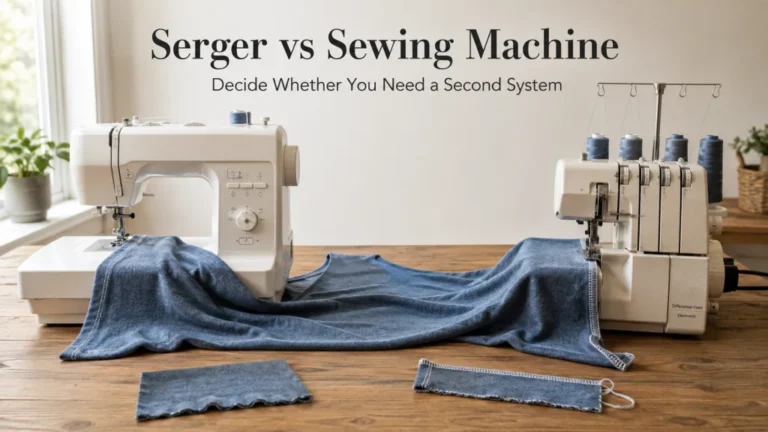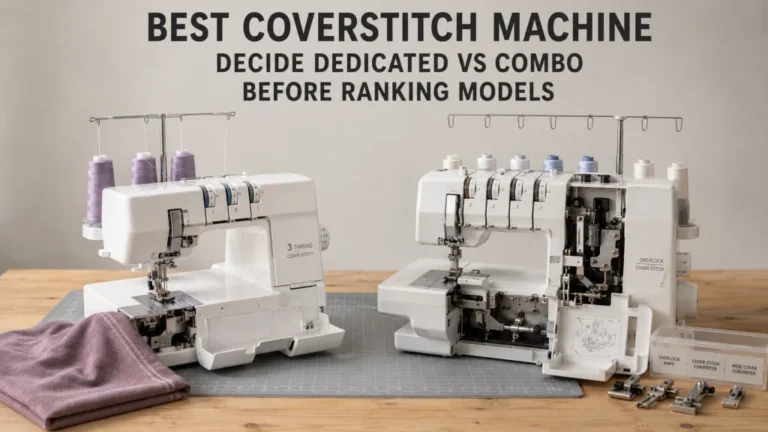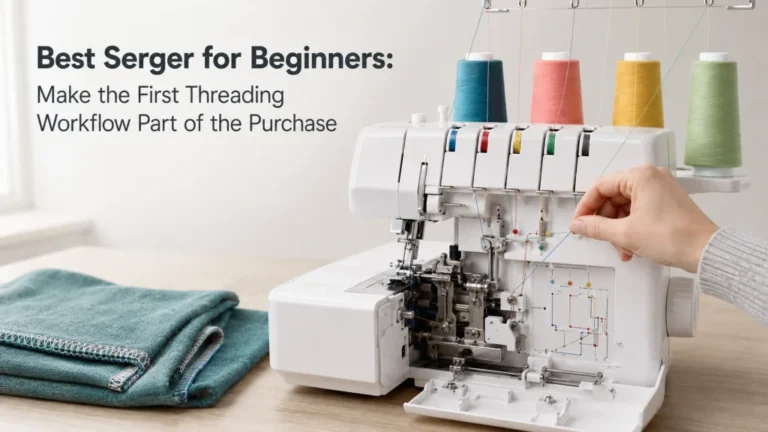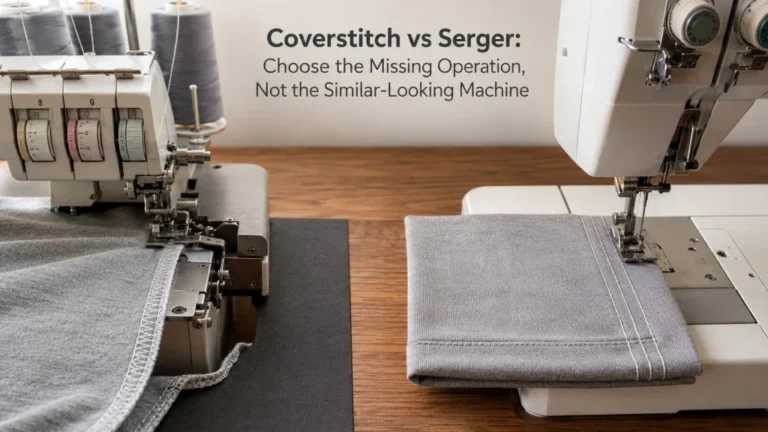
A serger coverstitch combo can reduce the number of machine bodies in a sewing space, but it also turns every switch between overlocking and coverstitching into part of the ownership workflow. Separate machines take more room and usually require a larger total equipment commitment, yet each function can remain threaded and ready when the project alternates between seam finishing and cover hems. The useful buying test is therefore not stitch count alone, but how often you change modes, what the exact conversion requires, how much working space you actually have, and what happens when the only specialist machine is unavailable. Choose the ownership architecture first, then compare individual machines within that architecture.
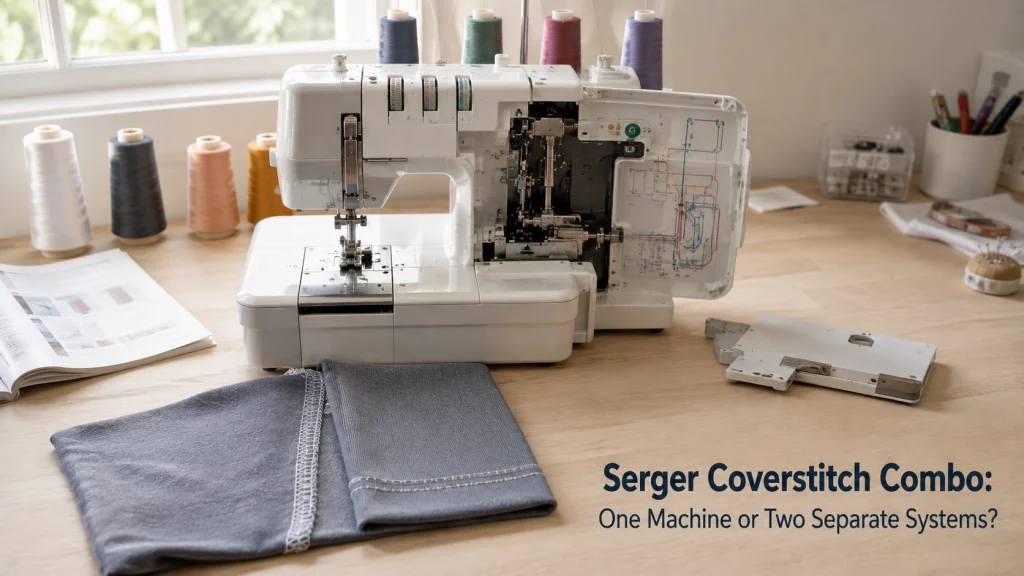
One chassis saves space but creates a switching workflow
A serger coverstitch combo puts overlock, coverstitch, chainstitch, and sometimes combination stitches into one machine body. That can fit a tight sewing space, but one chassis cannot stay permanently set for two modes at once.
Picture a garment that moves from overlocked seams to a cover hem, back to edge finishing, then to coverstitching again. Two dedicated machines can stay prepared for their jobs. A combo makes each change of function part of the project rhythm.
This article starts after you already know both functions are useful. If that is still uncertain, compare coverstitch and serger functions before deciding how to own them. The broader specialist sewing machine types overview also helps place these systems beside ordinary domestic machines without treating them as interchangeable.
Confirm that both functions are genuinely needed
Do not buy a combination architecture merely because it offers more stitches. The ownership decision only becomes relevant when your actual sewing calls for both edge-finishing overlock work and cover or chain stitching often enough to justify having both capabilities available. A machine with a long feature list is not automatically a better fit if one half of that feature set rarely leaves the manual.
A useful first pass is to write down the garment operations you expect to repeat. Overlocking raw knit edges, assembling stretch seams, finishing seam allowances, cover hemming T-shirts, topstitching stretch garments, or using chainstitch for a specific construction purpose are different jobs. If the cover function is only hypothetical, postponing that second system can be more sensible than forcing both functions into the first purchase.
- List the overlock operations you already perform or clearly expect to perform.
- List the coverstitch or chainstitch operations that would solve a real project need.
- Mark which operations occur on the same garments.
- Mark which operations alternate during the same sewing session.
- Leave speculative “maybe someday” stitches out of the core buying decision.
The result should tell you whether you are solving a real two-function problem. If you are, the next issue is not capability but availability: whether one chassis can support the way you move through a project.
Separate combo capability from simultaneous availability
A combo machine can contain both stitch systems without making them instantly available. Moving from overlock to coverstitch can require model-specific changes to threading, needles, covers, the knife state, or settings. That differs from two dedicated machines already prepared side by side.
Batch sewing may reduce those changes by finishing many edges before switching once to hems. Completing one garment at a time can create more back-and-forth, making the conversion routine more important.
Ownership test: Do not ask only, “Can this machine make both stitches?” Ask, “How often will I need both stitch systems available without reconfiguring the machine between them?”
That question is also why a combo machine cannot be judged by footprint alone. One chassis is physically compact compared with two machines sitting out, but simultaneous availability is a workflow feature that separate systems provide by design.

The Brother 2340CV is a dedicated coverstitch machine with a metal frame and multiple coverstitch configurations. Its listing specifies narrow and wide two-needle cover stitches, a tri-cover stitch, color-coded threading, a fast looper threading system, and differential feed. The machine sews at speeds up to 1,100 stitches per minute and includes snap-on presser feet.
Check On AmazonIf you click this link and buy, we earn a commission at no additional cost to you.
Count how often your workflow changes modes
Conversion frequency comes from your own sewing sequence rather than a marketing claim. Map one representative project and count each point where the next operation requires the other stitch system.
A batch workflow may overlock all pieces before moving to cover hems, creating few mode changes. A single-garment workflow may alternate several times. Both are valid, but they put different pressure on a combo setup.
| Project step | Function needed | Mode change? | Can work be batched? |
|---|---|---|---|
| Join or finish stretch seams | Overlock | Record from previous step | Often possible |
| Finish a knit hem | Coverstitch | Record if coming from overlock | Often possible across several pieces |
| Return to edge finishing | Overlock | Record if machine is in cover mode | Depends on construction order |
| Topstitch or bind with cover stitch | Coverstitch | Record if machine is in overlock mode | Depends on project design |
Use the worksheet on a real project order, not an idealized one. If the count is low because you naturally batch operations, a combo architecture may fit comfortably. If the count is high and you dislike reorganizing construction order around the machine, two ready systems deserve more weight.
Read the exact conversion procedure before comparing price
Conversion difficulty is model-specific because current machines use different threading systems, controls, covers, knife mechanisms, and guidance interfaces. Compare the documented procedure for the exact machine rather than treating every combo design as the same.
Follow that machine’s instructions for power state, needles, loopers, knife position, covers, inserts, threading, and stitch-specific setup. The audit below records what ownership requires without turning the article into a conversion tutorial.
Thread-path changes
Start by identifying which threads remain in use and which paths change when the machine moves between overlock and cover or chain stitching. Some current systems use assisted or air threading for loopers, while others use manual color-coded paths and dedicated looper access. The feature name matters less than what the exact conversion requires from a fully known starting mode.
Record whether you need to remove threads, reroute them, add a chain looper path, or change which needle threads are active. Do not assign a convenience score until the documentation makes those changes clear.
Needle-position changes
Different stitch families can require different needle positions or different numbers of needles. That means a conversion audit should record whether needles are physically moved, added, or removed rather than treating “threading” as the entire task. Needle handling also has to follow the exact machine instructions, including the specified needle system and tightening procedure.
A buyer who frequently switches modes should consider how often those needle changes would occur in the planned workflow. The issue is repetition, not whether one needle change sounds difficult in isolation.
Knife or cover changes where applicable
Overlocking normally uses an edge-cutting system, while coverstitching works across a folded or otherwise positioned fabric area without trimming it in the same way. Current combo designs therefore document how the knife is disengaged or positioned and how the sewing area is prepared for cover or chain stitching. The exact mechanism differs by machine.
Record each cover, insert, or knife-state change named in the documentation. Small removable pieces are also storage items, so the conversion audit should include where those pieces will live when they are not installed.
Presser-foot or table insert changes where applicable
Some machines use a common foot across multiple stitch families, while others document different inserts or accessories for specific setups. A coverstitch insert can change the shape or support of the work area even when the machine body stays the same.
Count only changes the documentation requires. Optional accessories belong in the audit only when the selected stitch actually depends on them.
| Conversion item | What the exact manual says | Change required? | Unknowns to test |
|---|---|---|---|
| Looper threading | Record the documented path or assisted-threading method | Yes / No / Depends on stitch | Ease from a fully unthreaded or opposite-mode start |
| Needles | Record positions and needle count | Yes / No / Depends on stitch | Comfort handling repeated changes |
| Knife state | Record documented engage or disengage action | Yes / No / Not applicable | How clearly the state is confirmed |
| Covers or inserts | Record required pieces | Yes / No / Depends on mode | Storage and handling during frequent switching |
| Stitch settings | Record manual or guided settings | Manual / Assisted / Automatic defaults | What still needs adjustment on your fabric |
Leave unanswered fields blank or mark them “Unknown until tested.” That keeps the audit useful without turning promotional wording into a personal-use conclusion.
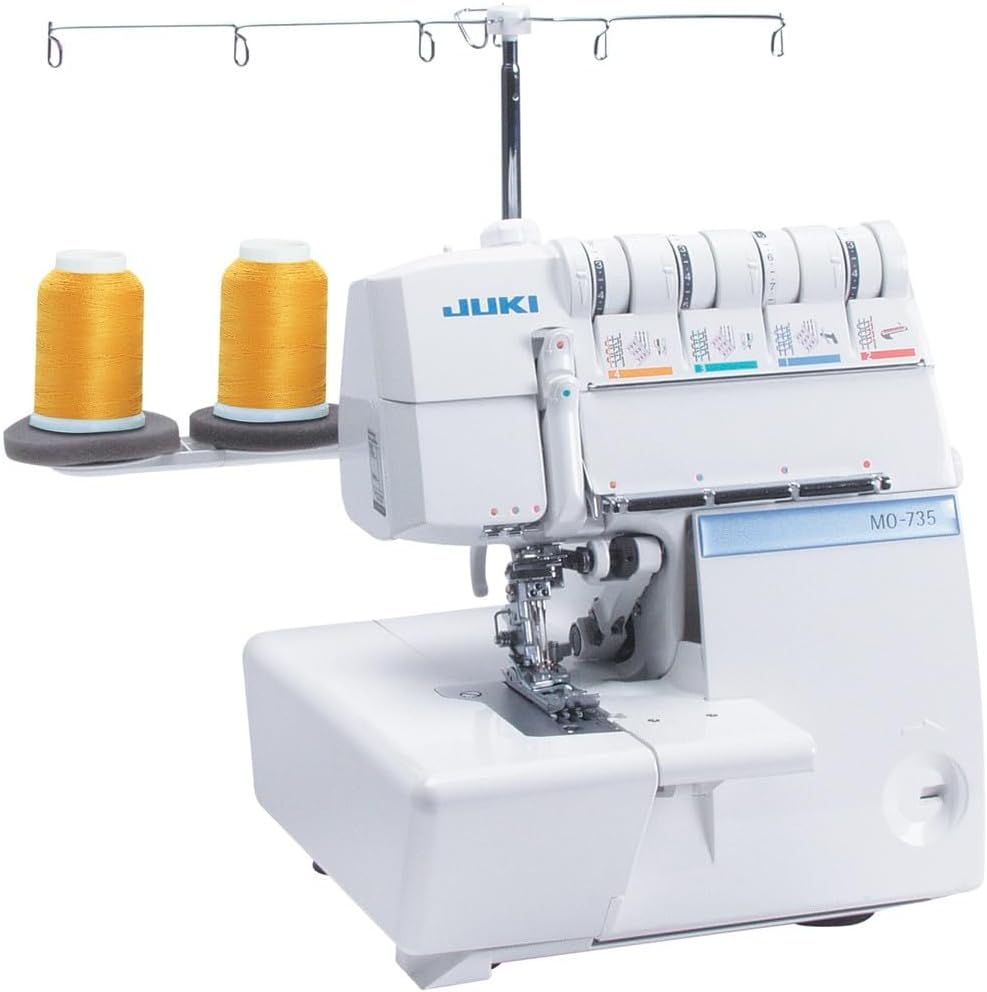
The JUKI MO-735 combines serging and cover hem functions in a 5-thread machine. Its listing includes 2- and 3-needle bottom coverstitch configurations, chainstitch capability, a 5-thread safety stitch, and chain looper threading. A multi-function presser foot is also included for several sewing operations.
Check On AmazonIf you click this link and buy, we earn a commission at no additional cost to you.
Compare one-machine space with two-machine working space
A single combo chassis usually takes less parked space than two machines side by side, but sewing also needs fabric clearance, thread-cone room, removable-table space, and access for threading and conversion. A machine that fits a shelf can still be awkward if the work area must be rebuilt for every use.
Two dedicated systems use more working width when both stay out. If one is stored, the comparison shifts to storage access and whether retrieving it is practical enough that the second function remains useful.
Current manufacturer documentation shows why the measurement needs more than one field. JUKI publishes the MO-735 machine body at 12 inches wide by 10.25 inches deep by 11.5 inches high and lists a wide table as an optional accessory. bernette publishes 130 mm of space to the right of the needle on the 68 AIRLOCK, includes a slide-on table, and identifies an integrated freearm. BERNINA publishes 5 5/8 inches to the right of the needle on the L 890, includes an extension table, and identifies a freearm for tubular work. Those figures describe different parts of the workspace, so do not treat one dimension as a complete room-planning number.
Space therefore favors a combo most strongly when one permanent workstation genuinely cannot accommodate two ready machines. If the second machine can stay nearby and ready without disrupting the room, simultaneous availability becomes more valuable than the raw footprint difference.

The bernette 48 FUNLOCK combines overlock and coverstitch functions in one machine with 23 stitch options. Its listing specifies 87 mm of working area to the right of the needles, color-coded threading paths, mechanical threading for the lower and chain loopers, and an adjustable knife. It supports sewing speeds up to 1,300 stitches per minute.
Check On AmazonIf you click this link and buy, we earn a commission at no additional cost to you.
Count service concentration and downtime
One combination machine concentrates both specialist functions into one service dependency. If it is unavailable for inspection or repair, both functions leave the workstation unless another machine can substitute. Two dedicated machines separate that dependency.
This does not mean combo machines are less reliable. The ownership point is simply that one chassis carries both functions, while servicing one of two dedicated machines can leave the other specialist system available.
Service boundary: Follow the exact machine instructions for cleaning, oiling, knife handling, covers, needles, and mode conversion. Stop and use qualified service for damaged cords, overheating, smoke, burning odor, sparks, uncontrolled motion, a hard mechanical lock, repeated hard needle strikes, or work the manufacturer reserves for service personnel.
| Ownership setup | If one machine is unavailable | What remains usable | What to check before buying |
|---|---|---|---|
| One combo machine | Both specialist functions may leave the workstation together | Only other machines you already own | Local service access, parts support, backup workflow |
| Two dedicated machines | One specialist function is affected | The other dedicated system remains available | Service access for both machines, total maintenance burden |
For a home sewist who works around deadlines or sells small batches, that concentration may deserve more weight. For occasional personal sewing, the same downtime may be less important than saving permanent workspace.
Compare current combo architectures by documented workflow
Current home combo systems show why the architecture cannot be reduced to one generic conversion description. The examples below are documentation references, not product recommendations or rankings. They illustrate different ways manufacturers handle threading, stitch guidance, knife state, and coverstitch preparation.
| Documentation example | Documented architecture | Conversion-relevant evidence | Workspace evidence | Still unknown without hands-on use |
|---|---|---|---|---|
| JUKI MO-735 | Manual lay-in and color-coded threading with overlock, chainstitch, and coverstitch capability | Manufacturer documents chain-looper access, an upper knife that can be released, and a cover/chain stitch extension plate among the supplied equipment | 12 in W x 10.25 in D x 11.5 in H machine body; optional wide table listed. The reviewed product page does not publish a right-of-needle workspace figure or identify a freearm feature. | How repeated mode changes feel in your normal project sequence |
| bernette 68 AIRLOCK | Overlock, cover, chain, and combo stitches with automatic air threading for loopers | Manufacturer support provides separate conversion tutorials and the manual identifies coverstitch inserts, knife-cover changes, and mode preparation | 130 mm of space to the right of the needle, integrated freearm, and included slide-on table | Whether those documented changes are acceptable at your switching frequency |
| BERNINA L 890 | Air-threaded loopers with screen-based stitch selection and guided or expert operation | Manufacturer documents guided setup, automatic default settings for selected stitches, external knife control, and an upper-looper control used when switching toward coverstitch sewing | 5 5/8 in to the right of the needle, freearm, and included extension table | Whether the interface and physical changes feel faster or clearer to you in person |
The table is useful because it exposes different ownership routines side by side. Preference still depends on how those documented steps fit your sewing sequence.
Keep stitch count separate from conversion convenience
A large stitch count describes capability, not how often you will reconfigure the machine. Two combo systems can cover the same core jobs while presenting them through very different controls and threading paths.
Write your required stitches before looking at the total. A basic overlock seam, the cover width you use for hems, chainstitch if genuinely needed, and any specific combination seam should be treated as requirements only when the project calls for them. Extra decorative or specialty stitches can be useful, but they should not compensate for a switching workflow that conflicts with the way you sew.
Automatic defaults, guided screens, air threading, and color-coded paths can reduce specific setup tasks. Compare them inside the complete conversion sequence rather than treating any one feature as a shortcut for the whole ownership experience.
Mark subjective convenience claims as unverified until tested
Words such as easy, fast, intuitive, and cumbersome describe an experience rather than a measurable specification. Record concrete features such as air threading, guided controls, knife access, or removable inserts, then keep personal convenience as a separate field.
If possible, use an in-person demonstration to resolve subjective fields. Start from a known overlock setup, follow the documented changes for the coverstitch you expect to use, then reverse the process. Judge clarity and repeatability, not speed.
- Can you identify every thread-path change without guessing?
- Are required needle changes clear and physically manageable?
- Can you confirm the knife and cover state without uncertainty?
- Are removable inserts easy to identify and store?
- Does returning to the original mode feel like a routine you would actually repeat?
Leave convenience as “unknown” if you cannot test it. That is a more accurate buying record than turning someone else’s preference into a universal claim.
Decide between one combo, two dedicated machines, or postponing one system
A combo makes the strongest case when both functions are needed, permanent space is limited, switches are infrequent or batchable, and the documented conversion looks acceptable. Two dedicated machines deserve more weight when both functions are used often, switching is frequent, and there is enough working space to keep both ready.
A third answer is to buy only the function that solves the immediate problem and postpone the other when its need is still speculative. More capability is not automatically a better ownership decision.
| If this describes your workflow | Architecture to investigate first | Reason |
|---|---|---|
| Both functions are used, space is tight, switches can be batched | One combo system | One chassis may solve the space constraint without constant reconfiguration |
| Both functions are used repeatedly and alternate often | Two dedicated systems | Each function can remain ready without converting one machine back and forth |
| Only one function has a clear current job | Postpone the second system | A speculative feature does not need to drive the purchase |
| Conversion comfort remains unknown | Test before choosing architecture | The unresolved issue is workflow, not another specification |
If the dedicated-coverstitch route wins, compare coverstitch machines more broadly using the actual hem workflow and support requirements you have now defined. If you discover that only one of the two specialist functions is truly necessary, return to the functional comparison instead of forcing a two-system purchase.

The Brother ST4031HD is a 3- or 4-thread dedicated serger built around a sturdy metal frame. Its listing specifies an extra-hard carbon-steel cutting blade, color-coded thread guides, numbered upper and lower loopers, and sewing speeds up to 1,300 stitches per minute. It includes standard, blind-stitch, and gathering feet plus a large extension table.
Check On AmazonIf you click this link and buy, we earn a commission at no additional cost to you.
Final Thoughts: buy around switching frequency
The one-machine-versus-two-machines decision is mainly an ownership workflow problem. A combo chassis can make excellent sense when space matters and you can group similar operations together, while separate systems can make more sense when overlocking and coverstitching alternate often enough that permanent readiness is valuable. Neither architecture is automatically cheaper, easier, more reliable, or more capable for every sewist.
Before choosing a machine, write the mode-switch count for a real project, read the exact conversion instructions, measure the working space rather than only the machine body, and decide how much service concentration matters to you. Those checks turn a vague pro-and-con comparison into a purchase decision tied to the way you actually sew.
Frequently Asked Questions
The questions below focus on the ownership decision, not on teaching a conversion procedure. Exact setup steps always come from the manual for the machine being considered.
🧵 Is a serger coverstitch combo harder to use than two separate machines?
Not automatically. The relevant difference is that a combo system may need reconfiguration when you move between stitch families, while separate machines can remain set for their individual jobs. Judge the exact conversion process and your switching frequency rather than the machine category alone.
🔄 How often is too often to switch between serger and coverstitch modes?
There is no universal threshold. Map one representative project and count the changes, then decide whether those changes can be batched or would repeatedly interrupt your preferred construction order.
📐 Does a combo machine always save sewing-room space?
It reduces the number of machine bodies, but practical space also includes fabric clearance, thread cones, inserts, removable tables, and access for threading. Compare the full working positions, not just cabinet dimensions.
🪡 Do all combo machines convert the same way?
No. Thread paths, needle positions, knife controls, covers, inserts, and guided settings can vary by model. Compare each machine’s documented conversion sequence rather than assuming one routine applies to the whole category.
⚙️ Does air threading eliminate mode conversion?
No. Air threading can simplify a documented looper-threading task on machines that provide it, but conversion may still involve needles, thread routing, the knife, covers, inserts, and stitch settings.
🧰 What happens if my only combo machine needs service?
Both specialist functions carried by that chassis may be unavailable while it is in service. Two dedicated machines separate that dependency, although each still has its own service and maintenance requirements.
✂️ Should I buy separate machines if I sew many knit garments?
Not based on fabric type alone. Separate systems become more compelling when your garment workflow uses both functions frequently and alternates between them enough that permanent readiness matters.
If the decision still feels unresolved after the specification comparison, the missing evidence is probably experiential. A manual-defined demonstration of the exact mode change you expect to repeat is more useful at that point than adding another feature to the comparison sheet.
References and Sources
These manufacturer sources are included because the article compares model-specific threading and conversion architecture. They verify documented functions and setup components, not subjective convenience or a recommendation to buy any particular model.
- JUKI MO-735 product documentation: verifies stitch capability, threading architecture, knife control, machine dimensions, supplied cover/chain components, and the optional wide table.
- bernette 68 AIRLOCK product documentation: verifies its combo stitch system, air looper threading, 130 mm working area, freearm, slide-on table, and current manufacturer support links.
- bernette 68 AIRLOCK user manual: documents machine covers, coverstitch inserts, and mode-preparation sections used in the conversion audit.
- BERNINA L 890 product documentation: verifies guided setup, air looper threading, knife and upper-looper controls, 5 5/8-inch right-of-needle space, freearm, and extension table.
Manufacturer documentation can establish what a machine requires, but it cannot prove how convenient repeated conversion will feel in a particular sewing workflow. Keep that distinction when comparing any additional combo system.