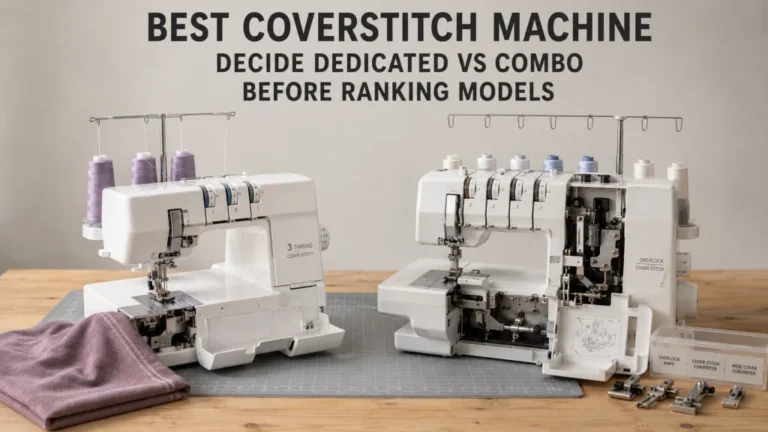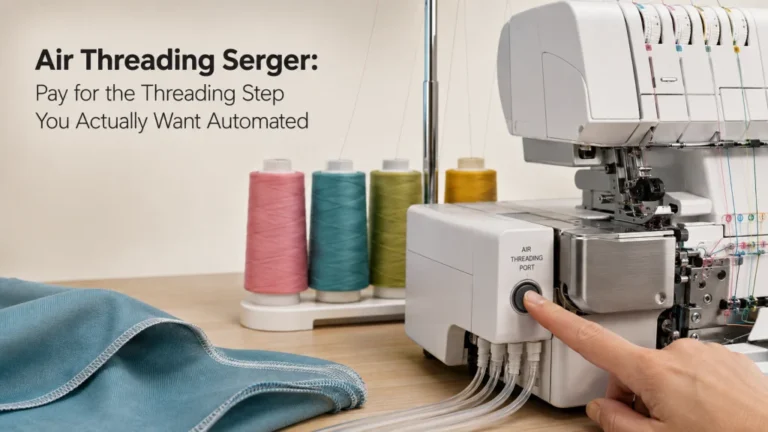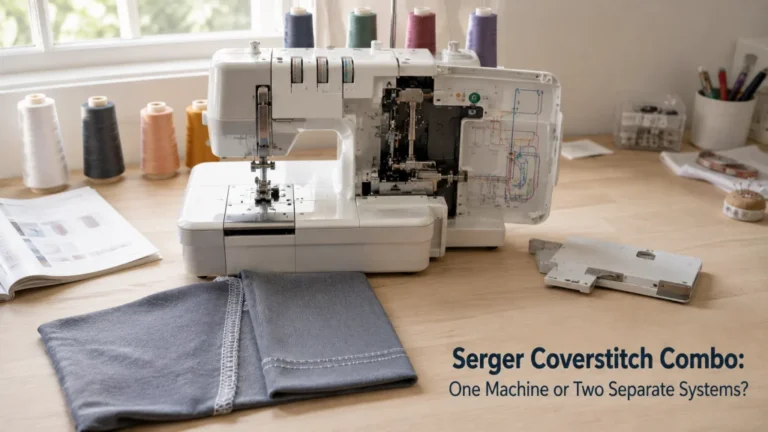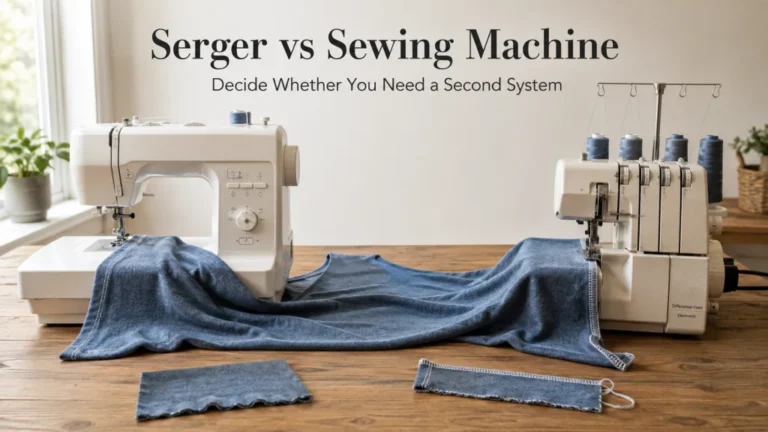
A serger and a coverstitch machine may look like close relatives, but they solve different garment operations. A serger is primarily useful when the missing job is trimming and enclosing an edge or constructing stretch seams, while a coverstitch system earns its place when folded knit hems, chainstitch work, or coverstitch topstitching are the recurring gap. Your regular sewing machine still matters because neither specialist system automatically replaces its broader construction functions. The right purchase is therefore the machine that adds an operation you actually repeat, not the one with the more impressive thread stand.
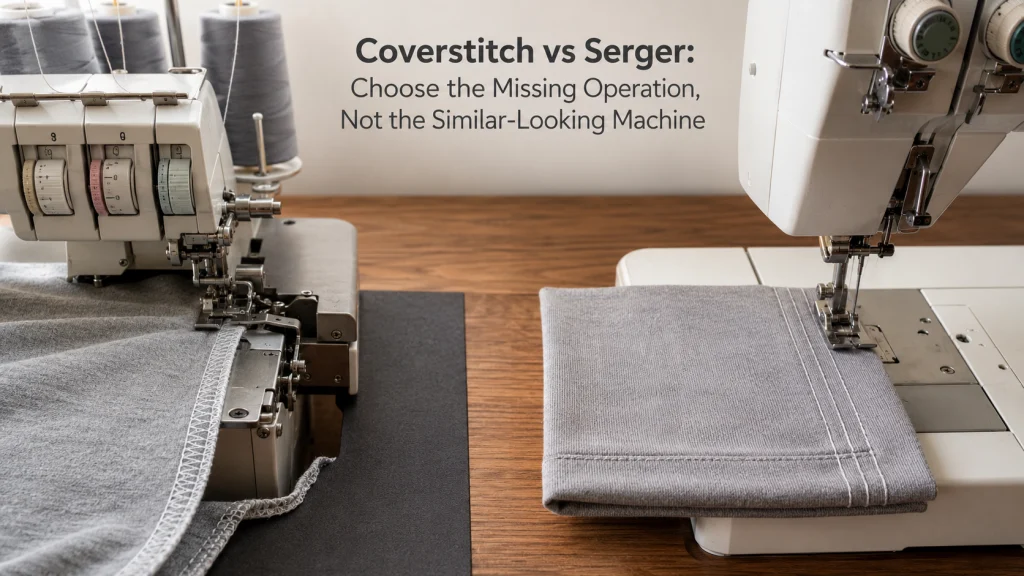
One T-shirt can need two different specialist jobs
Picture a basic knit T-shirt moving through construction. Shoulder and side seams may need a stretch-friendly seam while raw edges are being controlled, which is work associated with a serger. Later, the sleeve and lower edges are folded into hems, where a coverstitch can place parallel needle lines on the outside while the looper formation sits underneath. Those operations happen at different points and solve different problems.
That sequence is the useful starting point for any coverstitch vs serger decision. The machines can both use several threads, loopers, and differential feed, so their external similarity is easy to overvalue. Once the garment is broken into operations, the distinction becomes much less mysterious: one system is centered on edge treatment and overlock construction, while the other is centered on cover hems, chainstitch, and related surface stitching.
Define serger and coverstitch as different operation systems
A home serger, also called an overlocker in many markets, forms overlock stitches at the fabric edge and commonly uses a cutting system to trim excess seam allowance as the edge is stitched. For readers who use overlocker terminology, the coverstitch versus overlocker decision is the same system comparison described here. A dedicated coverstitch machine does not exist to duplicate that job. Its useful territory is farther in from the raw edge or across a folded hem, where one or more needle threads work with a looper thread to form coverstitch or chainstitch structures.
This is why the practical difference between serger and coverstitch systems is more important than a feature count. Current Brother documentation, for example, describes the 1634D as a 3 or 4 thread serger, while the 2340CV is documented for coverstitch and chainstitch work and lists overlock seam width as not applicable. Those are capability boundaries, not recommendations for either model.
| Operation question | Serger system | Coverstitch system |
|---|---|---|
| Trim and enclose a raw edge in one pass | Core use on machines equipped with the cutting system | Not the normal dedicated function |
| Construct many knit seams | Common specialist use | Not its primary replacement for overlock construction |
| Sew a folded knit hem with parallel top lines | Not the defining operation | Core use |
| Create chainstitch work | Available only on serger systems specifically designed for it | Common dedicated capability, depending on model |
| Work away from a raw edge | Restricted by the machine’s edge-oriented architecture | Expected for coverstitch and chainstitch work |
The table is a boundary map, not a promise that every machine inside one family has the same stitch package. Always confirm the exact model manual before treating a named stitch, needle position, thread count, differential-feed range, or conversion mode as available.
Keep the regular sewing machine visible in the workflow
The specialist-machine comparison can become misleading when the regular sewing machine disappears from view. A general-purpose machine still handles operations such as controlled straight stitching, zigzag and other utility stitches, many closures, buttonholes on equipped models, topstitching, and construction steps that need access around the needle rather than an edge-only workflow. Exact capability still depends on the machine, presser feet, needle system, fabric, and project.
A first-time buyer can easily assume that adding a serger or coverstitch means graduating away from the sewing machine. That is the wrong ownership model for most home garment workflows. Think of the specialist machine as adding a specific operation to the bench, while the regular machine continues to carry the broader set of tasks it already performs well.
Key point: Do not ask which specialist machine is more advanced. Ask which repeated operation your current sewing setup cannot perform efficiently or satisfactorily.
If the bigger question is how these systems fit among domestic and specialist equipment generally, compare their roles before buying another machine. That keeps the decision tied to actual machine functions instead of treating every new capability as a replacement.
Map edge construction and trimming to the serger
A serger becomes the stronger candidate when the job that keeps slowing you down sits at the edge of the fabric. Examples include constructing knit seams with an overlock formation, enclosing raw woven edges, or trimming a changing seam allowance while finishing that edge. The cutting function matters because it is part of the machine’s operation sequence, not because cutting by itself proves better sewing quality.
Consider a home sewist who makes knit tops and repeatedly spends extra time sewing a seam on the regular machine, trimming the allowance separately, then finishing the raw edge. If the desired change is to consolidate those edge operations, a serger addresses that missing step more directly than a dedicated coverstitch machine. A coverstitch may improve a later hem, but it does not answer the original edge-construction problem.
Warning: Cutting, threading, cleaning, needle changes, and other owner tasks must follow the exact serger manual. Do not reach near the knife or needle area with the machine powered for servicing, and do not bypass a cutting mechanism unless the manual specifically provides an owner control for that operation.
That safety boundary is also a buying boundary. If the edge operation is not something you expect to repeat, the presence of a knife, extra loopers, or more thread paths is not a reason by itself to add another machine.

The Brother ST4031HD is a 3- or 4-thread serger built with a metal frame and an extra-hard carbon-steel cutting blade. Its Amazon listing specifies speeds up to 1,300 stitches per minute plus color-coded guides and numbered upper and lower loopers for threading. The package includes standard, blind-stitch, and gathering feet, along with a large extension table.
Check On AmazonIf you click this link and buy, we earn a commission at no additional cost to you.
Map cover hems and chainstitch-oriented work to coverstitch
A coverstitch machine becomes more relevant when construction is already under control but the finishing workflow repeatedly stalls at folded hems or coverstitch-style topstitching. On a knit T-shirt, leggings, or another stretch garment, that can mean sewing across the folded hem while preserving stretch and placing the familiar parallel needle lines on the garment face. The exact stitch formation and available widths depend on the machine.
Chainstitch capability can widen the use case, but it should still be evaluated as a real operation rather than a box to check. If the work you make rarely calls for chainstitch or cover hems, a machine that offers them may spend more time threaded on a shelf than solving a problem. If those operations occur on nearly every garment, the ownership case changes.
For someone deciding between a serger or coverstitch machine, the location of the unfinished work is revealing. Repeated unfinished raw edges point toward overlock capability. Repeated hems waiting for a stretch-friendly, coverstitch-style finish point toward coverstitch capability.
The next step is not a model ranking. If coverstitch is clearly the missing system, you can then compare controls, threading, workspace, support, and the exact stitch package you need.

The Brother 2340CV is a dedicated coverstitch machine with a metal frame and 2-needle 2-3-4 coverstitch functions. Its Amazon listing includes tri-cover, wide and narrow cover stitches, color-coded threading, a fast looper threading system, and speeds up to 1,100 stitches per minute. A standard foot and hem sewing presser foot are included.
Check On AmazonIf you click this link and buy, we earn a commission at no additional cost to you.
Mark the operations neither specialist system replaces
Neither specialist system should be treated as a universal garment-construction machine. A serger’s edge-focused architecture is not designed to take over every seam, pivot, closure, buttonhole, or precision topstitching task. A coverstitch machine is also not a general substitute simply because it can sew away from the raw edge and may offer chainstitch.
For example, a zipper installation that depends on a conventional zipper foot and controlled stitching close to the zipper teeth still belongs to a suitably equipped regular sewing machine. Likewise, a small corner that needs a precise pivot is a different mechanical problem from continuously feeding a knit edge through an overlock system. Specialist speed is useful only when the operation matches the specialist architecture.
- Keep the regular machine for broad construction operations it already handles correctly.
- Add a serger when edge treatment or overlock construction is the job you keep needing.
- Add coverstitch when folded hems, coverstitch top lines, or chainstitch work are the recurring gap.
- Do not buy either machine merely because a garment was commercially produced with a similar-looking stitch.
This separation prevents a common first-machine misunderstanding: three machines on a garment workflow do not mean three machines are mandatory for every sewist. The right setup can be one machine, two machines, or more, depending on what you repeatedly make and what you are willing to do with the equipment you already own.
Walk one knit-garment workflow in operation order
Use a simple knit top as an operation map rather than a sewing tutorial. The exact construction order varies by project, but the sequence below shows why the two specialist systems are not interchangeable. It also makes the purchase question concrete before cost or specifications enter the discussion.
- Prepare and align garment pieces: this is project preparation, not a specialist-machine reason by itself.
- Construct selected knit seams: a serger may combine seam formation and edge control when that is appropriate for the project.
- Handle operations needing the regular machine: details, stabilization, controlled topstitching, or other construction may still belong there, depending on the garment.
- Fold the sleeve or body hem: the fabric is now prepared for a hem operation rather than raw-edge trimming.
- Sew the cover hem: a coverstitch system can complete that distinct finishing operation if its stitch formation matches the project.
Notice that the purchase decision can emerge from the unfinished stage. If the garment is consistently slowed at Step 2, a serger has a stronger case. If construction is comfortable but Step 5 is the repeated compromise, coverstitch has the stronger case. If neither stage is causing enough friction to matter, buying nothing remains a legitimate outcome.
Decide which missing operation happens often enough to justify a purchase
Frequency matters more than aspiration. Someone who makes one knit garment every few months may reasonably keep using an existing machine workflow, even if a specialist system could make one stage faster or cleaner. Someone producing knit tops, activewear, or children’s stretch garments repeatedly may value a dedicated operation much sooner because the same bottleneck appears project after project.
A useful test is to review the last several garments you actually completed. Note where extra steps, compromised finishes, or abandoned ideas occurred, then classify those moments by operation. This avoids buying for an imagined future sewing identity while ignoring the work already on your table.
That distinction is especially useful for a new garment sewist. A purchase can be technically capable and still be poorly timed if the current machine already produces acceptable results at the frequency you sew.
Count space, threading, consumables, and service
Capability is only half of ownership. Another machine needs realistic table or storage space, its own thread setup and consumables, manual-based cleaning, and service access for faults beyond owner-level maintenance. Awkward storage or repeated setup can also reduce how often the machine is used.
Thread use also changes with these systems, and the active thread count varies by stitch and machine. Treat cones as consumables to store and replace, not as a quality signal, and include needles, accessories, waste handling, and model-specific maintenance items in the ownership cost.
| Ownership check | What to write down before buying |
|---|---|
| Workspace | Permanent table space, shared table space, or storage and setup routine |
| Threading | How often the intended stitches require thread-path changes or rethreading |
| Consumables | Correct needle system, thread use, and model-specific expendable items |
| Workflow | Whether you need two operations repeatedly in the same garment session |
| Service | Local support, warranty route, parts availability, and what the manual reserves for service |
This quick score is a check on projects you already make. Add one point in the indicated column for each statement that currently fits your workflow.
| Statement | Add 1 to |
|---|---|
| I regularly want to trim and enclose raw edges as part of seam construction. | Serger |
| My knit garments are usually constructed successfully, but folded hems are the recurring compromise. | Coverstitch |
| I repeatedly want both overlock construction and cover hems in the same garment workflow. | Both functions |
| I have realistic space, setup time, consumable budget, and service access for another specialist machine. | Ownership readiness |
| My current machine still needs basic setup, handling, or stitch problems sorted before I can identify a specialist bottleneck. | Neither for now |
The score is not a buying formula. A clear pattern identifies the system worth evaluating, points on both sides support comparing separate versus combination ownership, and little specialist demand supports postponing the purchase.
Do not guess compatibility from a needle package, foot name, or visual resemblance. Verify the exact machine manual and manufacturer compatibility information for needles, feet, attachments, and other machine-interface parts before purchase.
Decide serger first, coverstitch first, both, combo, or neither
Once the operations and ownership footprint are visible, the decision can be reduced to five outcomes. None is automatically more serious or more professional than another. The useful answer is the one that matches the work you already do and the amount of equipment you want to own.
- Serger first: choose this direction when edge trimming, edge finishing, or overlock construction is the bottleneck you encounter most often.
- Coverstitch first: choose this direction when construction is already workable but cover hems or chainstitch-oriented work are where the workflow repeatedly falls short.
- Both separate systems: consider this only when both operation families are frequent enough to justify two machines and you have the space and ownership budget.
- Combination system: consider this when both functions are required but one-machine ownership has meaningful value, then evaluate conversion and workflow on the exact system.
- Neither: keep the existing machine setup when specialist operations are occasional or your current results are already acceptable for the work you make.
For a newer sewist, “neither for now” can also be the better choice when ordinary machine setup, fabric handling, needle and thread matching, or basic stitch control is still inconsistent enough to hide the real bottleneck. Resolve those fundamentals first, then see whether a specific specialist operation remains unsolved.
Current JUKI documentation illustrates why “combo” must be treated as its own ownership path rather than proof that all these machines are interchangeable. Its home coverstitch listing separates a specialized chainstitch and coverstitch machine from a model documented with overlock, chainstitch, and coverstitch functions. The existence of both architectures is exactly why the next comparison must move from function to workflow.
Stop before model ranking
This comparison has done its job once you know which operation family is missing. Model ranking is a separate decision because controls, threading access, stitch packages, free-arm arrangements, workspace, included accessories, warranty terms, price, service, and parts support can vary inside the same machine family. Mixing those questions too early makes it easy to buy a well-reviewed machine for the wrong operation.
The same boundary protects against marketing shortcuts. More stitches, more threads, a higher price, or a label suggesting professional results does not establish better fit for your fabric, garment workflow, or ownership needs. Capability should be verified from the exact model documentation, while performance judgments need conditions that match the material and operation you care about.
Note: Manufacturer documentation is most useful here for proving what a machine architecture is designed to do. It does not prove that every sewist needs that capability or that two machines with the same broad label perform identically.
Once you have the operation outcome, move to the page that evaluates that ownership decision instead of continuing to collect generic serger-versus-coverstitch features.
If the outcome is serger, stop this comparison
If edge construction or trimming is clearly the unresolved job, this page should not pull you sideways into a coverstitch purchase. The next useful step is to place the serger back into the broader specialist-machine picture and confirm that it fits the rest of your sewing setup. That keeps the decision from drifting into a different comparison simply because the machines share cones and loopers.
Use the machine types and system roles overview to recheck where a serger sits beside a regular sewing machine and other specialist systems. This article intentionally does not cross into a separate serger model ranking because that is a different purchase question.
Use the coverstitch buying path only when coverstitch is the outcome
If folded knit hems, coverstitch top lines, or chainstitch-oriented work are the repeated gap, you now have a reason to compare coverstitch systems. At that stage, details such as threading layout, available needle positions, stitch package, workspace, free-arm design, support, and owner maintenance become relevant because the required operation has already been established.
A first-time buyer can continue with the first coverstitch machine decision when ease of ownership and learning the system are central. For a broader equipment comparison, compare coverstitch machine choices without reopening the serger question unless your actual workflow has changed.
Use the combo comparison only when both functions are already required
A combination machine should enter the decision only after you have established that both overlock and coverstitch functions matter to your work. Otherwise, “two functions in one machine” can sound efficient while adding setup complexity for a function you rarely use. The meaningful comparison is not whether combo machines exist, but whether one convertible or combined system fits your switching frequency, space, budget, and tolerance for reconfiguration better than two separate machines.
If both operation families are frequent, compare combo system ownership as its own decision. That is where conversion workflow, one-machine footprint, and the tradeoff against keeping two machines ready can be judged without distorting the simpler question answered here.

The SINGER Professional 14T968DC supports 2-, 3-, 4-, and 5-thread stitch configurations, including cover stitches. Its Amazon listing specifies a self-adjusting tension system, differential feed, and speeds up to 1,300 stitches per minute. The included accessory set covers general-purpose, elastic, blind-hem, beading, cording, and shirring feet, plus an attachable clean pocket.
Check On AmazonIf you click this link and buy, we earn a commission at no additional cost to you.
Final Thoughts: Buy the missing operation
The cleanest way to choose is to ignore machine resemblance and follow the garment. If the repeated gap is edge trimming, edge finishing, or overlock construction, the decision points toward a serger. If the repeated gap is a folded knit hem, coverstitch surface work, or chainstitch capability, the decision points toward coverstitch.
Then apply the ownership test. Count the frequency of that operation, the space the machine will occupy, threading and consumables, service access, and the work your regular sewing machine already handles. Buying both, choosing a combo, or buying neither can all be correct outcomes when they match the operations you actually perform.
FAQs
The questions below focus on the purchase boundary between the two specialist systems, not on threading or sewing technique. Exact stitch packages and owner procedures still depend on the machine manual.
🧵 Can a serger do a coverstitch?
A dedicated serger should not be assumed to make a coverstitch. Some combination systems provide both overlock and coverstitch functions, but the exact modes and conversion process must be verified for the specific model.
👕 Do I need a coverstitch machine to hem T-shirts?
No. A coverstitch can make that operation more direct, but a regular sewing machine may provide workable alternatives depending on its stitches, needle options, fabric, and the finish you accept.
✂️ Does a coverstitch machine cut fabric like a serger?
A dedicated home coverstitch machine is not chosen for the serger’s trim-and-overlock edge operation. Check the exact model documentation rather than assuming a cutting function from the machine’s appearance.
🪡 Which should I buy first, a serger or coverstitch machine?
Buy for the operation you repeat most. Frequent edge construction and finishing point toward a serger, while frequent cover hems or chainstitch-oriented work point toward coverstitch.
⚙️ Can a combo machine replace two separate machines?
It can provide both function families when the exact model supports them, but that does not make the ownership experience identical. Compare conversion steps, switching frequency, space, service, and cost before deciding between one combo system and two dedicated machines.
📏 Is differential feed the same on a serger and coverstitch machine?
Do not assume identical ranges or behavior from the shared feature name. Verify the exact model’s differential-feed controls and manual, then judge them in the operation the machine is designed to perform.
If one answer keeps pointing back to the same workflow gap, that is more useful than trying to declare one machine universally better. The system should fit your garment workflow first, then the exact model can be evaluated inside that system.
References and Sources
These manufacturer pages are included because the article relies on them for the technical boundary between overlock, coverstitch, chainstitch, and combination capability. They are not included as product recommendations.
- Brother 1634D specifications: Documents a current home serger example with 3 and 4 thread operation and serger-oriented seam finishing.
- Brother 2340CV specifications: Documents coverstitch and chainstitch capability and distinguishes the machine from overlock seam operation.
- JUKI home coverstitch systems: Shows both a specialized coverstitch and chainstitch machine and a current system that combines overlock, chainstitch, and coverstitch functions.
Model availability and specifications can change. Before purchase, verify the exact current manual, supported stitches, included items, compatible consumables, warranty route, and service information for the machine you are considering.