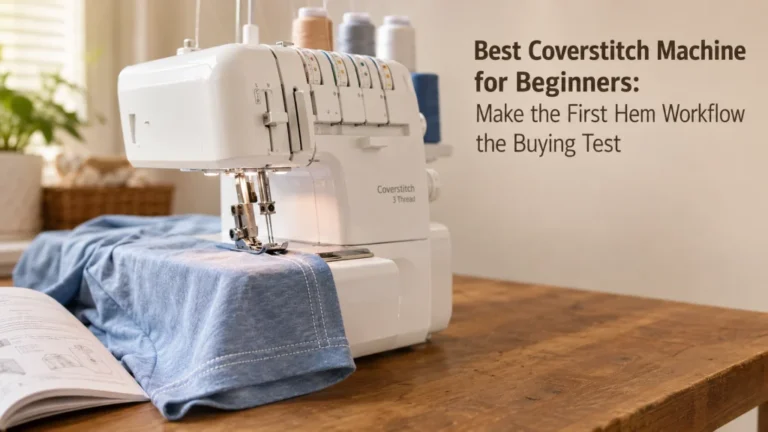
The best coverstitch machine matches a recurring operation and an ownership format you can live with, not simply the longest feature list. A dedicated system can stay ready for coverstitch work, while a combination overlock and coverstitch system trades that readiness for a smaller machine footprint. The right choice depends on required stitches, switching frequency, workspace, and the documented threading and conversion process. Write those requirements before comparing current models.
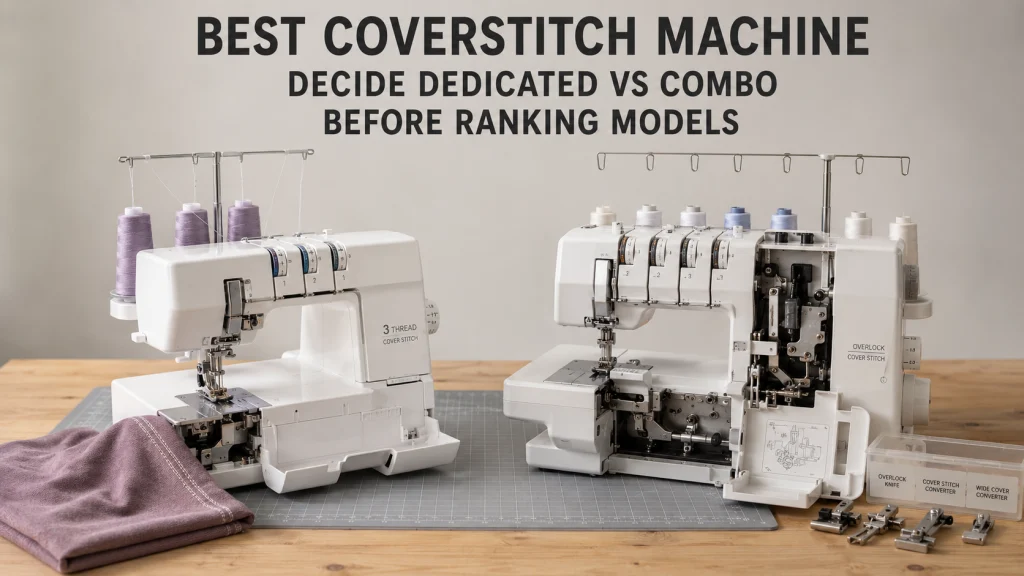
The same knit hem can point to two different machine setups
The best coverstitch machine for a sewist who already owns a serger may be a dedicated machine that can remain threaded for hemming. For another sewist working in a small room, the more important question may be whether one combination machine can cover both overlock and coverstitch work without making the switching process too disruptive.
Both buyers may want the same ready-to-wear style hem, yet their ownership decisions differ. Define the recurring operation and workflow first, then narrow the market.
Confirm the recurring operation that creates coverstitch demand
A coverstitch purchase is easier to justify when it solves a repeated job such as knit hems, certain bindings, parallel stretch topstitching, or chainstitch construction.
Look at the next several projects you expect to sew. Record how often the operation appears, whether your current method is acceptable, and what part of the workflow you want to change.
| Question | Write down your answer | Why it matters |
|---|---|---|
| What operation repeats? | For example, knit hems, bindings, stretch topstitching, or chainstitch | Defines the stitch capability you need |
| How often does it appear? | Occasional, monthly, or nearly every garment | Helps judge whether a specialist machine earns its space |
| What do you use now? | Twin needle, zigzag, stretch stitch, or another method | Shows whether the current method is actually limiting you |
| What is the problem? | Appearance, elasticity, repeatability, setup time, or workflow | Stops you from buying features that do not address the real issue |
This worksheet is a buying filter. Final results still depend on the fabric, thread, needle system, setup, handling, and exact machine.
Separate coverstitch, serger, and combination-machine jobs
A dedicated machine focuses on coverstitch and usually chainstitch operations. A serger trims and overlocks edges, while a combination machine provides both systems.
Those names are not interchangeable. If you are choosing between edge finishing and cover hems, compare the coverstitch and serger functions first. If overlock purchasing is the real decision, move to the serger buying criteria.
Key point: A combination machine can provide both systems, but its value depends on the exact conversion and threading workflow. One chassis may still require a deliberate changeover before the other mode is ready.
Current manufacturer documentation makes this boundary concrete. JUKI, for example, lists its MCS-1500 as a specialized chainstitch and coverstitch machine and its MO-735 as an overlock machine that also provides chainstitch and coverstitch functions. Those are different ownership architectures even though both can produce coverstitch work.
Decide whether a regular sewing-machine twin-needle workflow is still acceptable
Before adding another machine, check whether the twin-needle method on your current sewing machine already meets the requirement that matters to you. If the hem looks acceptable, stretches enough for the garment, and does not create a setup burden you care about, buying another system may not be the next useful move.
A first-time buyer may assume that a ready-to-wear style double row requires a specialist machine. Compare the actual result because stitch formation and the underside differ from a twin-needle seam.
If this substitution question is still open, the coverstitch and twin-needle comparison should be resolved before you build a shopping list. That keeps a specialist purchase tied to a repeated need instead of a feature you may rarely use.

The SCHMETZ Euro-Notions Stretch Twin Needle uses two needles mounted on one shank to sew two parallel rows at the same time. It is intended for elastic materials and highly elastic knitwear. The package contains one 4.0/75 stretch twin needle.
Check On AmazonIf you click this link and buy, we earn a commission at no additional cost to you.
Choose dedicated or combination architecture before comparing machines
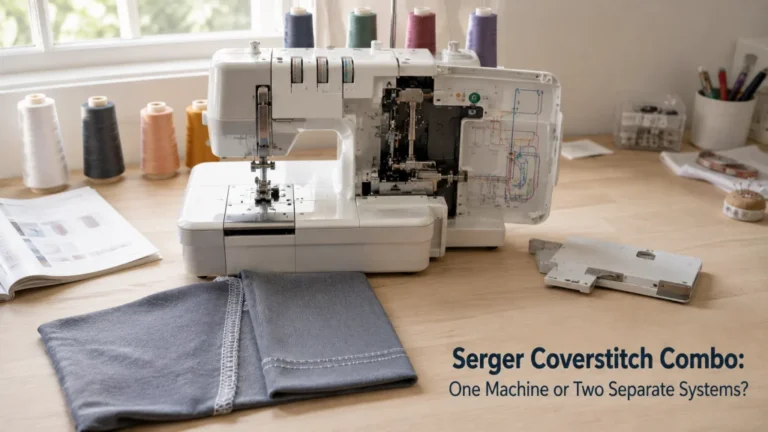
Dedicated and combination machines trade space against readiness. A dedicated unit can remain configured for coverstitch work, while a combination unit uses one chassis but may require documented changes between overlock and coverstitch modes.
Conversion is model-specific. Inspect the exact manual or support material instead of assuming every combo is difficult or every dedicated machine is faster.
| If this describes your workflow | Architecture to investigate first | Verify before buying |
|---|---|---|
| You already own and regularly use a serger | Dedicated coverstitch | Required stitches, workspace, machine footprint, and accessory fit |
| You need both overlock and coverstitch but have room for only one specialist chassis | Combination machine | Exact mode-change sequence, threading, knife and insert changes, and storage of conversion parts |
| You switch repeatedly between seam finishing and hemming in the same project | Compare both formats carefully | How often conversion interrupts your actual project sequence |
| Your current twin-needle method already works | No specialist purchase yet | Whether a recurring limitation actually exists |
The output is a format decision, not a winner. That makes later comparisons fair because a one-job machine and a multi-function machine no longer compete as though their workflows were identical.
Write the required coverstitch configuration brief
Once the architecture is clear, define the stitch set you need. The phrase coverstitch sewing machine can cover different needle counts and supported cover, chain, or top-cover configurations, so the generic label is not enough.
Mark each configuration as must-have, useful extra, or unnecessary. This keeps an impressive stitch chart from pushing the decision away from your actual work.
Narrow and wide two-needle coverstitch
Two-needle coverstitch is common for garment hems, but available widths depend on the machine and needle positions. If row spacing matters, verify the exact options in the current manual or stitch chart. Brother documents narrow and wide coverstitch options for the CV3550, showing why width belongs in the requirement sheet. Choose for the width you need, not the number of needle positions alone.
Three-needle coverstitch where the project calls for it
A three-needle configuration creates three visible parallel rows and requires a machine that supports that arrangement. It is useful only when that stitch belongs in your actual construction or decorative work. Janome documents one, two, or three-needle operation on the CoverPro 3000P, so needle count belongs in the evidence ledger. If your projects call only for two-needle hems, the third needle position can stay in the optional column.
Chainstitch
Chainstitch may be available alongside cover hems, so decide whether you have a real construction or decorative use for it. Brother lists standard chain stitching on the CV3550, and JUKI identifies the MCS-1500 as a chainstitch and coverstitch machine. Keep it mandatory only when your project list calls for it.
Top-cover capability only where it changes the work
Top-cover stitching adds thread on the top side of the work and appears only on some systems. Brother documents double-sided cover stitches on the CV3550, while Janome documents a built-in top-cover function on the CoverPro 3000P. Put this feature in the must-have column only when that appearance or construction is part of your planned work. Otherwise, it can remain an extra without affecting the shortlist.
| Requirement | Must have | Useful extra | Not needed |
|---|---|---|---|
| Narrow two-needle coverstitch | |||
| Wide two-needle coverstitch | |||
| Three-needle coverstitch | |||
| Chainstitch | |||
| Top-cover stitching |
After this card is filled in, eliminate machines that miss a must-have configuration. Extra stitch types deserve weight only when they appear in your projects.
Verify differential feed without treating it as performance proof
Differential feed changes the relationship between the feed mechanisms and can be relevant when working with fabrics that tend to stretch or gather during feeding. The available ratio and control method are machine-specific, so verify them in the exact specification or manual.
Use the published differential-feed range to understand the adjustment available on the exact machine. Janome publishes 0.5 to 2.25 for the CoverPro 3000P, while JUKI publishes 0.7 to 2.0 for the MO-735. Those figures describe adjustment range; fabric-specific results still need fabric-specific evidence.
Note: Fabric structure, layer count, presser-foot pressure where adjustable, thread, needle system, stitch settings, and handling still matter. A specification describes the control that exists, not the outcome on every project.
Use differential-feed information as an eligibility check and setup clue. Performance claims need an exact machine, material, thread, needle, stitch, and test condition before they should influence a buying judgment.
Audit threading and the end-of-seam workflow
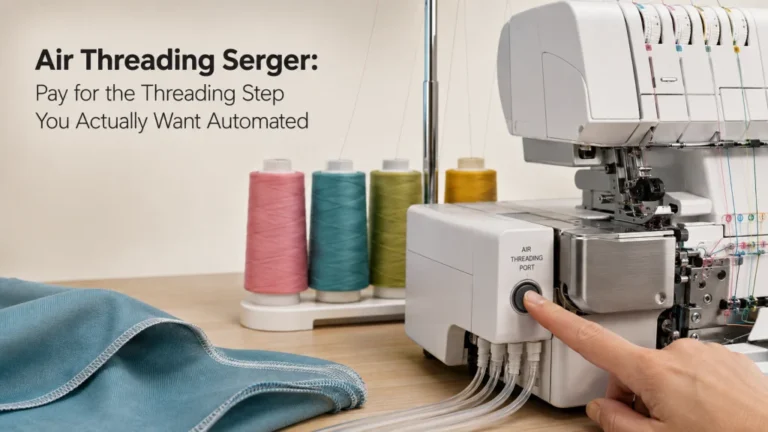
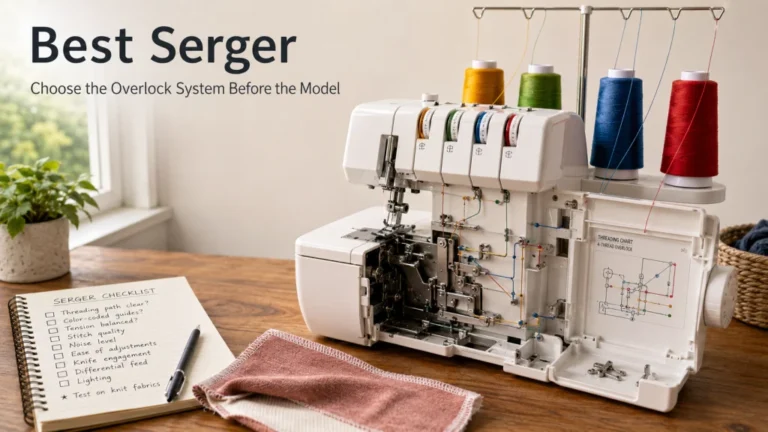
Evaluate the full threading sequence. Labels such as color-coded, lay-in, or air-threaded tell only part of the story, so check which threads receive assistance, which remain manual, and what changes between stitch configurations.
Combination systems need one additional check: what must change when the machine moves from overlock to coverstitch and back. For the b68 AIRLOCK, bernette publishes separate support material for that conversion, so the mode-change sequence belongs in the ownership decision rather than being treated as a minor setup detail.
- Read the exact threading diagram for the stitch configurations you expect to use.
- Check whether needle threading and looper threading use the same assistance system.
- Identify parts that must be removed, installed, repositioned, or stored during a mode change.
- Check the documented method for finishing and securing the end of a coverstitch seam.
- Repeat the check for the machine state you will return to most often.
Sophisticated threading assistance can still be a poor fit if your project sequence forces constant mode changes. A simpler system may be acceptable when it stays set up for one operation.
Audit work area, free arm, and tubular-garment access
Work area matters when fabric extends to the right of the needle. Measure your table space as well as the machine’s working area because more sewing room can also mean a larger storage footprint.
Tubular access deserves its own check if you frequently hem sleeves, cuffs, or narrow garment openings. Brother documents a free arm and a 6.1 by 3.9 inch workspace on the CV3550, while Janome documents a free arm and a 4 by 5.5 inch bed space on the CoverPro 3000P. The useful comparison is how each layout fits your garments and table space.
A wide skirt hem and a narrow sleeve create different handling problems. List the garments you sew before giving work-area measurements much weight.

The Brother 2340CV is a dedicated coverstitch machine with wide, narrow, and tri-cover stitch options. Its listing specifies color-coded threading, a fast looper threading system, differential feed, and speeds up to 1,100 stitches per minute. It includes a standard foot and a hem sewing presser foot.
Check On AmazonIf you click this link and buy, we earn a commission at no additional cost to you.
Treat binders and attachments as compatibility questions
Start with the compatibility list, not the attachment name. Match binders, hem guides, presser feet, extension tables, and other machine-interface parts by the manufacturer’s model list or exact part number rather than visual similarity or a universal marketplace label.
JUKI currently lists different part numbers for coverstitch hem guides used with the MO-735 and MCS-1500. That is a useful reminder that two machines from the same manufacturer can use different accessory references even when the accessory performs a similar job.
Warning: Follow the exact machine manual when changing needles, covers, inserts, knives, or other conversion-related parts. Stop using the machine after repeated hard needle strikes, a hard mechanical lock, abnormal heat, smoke, a burning odor, sparks, damaged wiring, or any condition the manual reserves for service.
Compatibility evidence belongs in the buying file before checkout. If the accessory you expect to use cannot be matched to the exact machine, mark compatibility as unresolved and keep that candidate out of the final comparison until the fit is verified.

The Janome CoverPro bonus pack combines an extension table, a clear-view coverstitch foot, and an elastic attachment for CoverPro 1000CPX and 2000CPX machines. The extension table expands the supported work surface. The clear-view foot provides a better view of the stitching area and uses front markings that correspond with needle positions.
Check On AmazonIf you click this link and buy, we earn a commission at no additional cost to you.
Set an evidence threshold for every machine on the list
A useful comparison separates facts that can be verified from questions that need different evidence. Official product pages and manuals can establish architecture, stitch configurations, differential feed, threading procedures, dimensions, included items, and documented accessory compatibility. Ease of use, stitch quality on a specific fabric, durability, and comparative performance require evidence that actually tests those outcomes.
Use a simple ledger and mark missing evidence as unknown. That tells you what still needs checking before purchase.
| Evidence field | Acceptable proof | Do not substitute |
|---|---|---|
| Dedicated or combination architecture | Current manufacturer product page or manual | Retail category label alone |
| Coverstitch and chainstitch configurations | Current stitch chart or manual | Thread count as a shortcut |
| Differential feed | Current specification or manual | Claim that knits will sew perfectly |
| Conversion workflow | Manual or official conversion instructions | Generic claim that combos are easy or difficult |
| Attachment fit | Exact model list or part number | Visual similarity or generic name |
| Stitch quality on a material | Named independent test with conditions, or documented original test | Manufacturer marketing language |
Find the current manufacturer document before scoring a machine
Start with the exact US manufacturer page and confirm the model number before opening its manual, support page, or accessory list. Use the product page for current specifications, the manual for stitch charts, threading, conversion, and service boundaries, and compatibility documents for attachments. If a retailer description conflicts with manufacturer documentation, record the discrepancy rather than merging the two. Check model suffixes and regional variants separately.
This threshold keeps the comparison tied to the exact machine. Price, speed, thread count, top-cover capability, or air threading are useful only when they connect to a requirement you already wrote down.
Build a current dedicated shortlist from written requirements
Once you have chosen a dedicated architecture, compare only current machines that meet every must-have stitch and physical requirement. Start from the written requirements, then keep only current machines that satisfy them.
Record supported stitches, differential feed, threading, work area, tubular access, attachment compatibility, support, warranty information, and current US availability. Mark anything unverified as unknown.
| Shortlist field | Qualifies when | Exclude when | Unknown when |
|---|---|---|---|
| Stitch brief | Every must-have configuration is documented | A required stitch is missing | The current stitch chart is unavailable |
| Workspace | The layout suits the garments and table space | A required access feature is absent | Dimensions are not documented clearly |
| Attachments | Required parts are listed for the exact model | A required attachment is incompatible | No exact compatibility evidence is found |
| Support | Current manual and support path are available | Support is no longer practical for the purchase | Availability or service status cannot be confirmed |
Once only qualified machines remain, compare price, service access, included items, warranty terms, and the workflow details that matter most. At that point, you are choosing among options that already fit the brief.

The JUKI MCS-1500 is a specialized coverstitch and chainstitch machine with three needles. Its listing specifies 3-thread coverstitch, 4-thread chainstitch, color-coded threading guides, and a maximum speed of 1,350 stitches per minute. The listing also states a US warranty of five years mechanical, two years electrical, and 90 days for adjustments.
Check On AmazonIf you click this link and buy, we earn a commission at no additional cost to you.
Build a combination shortlist only when both systems are needed
Build a combination shortlist only after confirming that both functions belong in the same purchase. If you already like your overlocker and have space, duplicating that function may add little value.
For buyers who need both functions in one chassis, add conversion workflow to the comparison. JUKI documents coverstitch capability on the MO-735, while documentation from bernette identifies the b68 AIRLOCK as an overlock and coverstitch combination machine and provides conversion support. Compare that workflow with the way you actually sew.
If the one-machine versus two-machine choice is still unresolved, use the combo versus separate-machine ownership comparison before narrowing the market. Once that format is settled and every must-have is verified, you are ready to choose among the remaining qualified options rather than keep expanding the list.

The bernette 68 AIRLOCK combines overlock, chainstitch, coverstitch, and combo functions in one machine. Its listing highlights 2, 3, 4, and 5-thread capability, adjustable stitch length, color-coded thread paths, and automatic air threading for the loopers. The machine also includes LED lighting and adjustable presser-foot pressure.
Check On AmazonIf you click this link and buy, we earn a commission at no additional cost to you.
Run one master audit before making the final comparison
The evidence ledger above answers a source question: what proof is strong enough for each specification or claim. This master audit answers a different buying question: have you resolved every requirement that matters before you stop searching and compare the final candidates?
| Final check | Ready when |
|---|---|
| Recurring operation | You can name the repeated job |
| Architecture | The format fits your space and switching workflow |
| Stitch brief | Every must-have stitch is documented |
| Differential feed | The exact model’s control and range are verified |
| Threading and conversion | You reviewed the thread path and any required mode changes |
| Work area | The machine fits your table and the garments you sew |
| Attachments | Required parts have exact compatibility evidence |
| Support and ownership | Manual, warranty, service, availability, and ongoing costs are acceptable |
This audit applies to both dedicated and combination machines. When every row is resolved, stop expanding the search and compare only the qualified candidates on price, support, included items, and the workflow details that matter most to you.
Keep industrial production systems out of the home shortlist
Industrial systems can use different beds, feeds, tables, motors, needles, service expectations, and workflows. Treat them as a separate equipment decision from a home coverstitch purchase.
This article stays with home-oriented systems for US home sewists and small makers. A cylinder bed, production throughput, or trade-service requirement belongs to a different equipment decision.
Resolve serger-versus-coverstitch uncertainty before shopping
If the real question is whether you need a serger or a cover stitch machine, separate edge finishing from cover hemming before shopping. Both appear often in knit sewing, but they solve different operations.
Use the serger versus coverstitch decision to identify the missing operation, then return here once a recurring coverstitch or chainstitch need is clear.
First-time coverstitch buyers need a narrower decision
A first specialist-machine purchase adds unfamiliar thread paths, needle positions, stitch changes, seam endings, and differential feed. Even an experienced sewing-machine user may prefer clearer documentation and a simpler learning sequence here.
After confirming the need, use the first coverstitch machine buying criteria to weigh setup, documentation, and required stitches together.
Treat combo ownership as a workflow decision
Limited space can justify a combination system, but you still need to check what changes between modes, what gets rethreaded, and how often your normal project sequence forces that switch.
Use the serger and coverstitch combo ownership decision when one machine versus two is the main uncertainty. Settle that workflow question before model features become decisive.
Recheck twin-needle substitution when the purchase still feels optional
If your main need is a two-line knit hem, compare the specialist stitch with what your existing machine can already do, especially if the new machine would be used only occasionally.
The twin-needle substitution decision keeps that question separate. A current method that already meets your appearance, stretch, handling, and repeatability requirements can remain the better ownership choice.
Explore related coverstitch decisions
Use these related comparisons only for the uncertainty that is still blocking the purchase. Once that question is resolved, return to the same written requirement sheet rather than starting a new shopping process.
| Topic | What you’ll find |
|---|---|
| Compare sewing machine types | Where coverstitch systems fit among domestic and specialist machine families. |
| Compare coverstitch and serger roles | Which operation belongs to edge finishing and which belongs to cover hems and chainstitch work. |
| Choose a first coverstitch system | How to narrow a first purchase around learning workflow, documentation, and required stitches. |
| Compare combo and separate machines | How space, conversion, machine occupancy, and repeated switching change the ownership decision. |
| Compare coverstitch and twin needles | When an existing domestic-machine method may still be enough for the hem you need. |
That keeps every next step tied to the same buying brief.
Final Thoughts: Choose the architecture before the badge
A good coverstitch purchase starts with a repeated operation, then moves through architecture, stitch configuration, threading, workspace, compatibility, support, and current availability. That sequence protects you from comparing dedicated and combination machines as though the same feature list means the same ownership experience.
Write the requirement first and verify every must-have against current manufacturer documentation. If a twin needle already solves the job, or if you still do not know whether the missing operation is overlock or coverstitch, resolve that question before adding another machine to the room.
Frequently Asked Questions
🧵 Is the best cover stitch machine always a dedicated model?
No. A dedicated machine can favor an always-ready coverstitch setup, while a combination system can favor limited space when both functions are needed. Check the exact conversion workflow before choosing a format.
✂️ Can a serger make a coverstitch?
Some combination machines can perform both overlock and coverstitch functions, but a serger-only machine cannot be assumed to make a coverstitch. Verify the exact stitch list and manual for the model.
👕 Do I need a coverstitch machine for knit hems?
A twin-needle method may be enough when the hem meets your appearance, stretch, and reliability needs. A specialist system is easier to justify when the operation repeats and your current method is limiting.
⚙️ Does differential feed guarantee better knit stitching?
Differential feed is a useful control, but the result still depends on the exact machine, fabric, layers, needle, thread, presser-foot pressure where adjustable, stitch settings, and handling. Use the published range to understand available adjustment, then judge results under the material conditions you actually sew.
🪡 Do I need three needles on a coverstitch machine?
Only if your intended stitch configuration uses them. If your projects call for narrow or wide two-needle hems, keep the three-needle option in the extra column unless a planned project needs it.
🧰 How do I know whether a binder will fit?
Match the attachment to the exact machine using a current manufacturer compatibility list or part number. A generic name, similar mounting shape, or marketplace claim is not enough evidence of fit.
References and Sources
- Brother CV3550 specifications: Verifies documented coverstitch configurations, chainstitch, free arm, workspace, and current machine specifications.
- Janome CoverPro 3000P specifications: Verifies needle configurations, top-cover function, stitch widths, differential feed, free arm, workspace, and current machine details.
- JUKI coverstitch product line: Verifies the current distinction between the dedicated MCS-1500 and the MO-735 overlock, chainstitch, and coverstitch combination architecture.
- b68 AIRLOCK documentation from bernette: Verifies combination-machine architecture, coverstitch functions, working area, threading support, and documented conversion resources.