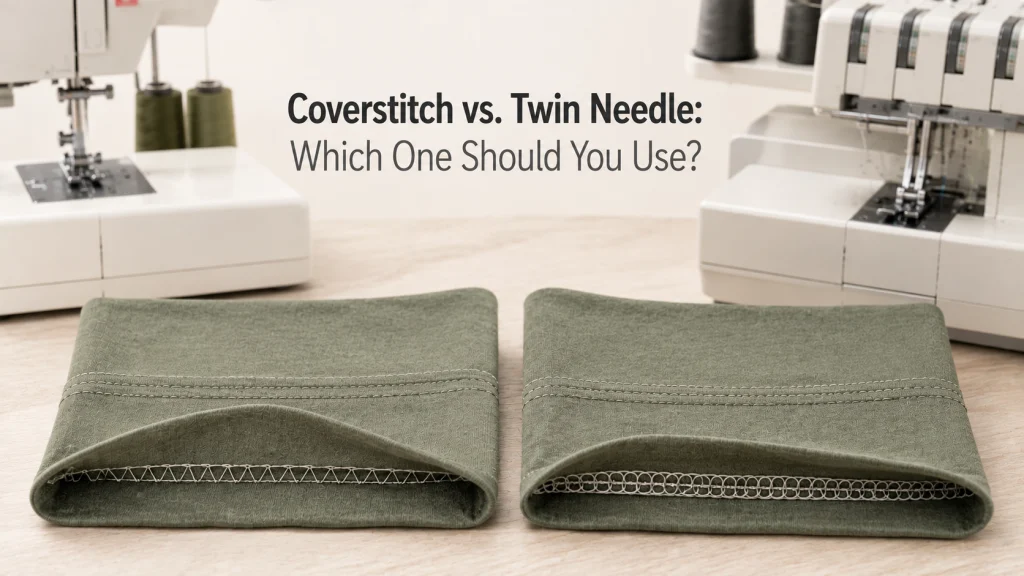
A coverstitch machine is not an automatic upgrade from a twin-needle hem on a regular sewing machine. The purchase only starts to make sense when the current twin-needle workflow has a specific, repeatable limitation on garments you actually sew, and that limitation belongs to the system rather than an unresolved setup problem. Compare appearance, stretch behavior, durability, workflow, space, thread use, and service burden as separate claims instead of treating one prettier sample as proof. The practical outcome can be to keep the twin needle, test a coverstitch on the same garment condition, or add a dedicated system.
A second machine needs a repeated limit, not a prettier sample
The useful coverstitch vs twin needle question starts with the garment that keeps exposing a problem. Imagine a domestic machine that produces acceptable twin-needle hems on most T-shirts but gives an unsatisfactory result on one recurring, high-stretch garment. That does not yet prove a coverstitch is necessary. The result could come from the particular fabric, needle choice, thread combination, hem construction, machine setup, or a genuine limit of the current stitch system.
That distinction matters because adding another machine also adds space, thread paths, maintenance, service dependence, and another setup routine. A specialist system can be justified when it repeatedly solves a requirement the owned machine cannot meet under a verified setup. It is much harder to justify when the evidence is only that a sample made on another system looks different.
This page stays at the buying-decision level. It does not teach twin-needle setup, diagnose tunneling or skipped stitches, choose a compatible twin needle, or prescribe coverstitch settings. If the dedicated-machine purchase survives the threshold here, the coverstitch machine buying criteria are the next step. If it does not, there is no requirement to buy another machine.
Define the purchase question and keep technique outside scope
Write the decision as a substitution question: what repeated garment requirement is the twin-needle method failing to meet, and would a coverstitch architecture plausibly address that requirement? That is more useful than asking which method is better in the abstract. Better appearance, greater stretch, easier workflow, and longer-lasting stitching are different claims and need different evidence.
Do not use this article to troubleshoot the current hem. If the result may still depend on an unresolved needle, thread, stabilizing, pressure, tension, or fabric-handling issue, resolve that through the exact machine documentation and the appropriate technique guidance before labeling the domestic system inadequate. A purchase decision made before that separation can turn a correctable setup problem into an unnecessary equipment purchase.
Purchase threshold: Add another machine only after you can name the repeated garment condition, reproduce the current limitation, and state what measurable change you expect a coverstitch system to provide.
The goal is not to defend the twin needle or promote a coverstitch. It is to make the current limitation specific enough that another machine can be evaluated against it.
Record the current domestic machine and twin-needle workflow
Start with the owned machine because twin-needle capability is model-specific. Brother, for example, documents twin-needle use on the CS7205 and requires the machine’s supported twin needle, two upper threads, an extra spool pin, an appropriate stitch, and model-specific precautions. That proves this named domestic machine supports twin-needle sewing; it does not establish how every domestic machine should be configured.
Your ledger does not need a tutorial. It only needs enough information to make a later comparison meaningful. Record the exact machine model, the twin needle already verified for it, the upper threads, the fabric, the hem construction, and the stitch family used. If one of those fields is unknown, mark it unknown rather than assuming the current result represents the best the domestic system can do.
| Current-workflow field | What to record | Why it matters to the purchase |
|---|---|---|
| Domestic machine | Exact model | Twin-needle support and limits vary by machine |
| Twin needle | Verified type and spacing for that machine | An unsupported needle cannot be used to judge the system fairly |
| Thread | Upper and bobbin thread identity | Thread changes can alter the observed result |
| Fabric and hem | Exact knit, layer stack, and hem construction | The failure may occur only under a narrow garment condition |
| Observed limit | One specific visible or functional problem | A vague dislike cannot be reproduced in a comparison |
This record is the baseline. Without it, the coverstitch sample and the twin-needle sample may differ in several variables at once, which makes the purchase conclusion much weaker.
Name the exact garment condition that fails
A result that appears only on one type of garment is more informative than a general statement such as “twin needles do not work for knits.” Name the condition precisely enough to reproduce it: a particular knit with more stretch, a hem that crosses bulky seams, a narrow tubular opening, a garment that is repeatedly stretched in wear, or another condition that actually appears in your sewing.
Then separate frequency from severity. A limitation that appears on one unusual project may not justify permanent floor or table space for another machine. A limitation that appears on most garments you make can carry much more weight even if the problem itself looks modest on a single sample.
- Write the garment type and fabric rather than only “knit.”
- Describe the exact hem area where the current result becomes unacceptable.
- Record whether the same issue appears on other garments made with the same workflow.
- Separate a visible flaw from a functional failure such as insufficient stretch for the garment.
- Do not add a durability claim unless you have observed it under a defined use or test condition.
This is the reproduced-limit ledger the buying decision needs. If you cannot reproduce the issue or state the condition that triggers it, testing another machine will tell you much less.
Separate appearance, stretch, durability, and workflow
One sample can look smoother without proving that it stretches farther, survives longer, or takes less effort to produce. Those are separate claims. Keeping them apart is especially important because online discussions often compress all four into a single statement that one system gives a better hem.
A twin-needle hem may be visually acceptable while the garment still exposes a stretch limitation, or the stretch may be acceptable while the setup interrupts the sewing flow more than the user wants. A coverstitch sample can also look attractive without proving that the new machine will eliminate every fabric-specific issue. The purchase should be tied to the claim that matters on the actual garment.
| Claim | What counts as evidence | What does not prove it |
|---|---|---|
| Appearance | Side-by-side samples on the same fabric and hem construction | A different garment photographed under different conditions |
| Stretch | A matched comparison that defines the garment’s stretch requirement | The fact that one stitch looks more elastic |
| Durability | Observed use or a disclosed repeated test on comparable samples | A new sample with no wear evidence |
| Workflow | Documented setup steps and the way the task fits your sewing sequence | Someone else’s preference for one machine type |
This claim-separation step prevents a cosmetic preference from silently becoming a technical conclusion. It also makes the eventual keep, test, or buy decision easier to defend.
Verify which claims are supported for the exact setup
Manufacturer documentation can establish architecture and supported features, but it cannot prove the result on your exact garment unless the conditions match. Brother documents the CV3550 as a dedicated coverstitch machine with narrow, wide, and three-needle cover stitches, chainstitch capability, a free arm, and differential feed controls. Janome documents the CoverPro 3000 Professional with one-, two-, and three-needle cover options, chainstitch, differential feed, and a free arm. Those are system facts, not proof that either machine will outperform your twin-needle hem on a specific fabric.
The same discipline applies to the domestic side. Brother’s twin-needle support for the CS7205 verifies that a named home machine can sew with a twin needle when its stated requirements are followed. It does not prove that the resulting hem has a universal level of stretch or durability. Those performance claims need a matched test or disclosed evidence that reflects the same machine, needle, thread, fabric, and hem condition.
Note: Treat manufacturer feature lists as architecture evidence. Treat personal reports as examples of buyer concerns. Treat performance as unknown until the comparison conditions are close enough to support the claim.
This evidence hierarchy protects both sides of the decision. It prevents a twin needle from being dismissed because of an unresolved setup, and it prevents a coverstitch from being credited with results that have not actually been tested on the garment that matters.

The Brother CS7205 is a computerized sewing and quilting machine with 150 built-in stitches, including utility, decorative, heirloom, and buttonhole options. Its listing includes an automatic needle threader, a quick-set drop-in bobbin, and a wide table. The package also includes 11 sewing feet, a quilt guide, and an English and Spanish user manual.
Check On AmazonIf you click this link and buy, we earn a commission at no additional cost to you.
Define what a coverstitch architecture changes at a high level
A dedicated coverstitch system is built around cover and chain stitches rather than reproducing a twin-needle look through the stitch system of a conventional sewing machine. Current home coverstitch machines can use multiple needles with a lower looper, and manufacturers document differential feed as part of the fabric-handling system. Those differences are relevant because they change the stitch architecture and the machine workflow available to the user.
They do not create an automatic winner. A home sewing machine that already produces acceptable twin-needle hems may still be the better ownership choice if the limiting garment is rare. The specialist architecture matters only when its documented capabilities line up with a recurring requirement that the current machine does not meet.
Keep this section deliberately high level. Needle installation, differential-feed settings, tension values, fabric stabilization, and troubleshooting belong to technique or model-specific support. This page only establishes what changes when the buyer moves from a domestic workaround to a dedicated stitch system.

The bernette 42 FUNLOCK is a dedicated coverstitch machine with three coverstitch configurations and a chain stitch. Its listing specifies 2.8 mm and 5.6 mm coverstitch widths, separate needle and looper threading aids, and differential feed. The machine also includes LED lighting and provides 87 mm of working space to the right of the needle.
Check On AmazonIf you click this link and buy, we earn a commission at no additional cost to you.
Count how often the limiting hem actually occurs
Frequency is the bridge between a technical limitation and a purchase. Review the garments you genuinely sew and mark how many would have triggered the same problem you recorded in the ledger. A limitation that appears repeatedly in your normal wardrobe or small-making work has a different ownership value from one that appears only when you use an unusual fabric.
Also note whether the limiting hems can be grouped. If only a small subset of garments needs the specialist stitch, testing or occasional access to a coverstitch may answer the need without permanent ownership. If the same requirement appears across most knit garments you make, the case for a dedicated system becomes stronger because the benefit would be used repeatedly.
| Frequency finding | What it suggests | What to do next |
|---|---|---|
| The limit is rare | The owned machine still covers most work | Keep the twin needle or seek an occasional test before buying |
| The limit is recurring but narrow | A specialist system may help a defined garment group | Run a matched comparison on that exact condition |
| The limit affects much of your knit sewing | The ownership benefit could be used often | Compare the specialist system against the repeated requirement |
Do not turn frequency into a universal numeric rule. The decision also depends on space, budget, service access, and how strongly the limitation affects the garments you care about.
Count space, setup, thread, and service burden
A second machine solves nothing for free. It needs a storage or working position, its own threading routine, compatible needles and consumables, cleaning and maintenance, and access to service when required. Some coverstitch systems use several thread cones at once, so thread inventory and working-room clearance can matter even when the machine body fits on the table.
Do not compare only purchase price. Ask whether the machine can remain ready to use or must be stored, whether the thread setup duplicates colors you already keep, whether you have practical dealer or service access, and whether the specialist function is frequent enough to justify those ongoing costs. An inexpensive second machine can still be a poor ownership fit if it is inconvenient to keep available.
The ownership side can legitimately reverse the technical conclusion. A coverstitch may address that documented garment limit, yet the correct decision can still be to test or postpone if the benefit appears too rarely to justify another system.
Build a like-for-like test plan without inventing results
If the purchase still looks plausible, compare the systems on equivalent samples. The purpose is not to create a universal contest. It is to answer the single limit you recorded at the start of the article while changing as few variables as practical.
Use the same fabric, comparable hem construction, comparable thread purpose, and the same evaluation criteria on both samples. Record the exact domestic machine and verified twin needle on one side, and the exact coverstitch machine on the other. Follow each machine’s documentation rather than improvising settings to force a preferred outcome.
You do not need to own a coverstitch before running this check. A local sewing-machine dealer or sewing class may have a demonstration machine, and a shared sewing studio, sewing group, or trusted friend may provide supervised access to one. Bring a prepared sample of the same fabric and hem construction you are trying to evaluate, and confirm in advance that the machine can be used for a comparison rather than treating a brief showroom sample as proof of long-term performance.
| Test field | Twin-needle sample | Coverstitch sample |
|---|---|---|
| Fabric and layer stack | Same defined garment condition | Same defined garment condition |
| Machine | Exact domestic model | Exact coverstitch model |
| Needle and thread | Record verified setup | Record manufacturer-supported setup |
| Appearance criterion | Record result | Record result |
| Stretch requirement | Record whether the garment requirement is met | Record whether the garment requirement is met |
| Workflow burden | Record setup and interruption points | Record setup and interruption points |
| Unknowns | Leave unverified claims blank | Leave unverified claims blank |
Do not stretch fabric near a moving needle, force the work through either machine, bypass guards, or operate outside the exact manuals. A buying test only has value when both systems are used within their documented consumer operating boundaries.
Decide: keep the twin needle, test a coverstitch, or buy
The decision should now follow the evidence rather than the appeal of another machine. Keep the twin needle when it meets the garment requirement on most work and the documented limitation is rare, unresolved, or too small to justify another system. Test a coverstitch when the limitation is real but the expected improvement remains unverified on comparable fabric.
Buying becomes the strongest option when the limit is reproduced, occurs often, the matched coverstitch test addresses the exact claim that matters, and the extra machine fits your space and sewing routine. Even then, the next step is choosing among coverstitch systems, not assuming every model will reproduce the same result.
| Decision | Evidence threshold | Next move |
|---|---|---|
| Keep twin needle | Current method meets normal needs; limit is rare or not yet isolated | Keep using the owned machine within its documented setup |
| Test coverstitch | Limit is reproducible, but specialist benefit is still uncertain | Run or observe a matched test on the actual garment condition |
| Buy coverstitch | Recurring limit, verified improvement, and acceptable ownership cost | Compare dedicated systems by the capabilities you have now proven you need |
If the decision reaches the specialist-shopping stage, use the coverstitch system comparison factors rather than restarting from generic feature counts. If the result is no purchase, the sewing machine system overview can help place that decision in the broader equipment picture.

The Brother 2340CV is a dedicated coverstitch machine with a metal frame and 2-3-4 coverstitch functions. Its listing includes narrow and wide two-needle cover stitches, a tri-cover stitch, color-coded threading, a fast looper threading system, and differential feed. The machine sews at speeds up to 1,100 stitches per minute and includes snap-on presser feet.
Check On AmazonIf you click this link and buy, we earn a commission at no additional cost to you.
Stop before settings and troubleshooting
Once the buying threshold is clear, do not turn this page into a settings guide. Twin-needle width, needle compatibility, stabilizer choices, tension changes, coverstitch differential feed, presser-foot pressure, and troubleshooting all depend on the exact machine, fabric, and symptom. Those questions need their own evidence and instructions.
This boundary protects the purchase decision from becoming biased by incomplete technique advice. If the twin-needle setup is still in doubt, resolve that first. If a coverstitch is being tested, use its manual and model-specific support so the specialist system is not credited or blamed for an improvised setup.
The purchase question is complete when you can say what the current method fails to do, how often that matters, whether the specialist architecture addresses it on a comparable sample, and whether the ownership cost is acceptable. Anything beyond that belongs to using the chosen system correctly.
Final Thoughts: upgrade only after reproducing the limit
A twin needle can remain the right solution even when a dedicated coverstitch machine exists. The case for another machine becomes stronger only when a specific garment condition repeatedly exposes a limit, the current setup has been fairly represented, and a matched coverstitch comparison addresses the claim that actually matters to you.
Record the failure before the purchase, keep appearance separate from stretch, durability, and workflow, and include the space and service burden in the decision. If the evidence says the domestic workaround is still enough, keeping it is a complete answer. If the evidence survives the threshold, you can shop for a coverstitch with a much clearer list of requirements.
Frequently Asked Questions
These answers stay focused on the substitution decision. They do not prescribe twin-needle or coverstitch settings for a specific machine.
🧵 Is a coverstitch always better than a twin needle?
No. A dedicated coverstitch changes the stitch architecture and workflow, but that does not prove it is the better ownership choice for every garment sewist. Compare it against a garment problem that reliably recurs in your current twin-needle workflow.
👕 Is a twin needle enough for hemming T-shirts?
It can be enough when the owned machine supports the twin needle and the resulting hem meets your appearance, stretch, and use requirements. A second machine needs a repeated reason, not the garment label alone.
↔️ Does coverstitch automatically have more stretch?
Do not assume a universal performance winner without comparable testing. Define the stretch requirement of the garment and compare supported setups on the same fabric and hem construction.
🪡 Does tunneling mean I need a coverstitch machine?
Not by itself. Tunneling can be setup-dependent, so isolate the cause through appropriate machine and technique guidance before treating it as proof that the domestic system should be replaced.
📏 Should I compare stitch appearance before buying?
Yes, but appearance is only one claim. Keep it separate from stretch, durability, workflow, and the cost of another system so a nicer-looking sample does not answer questions it was never tested to answer.
🧰 When is a coverstitch worth testing before purchase?
Test one when the twin-needle limitation is reproducible and occurs often enough to matter, but the specialist benefit is still unknown. Use the same garment condition and define what result would count as an improvement.
If you reach the end of the comparison with several unknowns, keep them visible. An unresolved field is a reason to test or research further, not a reason to assume the more specialized machine wins.
References and Sources
These manufacturer sources are included because the article relies on exact-machine capability and architecture claims. They do not establish a universal performance winner between the two systems.
- Brother twin-needle support guidance: documents twin-needle operation and model-specific precautions for the CS7205 and other named domestic machines.
- Brother CV3550 product documentation: verifies dedicated coverstitch and chainstitch capability, multiple coverstitch configurations, differential feed controls, and free-arm architecture.
- Janome CoverPro 3000 documentation: verifies one-, two-, and three-needle cover options, chainstitch, differential feed, and free-arm capability on a current home coverstitch system.
The model examples establish what named machines are documented to support. Appearance, stretch, durability, and workflow conclusions still require evidence that matches the fabric, thread, needle, hem construction, and operating conditions being compared.