A three-thread-only serger can be a sensible buy when the planned work is mainly edge finishing, but it can become an avoidable limitation when the projects call for a four-thread overlock configuration. Thread count is not a quality grade, and a four-thread label does not by itself prove better fabric handling, easier threading, or better overall value. The useful buying question is which stitch configurations the exact machine can form, then whether those configurations match the seams you actually plan to make. For used machines especially, verify the model documentation, needle arrangement, differential feed, threading system, condition, and parts support as separate facts before paying for a bargain.
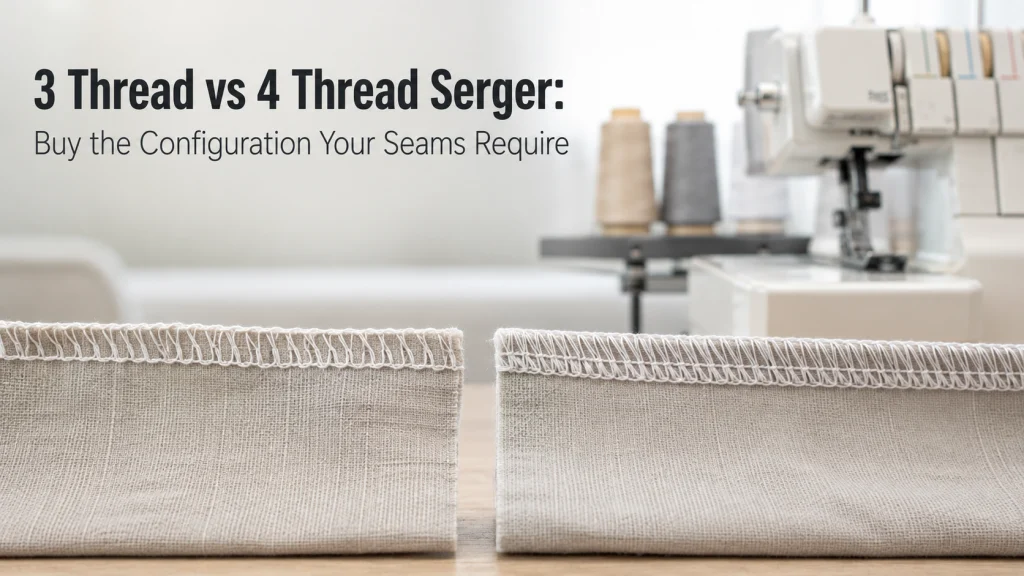
A cheap three-thread machine can be enough or a dead end
A 3-thread vs 4-thread serger decision becomes important when a low-cost older machine sits beside a current model that can switch between both configurations. If the job is simply wrapping raw seam allowances, the older machine may cover the intended work. If the plan includes constructing knit seams with a documented four-thread overlock, a three-thread-only machine cannot gain that configuration later just because the purchase price was attractive.
That is why thread count should be treated as a capability check, not a shortcut for deciding which machine is “better.” Start by listing the seams and finishes you expect to make, then confirm the exact stitch options in the candidate machine’s manual or manufacturer documentation. If you are still deciding what kind of serger belongs on the shortlist, compare broader serger buying factors before letting thread count dominate the whole purchase.
Define thread count as a stitch configuration, not a quality grade
On a conventional home overlock machine, the number in a stitch name describes how many threads participate in that configuration. A common three-thread overlock uses one needle thread with the looper threads, while a common four-thread overlock uses two needle threads with the loopers. That distinction changes the stitch structure, but it does not prove the whole machine is better built, easier to own, or more suitable for every fabric.
Brother’s current 1634D product information makes the distinction concrete: it lists a one-needle three-thread configuration and a two-needle four-thread configuration. That tells a buyer what the machine can form. It does not mean every project should use four threads or that another machine with a different configuration is inferior.
Key point: Buy the stitch configuration your planned seam requires. Do not turn the number of threads into a universal ranking of machine quality, seam safety, durability, or professionalism.
For a first-time owner, this is an easy point to miss because four cone stands look like a simple visual promise. The manual and supported stitch list matter more than the number of posts you can see from across the room.
Verify whether the candidate is three-thread-only or configurable
Do not assume a used machine can switch configurations just because a current serger can. Current manufacturer lineups show several arrangements: some models support three and four threads, some support two, three, and four, and others have a narrower range. The model number is therefore the starting point for the buying decision.
| Model example | Current listed capability | What that confirms |
|---|---|---|
| Brother 1634D | Three or four threads, including one-needle three-thread and two-needle four-thread options | The model supports both configurations |
| JUKI MO-623 | Two or three thread overlock | A home serger can legitimately have a more limited thread range |
| Janome MOD-8933 | Three and four thread convertible | The manufacturer explicitly identifies configuration flexibility |
These examples are evidence anchors, not product recommendations. They show why “serger” is not a complete capability description and why a seller’s generic listing should not replace the exact model page or manual. With an older machine, that check matters even more because the listing may omit the original stitch chart, accessories, or needle information.

The JUKI MO-623 is a one-needle overlock machine designed for two or three-thread operation. It includes built-in rolled hemming and adjustable differential feed. Its documented thread range makes it a useful example of why buyers should verify exact stitch capability instead of assuming every home serger supports four-thread overlock.
Check On AmazonIf you click this link and buy, we earn a commission at no additional cost to you.
Separate needle count from total thread count
A buyer can easily hear “four threads” and imagine four needle threads. That is not how the common home overlock configurations above are organized. The practical difference is that the four-thread overlock commonly uses two needles, while the three-thread overlock commonly uses one, with the loopers forming the wrapped portion of the stitch.
This matters when inspecting a used machine. A seller may say the machine “takes four cones,” but the useful questions are whether the exact model has two needle positions, which stitch configurations the manual lists, and what parts or conversions it requires. Do not remove needles, reroute thread, or improvise a conversion from a generic diagram when the exact manual gives a different procedure.
Quick terminology: A needle thread passes through a sewing needle and contributes to the seam line. A looper thread travels through a looper below or around the fabric edge and helps form the wrapped overlock structure. Thread count includes both, which is why a four-thread overlock does not mean four needles.
That distinction is enough for a buying decision. You do not need to learn the full threading path before comparing machines, but you do need to know whether the model uses one or two needle threads in the configuration you plan to sew.
Map planned jobs to required overlock configurations
The safest way to choose between a three-thread-only machine and a configurable machine is to work backward from the seam job. This keeps the purchase tied to actual sewing instead of a vague idea that more threads must always be better. Write down the work you expect to do in the next several projects, then check which stitch option the exact machine lists for that work.
| Planned job | Capability to verify | Buying implication |
|---|---|---|
| Finish raw woven seam allowances | A listed three-thread overlock suitable for the intended edge finish | A three-thread-only machine may be sufficient if this is the real use case |
| Construct knit seams with an overlock configuration | A listed four-thread overlock plus suitable feed control for the fabric | Passing on a three-thread-only machine can avoid a capability gap |
| Create narrow or rolled edges | The exact model’s listed narrow or rolled-edge stitch options | Do not infer this feature from thread count alone |
The worksheet is intentionally about capability rather than tension values or conversion steps. Those settings are model-specific and belong in the exact manual and setup instructions. At purchase time, the goal is simply to know whether the machine can form the stitch family your work calls for.
Edge finishing
Raw-edge finishing is the strongest case for considering a three-thread-only purchase without dismissing it automatically. Manufacturers commonly list three-thread overlock for overcasting and edge-finishing work, so a buyer who mainly wants cleaner seam allowances may not need four-thread capability for every pass. The material and desired finish still matter, and the manual should confirm the stitch rather than a seller making that decision for you.
For example, a sewist who constructs a woven garment on a conventional sewing machine and wants the serger only to finish exposed seam allowances has a different requirement from someone who wants the serger to construct stretch seams. The first buyer may accept a narrower capability set. That is a fit decision, not proof that three threads are universally enough.
Knit seam construction
Knit construction is where a cheap three-thread-only offer deserves more scrutiny. Current home-serger manuals and product pages commonly list four-thread overlock as a construction option for stretch or knit work, with two needle threads participating in the configuration. That does not justify a blanket claim that every four-thread seam is stronger under every condition. It does mean a buyer should notice when a planned method calls for a configuration the cheaper machine cannot form.
Imagine that your next projects are T-shirts and knit lounge pants, and the instructions you intend to follow call for a four-thread overlock construction seam. A three-thread-only machine cannot satisfy that requirement as written. Broaden the shortlist rather than trying to make a different stitch name stand in for the missing capability.
Narrow and rolled-edge work
Narrow and rolled edges are another reason not to shop by headline thread count. Some three and four thread machines document rolled hem or narrow overlock options, but the exact conversion, needle position, stitch finger arrangement, and threading path vary by model. A machine can therefore meet the desired edge-finishing job without that feature being obvious from the phrase “three-thread” or “four-thread.”
At this stage, verify that the stitch exists and that the required parts are present. Do not turn a buying comparison into a generic rolled-hem tutorial, because the setup steps belong to the exact machine instructions.

The Brother 1034D supports both three-thread and four-thread overlock configurations. Its documented stitch options also include narrow hem and rolled hem, while differential feed provides a separate fabric-feed control. That combination makes it useful for comparing a configurable machine against the specific seam and edge-finishing jobs planned in this section.
Check On AmazonIf you click this link and buy, we earn a commission at no additional cost to you.
Keep differential feed as a separate buying criterion
Thread count tells you one thing about stitch configuration. Differential feed tells you something different about how the machine can vary the relationship between its feed systems while handling fabric. A used three-thread-only machine that also lacks differential feed therefore presents two separate limitations, and the buyer should not collapse them into one judgment about “three threads.”
For instance, a buyer comparing an older fixed-feed machine with a current configurable serger should ask two questions: does each machine make the required overlock configuration, and does each provide the feed control needed for the intended materials? One answer cannot substitute for the other.
Keep the threading system separate too
Manual threading, assisted threading, and air threading affect setup convenience, not the basic meaning of a three-thread or four-thread stitch. A four-thread-capable machine can still have a threading system you dislike, while an older three-thread machine may be simple enough for a buyer who already understands its documented path. Treat convenience as its own ownership criterion.
This separation prevents a common comparison error. If a newer machine is easier to thread and also supports more configurations, those are two benefits that happen to exist on the same candidate. If ease of setup is a major concern for a first machine, choose a first serger by considering the whole setup and ownership picture rather than assuming thread count predicts ease of use.
Audit a used three-thread-only offer before buying
A used machine deserves a capability audit before price becomes persuasive. Older sergers may be perfectly useful for a narrow job, but a missing manual, unclear accessories, unavailable parts, or a condition problem can turn a cheap purchase into a machine that cannot do the work you bought it for. The audit should stay owner-level and should not involve opening the machine for internal repair diagnosis.
- Confirm the exact model number from the machine, not only the listing title.
- Find the correct manual or manufacturer page and list the supported thread configurations.
- Verify the needle arrangement and any parts the manual requires for the intended stitches.
- Check whether differential feed is present if the planned materials make that feature important.
- Confirm that the threading path, presser foot, stitch plate area, pedal, power cord, and other required external parts are present and appropriate for the exact model.
- Check current access to routine consumables, replacement parts, and qualified service before treating age or metal construction as a durability guarantee.
- Walk away from damaged cords, exposed wiring, overheating, smoke, a burning odor, sparks, uncontrolled motion, a hard mechanical lock, or repeated hard needle strikes that require qualified service.
Used-listing red flags: Treat a listing cautiously when the model label is not shown clearly, the seller uses vague phrases such as “four needle” without identifying the stitch system, the needle and presser-foot area is missing from the photos, or required external parts are not pictured. None of those details proves the machine is bad, but each one leaves a buying question unresolved.
A first-time buyer commonly overweights visible metal parts because they feel like evidence of longevity. Construction material alone does not prove the machine’s current mechanical condition, parts support, stitch capability, or suitability for the intended fabric. The better used-machine question is whether the exact unit can be verified, supported, and used for the planned work without immediately creating a capability gap.
Compare current three and four thread options only on documented capability
Current product pages are useful because they show exactly which configurations a manufacturer claims for a model, but they should not be converted into a ranking. Brother lists current three and four thread machines, Janome identifies models as three and four thread convertible, and JUKI’s home-serger lineup includes different thread ranges alongside systems outside this article’s scope. Those pages confirm configuration differences, not overall sewing quality or value by themselves.
That distinction matters when comparing a 3- or 4-thread serger listing with an older three-thread-only offer. Verify the stitch options first. Then compare feed control, threading, included parts, service access, condition, and ownership cost as separate questions. A wider thread range can preserve future options, but it cannot make the rest of the machine fit the buyer or the work.
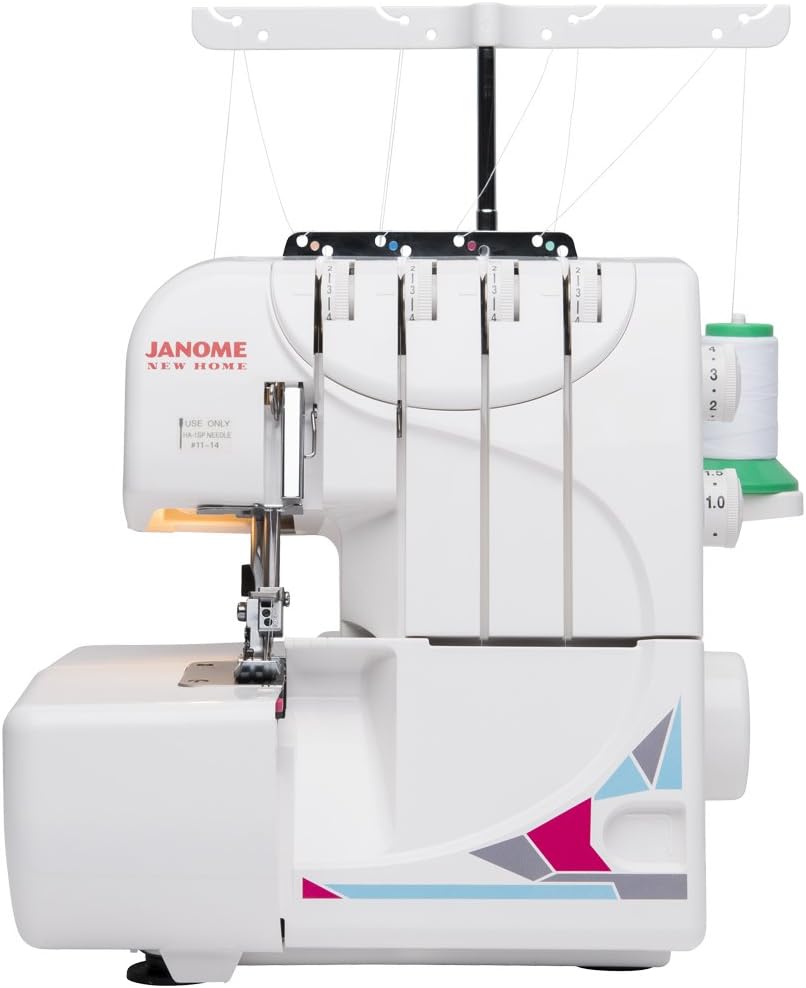
The Janome MOD-8933 is a three and four-thread convertible serger with easy lay-in threading. It also provides differential feed and a quick-change rolled hem system as separately documented features. It fits this section as a current configurable example whose thread range can be checked independently from its feed and threading controls.
Check On AmazonIf you click this link and buy, we earn a commission at no additional cost to you.
Stop before five-thread, chainstitch, and coverstitch systems
Once the comparison moves into five-thread safety stitches, chainstitch capability, or coverstitch functions, thread count no longer describes the same buying decision. Those systems can combine different stitch structures and ownership purposes, so folding them into a simple three-versus-four comparison makes the answer less accurate. This article stops at conventional home-serger buying significance for three-thread and four-thread overlock capability.
If your planned work genuinely requires another stitch system, the correct next step is to compare specialist sewing machine types instead of choosing a conventional serger and hoping extra thread positions mean the same thing. The machine type and documented stitch system control that decision.
Decide whether to buy, pass, or broaden the shortlist
The final choice becomes much simpler after the planned jobs and candidate capabilities are written down. Buy when the machine’s listed stitch options cover the work, the separate feed and threading features fit your needs, and the used or new ownership picture is acceptable. Pass when a required configuration is missing or when condition and support cannot be verified well enough for the price.
| What you verified | Reasonable next move |
|---|---|
| Your work is mainly three-thread edge finishing, and the candidate is complete and supportable | Keep the three-thread-only machine in consideration |
| Your planned seams require a four-thread overlock that the candidate cannot form | Pass on that machine and broaden the shortlist |
| Thread capability fits, but differential feed, threading convenience, condition, or parts support does not | Evaluate those separate limitations before buying |
| The job actually requires chainstitch, coverstitch, or another system | Move to the correct machine-system comparison |
A 3-thread serger is not automatically obsolete, and a 4-thread serger is not automatically the right purchase. The acceptable machine is the one whose verified configuration and ownership conditions match the work you intend to do.
Final Thoughts: buy the configuration, not the thread-count headline
A three-thread-only machine is worth keeping on the list when the jobs you wrote down fit its stitch options and the rest of the ownership picture checks out. If a planned seam already calls for a four-thread overlock the machine cannot form, the discount is buying a limitation rather than solving the sewing need.
For a used offer, uncertainty is part of the decision too. Confirm the model and manual first, then judge feed control, threading, condition, included parts, service access, and ongoing cost on their own merits. That gives you a reason to buy, pass, or widen the shortlist without asking thread count to answer questions it cannot answer.
Frequently Asked Questions
🧵 Is a three-thread serger enough for finishing seams?
It can be when your planned use is raw-edge finishing and the exact machine documents an appropriate three-thread overlock. If you also want the serger to construct seams that call for four-thread overlock, verify that capability before buying.
🪡 Can a four-thread serger sew with three threads?
Many configurable home sergers can, but the exact model documentation controls the answer. Brother, Janome, and JUKI all currently document models with multiple thread configurations, so check the manual rather than removing a thread based on a generic diagram.
🧶 Should I buy a three or four thread serger for knits?
Start with the seam configuration your knit projects actually require. If your intended construction method calls for a four-thread overlock, a three-thread-only machine creates a clear capability limit, while differential feed remains a separate feature to verify.
⚙️ Is differential feed the same thing as having four threads?
No. Thread count describes stitch configuration, while differential feed is a fabric-feed control. Check both independently, especially when comparing an older used machine with a current model.
🔍 Is an older metal three-thread serger automatically a better used buy?
No. Metal construction does not prove current condition, stitch capability, parts availability, or future service access. Verify the exact model, manual, external condition, required parts, and support before deciding whether the price makes sense.
References and Sources
- Brother 1634D product page: Verifies the model’s documented three-thread and four-thread options, including one-needle and two-needle configurations.
- JUKI home serger lineup: Verifies that current home-serger models are documented with different thread ranges, including two and three thread as well as two, three, and four thread configurations.
- Janome MOD-8933 product page: Verifies the model’s three and four thread convertible capability and separately documented differential feed.