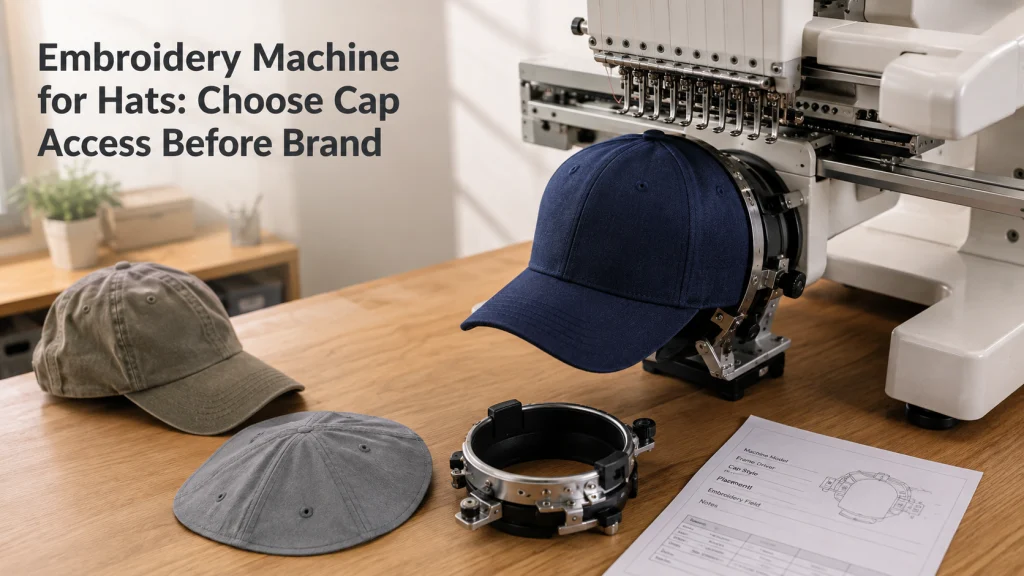
Choosing an embroidery machine for hats starts with cap construction, placement, and whether the finished crown can physically move through the required frame path. A soft cap, a flat panel, and a stiff structured baseball cap can create different access problems even with the same design. Verify the exact frame or driver before comparing needle count or machine class. This article stays at the equipment-selection level and does not cover digitizing, hooping technique, stabilizer choice, tension settings, or profit forecasts.
The Best Embroidery Machine for Hats Starts With Access, Not Brand
Choosing an embroidery machine for hats is not the same as choosing one for flat shirts or patches. A soft cap may flex into a supported frame arrangement that would not suit a rigid structured crown. A finished baseball cap can also require the crown and brim to clear parts of the machine while the frame moves. Start with that three-dimensional access problem, not with brand, speed, or needle count.
Search results often place flatbed home machines, single-needle free-arm systems, and tubular multi-needle machines beside one another. Those systems do not necessarily solve the same cap geometry. A buyer decorating occasional soft caps can reach a different answer from someone repeatedly stitching finished structured crowns. Before shopping, write down the cap construction, the placement, and whether the crown is already assembled.
Define the Exact Cap Styles and Embroidery Placements
Begin with the hats you actually expect to embroider, not the broad label “caps.” Record whether each item is unstructured, lightly supported, or built around a firm front panel. Then note the intended placement because a centered front logo, side mark, and rear name can create different clearance around seams and the brim. The machine decision should follow those physical conditions.
| Cap or part | Construction | Placement | Finished crown? | Access question |
|---|---|---|---|---|
| Soft cap | Unstructured or lightly supported | Front, side, or rear | Yes or no | Can the intended frame hold the placement? |
| Structured cap | Firm crown support | Front, side, or rear | Usually yes | Can the crown and brim clear the machine path? |
| Flat panel | Before final assembly | Panel area | No | Can it be handled as flat embroidery? |
Separate recurring work from one-off experiments as well. If most projects are flat garments and a soft cap appears rarely, the hat requirement may not need to control the entire purchase. If caps are the recurring target, give more weight to the stiffest crown and least convenient placement you expect. The worksheet is meant to identify the hardest recurring geometry before any machine reaches the shortlist.
Separate Flat Panels, Soft Caps, and Structured Caps
A flat panel is the least demanding geometry because the material can remain relatively flat while the frame moves. A soft cap adds curvature, seams, and a brim, but its crown may still flex enough for a documented frame method. A structured cap keeps more of its three-dimensional form and can resist being flattened into a conventional hooping path. Treating those cases as equivalent can make a hat embroidery machine look more capable than the evidence supports.
Manufacturer accessory descriptions help when they name the cap construction they support. An insert documented for unstructured hats proves that narrower use, not automatic support for a stiff finished crown. A frame can solve how the cap is held while the machine still limits how the crown can travel. Keep the cap type attached to every capability claim you record.
Record Whether the Machine Must Embroider the Finished Crown
Ask whether embroidery happens before assembly or on the finished crown. A flat panel can often be approached as ordinary flat embroidery, removing much of the access problem. A finished crown keeps the brim, seams, sweatband, and three-dimensional shell in the work area. That requirement can change the machine class even when the design dimensions stay the same.
- Is the crown already assembled when embroidery begins?
- Must the brim remain attached and retain its shape?
- Does the placement approach a seam or the brim?
- Will the crown need to travel around a narrow machine arm?
Do not let a large listed embroidery field answer the wrong question. A design can fit inside the stated field while the finished cap cannot be mounted or moved through it in the needed orientation. A modest soft-cap placement may also work without a more specialized system when the manufacturer documents the arrangement. Record finished-crown access as a yes-or-no requirement before comparing maximum frame sizes.
Verify Cap Frame or Driver Capability on the Exact Machine
A cap frame is not a universal accessory category. Some systems require a dedicated driver on the carriage, while others use an insert with a specific embroidery hoop. The exact model list, required holder or driver, stated embroidery field, and installation instructions are stronger evidence than visual similarity. If the machine is not named in compatibility documentation, treat fit as unverified.
Also separate frame compatibility from the machine access that the frame depends on. The carriage, arm geometry, presser-foot clearance, and permitted movement still come from the machine system. Manufacturer instructions may even specify frame orientation to prevent contact with nearby machine parts. A cap accessory therefore belongs to a coordinated machine-and-frame system, not to an interchangeable pool of hoops.
Compare Flatbed, Free-Arm, and Tubular Access at Purchase Level
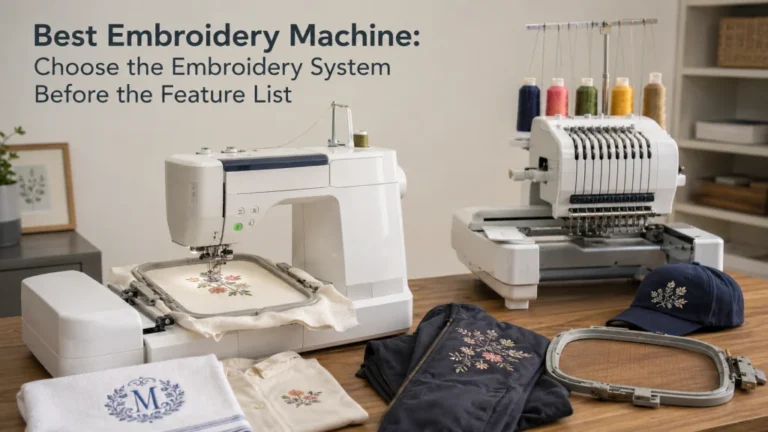
Flatbed, free-arm, and tubular systems create different amounts of space around the work. A flatbed arrangement can be reasonable for flat pieces and some documented soft-cap methods. A free arm opens space so a finished item can pass around a narrower machine arm. A tubular multi-needle layout combines this style of access with several threaded needles and a carriage designed around framed embroidery work.
| Access type | Useful buying question | What it does not prove |
|---|---|---|
| Flatbed | Can the documented method hold the exact soft cap or flat panel? | Support for every structured cap |
| Free arm | Can the crown pass around the arm with the specified frame? | Support for every placement |
| Tubular multi needle | Does the cap system match the finished crown and repeated workflow? | Perfect results on every cap |
None of those architecture labels proves success on a particular structured cap by itself. Verify the exact frame and crown geometry first, then compare convenience or needle count. If the broader machine families are unclear, compare sewing machine types and systems before treating one architecture as automatically better. For embroidery architecture specifically, compare single-needle and multi-needle systems without assuming needle count creates cap access.
Decide Whether Single Needle Remains Practical for the Planned Repetition
Single needle does not mean incapable of cap work. A documented free-arm or compatible cap-frame system may solve the physical access requirement while keeping the machine simpler than a multi-needle setup. The tradeoff appears when a repeated design changes colors and requires the operator to rethread often. If cap volume is occasional and color changes are limited, that intervention may be acceptable.
| Work pattern | Question | Possible outcome |
|---|---|---|
| Occasional cap, few colors | Are manual changes acceptable? | Single needle may remain practical |
| Repeated caps, many colors | Is operator attention the bottleneck? | Compare multi-needle architecture |
| Access unverified | Can the crown be framed and moved? | Do not use needle count to skip the access check |
Measure repetition from the work you expect rather than from a production label. Record batch size, recurring color count, and whether someone must remain nearby for thread changes, but do not invent hourly output. Machine speed, design structure, trimming, framing, and operator workflow all affect elapsed time. The useful question is whether intervention has become a recurring bottleneck after cap access is already verified.
Keep Multi Needle as an Architecture Outcome, Not an Automatic Requirement
Multi-needle systems are common in hat searches because they can combine tubular-style access with several threaded needles. That does not make them the default answer for every cap buyer. First verify the cap frame, driver, crown clearance, and placement on the exact system. Then ask whether repeated color work makes operator attention important enough to justify multiple needles.
Do not use “commercial” as a synonym for “handles structured hats” either. A machine aimed at paid work can still have model-specific frame limits, while a single-needle free arm may support the required geometry without solving a high-repetition workflow. If multi needle has already won the access and workload checks, evaluate multi-needle embroidery machine options with those requirements in hand. Otherwise, remain at the architecture decision instead of shopping by needle count.
Record Cap-Frame Cost, Support, and Service Separately
The machine price is only one part of a cap-capable system. A dedicated cap frame may require a separate driver, holder, hooping fixture, or other model-specific component. Record every required piece instead of assuming that “cap capability” means the complete workflow is included. If the machine cannot perform the intended task without an accessory, that accessory belongs in the ownership decision.
- Exact frame, driver, holder, or fixture identified
- Included and optional components separated
- Current compatibility documentation located
- Manual or support path available
- Service route checked when relevant
Support matters because specialized hardware is useful only while compatible parts and instructions remain available. Do not invent service intervals or repair probabilities; simply record the documented support path and whether the frame remains listed for the machine. For paid-order decisions that extend beyond hats, choose embroidery equipment for paid orders using workload and downtime rather than profit promises. This keeps ownership cost separate from unsupported return-on-investment claims.
Set the Evidence Threshold for Structured-Cap Claims
Structured-cap capability needs stronger evidence than a marketing photo. Look for exact manufacturer documentation naming the machine, compatible cap frame or driver, embroidery field, and any stated cap or orientation limit. A page that specifically describes an accessory for unstructured hats should not be expanded to cover rigid finished crowns. Compatibility evidence is useful, but it still does not guarantee success on every construction or design.
Independent testing can add evidence when the machine, frame, cap construction, placement, design, and conditions are disclosed. Community reports are useful for identifying recurring buyer problems, but one success or failure does not create a universal rule. The phrase best embroidery machine for hats should therefore lead to a verification check, not a popularity ranking. If the documentation stops short of the structured-cap condition you need, mark that capability unknown.
Build the Shortlist by Cap Geometry and Workflow
Shortlist system classes only after the access checks are complete. Keep a home flatbed when a documented flat-panel or soft-cap method matches the recurring project. Keep a single-needle free arm when finished-item clearance is needed but manual thread changes remain acceptable. Keep a tubular multi-needle system when the cap geometry is supported and repeated color work makes operator intervention a real constraint.
| System class | Keep it when | Remove it when |
|---|---|---|
| Home flatbed | Documented limited cap method matches the project | Finished-crown access is unsupported |
| Single-needle free arm | Cap access is verified and manual changes are acceptable | Frame compatibility remains unclear |
| Tubular multi needle | Cap access and repetition both justify it | Needle count is the only reason |
| Outsource | Geometry is specialized, infrequent, or poorly supported | An owned system is clearly justified |
Outsourcing belongs on the same shortlist because ownership is not automatically the best answer. If affordable candidates cannot document the recurring structured-cap geometry, sending that work elsewhere can be more rational than buying around a vague promise. For a broader comparison not controlled by hats, compare embroidery machine systems by task instead. The shortlist should shrink as evidence improves, not grow because more models exist.
Mark Unsupported Hat-Performance Claims as Unknown
Some hat claims sound precise while hiding the test conditions. Statements such as “handles structured caps” or “perfect for baseball caps” are incomplete without the exact machine, frame, cap construction, placement, and limitation. Do not turn retailer enthusiasm or one community success story into a universal performance claim. Record the claim, then record what evidence is missing.
| Claim | Evidence | Status |
|---|---|---|
| Works on hats | Generic wording only | Unknown |
| Supports a named cap frame | Exact compatibility page | Compatibility verified, performance bounded |
| Handles a structured crown | Exact documented setup or bounded test | Verified only within stated conditions |
A successful soft-cap example does not prove performance on every structured cap. Likewise, one needle-strike report does not establish a failure rate for the machine. Different crowns, frames, designs, placements, and machine configurations can produce different results. Keeping unknowns visible is more useful than replacing them with confident guesses.
Decide Between a Home System, Free Arm, Tubular Multi Needle, or Outsourcing
The decision should now reduce to four practical outcomes. A home flatbed can remain viable for flat panels or a documented limited cap method. A single-needle free arm fits when finished-item clearance matters but repeated thread changes remain acceptable. A tubular multi-needle system becomes relevant when both cap access and repeated operator intervention support that architecture.
| Question | Yes | No |
|---|---|---|
| Can a documented flat or soft-cap method handle the recurring work? | Keep a home system in consideration | Check finished-item access |
| Does the crown need free-arm or tubular clearance? | Remove unsupported flatbed options | Do not buy specialized access without a reason |
| Are repeated color changes an operator bottleneck? | Compare multi-needle architecture | Single needle may remain practical |
| Is the required geometry still unsupported? | Keep outsourcing in the decision | Shortlist within the verified class |
Outsourcing is not a failure to choose. It can fit when structured-cap work is infrequent, the required frame path is undocumented on affordable candidates, or accessory support is weak. Do not turn this flow into a profit forecast because there are no primary business records here for revenue, labor, or payback. The operational question is simply which path documents the required cap geometry with an acceptable ownership burden.
Final Thoughts: Buy for Cap Access, Not the Word Embroidery
A hat project can expose machine geometry that barely matters on a flat shirt or patch. Define the cap construction and placement, decide whether the crown is already assembled, and verify the exact frame or driver before comparing machine classes. Needle count comes later because it can reduce operator intervention without creating missing compatibility. That sequence keeps a broad “hat capable” label from replacing the actual access question.
Keep the result bounded to the work you can verify. A home system can be enough for limited documented cap work, while a free-arm single needle can solve access without automatically requiring multiple needles. A tubular multi-needle system makes sense only when cap geometry and repetition both support it. Outsourcing remains valid when the required structured-cap workflow cannot be verified or does not justify specialized ownership.
FAQs
Hat-machine questions often sound like model questions when the real uncertainty is access. The answer usually depends on cap structure, finished-crown geometry, placement, and the exact frame or driver. Needle count and embroidery-field size matter only after those requirements are clear. Use the questions below to identify what needs verification before shopping.
These answers stay at the buying and compatibility level. They do not replace the machine manual or cap-frame instructions. They also do not promise stitch quality on an untested cap. Treat each answer as a decision boundary rather than a universal performance claim.
🧢 Do I need a commercial machine to embroider hats?
No. Some flatbed or free-arm systems have documented cap options, especially for limited or unstructured-cap work. Move toward more specialized architecture only when the required finished-crown access or repetition justifies it.
🪡 Can a single-needle embroidery machine do caps?
Yes, when the exact machine and compatible frame system are documented for the cap geometry you need. Single needle affects thread-change workflow, not whether an unsupported frame becomes compatible.
⚙️ Does a multi-needle machine automatically handle structured caps?
No. Multi needle describes needle architecture, while structured-cap capability still depends on machine access and the exact compatible cap system. Verify both before treating a structured crown as supported.
📐 Is the maximum embroidery area the same as the cap embroidery area?
Not necessarily. Cap frames can have their own stated embroidery field, and finished-cap geometry can further affect usable placement. Check the exact cap-frame documentation.
🧰 What should I verify before buying a cap frame?
Verify the machine model, frame or insert, required driver or holder, stated cap type, embroidery field, and installation documentation. Visual similarity is not compatibility evidence.
🏷️ Should I outsource structured-cap embroidery instead of buying a machine?
Outsourcing can be reasonable when the work is infrequent or affordable candidates cannot document the finished-cap geometry you need. Compare that operational burden separately from any unsupported promise of profit or payback.
References and Sources
The external references are limited to claims that need exact manufacturer evidence. They establish examples of free-arm cap access, cap-frame compatibility, driver requirements, and cap-specific embroidery fields. They are not a product ranking or a recommendation to buy a particular machine. Recheck documentation for any exact model considered later.
These sources also show why generic hat claims are too broad. One page can document free-arm cap use while another narrows an accessory to unstructured hats or requires a dedicated driver. That difference supports the compatibility-first method used here. Community reports can identify buyer confusion, but they are not needed to prove these technical relationships.
- Brother free-arm embroidery specifications: Documents free-arm cap use and model-specific cap-frame capability.
- Brother unstructured-cap frame insert: Documents an accessory specifically described for unstructured caps and hats.
- Brother cap-frame attachment support: Documents the driver requirement and machine-clearance instructions for covered systems.
- Brother cap-frame embroidery area support: Documents a cap-frame field that is separate from the machine’s general maximum embroidery area.