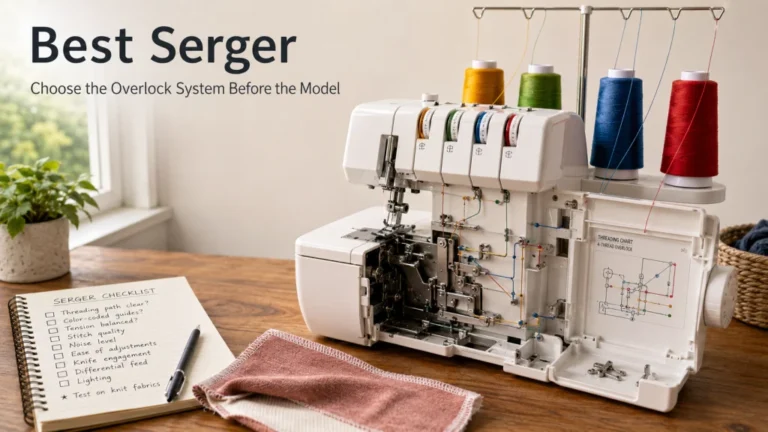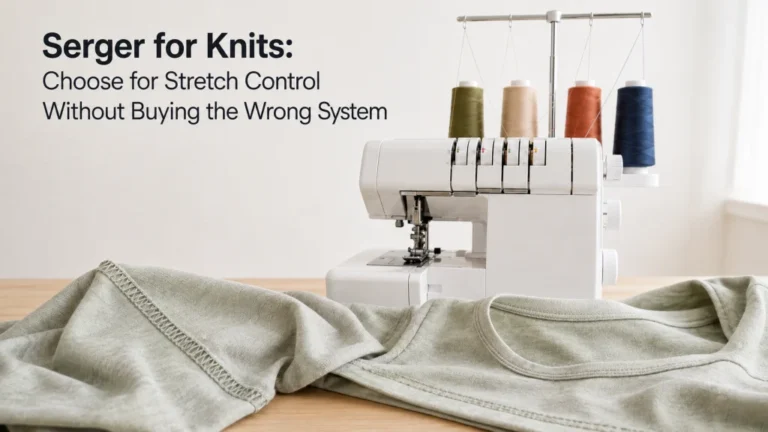
When I compare air-threading sergers, I separate the feature name from the actual threading work it removes. Current Brother and JUKI materials show different controls for loopers, needles, and tension, so the useful buying test is to map each job before comparing price. The value also depends on how often you rethread, change colors, or convert stitches. This article stays with current home overlock machines, not combination coverstitch systems, industrial pneumatic equipment, or internal repair.
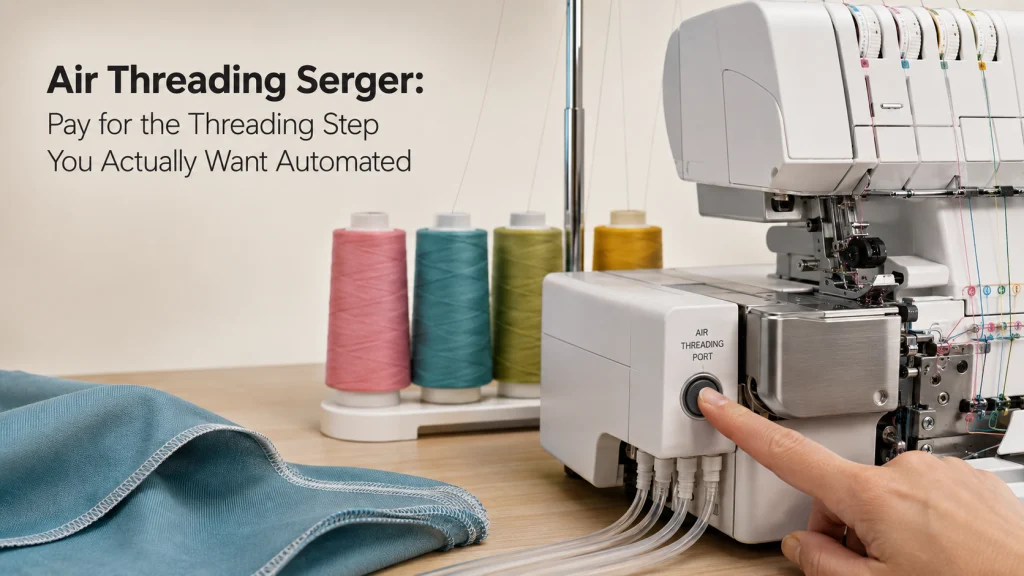
Define the buyer problem before defining the technology
I would only pay extra for an air-threading serger after identifying the part of setup I actually want the feature to remove. Two machines can both be marketed as easier to thread while asking the owner to do very different work before the first stitch. Paying more makes sense only after that workload has been named precisely.
Imagine changing from four-thread overlock with white thread to a dark rolled hem. The useful comparison is not whether both machines carry an easy-threading label, but which paths, controls, and conversion steps you still touch during that change.
Key point: I compare the threading workflow step by step. A broad label such as self threading is not evidence that every thread path or setup control is automated.
This narrower question also keeps the purchase decision in the right place. If threading is only one of several things you are evaluating, compare sergers by broader buying criteria before letting one convenience feature dominate the choice.
Split serger threading into separate jobs
A common four-thread setup can use two needles and two loopers, but those paths are not one task. Current manufacturers document looper threading separately from needle threading and tension adjustment. Compare the jobs first, then the feature names.
I do not score comfort or speed in the ledger below because those outcomes depend on the person, thread, stitch configuration, starting state, and exact model. It records only the jobs a buyer should verify.
Upper looper
Current Brother AIR models and JUKI MO air-threading models explicitly route the upper looper through an air-assisted system. The user still prepares the machine and inserts thread into the designated port. Air changes the internal looper-path step, not every action from spool to stitch.
Lower looper
The lower looper deserves its own line in the ledger because sales wording can collapse both loopers into one feature badge. Brother lists air support for both loopers on the AIR1800 and AIRFLOW 3000, and JUKI lists the same coverage for the MO-1000 and MO-2800.
Needle threads
Needle threading has a different starting point. Brother still routes each needle thread through guides and its tension disc before the needle-threader mechanism, while JUKI lists its needle threader as a separate control. For a buyer, the practical question is how much routing remains before that aid takes over.
Tension path
Tension belongs on a separate row because it changes stitch formation rather than simply moving thread through a looper path. Brother lists manual tension on the AIR1800 and AIRFLOW 3000, while JUKI uses adjustable dials on the MO-1000 and MO-2800.
Rethreading after a stitch change
The workload changes with the project. A sewist who leaves four cones installed for long runs may rethread far less often than someone changing colors, thread counts, or rolled-hem setups. Value should be tied to those real transitions, not the number of feature badges.
| Threading job | What to verify | Do not assume |
|---|---|---|
| Upper looper | Whether the exact model routes it through the air system | That every thread path uses air |
| Lower looper | Whether the exact model routes it through the air system | That no preparation or port loading remains |
| Needle thread | Whether there is a separate needle threader and what steps precede it | That air passes thread through the needle |
| Tension | Manual dials, assisted settings, or another documented system | That air threading means automatic tension |
| Stitch change | Which threads, needles, levers, or settings must change | That every stitch conversion is automatic |
That ledger is more useful than a single easy-threading score because it survives differences in terminology. Once the jobs are separated, manufacturer claims become much easier to read without accidentally expanding their scope.
Translate air threading, jet air, and self threading cautiously
Search language is looser than product manuals. A page labeled self threading serger may refer to air-assisted loopers, a built-in needle threader, simplified lay-in paths, automatic tension, or some combination of those features. Searches for “air thread serger” and “jet air serger” often lead to the same buying problem, but the words alone do not define the workflow.
I translate the term by function: list the steps the manufacturer assigns to the feature, then list the steps still performed by the user. If seller wording is broader than the support material, I use the narrower description.
| Term you may see | Useful interpretation | Verification needed |
|---|---|---|
| Air threading | Air assists a documented thread path | Which loopers or other paths are actually included |
| Jet air | Brand or market wording for an air-assisted threading system | Exact path and activation sequence on that model |
| Self threading | Broad market shorthand | Every automated and manual step must be listed |
| Automatic needle threader | A separate aid for getting thread through the needle eye | What guide and tension routing still precedes it |
| Automatic tension | A separate tension-control feature when explicitly documented | Do not infer it from air threading |
A first-time serger buyer can easily read several convenience features as one automation promise. My practical correction is simple: count the jobs, not the adjectives.
Verify exactly what the Brother air system automates
Brother’s current US material for the AIR1800 and AIRFLOW 3000 describes threading ports connected by tubes to the upper and lower loopers. The user places thread into the port and activates the air system, while the product specifications list two, three, and four-thread operation and manual tension.
Brother handles the needles through another sequence: route each thread through the guides and tension disc, then use the built-in needle threader at the needle eye. The instructions also require the machine to be turned off for needle threading, which is a useful reminder that convenience features do not replace the stated safety sequence.
Note: Brother’s support pages use separate procedures for “Threading the loopers” and “Threading the needles.” I use that separation to see where one feature stops and the next task begins without relying on retailer shorthand.
For comparison purposes, I find the Brother examples most useful as a workflow map: port loading and air assistance for the loopers, conventional routing to the needle area, then a needle-threader mechanism for the final eye-threading step.

The Brother AIR1800 uses air-powered looper threading, with threading ports connected to the loopers and a push-button air blast to move thread through the paths. It supports two, three, or four threads and uses manual tension. Color-coded thread guides and built-in work lighting support the setup workflow discussed in this section.
Check On AmazonIf you click this link and buy, we earn a commission at no additional cost to you.
Verify exactly what the JUKI air system automates
JUKI currently lists the MO-1000 and MO-2800 as two, three, or four-thread overlock machines. Their product pages describe air moving thread from the threading hole to either looper, while the automatic needle threader appears as its own lever-and-hook operation.
The tension controls add another useful distinction. Both machines use variable adjustment from 1 through 9, and the MO-2800 adds a rolled-hem tension lever. Those controls matter when comparing setup, but they are not part of the air path itself.
Read together, the JUKI pages give me three separate checkpoints: how the loopers are loaded, how the needle eye is threaded, and how stitch balance is adjusted. That is a more informative comparison than asking whether the machine “threads itself.”
Other controls may still affect the purchase, but they should be evaluated on their own function rather than grouped under the air-threading label.
Record the remaining manual needle steps
A built-in needle threader is helpful only if you understand where its job starts. In the Brother instructions checked here, thread still travels from the spool through the thread tree, guides, the correct tension disc, and the marked needle path before the needle-threader lever is used. JUKI also gives the needle threader its own operating sequence.
During a full rethread or a change from two needles to one, you may still need to identify the correct needle path, change a needle as the manual requires, and confirm the thread configuration. Passing thread through the needle eye is only one part of that sequence.
- Check whether the needle threader works with the needle position you plan to use.
- Confirm which guides and tension discs must still be threaded manually.
- Check whether a stitch change requires removing a needle or changing a converter or lever.
- Follow the machine manual for power-off, cover, presser-foot, and threading-position requirements.
For someone buying specifically to avoid looper threading, those remaining needle steps may be perfectly acceptable. For someone expecting to place cones on the stand and press one button, they are the difference between an accurate purchase expectation and an expensive misunderstanding.
Separate threading automation from automatic tension claims
Threading and tension interact, but they answer different setup questions. The Brother AIR1800 and AIRFLOW 3000 use manual tension controls, while the JUKI MO-1000 and MO-2800 use user-adjustable dials.
So a threading comparison cannot substitute for a tension comparison. If a sales page mentions automatic tension, assisted settings, or another thread-delivery system, verify that feature independently and in the operating context the manufacturer gives it.
This separation is especially useful when a stitch looks unbalanced after rethreading. The next check may involve thread seating, the selected tension, needle setup, or the exact stitch configuration; the presence of an air system does not prove those other variables are correct.
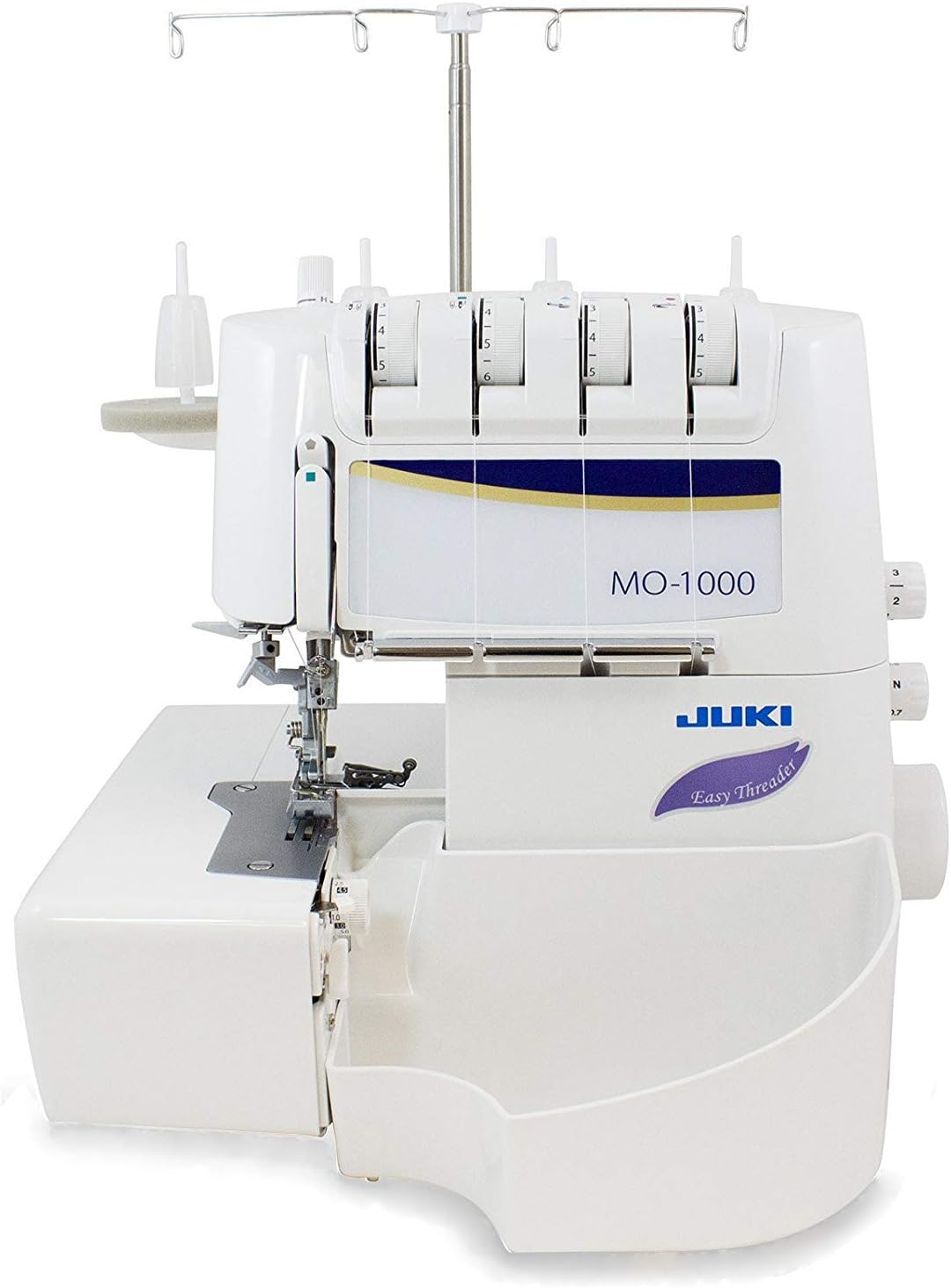
The JUKI MO-1000 uses air threading for the upper and lower loopers and provides a separate automatic needle threader. It supports two, three, and four-thread overlock work with adjustable differential feed. Its tension remains user-adjustable, making it a useful example of why air threading and tension control should be evaluated separately.
Check On AmazonIf you click this link and buy, we earn a commission at no additional cost to you.
Compare thread configurations and stitch range without assuming more is better
The Brother AIR1800 and AIRFLOW 3000 and the JUKI MO-1000 and MO-2800 are documented for two, three, and four-thread overlock work. Different stitches can still change needles, levers, or settings. The useful question is how much reconfiguration your own work creates, not which model has the longest feature list.
A sewist who mainly uses one four-thread setup may leave the machine threaded for long periods. Small-batch work with frequent color or rolled-hem changes exposes the threading workflow more often. The same feature can therefore carry different value for two people who sew similar hours.
Note: This article does not extend the comparison to serger-coverstitch combination machines. Those systems add different thread paths and conversion decisions, so their threading workflow needs to be evaluated separately.
If you are still deciding whether a serger is the right specialist system at all, compare sewing machine types and systems before paying a premium for a feature on the wrong machine category.
Price the feature against how often rethreading happens
Air threading has value only in a workflow where the automated step appears often enough to matter to the buyer. Current prices and stock can change quickly, and the premium cannot be isolated from the other differences between these machines. I would compare the actual purchase price available to me with a suitable manual-threading alternative that still meets the rest of the requirements.
Then I would count complete rethreads, partial rethreads, color changes, and stitch conversions in normal work. A premium can make sense for a frequently used step without making sense for everyone.
| Your rethreading pattern | Question to ask | What the answer means |
|---|---|---|
| Same cones and same stitch for long runs | How often do I actually enter the looper paths? | Looper automation may affect fewer sessions than expected |
| Frequent color changes | Do I fully rethread or tie on and pull through? | Compare the exact workflow you really use |
| Frequent stitch changes | Which changes require new looper or needle paths? | Automation value depends on the changed paths |
| Thread breaks are a recurring concern | Which path is most difficult to restore correctly? | Target the troublesome step rather than a broad label |
Do not convert this worksheet into a universal dollar-per-minute calculation. Without controlled same-user testing on the exact machines and starting conditions, a time-saving number would be invented precision rather than useful evidence.

The Brother 1034D is a 3/4-thread serger with color-coded threading and a lower-looper threading system rather than the air threading used on Brother AIR models. It includes differential feed and supports overlock, narrow hem, rolled hem, and ribbon lock stitches. It provides a practical non-air reference point when comparing how much an air-threading premium matters to your workflow.
Check On AmazonIf you click this link and buy, we earn a commission at no additional cost to you.
Audit current air-threading models by workflow
The table below is an evidence audit, not a recommendation list. I use the same columns for each model so the workflow can be compared without relying on marketing vocabulary. Availability, dealer price, packages, and model status should be rechecked before purchase.
The useful difference is not the number of convenience claims attached to a machine. It is whether the feature you are paying for changes the particular rethreading step that recurs in your work.
| Model | Looper threading | Needle threading | Tension | Price or availability note |
|---|---|---|---|---|
| Brother AIR1800 | Air through upper and lower looper paths | Separate built-in needle-threader process | Manual | Check current Brother US or dealer price and stock |
| Brother AIRFLOW 3000 | Air through upper and lower looper paths | Separate built-in needle-threader process | Manual | Check current dealer or retailer price and stock |
| JUKI MO-1000 | Air through upper and lower loopers | Separate automatic needle threader | Adjustable dial | Check current JUKI or dealer price |
| JUKI MO-2800 | Air through upper and lower loopers | Separate automatic needle threader | Adjustable dial | Check current JUKI or dealer price |
The table should not be read as a quality ranking. Stitch quality, material behavior, service support, noise, controls, included accessories, and long-term reliability require evidence beyond the threading feature and may change the purchase decision.

The Brother AIRFLOW 3000 uses air threading through the looper paths while needle threading remains a separate process. The model supports two, three, and four-thread configurations and uses manual thread tension. It fits this workflow audit because the looper, needle, and tension steps can be compared separately instead of being treated as one automated system.
Check On AmazonIf you click this link and buy, we earn a commission at no additional cost to you.
Mark dealer-only, model-specific, and unknown claims
Air-threading terminology changes across brands and sales pages, and current availability can change faster than the underlying machine design. Use the manufacturer product page, support instructions, and manual to define what the feature covers. A dealer demonstration can add practical context, but it should not turn a narrow feature into a broader automation claim.
Unknowns should stay unknown. Do not infer disability suitability, universal time savings, universal frustration reduction, or better reliability from an air-threading specification. Those claims require different evidence.
Warning: Follow the exact model manual for threading position, power state, cover position, knife controls, cleaning, and service. Stop using the machine and seek qualified service for damaged cords, overheating, smoke, burning odor, sparks, exposed wiring, uncontrolled motion, a hard mechanical lock, repeated hard needle strikes, or work the manual reserves for service personnel.
Community reports can show that threading burden drives purchases, but they do not prove performance, durability, or suitability for another person.
Decide between air threading, manual threading, or an in-person trial
I match the choice to the step I actually want changed. Air support can earn its premium when the looper path is the recurring nuisance to remove; a manual-threading machine can still be the better buy when the rest of the machine fits and the price difference matters more.
An in-person trial is useful when written instructions do not tell you how the remaining work feels as a sequence. Start unthreaded, check both loopers, thread the needles, change one color, and switch to a stitch you expect to use. The goal is to test the whole transition you will repeat at home, not just watch the air button work.
There is also a small workflow cost around verification itself. If you need a dealer appointment, a shipped machine, or a return window to confirm the threading sequence, check those purchase terms before paying. Record whether a demonstration is available, what condition a return must be in, who pays any return shipping or restocking charge, and how warranty or service questions are handled. Do not assume one dealer’s policy applies to another, and do not treat a generous return policy as evidence that the machine fits your workflow.
- Write down the model number before comparing demonstrations or manuals.
- Verify both looper paths rather than accepting a general air-threading label.
- Verify the needle-threader sequence separately.
- Verify whether tension is manual, assisted, or automatic on that machine.
- Compare the purchase premium with your actual rethreading frequency.
- Check current service access, warranty terms, parts support, and return conditions before purchase.
If this will be your first serger, threading should sit alongside controls, stitch setup, support, and the projects you actually plan to sew. The separate first-serger buying decision is the better place to weigh those broader beginner concerns.
Final Thoughts: Pay for the exact step you want removed
The strongest reason I see to pay more is simple: the feature changes a task that recurs often enough in the actual workflow to justify the premium. If the machine solves that problem but leaves other setup work you already expected to do, that can still be a good fit.
Before buying, make a one-page ledger with upper looper, lower looper, needle paths, tension, stitch-change rethreading, and purchase terms. Mark each row automatic, assisted, manual, trial needed, or unknown. That turns a vague self-threading promise into a decision you can check beside the machine, its manual, and the seller’s current terms.
FAQs
These questions reflect recurring language in current serger shopping discussions and manufacturer support material. The answers stay focused on threading rather than overall machine quality.
💨 Does an air-threading serger thread the whole machine?
Not on the current Brother and JUKI examples checked here. Their air systems handle the looper paths, while the remaining setup still includes separate needle and tension controls.
🧵 Is a self-threading serger the same as an air-threading serger?
Do not assume they are synonyms. “Self threading” is broad market language, so list the actual looper, needle, tension, and stitch-change steps before comparing machines.
🪡 Do air-threading sergers still need the needles threaded?
Yes, unless the machine uses another stated system for that job. The Brother and JUKI examples here use separate needle-threader mechanisms, with thread still following guides and tension paths before the needle eye.
🎛️ Does air threading mean the serger has automatic tension?
No. The Brother AIR1800 and AIRFLOW 3000 list manual tension, and the JUKI MO-1000 and MO-2800 document adjustable tension dials, so tension must be verified independently.
💵 Is air threading worth paying extra for?
It can be if looper rethreading is a frequent part of your workflow and that is the step you want changed. Compare the actual price premium with how often you rethread rather than assuming the feature has the same value for every sewist.
🔄 Do I need to rethread a serger every time I change stitches?
Not every stitch change requires the same rethreading work. Check the stitch chart and manual to see which needles, loopers, converters, levers, and tension settings change for the stitch you plan to use.
🏪 Should I try an air-threading serger at a dealer first?
An in-person trial is useful when you want to see the remaining manual steps rather than only watching the air action. Ask to compare a full looper rethread, needle threading, and one realistic stitch or color change on the exact model.
If seller wording is broader than the manual, let the machine instructions set the boundary. The feature should map to a real task, not merely a convenient label.
References and Sources
Manufacturer sources support threading scope, tension controls, and model status. Community discussions are used only to establish the buyer problem and shopping language. Current prices and stock should be checked directly when the purchase is being made.
- Brother AIR1800 product page: verifies air-assisted looper threading, manual tension, and two, three, or four-thread capability; current price and availability should be checked directly.
- Brother AIRFLOW 3000 product page: verifies air threading through the loopers, manual tension, differential feed, and documented thread configurations.
- Brother needle-threading instructions: verifies that the AIR1800 and AIRFLOW 3000 use a separate needle-threader process after manual routing through guides and tension discs.
- Brother looper-threading support: verifies upper and lower looper air-threading procedures and the model-specific safety cautions around the air-threading pushbutton.
- JUKI MO-1000 product page: verifies upper and lower looper air threading, the separate automatic needle threader, adjustable tension, and thread configurations; current price should be checked directly.
- JUKI MO-2800 product page: verifies upper and lower looper air threading, the separate automatic needle threader, adjustable tension, and thread configurations; current price should be checked directly.
- Sewing community threading discussion: supports the observation that looper-threading frustration and rethreading frequency are real purchase drivers, without being used as technical proof.
- Air versus manual threading discussion: supports the recurring buyer question about whether the added cost of air threading fits an individual’s workflow and budget.
Model pages, prices, stock status, manuals, feature names, and purchase terms can change. Recheck the current US information before publication updates or a purchase decision.