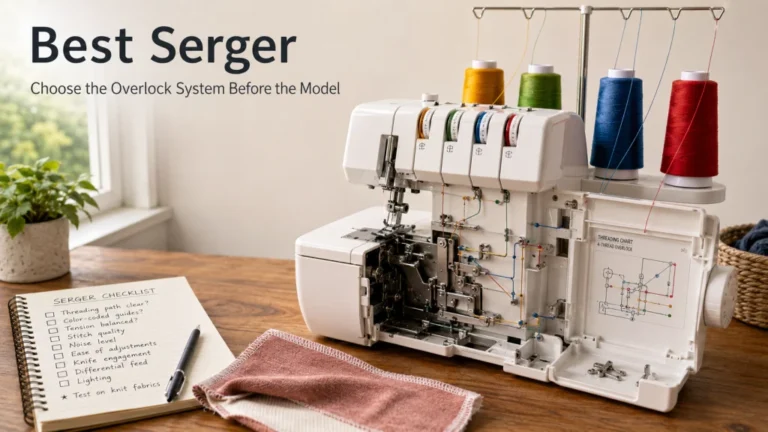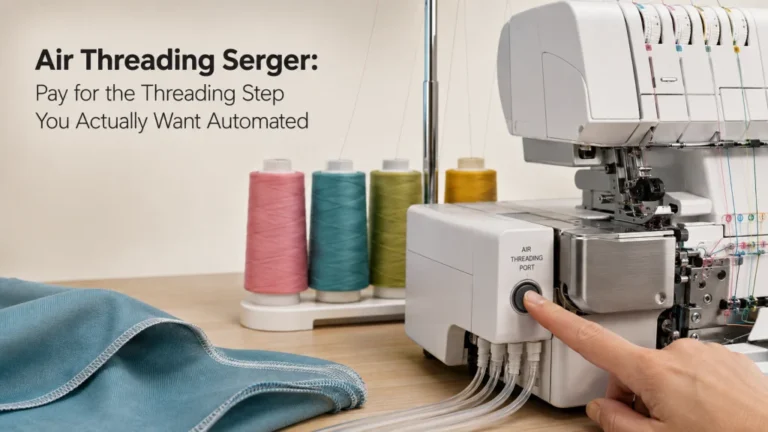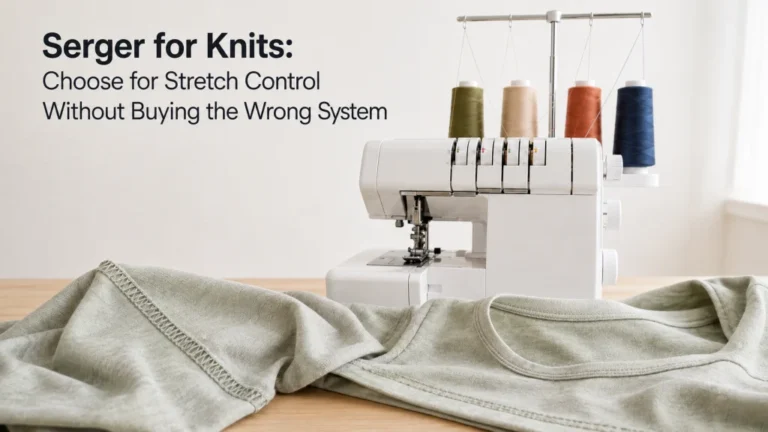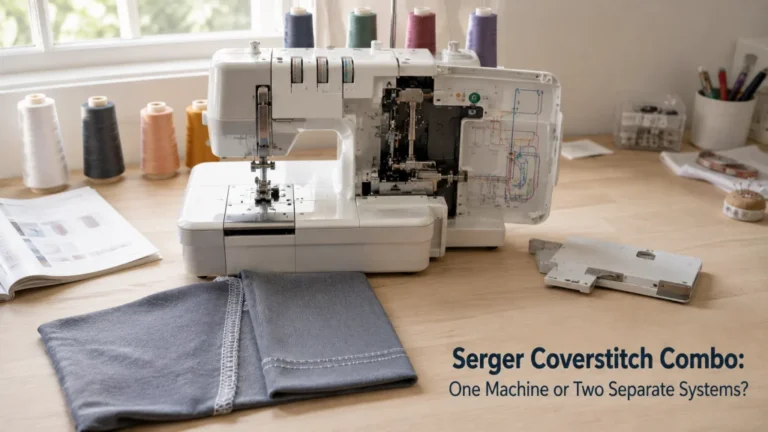
A serger becomes useful when your projects repeatedly need overlock construction, raw-edge finishing, trimming, or more controlled feeding on stretch fabrics. The practical decision is to list the operations you actually sew, see which system owns each job, and decide whether a second machine removes enough repeated work to justify its space, threading, consumables, and service needs. Closures, topstitching, utility work, and other operations may still belong to a regular sewing machine, so the answer depends on the project mix and the documented capabilities of the exact machines involved.
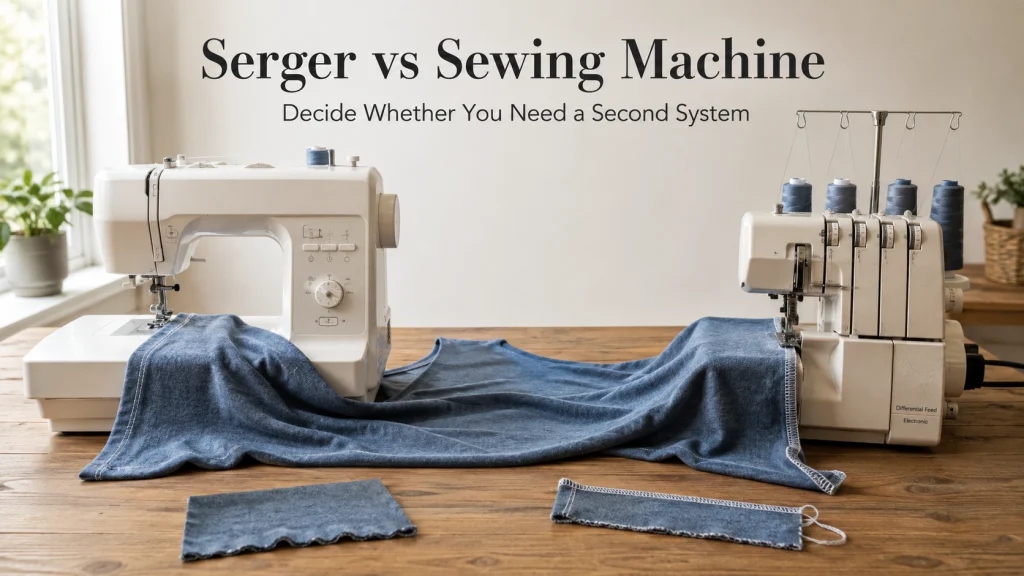
One garment can require two different machine jobs
The serger vs sewing machine decision makes more sense when you stop comparing machines as if one must win. Picture a knit T-shirt with shoulder seams, side seams, a neckband, a hem, and perhaps a small area that needs basting or precise topstitching. A serger may handle several construction seams and finish their raw edges in the same pass, while a regular sewing machine remains useful for operations that happen away from a raw edge or require a different stitch system. That division of labor is the core of the decision.
This article does not rank models or teach threading and troubleshooting. It asks whether adding an overlock system changes enough recurring operations to justify a second machine. If choosing a serger or sewing machine next, start with different sewing machine types and systems. Here, the question is narrower: what work moves to a serger, and what stays on the regular machine?
Define the two systems without ranking them
A regular domestic sewing machine is a general-purpose system. Depending on the model, it may provide straight and zigzag stitches, buttonholes, zipper-foot work, button sewing, overcasting, and other utility functions. A documented feature proves only what that model includes, not what every domestic machine can do.
A home serger, also called an overlocker, uses loopers and multiple threads around a fabric edge, and many models combine stitching with trimming. Manufacturer documentation lists overlock options, rolled hems, edge finishing, and differential feed. The useful distinction is job ownership, not which system looks more specialized.
Note: A listed stitch, foot, knife, feed feature, or thread configuration proves that the named model includes that function. It does not prove universal material capacity, stitch quality, or suitability for every project.
A first-time buyer can mistake a cleaner overlocked edge for proof of broader capability. That conclusion does not follow from the finish alone. Treat the visible seam as evidence of what that stitch did at that edge, then return to the operation list to see what the rest of the project still requires.
List the operations in the projects you actually sew
Take two or three projects you make often and break each into operations. A garment quickly exposes the split between construction seams, raw-edge finishing, closures, hems, and topstitching. Different project mixes can therefore produce completely different answers about whether a serger changes the workflow.
Use the ledger below as a decision tool rather than a universal recipe. The regular-machine and serger columns describe common roles, but your exact manuals and project instructions still control what each machine can safely and effectively do. Mark only the rows that genuinely recur in your work.
| Project operation | Regular sewing machine role | Serger role | Your recurring need? |
|---|---|---|---|
| Straight seam away from a raw edge | Core task on models with straight stitch | Not the normal replacement route | Mark yes or no |
| Raw-edge seam finishing | May use zigzag, overcasting, or another supported finish | Core overlock role on supported stitch setups | Mark yes or no |
| Seam plus edge trim in one pass | Normally separate cutting and stitching steps | Common serger role when the knife is engaged and the setup allows it | Mark yes or no |
| Stretch-oriented garment construction | Possible on suitable models with appropriate stitch, needle, thread, and handling | Often valuable because overlock stitches and differential feed are designed around edge-based stretch work | Mark yes or no |
| Zipper installation | Common utility task with the appropriate foot and setup | Usually remains with the regular machine | Mark yes or no |
| Buttonholes and button sewing | Available on many general-purpose machines | Not a normal serger replacement task | Mark yes or no |
| Precision topstitching | Common regular-machine job | Not the main overlock role | Mark yes or no |
| Quilting or broad utility sewing | Depends on the exact domestic machine and accessories | Outside the normal reason to add a serger | Mark yes or no |
If only one or two occasional rows point toward the serger, a second machine may remove little friction. If several recurring operations point toward overlocking, trimming, and stretch-oriented edge construction, the case becomes stronger. The ledger keeps one impressive finished seam from outweighing the rest of the project.
Mark what a regular sewing machine already covers
A regular sewing machine may construct woven seams, insert zippers, make buttonholes, topstitch, and finish raw edges with a supported zigzag or overcasting method. A suitable model may also sew knits with the correct stitch, needle, thread, and handling.
Ask whether your existing machine already produces acceptable results without repeated steps that materially slow or complicate your work. If it does, keeping one machine is a valid equipment decision.
- Check the exact stitch list and presser feet in your machine manual.
- Confirm whether the machine supports the zipper, buttonhole, overcasting, blind-hem, or stretch operations you actually use.
- Test the real fabric, needle, thread, stitch, and seam construction on scraps rather than assuming a generic setting will work.
- Separate a capability problem from a convenience problem. Two extra finishing steps may be annoying without making the current machine incapable.
- Do not treat stitch count, motor wording, frame material, price, or a marketing label as proof that a machine will handle a specific material stack well.
For example, someone making mostly cotton skirts, cushion covers, and simple bags may find that straight seams, zippers, topstitching, and occasional edge finishing dominate the ledger. A serger could help, but it would not take over most of the work. Weekly knit garment sewing can produce the opposite result.
Mark what a serger actually changes
A serger becomes more relevant when repeated jobs line up with its edge-based stitch system. Many home sergers combine overlock stitching, raw-edge enclosure, trimming, and differential feed, which changes how fabric is transported through the machine.
Those controls do not guarantee a better seam on every material. Fabric elasticity, layers, thread, needle system, stitch setup, and machine condition still affect the result.
Overlock seams and edge finishing
A serger can wrap thread around a raw edge while forming an overlock stitch, combining construction and finishing on appropriate seams. Thread count matters because it changes the stitch configuration, but the number alone is not a quality score. Current manufacturer documentation commonly assigns a four-thread overlock to seam construction plus finishing, while three-thread overlock options are often listed for seam finishing or decorative edge work. A woven garment may still be sewn first on the regular machine and finished afterward, while some knit seams may move directly to a supported four-thread construction setup. Use the exact stitch chart and manual for the model rather than assuming that more threads automatically mean more stretch, more strength, or a better result on every fabric.
Simultaneous trimming where appropriate
The cutting system can trim excess seam allowance while the edge is stitched. That is efficient when seam placement is already confirmed, but removed fabric cannot be restored. Test or baste fitting-sensitive work before committing the edge to the cutter.
Stretch-oriented overlock construction
Knits make the difference especially visible because overlock stitches can accommodate movement at the edge and differential feed changes how fabric is transported. Brother documents the control for reducing waviness on stretch materials while noting that the useful ratio depends on elasticity. Test the exact material instead of copying one setting onto every jersey.
Warning: Follow the exact manual for threading, knife engagement, covers, and safe operation, and do not sew over pins or hard objects in the stitch path. Stop for a hard mechanical lock, repeated hard needle strikes, damaged wiring, smoke, sparks, overheating, or a burning odor, and use qualified service rather than forcing the mechanism.
Once those edge-based jobs are identified, the next step is simpler: mark the operations that still require a different stitch path, closure method, or utility function.
Mark the operations a serger does not replace
Some simple knit garments move many construction seams to a serger, yet closures, basting, topstitching, and other details can still require ordinary sewing functions. Community reports help reveal that workflow split, while the exact machine manuals establish capability.
That makes the remaining audit straightforward: identify the jobs that need a stitch line away from the raw edge, precise placement, or a dedicated utility function.
Straight stitching away from an edge
A regular sewing machine remains the natural tool when the stitch line needs to run inside the fabric rather than wrap a raw edge. Understitching, basting, and precise seam placement are common examples. A serger can join fabric, but its edge-based looper system does not make it the default tool for those stitch paths.
Zippers and many closures
Zipper work depends on placement and clearance around the teeth rather than wrapping a raw edge. General-purpose machines commonly support zipper feet, while a serger may appear only in nearby finishing steps. If zippers recur in your projects, keep that operation in the regular-machine column.
Buttonholes and button work
Many domestic machines provide dedicated buttonhole functions, and some also include button-sewing support. Those closure operations can keep the regular machine in the workflow even when long knit seams are overlocked. Count them separately from seam construction instead of treating the garment as one machine job.
Precision topstitching and other utility operations
Topstitching asks for a controlled line at a chosen distance from a seam, fold, zipper, pocket, or edge. Decorative stitches and many other utility operations likewise depend on regular-machine capabilities. If those jobs dominate your project list, they limit how much work a serger can actually absorb.
For each operation, ask whether it happens at a raw edge, whether trimming helps, whether stretch-oriented overlocking matters, and whether precise utility stitching is still needed elsewhere. Frequent switches between those answers point toward a two-machine workflow.
Compare the one-machine and two-machine workflows
A one-machine workflow keeps setup, maintenance, storage, and technique around one system. Separate edge finishing or trimming can still be reasonable when garment sewing is occasional or workspace simplicity matters more than saving steps.
A two-machine workflow trades simplicity for specialization. Some current home sergers list maximum speeds around 1,300 stitches per minute, but that number is not total project time. Threading, test seams, preparation, and machine switching can outweigh maximum stitch rate on short or complicated work.
| Workflow question | One regular machine | Regular machine plus serger |
|---|---|---|
| Raw-edge finishing | Handled with a supported domestic method or separate finish | Can move to overlock finishing |
| Trimming while stitching | Usually separate | Possible when the serger knife and seam plan allow it |
| Zippers and buttonholes | Remain on the regular machine | Still remain on the regular machine |
| Machine changes during a garment | Fewer machines, more stitch or setup changes on one system | More machine switching, less need to make one machine cover every job |
| Speed and sound in the workspace | Depends on the exact machine, stitch, speed setting, table, and material | High maximum stitch speed may shorten long edge runs, but it does not predict total project time or noise |
| Storage and maintenance | One machine to store and maintain | Two machines, two sets of consumables and service needs |
On a simple woven skirt, the serger may add only edge finishing. On a knit T-shirt, several long seams may move to it while the regular machine handles basting, topstitching, or another supported hem method. Noise is harder to compare from ordinary specification sheets because manufacturers do not consistently publish standardized sound measurements, so do not infer quietness from maximum speed or motor wording. If sound matters in a shared room or apartment, assess the exact machine under realistic conditions or use an independent test that states how the measurement was made.
Decide whether knit-heavy sewing changes the value of a serger
Knit-heavy sewing deserves a second pass through the ledger because repeated stretch seams make differential feed and overlock construction more relevant. In a recent r/sewhelp discussion, an owner with both machines asked whether a jersey project should stay on one system or be split between the two. Responses varied, but several kept the regular machine available for basting, zippers, topstitching, or hems.
A stable knit top with simple bands may shift many operations to a serger, while a knit jacket with zippers or precise topstitching can keep the regular machine busy. If knits are the main reason you are considering another system, continue to the serger decision for knit-heavy sewing for a more focused fabric and project check.
Do not turn “knits” into an automatic purchase trigger. A suitable regular machine may already handle your fabrics with the right needle, thread, stitch, and setup. A serger becomes more compelling when the same stretch-edge or finishing needs recur often enough to change the workflow.

The SINGER S0100 is a 2, 3, or 4 thread serger designed for seam construction, edge finishing, and trimming in one workflow. Its differential feed helps control distortion when working with stretchy fabrics, while the free arm provides access around sleeves and cuffs. The color-coded threading system also provides a clearer threading path during setup.
Check On AmazonIf you click this link and buy, we earn a commission at no additional cost to you.
Count space, threading, consumables, and service as part of the decision
Purchase price is only one part of adding a serger. A second machine needs space, power, thread, model-specified consumables, cleaning, maintenance, and eventually service. It also adds another threading and tension system to learn.
Do not use a fixed ownership-cost number unless you have priced the exact machine, consumables, and service options available to you. Compare those costs with how much repetitive work the serger would actually remove. Weekly use creates a different ownership case from occasional edge finishing.
- Workspace: permanent table space, storage space, lighting, and room to keep thread cones clear.
- Threading time: the effort required to change colors or stitch configurations on the exact model.
- Consumables: thread usage, needles or needle system, replacement cutters where applicable, and cleaning supplies.
- Maintenance: owner-level cleaning or oiling only where the exact manual permits it.
- Service access: local or mail-in service options, transport effort, parts availability, and warranty terms.
- Used or refurbished condition: lower entry cost can change the equation, but verify condition, return terms, included accessories, warranty coverage, parts support, and whether the machine can be serviced before treating the saving as real.
- Workflow value: how many recurring project steps genuinely become easier, faster, or more consistent for you.
A small fold-away workspace may make a second machine impractical even when overlocking is attractive. A permanent table and steady knit workload may justify the extra footprint. Ownership fit is part of machine fit.
Decide: stay with the sewing machine, add a serger, or stop and reassess
By this point, the decision should come from your operation ledger rather than a generic pros-and-cons list. Count the recurring steps where a serger changes the workflow in a way you value. The answer can be one machine, two machines, or a pause while another specialist need is clarified.
The three outcomes below are conditional rather than universal buying rules. They do not assume that a second machine is an upgrade. They simply turn the workflow evidence into a next step.
Stop and reassess: If the operation driving the purchase is not actually an overlock job, do not force the serger into the decision. A recurring need for a different stitch system or specialist function may belong to another machine type, so return to the specialist sewing machine system overview before spending money.
If the recurring problem is finishing knit seam edges and managing waviness, a serger has a direct job to do. If the problem is a specialized hem or another operation outside overlocking, stop this comparison. Buying a serger does not make it responsible for a different stitch system.

The Brother 1034D is a 3 or 4 thread serger with options for 4-thread overlock, 3-thread overlock, narrow hems, and rolled hems. Its differential fabric feed is designed to help produce more even stitching on thin and stretchy fabrics. Color-coded threading guides and interchangeable presser feet support the transition between common serging operations.
Check On AmazonIf you click this link and buy, we earn a commission at no additional cost to you.
Compare sergers only after the need is real
Once the ledger shows that a serger would take over enough repeated work, model selection becomes useful. Compare the exact stitch configurations you need, differential-feed controls, threading system, knife controls, dimensions, support, warranty, service access, and consumable requirements. The generic label “serger” does not prove that a particular machine fits your projects.
Only then move into the serger buying factors and system choices. Comparing models earlier encourages feature shopping before the second machine has a defined job. Keep the sequence simple: need first, machine second.

The SINGER X5004-HD supports 2-, 3-, and 4-thread overlock configurations with eight stitch options. Adjustable differential feed helps control stretching and puckering across different fabrics. A metal frame, color-coded threading path, and dual LED lights support regular serging work.
Check On AmazonIf you click this link and buy, we earn a commission at no additional cost to you.
Final Thoughts: choose the workflow, not a winner
A serger and a regular sewing machine are easiest to compare when every project operation has an owner. The regular machine covers many construction and utility tasks, while the serger can take over overlock seams, edge finishing, trimming, and some stretch-oriented construction. Neither role makes one system universally better.
If a serger would remove the same friction from project after project, adding one can be rational. If your current machine already covers nearly everything you sew, buying nothing is equally rational. Verify the exact manuals and let repeated operations decide.
Frequently Asked Questions
Use these questions to pressure-test the few decisions that commonly remain after the operation ledger is filled out. Confirm any model-specific capability in the exact manual before changing your setup or buying another machine.
The answers stay short here because the main workflow decisions are already covered above; the FAQ is for edge cases, not a second version of the article.
🧵 Do I need a serger if I already have a sewing machine?
Only when it has a repeated job in your project ledger. If most of your work is already covered well by the machine you own, the extra system may add more setup and storage than useful workflow change.
👕 Can I sew knit garments without a serger?
Yes, many knit projects can be sewn on a suitable regular machine with the correct needle, thread, stitch, presser-foot setup, and fabric handling. A serger may become more valuable when knit sewing is frequent and differential feed or overlock construction repeatedly improves the workflow.
✂️ Can a serger replace my regular sewing machine?
Check the operation, not the label. A serger is built around edge-based overlock work, while buttonholes, zipper placement, straight stitching away from an edge, and many utility operations use a different workflow, so those jobs still need a machine that documents the required function.
🪡 Should I sew the seam first and serge the edge afterward?
Sometimes. On fitting-sensitive or precise seams, sewing or basting first can preserve control before trimming, while other approved seams may be constructed and finished on the serger in one pass. Follow the project requirements and test the exact fabric and setup.
📏 Does differential feed mean a serger will handle every stretch fabric well?
No. Differential feed changes how the feed dogs move fabric, but the useful setting depends on material elasticity and the exact machine. Needle, thread, layer stack, stitch setup, presser-foot pressure where adjustable, and fabric behavior still matter.
References and Sources
Manufacturer documentation is used here for exact machine functions and control boundaries. Community discussions are used only to identify recurring ownership questions and workflow patterns, not as technical proof.
- Brother differential feed support: explains how front and rear feed-dog movement changes with the differential-feed ratio and why settings depend on fabric behavior.
- Brother 1134DW specifications: documents a current home serger example with three-thread and four-thread overlock options, differential feed, trimming, and a maximum sewing speed of 1,300 stitches per minute.
- Singer S0100 stitch documentation: distinguishes four-thread overlock construction from three-thread finishing roles and documents a 1,300 stitches-per-minute maximum speed on one current serger.
- Brother CS7000X specifications: documents a current general-purpose sewing machine example with buttonhole, zipper, button-sewing, overcasting, walking, and other utility feet and stitches.
- Singer serger support: describes the serger as a companion system that can sew and finish a seam while trimming excess seam allowance.
- Brother sewing safety guidance: supports the warning to keep clear of moving parts and not sew over pins or other hard objects in the stitch path.
- r/sewhelp knit workflow discussion: shows the recurring owner question of whether knit construction should stay on one machine or be divided between a serger and a regular machine.
- r/sewing serger ownership discussion: illustrates how owners frame the purchase around garment frequency, knit use, convenience, and whether an existing machine already covers the work.
The model pages above are evidence examples, not product recommendations. Before acting on any capability, compatibility, maintenance, or safety detail, check the documentation for the exact machine you own or plan to use.